The Architecture of Achievement: What Jack Canfield's Success Principles Teach Us About Taking Total Charge
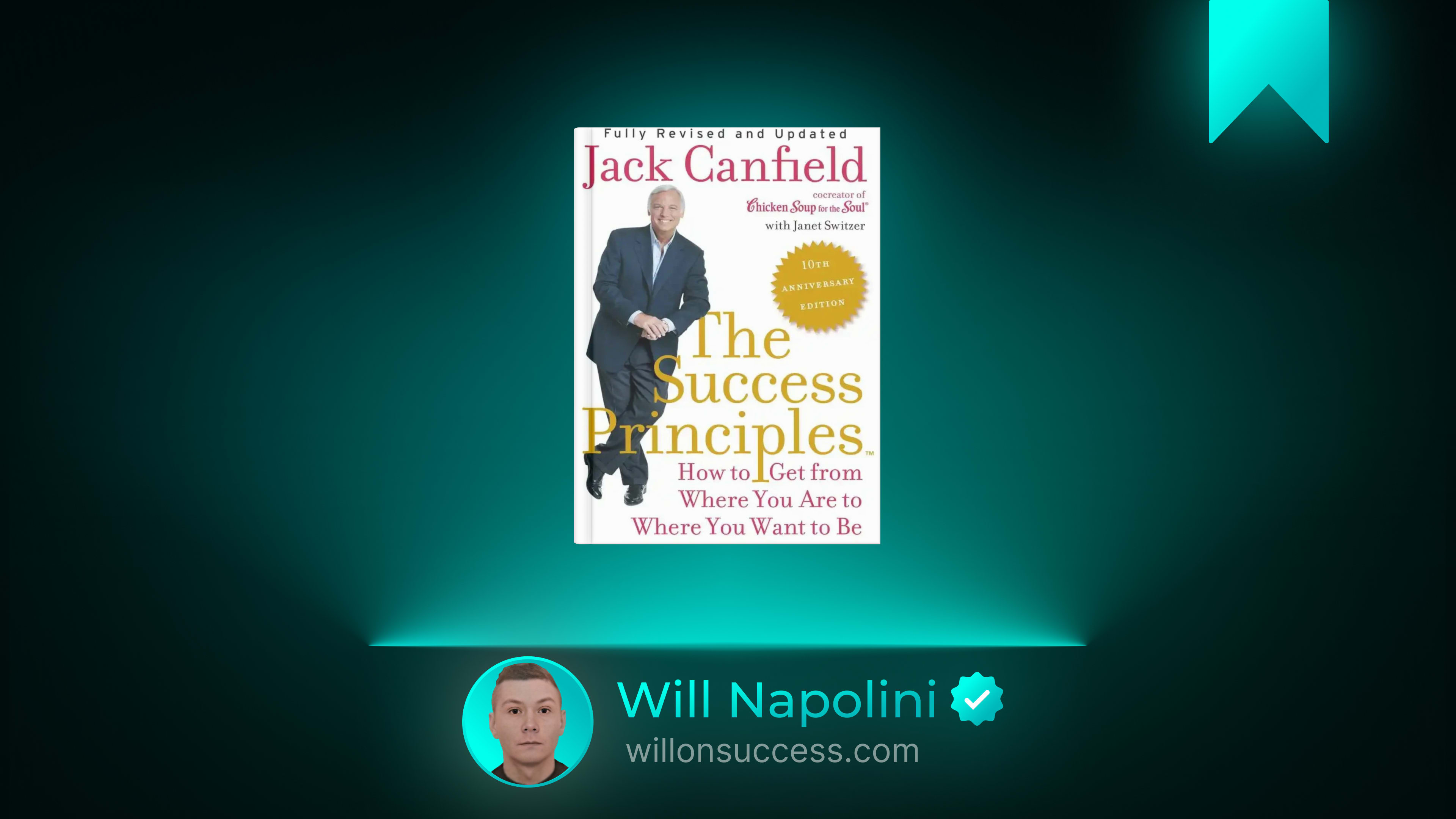
Look at the people in your life who seem to consistently win. The ones who launch the business, write the book, build the healthy marriage, or simply navigate crises with a quiet, unshakeable grace.
It is tempting to look at them and conclude that they possess some invisible advantage. A better network. A genetic predisposition to optimism. A stroke of timing you simply did not get. I used to believe this, too. I used to think success was a lottery where the winning numbers were handed out at birth, and the rest of us were just buying tickets and hoping.
But after years of studying people who build remarkable lives, I have discovered something both humbling and deeply liberating. Success is rarely an accident. It is an architecture. It is built brick by brick, decision by decision, using a set of blueprints that anyone can learn to read.
Jack Canfield spent decades collecting these blueprints. Long before he co-created the Chicken Soup for the Soul series, he was a teacher and a researcher, obsessed with a single question: Why do some people consistently achieve their goals while others, with equal or greater talent, stall out?
His answer became The Success Principles. And the core of his answer is not what most people want to hear. It is not a secret hack, a morning routine, or a manifestation trick. It is a fundamental shift in how you view your relationship with the world.
The Big Idea: Success Is an Engineering Problem, Not a Mystical One
Canfield’s central thesis is straightforward: success leaves clues. If you want to achieve a specific result, you do not need to invent a new path. You need to find the people who have already achieved that result, study exactly what they did, and then do it yourself.
This sounds simple, but it requires abandoning the romantic idea that your life is happening to you. Canfield argues that a good life is not something you wait for, hope for, or attract through positive thinking alone. It is something you engineer through a series of deliberate, repeatable actions.
If you build a house on a flawed foundation, it will collapse, no matter how beautifully you paint the walls. If you build a life on flawed principles, it will fracture, no matter how hard you work. The Success Principles is essentially a masterclass in pouring a better foundation.
The Formula That Changes Everything: E + R = O
If I could sit across the table from you and only share one concept from this entire book, it would be this formula. It is the load-bearing wall of Canfield’s philosophy.
Event + Response = Outcome.
Most of us move through life believing that our Outcomes are the direct result of Events. The economy crashed (Event), so my business failed (Outcome). My boss is toxic (Event), so I am miserable at work (Outcome). I didn’t get a good education (Event), so I can’t get a good job (Outcome).
When you believe this, your only strategy for changing your life is to try and change the Event. You try to fix the economy, change your boss, or rewrite your history. And when you inevitably fail to control the external world, you feel helpless.
Canfield’s intervention is radical. He points out that you have almost zero control over the Event. The Event is the weather. It is the traffic. It is the diagnosis. It is the rude comment.
But you have absolute control over the Response.
If you want a different Outcome, you do not need a different Event. You need a different Response.
The economy crashed (Event) + I pivoted my services to solve new recession-era problems (Response) = My business survived and grew (Outcome).
I know what you might be thinking. That isn’t fair. And you are right. It is profoundly unfair that you have to respond perfectly to an Event you did not cause. But fairness is a moral concept, not a mechanical one. The universe does not grade on fairness; it grades on physics. If you step off a roof, gravity does not care if it was fair that you slipped. It only responds to the physics of the fall.
Blame looks backward for a culprit. Responsibility looks forward for a solution. Taking 100% responsibility does not mean everything is your fault. It means everything is your responsibility to respond to. When you stop blaming the Event, you reclaim the power of the Response. And the Response is where all your power lives.
Clarity Is the Currency of Achievement
You cannot hit a target you cannot see. This sounds like a cliché, but Canfield demonstrates how few people actually practice it.
If I ask you what you want, you might say, “I want to be financially secure,” or “I want to be happy,” or “I want to lose weight.” Canfield would gently tell you that these are not goals. These are vague wishes. The brain does not know how to execute “financial security.” It does not know what “happy” looks like on a Tuesday afternoon.
A true goal is specific, measurable, and time-bound. It is a coordinate on a map. I want to save $15,000 by December 31st. I want to lose 12 pounds in 90 days. I want to write a 60,000-word manuscript by August.
Why does this matter so much? Because of the way human attention works. Have you ever decided to buy a specific model of car, and suddenly you see that exact car everywhere on the highway? The cars were always there. Your brain was just filtering them out as irrelevant noise. Once you gave your brain a specific target, your Reticular Activating System (the brain’s filtering mechanism) started flagging those cars as important.
When you write down a highly specific goal, you program your brain to filter the world for opportunities, resources, and connections that match that goal. Clarity acts like a magnet. Vagueness acts like a fog.
The Rule of Five: Consistency Beats Intensity
Let us say you have taken responsibility. You have clarified your goal. Now, how do you actually get there without burning out in week two?
This is where most people fail. They rely on intensity. They work fourteen-hour days for a week, eat perfectly for three days, or write furiously for a weekend, and then they crash. They treat success like a sprint, but life is a marathon.
Canfield introduces a concept he calls The Rule of Five.
The principle is this: Identify your single most important goal. Then, commit to doing exactly five specific actions every single day that move you closer to that goal. Not fifty actions. Just five.
If your goal is to write a book, your five actions might be: write 500 words, read one chapter of a competing book, email one potential source, outline the next section, and review yesterday’s draft.
If your goal is to grow your business, it might be: make five sales calls, publish one piece of content, connect with one industry peer, review your analytics, and organize your desk for tomorrow.
The magic of the Rule of Five is that it lowers the barrier to entry. On days when you feel motivated, you will easily do your five actions and perhaps do more. On days when you are exhausted, sick, or discouraged, you can still manage five small actions.
You start small. You stay consistent. You let time do its work.
A small decision becomes a direction, and a direction repeated long enough becomes a life. The Rule of Five ensures that no matter what happens in your day, the needle on your most important goal always moves forward, even if only by an inch.
Rejection Is a Tollbooth, Not a Stop Sign
There is a section in the book about asking for what you want, and it addresses one of the most universal human fears: the fear of hearing “no.”
Canfield points out that highly successful people ask for things constantly. They ask for funding, for mentorship, for the sale, for the date, for the extension. And because they ask more, they get rejected more.
Most people interpret rejection as a stop sign. They hear “no” and think, I am not good enough, this isn’t meant to be, I should stop trying.
Canfield reframes rejection as a tollbooth. It is simply the price of admission to the next level. He teaches a mindset often summarized by the acronym SWSWSWSW: Some Will, Some Won’t, So What, Someone’s Waiting.
When you ask for something, some people will say yes. Some people will say no. So what? The next person is waiting to say yes.
If you internalize this, rejection loses its sting. It ceases to be a referendum on your self-worth and becomes simple data. A “no” just means not this person, not this time, not this offer. It is feedback. You adjust your approach, you maintain your self-esteem, and you ask the next person. The people who win are rarely the ones who never get rejected; they are the ones who refuse to let rejection dictate their next move.
Why This Matters on an Ordinary Tuesday
It is easy to read about success principles and feel inspired for an hour. But how does this translate to a rainy Tuesday morning when your alarm goes off and you just want to pull the covers over your head?
It looks like this:
The alarm goes off. You are tired. That is the Event. Your habitual Response is to hit snooze, rush later, feel guilty, and start the day reactive and behind. The Outcome is a stressful, scattered morning.
Applying Canfield’s principles means catching yourself in the gap between the Event and the Response. You feel the urge to hit snooze. You recognize it. You choose a new Response: you put your feet on the floor. You do your first action from your Rule of Five before you even open your email.
You stop waiting to “feel” like a successful person. You realize that successful people do not always feel like doing the work either. They just do it anyway, because they have built systems (like the Rule of Five) that make the right action easier than the wrong one.
You stop asking, Why is this happening to me? and start asking, Given that this is happening, what is my best next move?
Who Should Read This Book
The Success Principles is a massive, comprehensive book. It is essentially an encyclopedia of personal development.
Who will benefit most: If you are someone who feels stuck in a loop of blaming your circumstances, if you struggle to finish what you start, or if you have big dreams but no tactical roadmap to achieve them, this book will be a revelation. It is exceptionally good for entrepreneurs, sales professionals, and anyone who needs to build high levels of self-discipline and personal accountability.
Who might find it less useful: If you are looking for deep, nuanced psychological exploration of childhood trauma or systemic societal barriers, this book will feel too tactical and individualistic. Canfield’s approach is highly behavioral and heavily focused on individual agency. It assumes you have the baseline capacity to act, and it gives you the tools to act better. It is not a therapy manual; it is a builder’s manual.
One Small Step You Can Take Today
I want you to take this off the page and put it into your hands before the sun goes down.
Take out a piece of paper. I want you to identify one area of your life where you currently feel stuck, frustrated, or victimized. It could be your finances, your health, or a specific relationship.
At the top of the page, write down the Event. What is the external circumstance you are currently blaming? (e.g., “My company is downsizing,” or “I don’t have time to exercise.”)
Below that, write down your current Response. What are you actually doing in reaction to this event? (e.g., “I am complaining to my spouse, doomscrolling on my phone, and eating junk food.”)
Below that, write down the Outcome. What is the result of your current response? (e.g., “I feel anxious, out of shape, and powerless.”)
Now, draw a line through your current Response.
Write down one New Response. What is one specific, actionable thing you can do today that is entirely within your control, regardless of the Event? (e.g., “I will update my resume for 30 minutes,” or “I will do a 15-minute bodyweight workout in my living room.”)
Do that one thing today.
You cannot negotiate with the wind, but you can always adjust the sail. The Event will blow exactly as it pleases. The question, as it always has been, is how you will choose to respond.