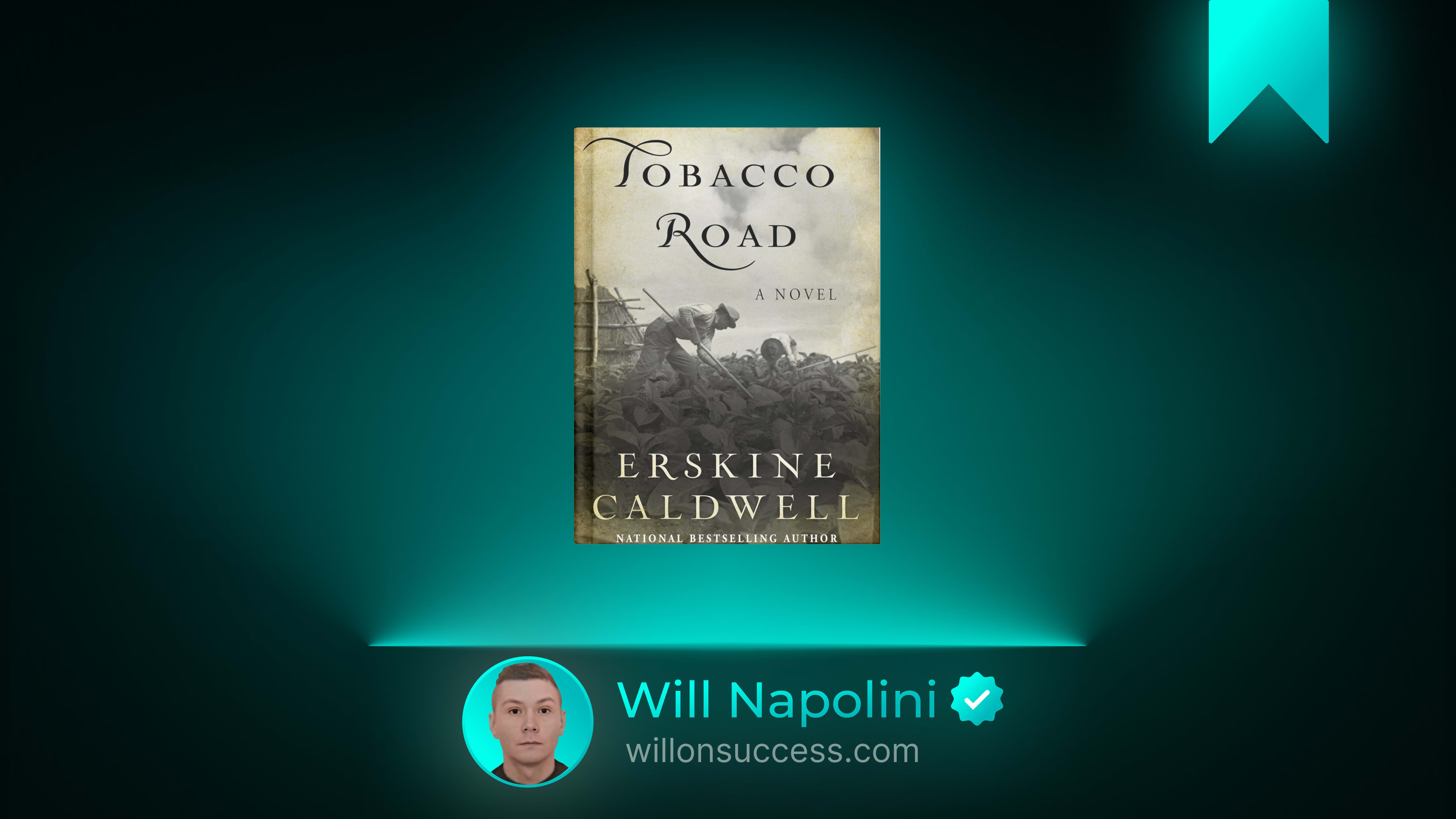
Tobacco Road by Erskine Caldwell: What a Broken Family Teaches Us About Letting Go of Dead Ground
Have you ever stayed in a situation— a job, a relationship, a routine, a plan—long after it stopped giving you anything back, simply because leaving would mean admitting the years you spent there did not produce what you hoped?
I have. And I suspect you have too.
There is a particular kind of exhaustion that comes not from working too hard, but from working hard at something that has quietly died beneath your hands while you kept pretending the soil still had life in it. You keep showing up. You keep turning the dirt. You keep telling yourself that next season will be different. And each season, the ground gives back a little less, until one morning you look around and realize you have been farming dust.
Erskine Caldwell wrote a novel about exactly this in 1932. It is called Tobacco Road, and it is not a comfortable book. It is short, raw, sometimes grotesque, and deeply human. It does not hand you a five-step plan. What it does is hold up a mirror so honest and unflinching that you cannot look away. And in that mirror, if you are brave enough to look, you might see the one thing you are still refusing to release.
The Big Idea: You Can Starve on Land You Will Not Leave
Tobacco Road is set in rural Georgia during the worst years of the Depression. It follows Jeeter Lester, his wife Ada, and the remnants of their family as they live on a stretch of red clay ground that has been farmed into total exhaustion. Nothing grows. Nothing will grow. The topsoil is gone, washed and blown away by years of cotton monoculture and neglect. The tobacco that once gave the road its name has not been raised here in living memory.
And yet Jeeter will not leave.
He talks constantly about planting next year. He talks about borrowing seed. He talks about how his father and grandfather worked this land. He wraps his identity around the dirt so completely that leaving would feel like dying. So he stays. And the family starves, slowly, in a house falling apart around them, while Jeeter narrates plans that never become actions.
The central idea Caldwell is pressing into the reader’s chest is this: the thing you built your identity around can become the very thing that keeps you trapped. And the longer you refuse to grieve what it no longer is, the deeper the trap closes around you.
This is not a novel that offers a tidy redemption arc. Caldwell was writing social protest dressed as fiction. He wanted America to look at what sharecropping and land exhaustion had done to real families. But woven into that protest is a truth that reaches far beyond 1930s Georgia. It reaches into any life where a person has confused loyalty to a dead situation with loyalty to themselves.
The Story: A Family at the End of the Road
Picture it. A shack with no glass in the windows, only crooked boards nailed over the openings. A car in the yard with no wheels, no engine, no function—just a rusted shell that Jeeter’s son Dude treats like a treasure. A road out front that leads to a town where no one is hiring.
Jeeter is not a villain. That is what makes the book so unsettling. He is not lazy in the way we casually use that word. He genuinely believes he will farm again. He genuinely loves the idea of the land. But belief without adaptation becomes a slow poison. He cannot conceive of himself as anything other than a farmer on this particular plot, and so he cannot conceive of any action that would save him.
Ada, his wife, has given up the pretense. She is tired in her bones. Their children have scattered or twisted into shapes that survival demands. Ellie May, their daughter, is hungry for connection in a world that offers her none. Dude, their son, has the mind of a child and the body of a man, and he becomes a pawn in other people’s arrangements. Lov Bensey, a young neighbor married to another Lester daughter, exists in his own quiet desperation on the margins of the story.
Caldwell does not romanticize these people. He does not sentimentalize poverty. He shows it as it is: degrading, repetitive, grinding. But he also shows that beneath the degradation, every one of them is still reaching for something—a scrap of dignity, a moment of pleasure, a reason to wake up tomorrow.
That tension is where the book’s wisdom lives. Not in the suffering itself, but in the question the suffering forces: What are you willing to let go of in order to live?
The Land That No Longer Feeds You
Here is the principle I keep returning to when I think about this novel, and here is what I would tell you if we were sitting across from each other with coffee going cold between us.
You have a piece of ground. Maybe it is literal—a business, a career path, a project you started years ago. Maybe it is relational—a friendship that has gone barren, a role in your family you outgrew a decade ago. Maybe it is internal—a story about who you are that was true once but is no longer true now.
You planted there. You worked there. For a while, it gave you something real. And because it once produced, you keep returning to it, season after season, expecting the same harvest. But the nutrients are gone. The topsoil has eroded. You are turning dust and calling it farming.
Jeeter Lester does not leave his land because leaving would mean he was wrong to stay all these years. It would mean the identity he built—”I am a farmer on this road, like my father, like his father”—was built on something that could not hold. And that grief is so large, so terrifying, that it is easier to starve slowly than to face it all at once.
I have seen this pattern in careers. I have seen it in marriages. I have seen it in people who keep returning to a creative project or a business model that the market abandoned years ago, not because the work is bad, but because starting over feels like erasing themselves.
The ground does not owe you a harvest because you remember when it was green.
Waiting for Rain in a Dry Season
One of the most quietly devastating aspects of the novel is Jeeter’s constant talk of tomorrow. He will get seed tomorrow. He will fix the fence tomorrow. He will go into town and arrange a loan tomorrow. Tomorrow becomes a religion. Tomorrow becomes the thing that lets him avoid today.
I recognize this in myself more than I like to admit. How many times have I said, “I will start Monday,” or “I will figure it out after this current stretch settles down”? How many times has “tomorrow” been a small, comfortable lie that protected me from the discomfort of acting today?
Caldwell shows us where that habit leads if we let it run its full course. Tomorrow, repeated enough times, becomes never. And never becomes a life you did not choose, lived in a house you did not maintain, on ground you did not tend while there was still time.
You do not need a dramatic collapse to wake you up. You do not need to reach Jeeter’s depth of destitution before you ask yourself the honest question. You can ask it now, while there is still topsoil left. You can ask it while the options are wider than they will be next year.
What are you planning to do “tomorrow” that you could take one small step toward today?
Identity Is Not a Prison Sentence
Here is something I have learned slowly, and something Caldwell’s novel teaches through absence rather than presence: you are allowed to outgrow the story you told about yourself.
Jeeter cannot say, “I was a farmer, and that season of my life is over, and now I must become something else.” The words are not available to him. His entire sense of self is fused to one role on one plot of land. Without it, he does not know who he is. So he keeps the role and loses the life.
You do not have to make that trade.
You can honor what you were without being chained to it. You can grieve the version of your life that did not work out and still walk toward something new. You can say, “I gave that chapter everything I had, and it was not enough, and that does not erase what I learned, and it does not mean I am a failure, and it does mean I must walk a different road now.”
That sentence is not defeat. That sentence is the beginning of every second act.
The tobacco road in Caldwell’s novel is overgrown. No one hauls tobacco on it anymore. The name remains, but the function is gone. And the people who live beside it are trapped because they keep treating a dead road as if it still leads somewhere.
What dead road are you still walking? What name from your past are you still carrying as if it must define your future?
Dignity Does Not Require Staying
One thing I want to be careful about here. Caldwell’s novel is, at its heart, a work of social compassion. The Lesters are not poor because of a character flaw. They are poor because the economic system, the agricultural practices, and the history of the South created conditions in which people like them had almost no viable options. Caldwell wrote the book to make visible a class of people America preferred to ignore.
So let me be clear: I am not telling you that every difficult circumstance is your fault. I am not telling you to simply “choose differently” as if systems, trauma, and bad luck do not exist. They do. Caldwell knew they did. That knowledge is woven into every page.
But even within constraints—and we all live within constraints—there is a small space where choice still operates. Jeeter’s tragedy is not that he is poor. His tragedy is that within the narrow range of actions still available to him, he cannot bring himself to take one. He cannot walk to town. He cannot ask for help without the performance of pride getting in the way. He cannot imagine himself in any configuration other than the one he knows.
Your circumstances may be genuinely hard. I do not minimize that. But within your hard circumstances, is there one small action you are avoiding because it would require you to see yourself differently? That is the space where change still lives. Not a grand revolution. One small, honest step in a direction that is not the direction you have always walked.
What This Looks Like on an Ordinary Tuesday
Let me bring this down from the literary and the philosophical into the Tuesday-morning, kitchen-table reality of your life.
Maybe your “tobacco road” is a career you trained for over many years that no longer uses your gifts or interests you, but you stay because the title is part of how you introduce yourself at parties.
Maybe it is a project you have been maintaining for three years that no one uses, that no longer energizes you, but you keep tending it because stopping would mean admitting the investment did not pay off.
Maybe it is a relationship dynamic where you keep playing a role—the caretaker, the peacemaker, the strong one—because you do not know who you are in the relationship without that role, even though it is slowly hollowing you out.
Maybe it is a belief. “I am not the kind of person who can do that.” “I missed my window.” “It is too late for me to start over.” These are dead roads. They may have been accurate descriptions once. They are not permanent sentences.
The question is not whether leaving will be frightening. It will be. The question is whether staying is slowly costing you more than leaving would cost you all at once.
Who Should Read This Book
Tobacco Road is not a comfortable read, and I will not pretend it is. Caldwell’s prose is blunt. The characters live in conditions that are sometimes difficult to witness. The novel is short—barely over a hundred pages in most editions—but it is dense with implication.
You should read it if you are at a crossroads and feel paralyzed by loyalty to a past version of your life. You should read it if you sense that you are waiting for circumstances to improve while taking no new action. You should read it if you appreciate fiction that trusts you to draw your own conclusions without a moralizing narrator telling you what to think.
It may not be the right book for you if you are looking for uplift or a neat resolution. Caldwell does not provide one. The ending is stark. But starkness has its own value. Sometimes the most compassionate thing a story can do is refuse to look away, so that you are finally forced to look too.
It is also worth reading if you want to understand a particular strand of American literature—the Southern grotesque, the social realist tradition, the fiction of the Depression that insisted on making invisible people visible. Caldwell, alongside writers of his era, shaped how we talk about poverty and dignity in this country.
One Small Step You Can Take Today
I am not going to ask you to overhaul your life by Friday. That is not how change works, and pretending otherwise sets you up for the same cycle of grand intention followed by quiet abandonment that keeps you exactly where you are.
Here is what I would ask instead.
Tonight, before you go to sleep, take one sheet of paper and write down the answer to a single question:
What am I still tending that no longer feeds me?
Do not judge the answer. Do not solve it tonight. Do not build a five-year plan. Just name it. One sentence. Maybe two. “I am staying in this role because I am afraid of who I am without it.” “I keep working on this project because quitting feels like failure.” “I keep waiting for this situation to change without changing anything about how I show up in it.”
Name it. Then set the paper on your nightstand. Let it sit there. You do not have to act on it tomorrow. But you have to stop pretending you did not see it.
That is the first step off the tobacco road. Not a dramatic departure. Just the quiet, honest admission that the ground beneath your feet has gone dry, and that you deserve to walk somewhere green.
A road keeps its name long after the last wagon has passed. But you are not a road. You are the one walking it. And you are allowed, at any point, to turn onto a different path, even if no one else has walked it yet, even if you cannot see where it leads, even if the only thing you carry with you is the hard-won knowledge of what no longer works.
The ground you leave behind does not disappear. You do not owe it another season. You owe yourself the next one.