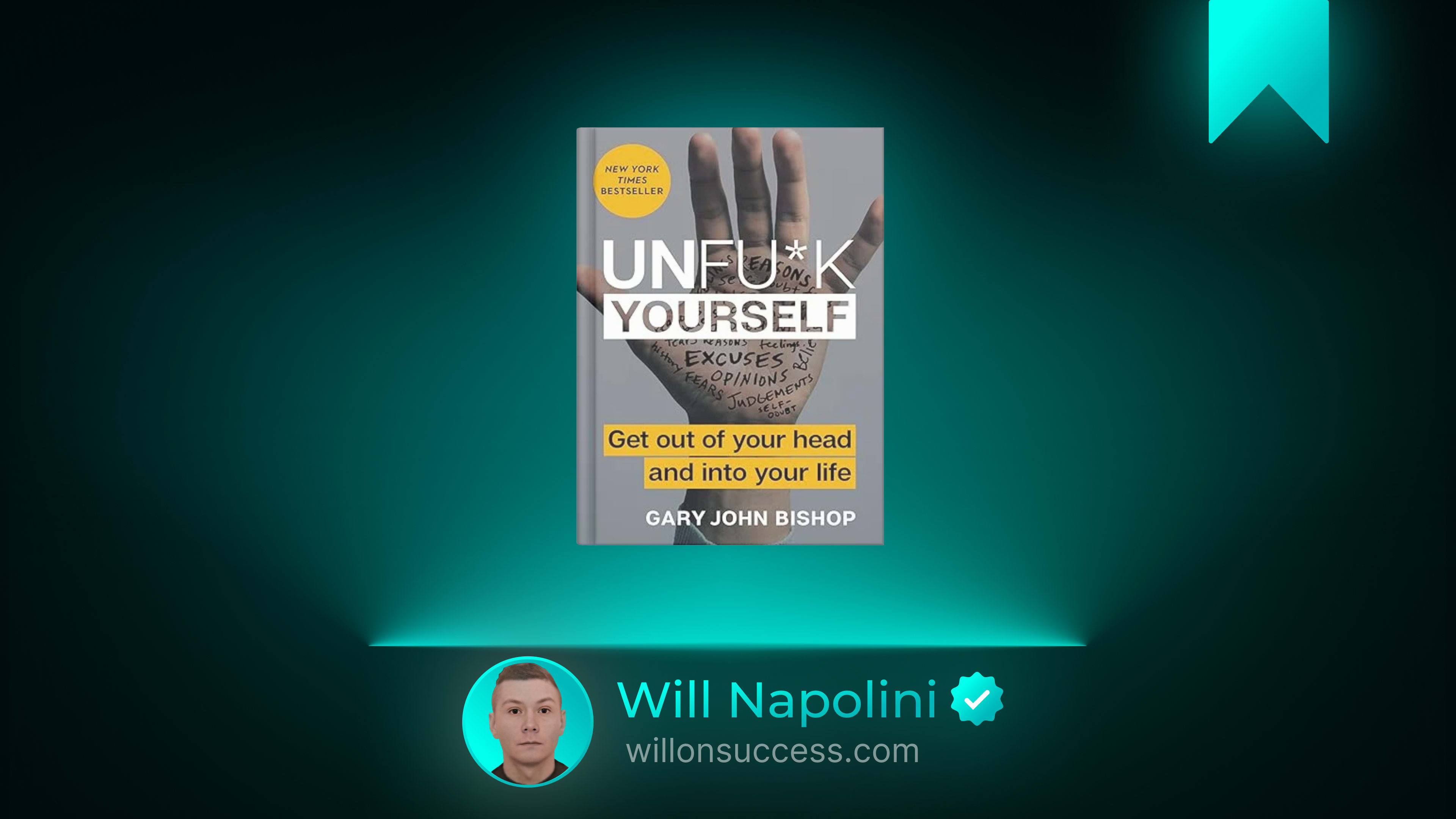
Unfu*k Yourself by Gary John Bishop: The Book That Asks You to Stop Negotiating With Your Own Potential
Have you ever caught yourself rehearsing an argument in the shower that will never happen? Or lying awake at two in the morning, constructing an elaborate case for why you cannot start the thing you keep saying you want to start?
I have. More times than I care to admit.
And what I have learned, slowly and sometimes painfully, is that the most expensive thing a person can do is negotiate with their own hesitation. You sit across from yourself at an imaginary table, and you say, “I will begin when I feel more confident. When the timing is better. When I have figured out exactly how this will go.” And the other version of you nods and says, “Yes, that sounds wise.” And another year passes.
Gary John Bishop wrote Unfuk Yourself* for the person sitting at that table. The person who has every reason in the world to move but has somehow convinced themselves they need permission from their own mood before they can take a single step.
This book is not gentle. It is not supposed to be. It is the friend who looks you in the eye and says, “You are not stuck because the world is against you. You are stuck because you keep agreeing with the voice that says you are stuck.” And somehow, because it is said plainly and without apology, it lands differently than a hundred softer versions of the same truth.
Let me walk you through what this book actually teaches, why it works, and how you can use it starting today.
The Central Claim: You Are Not Your Thoughts—You Are What You Do
If I could reduce the entire book to one sentence, it would be this: the story you tell yourself about who you are is not the truth, and you do not have to wait for it to change before you act.
Bishop builds the book around a series of personal assertions—short, declarative statements meant to interrupt the looping, self-protective narration most of us run on autopilot. Assertions like being willing, being wired to win, embracing uncertainty, being relentless, and accepting everything while expecting nothing. They sound almost too simple. That is part of the point.
The idea underneath all of them is that most people are not held back by a lack of information, resources, or opportunity. They are held back by a conversation happening between their ears that has been running for years, maybe decades, and that they have mistaken for reality. “I am the kind of person who quits.” “I always mess this up.” “People like me do not get that kind of life.”
And here is what I would tell you if we were sitting across from each other right now: those sentences are not descriptions of you. They are habits. They are grooves worn into the mind by repetition, and like any groove, they can be filled in. Not overnight. Not by wishing. But by doing something that contradicts the story, over and over, until the story loses its authority.
You do not think your way into a new life. You act your way into one.
The Voice in the Background Is Not the Boss
One of the most useful distinctions Bishop draws is between the thought you are having and the person having it. You are not the anxious voice. You are not the critical commentary. You are the awareness behind it, the one who notices the voice and can choose whether to obey it.
I have seen this play out in my own life in ways I did not expect. There was a period when I had convinced myself I was simply not the kind of person who could build something from nothing. Every time an idea arrived, the internal narration would begin: You will lose money. You will embarrass yourself. Who do you think you are? And I treated that narration as a weather report—accurate, final, not worth questioning.
What changed was not the voice. The voice kept talking. What changed was that I stopped treating it as a command. I started treating it as background noise in a room where I was trying to work. Loud, yes. Unpleasant, sure. But not the person in charge.
Bishop pushes this idea further than most personal-development writers are willing to go. He does not say, “Think positive thoughts and the negative ones will disappear.” He says, essentially: the thoughts will keep coming. Your job is not to silence them. Your job is to move your feet anyway.
That distinction matters. Because if you wait until you feel certain, confident, and completely free of doubt before you begin, you will wait forever. The feeling of readiness is not a prerequisite for action. It is usually a result of it.
Willingness Is the Gate, Not the Destination
The first assertion Bishop explores is the idea of willingness. Not enthusiasm. Not motivation. Willingness.
There is a difference, and it is important. Motivation is weather. It comes and goes, and you cannot build a life on it. Willingness is a decision. It means: I will show up even though part of me would rather not. I will do the uncomfortable thing even though my mind is listing seventeen reasons to postpone it.
Think of it like this. You do not need to love cold mornings to get out of bed. You just need to be willing to put your feet on the floor. The rest of the day unfolds from that single, unglamorous act.
Willingness is small. It does not demand that you feel brave. It only asks that you stop waiting to feel brave. And once you begin moving, something shifts. The fog of overthinking thins, not because you solved every problem, but because motion creates information that stillness never will. You learn what actually needs to happen by being in the middle of it, not by standing outside and analyzing.
Embracing Uncertainty Without Collapsing
Another principle the book returns to is the relationship between uncertainty and action. Most people treat uncertainty as a signal to stop. If they cannot see the whole path, they will not take the first step. If the outcome is not guaranteed, the effort feels pointless.
Bishop flips this. He argues that uncertainty is not the enemy of progress. It is the environment in which all real progress happens. No meaningful decision in your life will ever come with a guarantee. The job you want, the relationship you are building, the project you are starting—all of them require you to move before you can see the landing.
I think of it like walking into a dense fog on a mountain trail. You cannot see the summit. You cannot see the next bend. But you can see the next three feet. And three feet is enough. You take those three feet, and then you can see three more. The path reveals itself to the person who walks it, not to the person who stands at the trailhead demanding a full aerial photograph before committing.
You do not need certainty. You need the willingness to be uncertain and move anyway.
“I Am Wired to Win” Is Not a Pep Talk—It Is a Reframe
One of the assertions in the book that initially made me skeptical was the idea that you are, in some fundamental sense, wired to win. It sounds like something you would see stitched onto a pillow.
But Bishop is not saying the universe will hand you victories. He is pointing at something more practical: human beings are built to adapt, solve, persist, and find ways through. You have already survived every difficult day you have ever lived. You have figured out problems you once thought were beyond you. You have adapted to losses, changes, and surprises that would have broken you if someone had described them in advance.
The wiring is there. The question is whether you are pointing it toward something, or letting it run in circles, solving the same imaginary problem of why you cannot start.
Your capacity is not the issue. Direction is.
Expect Nothing, Accept Everything
This is perhaps the most quietly radical idea in the book. Bishop suggests that much of our suffering comes not from what happens but from the gap between what happens and what we insisted should happen. We carry a script in our pocket—how the conversation should go, how the project should unfold, how other people should respond—and when reality deviates, we experience it as a personal offense.
To expect nothing is not to become passive or indifferent. It is to release the demand that life follow your outline. To accept everything is not to approve of injustice or refuse to improve things. It is to say: This is what is happening right now. I will work with what is real rather than arguing with what is not.
There is an enormous amount of energy trapped inside the sentence “This should not be happening.” Energy you could use to figure out what to do next. When you let go of the should, the next step often becomes visible almost immediately.
Why This Hits Differently Than Other Self-Help Books
I have read a lot of personal-development writing. Most of it is kind. Most of it validates you, comforts you, tells you that you are enough and the world is hard and you deserve a break. And some of that is genuinely needed.
But there is a point where comfort becomes a cage. Where “you are enough” quietly becomes “you do not need to change, and the fact that you are struggling is someone else’s fault.” And you stay in the same position, year after year, feeling understood but unmoved.
This book is not that. It respects you too much to let you stay comfortable inside your own excuses. It says: your circumstances may be genuinely difficult, and you still have agency. You may have been treated unfairly, and you still get to decide what you do next. That is not cruelty. That is the only honest foundation on which a person can rebuild.
The tone is direct, sometimes blunt, occasionally profane. It reads less like a seminar and more like a conversation with someone who cares about you and refuses to let you waste your potential while you wait for the perfect moment.
Who This Book Will Help—and Who Might Want Something Else
If you are someone who thinks too much before acting, who has a rich inner world of reasons why now is not the right time, who has been “preparing” for years without starting—this book will feel like a hand on your shoulder and a firm push forward.
If you are in the middle of a genuine crisis—grief, trauma, a mental health emergency—this is probably not the first resource you need. The book’s strength is momentum, and momentum is not always the medicine for every season. There is nothing wrong with seeking gentler support when you need it.
If you are looking for a detailed system, a step-by-step framework, or a deeply researched exploration of behavioral psychology, this is not that book either. It is short, punchy, and built to shift your orientation rather than hand you a blueprint. Think of it as the spark, not the whole engine. You will still need to build the engine yourself.
And that is fine. Sometimes the most valuable thing a book can do is get you out of the chair.
Turning the Idea Into a Tuesday Morning
Knowing these principles is not the same as living them. And I do not want you to finish reading and simply feel briefly inspired before returning to the same internal negotiation.
So here is what I would suggest. Not a grand overhaul. Not a new identity by Friday. Just one small, observable shift.
Tomorrow morning, identify the single task you have been postponing. The email you keep not sending. The phone call you keep rescheduling. The first paragraph of the thing you keep saying you want to write. The conversation you keep avoiding.
Before you open your phone, before you check messages, before you give yourself time to build a case against doing it—do it. Not perfectly. Not after you feel ready. Just do it.
And notice what happens to the internal narration. It will protest. It will say you should have prepared more, thought more, waited for a better moment. Let it talk. You will already be past it.
That is the whole book in practice. One decision to move before the voice finishes its argument.
You do this once, and it is a small victory. You do it ten times, and you start to suspect the voice was never as powerful as it claimed. You do it a hundred times, and the voice becomes what it always should have been: a passing thought, not a life sentence.
The Deeper Truth Underneath All of It
What Bishop is really pointing toward, beneath the bluntness and the profanity and the urgency, is something tender. He is saying: you are allowed to be imperfect and begin anyway. You are allowed to be scared and walk forward. You are allowed to not have the whole map and take the next step. You do not owe anyone a finished, polished, fully justified version of yourself before you are permitted to participate in your own life.
You just have to be willing.
And willingness is not a grand gesture. It is a Tuesday. It is a single choice made in a quiet moment when no one is watching. It is the decision to stop arguing with yourself and simply begin.
Your life is not happening in some future version where everything is sorted. It is happening right now, in the middle of the uncertainty, in the middle of the fog, in the middle of the imperfect, unglamorous, ordinary day.
And you are already in it. You do not need permission to participate.
So here is your one small step, the one I want you to take before you close this page: think of the thing you have been telling yourself you will do “when the time is right.” Name it. Just name it, out loud or on a scrap of paper. And then ask yourself one question—What would I do today if I were willing?
Not if you were fearless. Not if you were certain. Just willing.
Then do that one thing. Small, imperfect, today.
The version of you that you keep waiting to become is not arriving someday in the future. That version is built by what you do in the next ten minutes.
You do not need to be ready. You need to begin. And beginning is always available to you, even now, even here, even in the middle of everything you have not yet figured out.
The door is not locked. You have been leaning against it from the inside, mistaking your own weight for the resistance. Step back. Push. Walk through.