Your Memory Is Not Broken: What Unlimited Memory Teaches About Building a Mind You Can Trust
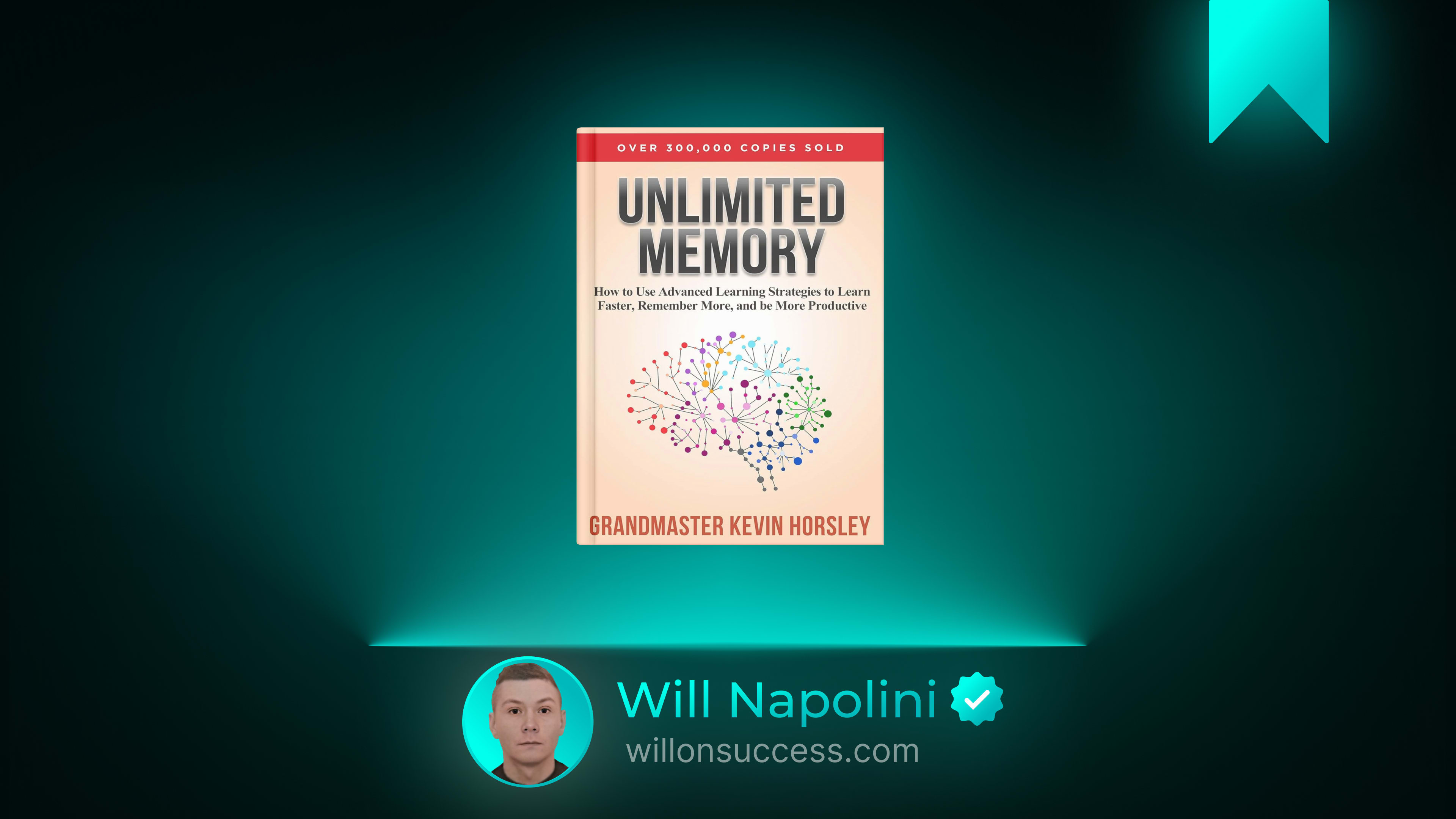
Have you ever stood in a grocery aisle, phone in hand, staring at a list you wrote three minutes ago, and still felt the fog roll in? Or sat across from someone at a meeting, smiling warmly, while their name evaporated the instant they finished introducing themselves?
If you have, you are not broken. You are untrained.
That distinction matters more than you might realize, because one of those beliefs leads to resignation, and the other leads to possibility. Kevin Horsley’s Unlimited Memory is built entirely on the second belief. And what I want to show you in this summary is not just what the book teaches, but why it matters for the way you work, the way you learn, and the way you feel about your own mind on an ordinary Tuesday afternoon when you can’t remember where you left your keys.
The Big Idea: You Were Never Given a Bad Memory
The central argument of this book is disarmingly simple. Memory is not a container you were born with—a fixed-size bucket that some people got larger and others got smaller. Memory is a process. And processes can be improved with technique, practice, and patience.
Horsley writes that most people carry around a story about themselves: “I have a bad memory.” They say it the way someone might say, “I have brown eyes.” As if it were a fact of nature, unchangeable, genetic, final. But what if that story is simply wrong? What if the reason you forget names, lose track of conversations, or read a page and retain nothing is not that your brain is defective, but that nobody ever taught you how to use it deliberately?
This reframing is the foundation everything else rests on. Because once you stop treating forgetfulness as a character flaw and start treating it as a missing skill, you move from helplessness into agency. And agency, as I have learned over many years of watching people change, is where all real growth begins.
The Boy Who Could Not Read Well
Here is the story that makes this book credible, and it is worth pausing on.
Kevin Horsley did not begin life as a memory champion. He was dyslexic. He struggled in school the way so many children struggle—slowly, quietly, with the slow accumulation of being told, directly or indirectly, that his mind simply did not work the way it should. After finishing school, rather than accepting that label, he became fascinated by the question of how the brain actually stores and retrieves information. He studied. He interviewed people who seemed to remember effortlessly. He experimented on himself.
Over years of deliberate practice, he trained his memory the way an athlete trains a body—progressively, consistently, with structure. In 1995, he placed fifth at the World Memory Championships. In 1999, he memorized the first ten thousand digits of pi, a feat sometimes called “The Everest of Memory Tests.” He was awarded the title of International Grandmaster of Memory.
I tell you this not to impress you. I tell you because the distance between a dyslexic child who struggles to read and a person who can recall ten thousand digits in sequence is not a genetic gap. It is a training gap. And that gap can be crossed by anyone willing to learn the method and do the repetitions.
Your starting point does not determine your ceiling. Your method does.
The Four Pillars: How Memory Actually Works
Horsley organizes his approach around four principles he calls the 4 Cs: Concentration, Creating imagery, Connecting concepts, and Continuous use. Each one addresses a different reason information slips away. Together, they form a system. Let me walk you through them.
Your Attention Is the Gate, and Most of Us Leave It Wide Open
The first and most overlooked reason we forget is not that our memory is weak. It is that we never truly encoded the information in the first place. We were half-listening. We were checking our phone. We were rehearsing what we wanted to say next. The information never got through the front door, so of course we cannot find it later in the house.
Horsley emphasizes that concentration is not a mystical state of deep focus reserved for monks. It is a decision. It means doing one thing at a time and giving that thing your full presence. He points out that multitasking—so celebrated in modern work culture—is largely a myth. When you divide your attention, you do not do two things at once. You do two things poorly, and you remember neither.
Think about the last conversation where someone’s name slipped away from you. Were you truly present when they said it? Or were you already scanning the room, composing your response, wondering what to do with your hands? The name did not escape your memory. It never entered.
This is the first principle, and it is also the hardest, because it asks something of you before any technique arrives. It asks you to be here. Fully. On purpose.
Make It Strange, Make It Sensory, Make It Alive
Once your attention is engaged, the next challenge is making information stick. Horsley introduces what he calls the SEE principle for creating mental images:
Senses. Engage more than sight. If you are trying to remember something, imagine its texture, its smell, its sound, even its taste. The more sensory channels you activate, the more anchors your brain has to hold onto.
Exaggeration. The brain ignores the ordinary and remembers the absurd. A normal orange on a table is forgettable. An orange the size of a football, dripping juice onto a white carpet, is unforgettable. Make your mental images ridiculous. Oversized. Ridiculously colorful.
Energize. Add movement. Add humor. Add emotion. A static image fades. A dancing, singing, neon-pink horse galloping across your kitchen counter does not.
The reason this works is not magic. It is how the brain evolved. For hundreds of thousands of years, human survival depended on noticing what was unusual, vivid, and emotionally charged. A rustle in the grass mattered. A flat, beige rock did not. Your brain still prioritizes the vivid and the strange. Horsley’s techniques simply give you a way to speak that ancient language deliberately.
To make this concrete: imagine you need to remember that the capital of Greece is Athens. You could picture eight hens (the sound “A-thens”) swimming in a pool of grease (the sound “Greece”). It is silly. It is absurd. And that is precisely why it works. You will not forget eight greased hens. You might have forgotten the word “Athens” read plainly on a page.
Build Bridges: Connect New Information to What You Already Know
The third principle addresses a question most people never think to ask: where does new information live in your mind?
Horsley explains that your brain stores new data initially in short-term memory, which is fragile and temporary. To make it durable, you must connect it to something already anchored in long-term memory. You must build a bridge from the unknown to the known.
He offers several practical systems for doing this:
The Body Method. You use parts of your own body as fixed reference points. You associate each piece of information you want to remember with a body part—your feet, your knees, your hips, your chest—and when you need to recall the list, you simply walk mentally from toe to head.
The Car Method. Same idea, but using parts of a car you know well. The steering wheel holds one fact. The rearview mirror holds another. The trunk holds a third.
The Location or Route Method. Sometimes called the method of loci, this involves mentally placing information along a familiar path—your walk to the kitchen, your drive to work—and retrieving it by mentally walking that path again.
What all of these share is a single insight: your brain remembers spatial, physical, and familiar information far better than it remembers abstract lists. So you give the abstract list a physical home. You hang the new idea on a hook that is already nailed into the wall.
I think of it like this. If you throw a handful of seeds onto bare concrete, nothing takes root. But if you press those same seeds into prepared soil—soil that already has structure, nutrients, and depth—they grow. Your existing knowledge is the soil. The techniques are how you press the seed in rather than letting it bounce off the surface.
The Compound Effect of Returning
The final C is the one most people skip, and it is the one that separates a technique you tried once from a skill you actually own.
Continuous use. Spaced repetition. Coming back.
Horsley notes that without review, most of what you learn fades within days. But if you review at expanding intervals—ten minutes after learning, then one hour, then one day, three days, one week, two weeks, three weeks, one month, two months, three months—the information migrates into long-term storage. It becomes part of you. Not because you are special. Because you returned.
This is the principle of consistency over intensity. You do not need a twelve-hour study marathon. You need seven minutes tomorrow, four minutes next week, two minutes next month. Small returns. Compounding. Like deposits into a bank account that quietly grows.
What you repeat in private eventually becomes visible in your life. That applies to memory the way it applies to every other skill worth building.
Why This Matters Beyond Exams
You might be thinking, “I am not a student. I do not need to memorize presidents or pi.” Fair enough. But consider what memory actually underpins in your daily life.
Remembering a colleague’s name in a meeting changes the power dynamic. You are no longer the person fumbling; you are the person who listened. Remembering what a client said three weeks ago, unprompted, builds trust faster than any sales technique. Remembering a promise you made to your child, and following through, is how character is built in small, invisible moments. Remembering what you read, what you learned, what you decided last month—this is how you stop repeating the same mistakes and actually move forward.
Memory is not just a study tool. It is the scaffolding of your identity, your relationships, and your competence. When you strengthen it, you are not preparing for a test. You are building a life where you can trust yourself to hold what matters.
A Practical Starting Point
Understanding the principles is valuable. But understanding without action changes nothing. So let me give you something you can do today. Not tomorrow. Not after you finish this article and “get around to it.” Today.
One small experiment: Choose one thing you need to remember this week. A name. A task. A fact for work. Whatever it is, stop and apply the SEE principle. Close your eyes for ten seconds. Build an image. Make it absurd. Add a sense beyond sight—maybe the thing has a smell, or it makes a sound. Give it movement. Make it ridiculous.
Then, tonight, before you sleep, recall that image once. Tomorrow morning, recall it again. That is two repetitions. You have already done more than most people will ever do for a single fact.
One behavior to stop: The next time someone introduces themselves to you, resist the urge to think about your response while they are still speaking. Listen fully. Hear the name. Build a tiny image for it. Then say it back: “Nice to meet you, Sandra.” You just doubled the likelihood you will remember.
One system to build: Pick a familiar route—your walk from your front door to your kitchen, or your commute to work. This week, practice placing three items you want to remember along that route. Walk the route mentally. See the items. Do this once a day for five days. You are building the muscle. You are laying the first bricks.
You start small. You stay consistent. You let time do its work.
Who This Book Is For, and Who It Is Not For
If you are a student drowning in material, a professional who needs to retain complex information, a public speaker who wants to work without notes, or simply someone tired of feeling like their mind is a sieve, this book will give you concrete tools within the first few chapters. It is short, direct, and relentlessly practical. Horsley does not spend pages theorizing. He shows you the technique, gives you an example, and asks you to try it.
If you are looking for deep neuroscience, academic citations, or a philosophical exploration of consciousness, this is not that book. The science is present but light. The value is in the doing. Some readers may find the repetition of basic concepts unnecessary if they have already studied mnemonic systems elsewhere. But for most people—people who have never been taught how their own memory works—this is a clear, encouraging, and immediately useful guide.
What makes it worth reading is not merely the techniques. It is the permission it gives you to stop believing the story that you are stuck. That your mind is what it is. That some people just remember things and you are not one of them.
You are one of them. You have always been one of them. You simply were not shown the method.
The Door Is Open
If I could sit across the table from you right now, I would say this: the forgetting is not the verdict. It is the starting point. Every person who has ever built a remarkable memory began exactly where you are—frustrated, a little embarrassed, wondering if something is wrong with them. Nothing is wrong. You just need a method and a few minutes a day.
Kevin Horsley went from a child who struggled to read to a person who held ten thousand digits in his mind. The bridge between those two realities was not talent. It was technique, repeated. It was showing up to the practice when it felt slow and pointless, and trusting that the repetition was doing invisible work beneath the surface.
Your memory is not a fixed inheritance. It is a house you are building, brick by brick, image by image, review by review. And every single brick you lay today is one that will still be there tomorrow, holding up the next floor.
Here is your one step for today. Right now. Before you close this article. Think of one name, one fact, one task you want to remember this week. Close your eyes. Build one absurd, colorful, moving image for it. Make it strange. Make it yours. Hold it for ten seconds.
Open your eyes. You just did the thing. You just laid the first brick.
The mind you want is not waiting for you at some distant finish line. It is being built in the next ten seconds, by the next image, by the next small act of attention you choose to give. And that is not a burden.
That is a door, already opening. Walk through it.