Can't Hurt Me: Why Your Mind Quits Long Before Your Body Does (And How to Fix It)
There is a specific, quiet moment that happens to all of us. It happens on the treadmill when your lungs burn. It happens at your desk when the project seems too vast and your energy is too low. It happens in the mirror when you look at your life and realize it is not what you hoped it would be.
In that moment, a voice inside your head speaks up. It sounds reasonable. It sounds protective. It says, “You’ve done enough. You can stop now. It’s okay to quit.”
Most of us listen to that voice. We treat it as the absolute truth. We step off the treadmill, we close the laptop, we look away from the mirror.
But what if that voice is lying to you? What if the feeling of being completely empty is actually a biological illusion, a safety mechanism designed to keep you comfortable, rather than a true measure of your capacity?
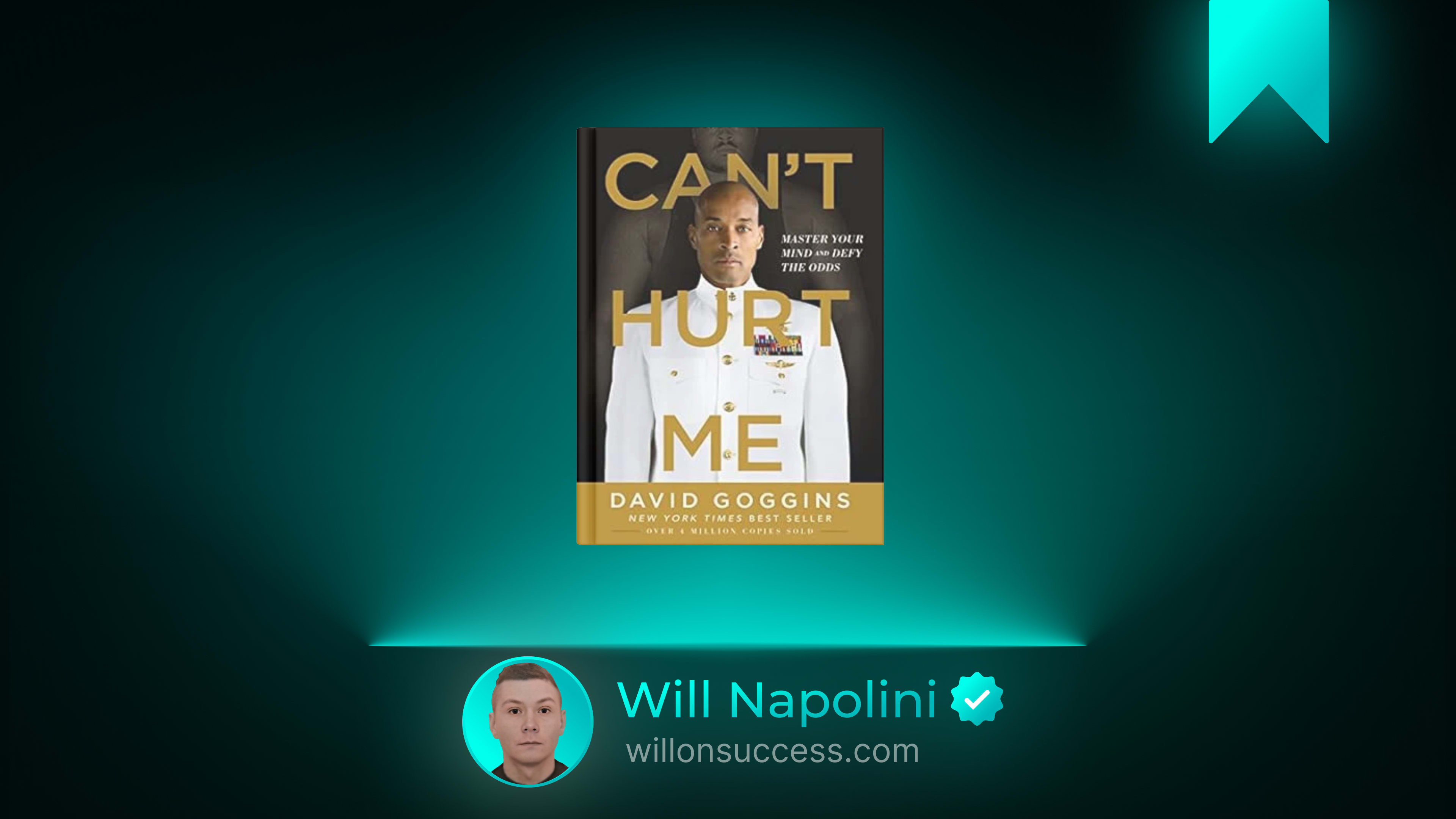
David Goggins built an entire life around proving that the voice in your head is a liar. In his memoir and manifesto, Can’t Hurt Me, he does not offer gentle affirmations or five-step hacks for easy success. He offers a sledgehammer to the comfortable illusions we build around our own potential.
If you have ever felt that you are capable of more but cannot seem to bridge the gap between your intentions and your actions, I want to sit across from you and unpack what Goggins has learned. Because beneath the extreme ultramarathons and the military records, there is a deeply practical, profoundly hopeful message about what it means to take absolute ownership of your life.

The Big Idea: You Are Living in the Shallow End of Your Potential
The central thesis of Can’t Hurt Me is that human beings rarely tap into more than a fraction of their true capability. We are governed by our minds, and our minds are deeply invested in keeping us safe, comfortable, and away from pain.
When you feel exhausted, your brain is not telling you that your body is out of fuel. It is telling you that it is time to stop before you might run out of fuel. It is a governor. And because we listen to the governor, we stop at the first sign of friction.
Goggins argues that to achieve anything extraordinary—or even to build an ordinary life of deep resilience and character—you must learn to override that governor. You must become comfortable with being uncomfortable. You must deliberately seek out friction to build mental armor.
This is not about masochism. It is about preparation. Life will eventually hand you a tragedy, a failure, or a burden that you cannot avoid. If your mind is soft, that burden will crush you. If your mind is calloused, you will carry it.
The Story of the Exterminator Who Refused to Be a Victim
To understand the weight of Goggins’ philosophy, you have to understand where he started. He did not begin as a superhero. He began as a young man who was deeply traumatized by a violently abusive father, struggled with severe learning disabilities, and found himself in his twenties weighing nearly 300 pounds, spraying cockroaches for a living.
He was depressed. He was terrified of the world. He was hiding.
The turning point was not a magical epiphany. It was a moment of brutal, unvarnished honesty. He saw a documentary about Navy SEAL training, looked at his own life, and realized that no one was coming to save him. The cavalry was not coming.
To enter the SEALs, he had to lose over 100 pounds in less than three months. It was a medically dangerous, agonizing process, but he did it. He went on to endure Hell Week three times (due to injuries), become an Army Ranger, and eventually set the world record for pull-ups (4,030 in 17 hours).
I tell you this not to intimidate you, but to show you the baseline. Goggins did not start with elite genetics or a privileged mindset. He started from the absolute bottom of the barrel. His transformation was not a matter of talent. It was a matter of methodology. He built a system to dismantle his own excuses.
The Accountability Mirror: Stripping Away the Illusions
The first and most critical step in Goggins’ framework is what he calls the Accountability Mirror.
Most of us walk through life wrapped in a soft blanket of rationalizations. We tell ourselves we are “big-boned,” that we are “just not good at math,” that our boss is the reason we are stuck, or that we are “too busy” to work on our health. We use euphemisms to soften our failures.
Goggins demands that you stand in front of your mirror, look yourself in the eyes, and speak the brutal, unvarnished truth.
If you are overweight, you do not say, “I need to shed a few pounds.” You say, “I am fat.” If you are underperforming at work, you do not say, “I need to optimize my workflow.” You say, “I am lazy and easily distracted.”
This sounds harsh. It sounds like the opposite of self-compassion. But I have learned that true compassion does not mean lying to yourself to make you feel better in the short term. True compassion means telling yourself the hard truth so you can actually fix the problem.
When you paste a sticky note to your mirror with your raw, unfiltered goal and your current, unfiltered reality, you remove the hiding places. You cannot fix a problem you refuse to name. The Accountability Mirror forces you to take absolute, radical responsibility for your life. Circumstances matter, but from this moment forward, your response to those circumstances is entirely on you.
Callousing Your Mind: The Architecture of Resilience
If you chop wood every day, your hands will blister, bleed, and eventually form thick, hard callouses. The wood stops hurting you because your skin has adapted to the friction.
Goggins applies this exact principle to the human mind. We live in a world that is obsessed with removing friction. We have climate-controlled homes, food delivered to our doors, and endless entertainment to distract us from silence. Because we avoid daily discomfort, our minds remain soft. When a real crisis hits—a health scare, a financial loss, a broken relationship—our soft minds tear apart under the pressure.
To callous your mind, you must deliberately do things you hate doing, every single day.
This is where the principle of consistency before intensity becomes vital. You do not need to run a hundred miles to callous your mind. You just need to identify the small, daily frictions you usually avoid, and lean into them.
It is the decision to wake up when the alarm goes off instead of hitting snooze. It is the choice to make the difficult phone call instead of sending an evasive email. It is the discipline to sit in silence for ten minutes instead of reaching for your phone.
Every time you choose the hard path when the easy path was available, you are adding a layer of armor to your mind. You are teaching your brain that you are in charge, not your impulses. Over time, the things that used to break you will barely register.
The 40% Rule: Overriding the Governor
One of the most famous concepts from the book is the 40% Rule. Goggins argues that when your mind tells you that you are completely done, that you have nothing left to give, that you are going to collapse—you are actually only at 40% of your physical and mental capacity.
Sports science supports this through the “Central Governor Theory.” The brain restricts muscle output and creates the sensation of overwhelming fatigue long before the muscles actually fail, in order to preserve a reserve of energy for survival.
Think of the fuel gauge in your car. When the needle drops to “Empty” and the low-fuel light flashes, the tank is not actually dry. There is a reserve built in so you can make it to a gas station. Your brain works the same way. The pain, the exhaustion, the overwhelming urge to quit—that is just the low-fuel light flashing.
Understanding this changes everything. When you hit the wall, you do not have to view it as a stop sign. You can view it as a checkpoint. You can say to yourself, “This is just the 40% mark. I have a reserve tank.”
You do not access that reserve tank through motivation. Motivation is a fleeting emotion. You access it through a quiet, stubborn refusal to negotiate with your own weakness. You just take one more step. And then one more.
The Cookie Jar: Harvesting Fuel from Past Fires
When you are deep in the suffering, when the 40% rule is tested and your mind is screaming at you to quit, where do you find the energy to keep going?
Goggins suggests building a mental “Cookie Jar.” But this jar is not filled with literal cookies, and it is not filled with shallow affirmations. It is filled with the memories of every obstacle you have ever overcome, every fear you have ever faced, and every time you proved your inner critic wrong.
Too often, we suffer from amnesia regarding our own strength. We forget the nights we stayed up to finish the degree. We forget the grief we survived. We forget the times we were terrified but spoke up anyway.
When you are in the middle of a dark moment, you reach into the Cookie Jar. You pull out a memory. You remind yourself: “I survived the divorce. I built that business from nothing. I ran that race when my knees were bleeding. I am someone who overcomes.”
This is not arrogance. This is evidence-based confidence. You are using the harvest of your past struggles to feed your present endurance.
Taking Souls: The Power of Undeniable Effort
There is a concept in the book that Goggins calls “Taking Souls.” It sounds aggressive, but at its core, it is about earning profound respect through undeniable, relentless effort, even from those who doubt you or wish you ill.
Imagine you are in a grueling training environment, or a highly competitive workplace, and there is someone who wants to see you fail. The instinct is to get angry, to complain, or to try and sabotage them back.
Goggins’ approach is different. You look at them, you smile internally, and you simply outwork them. You show up earlier. You stay later. You maintain your standard when they are cutting corners. You do not do this to destroy them. You do it to show them that their doubt has no power over you.
Eventually, the sheer weight of your consistency breaks down their negativity. They stop doubting you and start respecting you. More importantly, you stop caring about their opinion because you have proven your character to yourself. You took their negative energy and used it as fuel for your own growth.
Why This Matters on an Ordinary Tuesday
You might be reading this and thinking, “This is incredible for a Navy SEAL, but I am an accountant, a teacher, a stay-at-home parent. I am not trying to break pull-up records.”
Here is what I want you to understand: The arena does not matter. The principles are universal.
You may not be running through the mud in Coronado, but you are facing your own versions of Hell Week. It is the Tuesday morning when your child is sick, you slept three hours, the house is a mess, and you have a major presentation at work.
If your mind is soft, you will snap at your child. You will call in sick. You will let the day defeat you.
But if you have been callousing your mind, if you have practiced doing hard things when no one was watching, you will take a deep breath. You will access your reserve tank. You will speak gently to your child, handle the crisis, and deliver the presentation.
Mental toughness is not just for extreme athletes. It is the foundational requirement for being a reliable parent, a trustworthy partner, and a person of deep character. We build our resilience in the small, unseen moments so that when the heavy moments arrive, we do not buckle.
Practical Application: Building Your System
Understanding Goggins’ philosophy is inspiring, but inspiration without a system changes nothing. Here is how you translate this into your daily life without breaking your body or your spirit.
1. The Daily Friction Audit Identify one thing you do every day purely for comfort, and remove it. Maybe it is the extra twenty minutes of scrolling in bed. Maybe it is the sugary snack at 3:00 PM. Maybe it is turning up the heat instead of putting on a sweater. Choose one comfort to sacrifice. Do it every day for a week. Notice how your mind tries to negotiate with you, and refuse the negotiation.
2. Build Your Cookie Jar Take thirty minutes this weekend with a journal. Write down ten of the hardest things you have ever survived or accomplished. Write down the details. How bad did it feel? What did you do to get through it? Keep this list accessible. The next time you feel overwhelmed, read it before you react.
3. The “One More” Rule You do not have to push yourself to physical collapse to test the 40% rule. Just practice the “One More” rule in low-stakes environments. When you are reading a book and feel like stopping, read one more page. When you are doing dishes and want to leave the last few for tomorrow, wash one more plate. Train your brain to tolerate the slight extension of effort.
Who Should Read This Book
Can’t Hurt Me is a vital read for anyone who feels stuck in a rut, anyone who suspects they are living far below their potential, and anyone who is tired of making excuses. It is particularly powerful for those who need a massive, unapologetic wake-up call to stop playing the victim.
A note of caution: Goggins’ approach is extreme. It is a sledgehammer. If you are currently dealing with acute, unhealed trauma, severe clinical depression, or physical injuries, this book should not replace professional medical or psychological care. Goggins used physical suffering to bypass his psychological pain, which worked for him, but it is not a universally safe prescription for everyone. Use his principles to build resilience, but pair them with the wisdom to know when you need healing rather than just hardening.
Your One Small Step
If you take only one thing from this book, let it be the Accountability Mirror.
Today, I want you to buy a pack of sticky notes. Go to the mirror in your bathroom. Look at yourself. Ask yourself what is the one area of your life where you have been lying to yourself. Where have you been using an excuse?
Write the raw truth on that sticky note. Not the polite version. The real version. Stick it to the mirror.
Tomorrow morning, when you brush your teeth, look at it. Do not look away. Acknowledge it. And then, make one small decision that aligns with the truth, rather than the excuse.
The friction you avoid today is the exact material you need to build the person you want to become tomorrow. The wall is not there to keep you out. The wall is there to ask you, quietly and firmly, how much you are willing to endure to get to the other side.