What a Broken Back Taught Bear Grylls About Rebuilding a Life
What a Broken Back Taught Bear Grylls About Rebuilding a Life
There is a moment in every person’s life when the story they were telling themselves about who they are gets torn in half. Not edited. Not revised. Torn. And you are left standing in the wreckage of a plan you never imagined would fail, holding pieces that no longer fit together.
If you have been there, or if you are there right now, I want to talk to you about a book that understands that moment better than most.
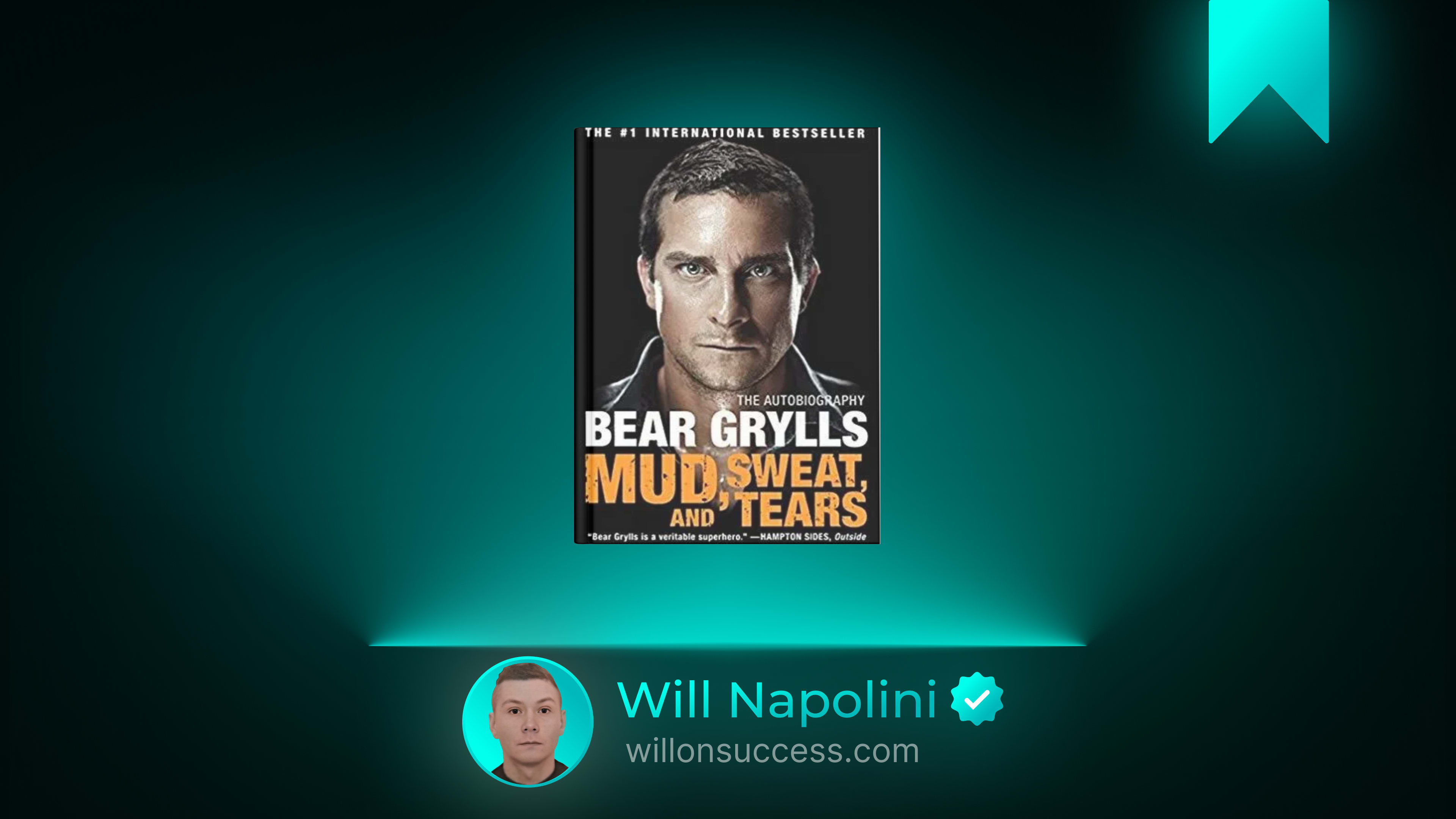
Mud, Sweat and Tears by Bear Grylls looks, from the outside, like an adventure memoir. A man climbs mountains, jumps out of planes, dangles from helicopters, and eats things on television that make audiences wince. But if you read it only as a catalogue of stunts, you will miss the actual story. The real story is about a young man who broke his back in three places, was told he might never walk properly again, and had to decide what kind of person he would become in the space between that diagnosis and whatever came next.
That story belongs to all of us. Not because we will all summit Everest. But because every one of us will face a season where the ground gives way beneath a plan we trusted, and we will need to find our footing again in the dark.
The Big Idea: Character Is Forged in the Falling, Not the Standing
Grylls’ central message, woven through every chapter, is deceptively simple: you do not discover who you are by avoiding difficulty. You discover who you are by moving through it.
Not around it. Not after it passes. Through it.
The mud, the sweat, and the tears of the title are not obstacles on the way to a meaningful life. They are the material from which a meaningful life is built. You cannot separate the adventure from the suffering any more than you can separate the blade from the heat that shaped it.
What struck me most, reading this book, was how Grylls treats his own fear. He does not pretend it is absent. He does not perform fearlessness for the reader. He admits, repeatedly, that his hands shake, that his stomach turns, that there are moments on cliff faces and in freefall where every instinct screams at him to stop. And then he takes the next step anyway.
Courage, in this book, is not the absence of terror. It is the decision that your purpose is louder than your panic.
The Accident That Broke the Story Open
In 1996, during a free-fall parachute jump in Africa, Grylls’ parachute failed to deploy correctly. He hit the ground at tremendous speed. Three vertebrae in his back were broken. He was twenty-two years old.
The doctors were blunt. They told him he was fortunate to be alive. They told him that walking again was not guaranteed. They told him to be realistic.
I want you to sit with that for a moment. Imagine being twenty-two, in the prime of your physical life, trained in elite military service, built for movement and action, and being told by a calm, professional voice that your body may simply not allow you to return to the life you had planned.
Grylls spent months in recovery. Months of pain. Months of uncertainty. Months where the future was not a road stretching ahead but a blank wall, featureless and close.
And here is where the book earns its weight. Because what Grylls describes is not a cinematic montage of triumph. It is slow. It is boring, in the way that all real recovery is boring. It is small exercises that produce almost no visible progress. It is waking up and choosing, again, to try the same movement that failed yesterday. It is swallowing pride. It is asking for help.
He did not leap from a hospital bed to a mountaintop. He inched forward. Day by day. Rep by rep. And the inching was the actual heroism. Everything that came later was built on those quiet, unglamorous weeks where no one was watching and no one was applauding.
Fear Is Information, Not a Verdict
One of the most practical ideas running through the book is Grylls’ relationship with fear. He does not treat fear as an enemy to be conquered or a weakness to be ashamed of. He treats it as data.
Before a climb, before a jump, before a live broadcast in front of millions, he feels the fear arrive. His body responds. His mind catalogues dangers. And then he asks himself a question that I think is worth writing down: Is this fear telling me to prepare more, or is it telling me to stop?
Most of the time, the answer is preparation. The fear is pointing at something he has not yet accounted for, a skill he has not yet sharpened, a contingency he has not yet planned. So he prepares. He checks his equipment. He rehearses. He breathes. And then he acts.
This distinction matters enormously in ordinary life. You feel afraid before a difficult conversation, a career change, a creative project, a boundary you need to set. The fear arrives and says, Stop. Go back. Stay safe. And most of us obey, because the fear feels like a conclusion. But it is not a conclusion. It is a question. It is asking: Are you ready? Have you prepared? Do you understand what you are walking into?
If the answer is no, you prepare. If the answer is yes, you move forward while your hands are still shaking.
The mountain does not care whether you are afraid. It only cares whether you keep climbing.
Preparation Is How You Respect the Future
Grylls is, above all things, a preparer. The book makes this clear in ways that might surprise readers who only know him from television, where everything looks spontaneous and reckless. Behind every sequence that appears improvised, there were hours of planning, risk assessment, physical conditioning, and contingency mapping.
He writes about checking equipment obsessively. About studying routes. About understanding weather patterns. About knowing his own physical limits and respecting them even when ambition pulls him to ignore them.
This is not glamorous work. No one makes a film about the hours you spend studying a map in a quiet room. No one applauds the third rehearsal of a skill you have not yet mastered. But Grylls is honest that this invisible work is what separates survival from recklessness. The difference between a person who takes a calculated risk and a person who simply gambles with their life is preparation.
And this translates far beyond mountaineering. Think about your own life. The presentation you are dreading. The business you want to start. The conversation you have been avoiding for months. The habit you keep trying to build and keep abandoning.
In almost every case, the anxiety you feel is not really about the task itself. It is about the gap between where you are and where you need to be, and your suspicion that you have not closed that gap. Preparation closes the gap. Not perfect preparation. Not endless preparation that becomes its own form of avoidance. But honest, focused work that says: I will not walk into this blind.
You prepare the night before. You write the outline. You rehearse the first three sentences. You lay out the clothes. You set the alarm. You remove the obstacles you already know will be there. Small acts of respect toward your future self.
The People Who Hold the Rope
Grylls is candid throughout the book about the people who carried him when he could not carry himself. His family. His wife, Shara. His close friends. His team members in the SAS and later in television. The surgeons and physiotherapists who rebuilt his spine and his strength.
There is a strand of adventure culture that celebrates the lone figure against the elements, the solitary hero who needs no one. Grylls pushes back against that quietly but firmly. He describes trust as essential. He describes asking for help as a form of strength, not surrender. He describes the way a climbing partner’s steady hand on the rope allows you to attempt a move you would never try alone.
I think this is one of the most important corrections the book offers. We live in a culture that often treats independence as the highest virtue. You should be self-sufficient. You should not burden others. You should handle it yourself.
But here is what I have learned, and what Grylls’ story confirms: the people who go furthest are almost never the people who go alone. They are the people who build trust, who accept support, who let others see them struggling. The rope between you and another person is not a leash. It is what makes the climb possible.
If you are in a hard season right now, and you have been trying to white-knuckle your way through it in silence, I would gently ask: who holds your rope? And if the answer is no one, the first step forward might not be more effort. It might be one honest conversation where you say, I am struggling, and I need help.
Faith as an Anchor in the Storm
Grylls is open about his Christian faith, and it threads through the book not as a performance but as a quiet anchor. He does not preach. He does not present his survival as divine reward. But he acknowledges, in moments of extreme vulnerability, that something beyond his own will held him steady. That prayer, for him, was not a magic formula but a practice of surrender. A way of saying, I have done what I can. The rest is not mine to control.
You do not have to share his specific faith to recognize the principle underneath it. There comes a point in every ordeal where your effort reaches its limit. You have prepared. You have persevered. You have shown up day after day. And the outcome is still not guaranteed. At that point, you either find a way to release the need to control everything, or you are crushed by the weight of trying to be the sole author of your fate.
Whatever form that surrender takes for you, prayer, meditation, a walk in silence, a conversation with someone you trust, the act of releasing is not weakness. It is the final act of preparation. You have done your part. You let go of the rest.
What This Looks Like on an Ordinary Tuesday
Let me bring this down from the mountain and into your kitchen, your office, your commute.
You do not need to climb Everest for this book to matter. The principles Grylls describes operate at every scale.
You are afraid to apply for the role you want. The fear is not a verdict. It is information. It is asking whether you have prepared your resume, practiced your answers, researched the company. Do that work. Then apply while your hands are still trembling.
You broke something last year. A relationship. A business. A routine. A sense of yourself. And you have been waiting to feel whole before you move forward. Grylls’ story says: you rebuild in the brokenness. You do not wait for the pain to leave. You start the small exercise. You take the first small step while the ache is still there.
You have been trying to build a habit and keep failing by day four. The problem is not your character. The problem is that you are asking for a summit when you need a foothold. Make the next step smaller than feels worthy. Then take it. Then take it again tomorrow. The consistency is the climb.
You are trying to do everything alone because asking for help feels like admitting defeat. Pick one person. Tell them one true thing about where you are. Let them hold the rope.
Who Should Read This Book
If you are in a season of recovery, if something in your life has broken and you are trying to figure out how to stand up again, this book will meet you where you are. Grylls does not skip over the pain. He sits in it. And then he shows you, slowly, how he stood up.
If you are someone who feels stuck, who has been waiting for the right moment or the right feeling before taking action, the sheer momentum of this story will challenge you. Not through shame. Through example. If this man could rebuild his spine and then climb the highest mountain on earth eighteen months later, perhaps the thing you have been postponing is not as impossible as your fear insists.
If you love adventure for its own sake, the book delivers. The SAS training sequences, the Everest ascent, the early days of filming in some of the most hostile environments on earth, all of it is vivid and gripping.
Who might find it less useful? If you are looking for a structured self-help framework, a step-by-step system, or a philosophical treatise on resilience, this is not that book. It is a memoir. The lessons are embedded in the story, and you have to meet them there. If you prefer your wisdom delivered as bullet points and exercises, you may find the narrative format slow in places.
But if you are willing to let a story teach you, the teaching here is deep.
One Small Step
Here is what I would ask you to do today. Not tomorrow. Today.
Think of one thing you have been putting off because you are waiting to feel ready. A conversation. A project. A phone call. An application. A first draft. A walk outside when you have been inside too long.
You are not going to feel ready. Grylls was not ready on that mountain. He was afraid. His body was still healing. The weather was uncertain. He went anyway, one handhold at a time.
So here is your handhold. Set a timer for ten minutes. Spend those ten minutes doing the smallest possible version of the thing you have been avoiding. Not finishing it. Not perfecting it. Just touching it. Opening the document. Dialing the first three digits. Writing the first sentence. Putting on your shoes and stepping outside.
Ten minutes. Then you can stop. You will not want to, but you can.
Because what you will discover, the same thing Grylls discovered in that rehabilitation ward, is that the hardest part was never the task. The hardest part was the first movement toward it. And once your hands are on the rope, climbing becomes possible.
You do not need to see the summit. You need to grip the next hold.
The mud will come. The sweat will come. The tears will come. They are not signs that you are failing. They are signs that you are building something real. And what you build in the hardest seasons of your life will be the thing you trust most when the weather finally clears.
So grip the next hold. Breathe. And climb.