Stop Doubting Your Greatness: The Core Lessons from 'You Are a Badass'
There is a voice in your head that has been narrating your life for years. It tells you who you are, what you deserve, what is realistic, and what is foolish to even attempt. You did not hire this narrator. You did not audition it. And yet it speaks with the calm authority of someone who has always been in the room.
What if I told you that most of what that voice says is not truth? It is rehearsal. It is a script handed to you by old experiences, other people’s fears, and a handful of painful moments you never fully processed. And what if the single most important thing you could do for your life is not to find more motivation, more information, or more permission—but to finally question the narrator?
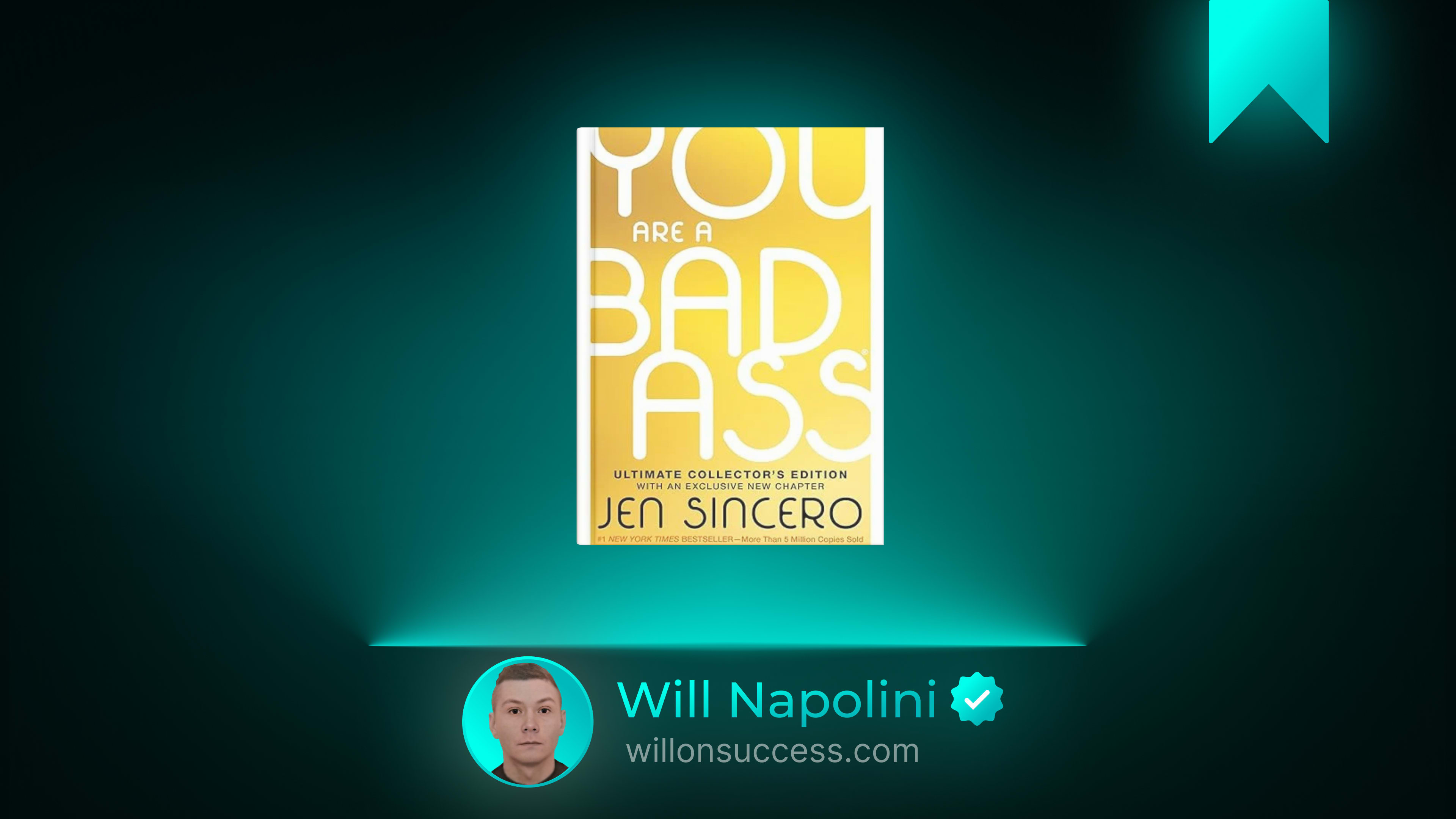
That is the beating heart of Jen Sincero’s You Are a Badass: How to Stop Doubting Your Greatness and Start Living an Awesome Life. It is not a gentle book. It is loud, funny, blunt, and occasionally profane. But underneath the swagger is a genuinely serious argument: you are not stuck because you lack talent or opportunity. You are stuck because you have built an identity around your own limitations, and you protect that identity more fiercely than you pursue your desires.
I have seen this pattern play out in so many lives, including periods of my own. You work hard. You try things. But somewhere beneath the effort, a quiet conviction whispers, This isn’t really for someone like you. And that whisper is louder than any plan, any goal, any motivational speech you listen to on a Monday morning.
Sincero’s book is about silencing that whisper. Not by shouting over it. By understanding where it came from, thanking it for trying to keep you safe, and then choosing a different story.
The Big Idea: You Were Born Believing in Yourself. Then You Were Trained Out of It.
Here is the central claim, stated plainly: you do not need to become extraordinary. You need to stop practicing the belief that you are not.
Sincero argues that self-doubt is not your natural state. Watch a three-year-old attempt to build a tower out of blocks. Watch them announce, with total sincerity, that they are going to be an astronaut, a painter, and a dinosaur when they grow up. They do not qualify their ambitions. They do not check whether they are realistic. They simply decide and reach.
Somewhere along the way—through criticism, comparison, failure, embarrassment, or the quiet modeling of fearful adults around us—we learned to shrink. We learned to edit our desires before speaking them aloud. We learned that wanting too much made us vulnerable to disappointment, so we started wanting less. And after enough years of wanting less, we forgot how to want at all.
The book’s project is to reverse that training. Not with abstract affirmations taped to a mirror, but with a direct confrontation of the beliefs running your life beneath conscious awareness.
Your Subconscious Is Driving the Car. You Are Sitting in the Passenger Seat Calling Yourself the Driver.
One of the most important ideas Sincero develops early in the book is the role of the subconscious mind in shaping your daily experience. The concept is not new, but she makes it concrete in a way that lands.
Think of it this way. Your conscious mind—the part of you setting goals, reading books, making plans—is like a person sitting in the passenger seat of a car, pointing at the road and saying, “I want to go north.” But the subconscious mind is the one actually holding the steering wheel. And if the subconscious has been programmed with the belief that north is dangerous, that you do not deserve to arrive, or that the car will break down before you get there, then no amount of pointing will change the direction.
You set the goal. You feel excited for a week. Then something pulls you back. You procrastinate. You sabotage. You choose the familiar discomfort over the unfamiliar possibility. And you call yourself lazy or undisciplined.
But it may not be laziness. It may be a deeper program running underneath, saying, This is not who we are. Return to what is known.
Sincero’s point is not mystical. It is practical. If you want your life to change, you cannot work only at the level of to-do lists and willpower. You have to go underneath. You have to identify the beliefs that are quietly vetoing your efforts, and you have to consciously, deliberately, repeatedly replace them.
This is not a one-time exercise. It is more like retraining a muscle. You will not fix a lifetime of self-doubt in an afternoon of positive thinking. But you can begin. And beginning, sustained over weeks and months, genuinely rewires the direction you drive.
Fear Is Not a Stop Sign. It Is a Compass.
One of the ideas I find most useful in the book, and one I return to often, is Sincero’s treatment of fear.
Most of us treat fear as information that says, You should not do this. Fear means danger. Fear means stop. Fear means you are not ready, not qualified, not meant for this particular thing.
Sincero flips that reading. She argues that the things that scare you most are very often the things you most need to do. Not because danger is irrelevant—real danger exists, and discernment matters—but because the specific flavor of fear you feel when you are about to grow, create, speak up, or step into something larger than your current identity is not the same as the fear of genuine harm. It is the fear of being seen. Of failing publicly. Of discovering that you might actually succeed and then having to live as a bigger version of yourself.
That fear is not a warning. It is a compass needle pointing toward the direction of your growth.
I have found this reframe to be one of the most liberating shifts a person can make. You stop waiting for fear to leave before you act. You learn to walk alongside it. You say, “I see you. I understand what you are trying to protect me from. But we are going this way.”
And something remarkable happens. The fear does not always disappear. But it loses its authority. It becomes a passenger instead of the driver.
You Cannot Outperform Your Sense of What You Deserve
There is a quiet, uncomfortable idea threaded through the book, and it concerns your relationship with what you believe you are allowed to have.
Sincero talks openly about her own years of financial struggle, of being broke, of cycling through jobs and relationships that did not serve her, of feeling like life was happening to her rather than through her. What she came to understand was that her external circumstances were, in significant part, a reflection of an internal permission slip she had never signed. She did not believe she deserved ease. She did not believe she deserved money, love, creative success, or a life that felt good. And so, unconsciously, she kept arranging her life to match that belief.
This is not about blaming yourself for hardship. Circumstances are real. Systems are real. Bad luck is real. Sincero does not deny any of that. But she insists that within whatever hand you have been dealt, there is still a powerful lever: the story you tell yourself about what is possible and what you are worthy of receiving.
If you believe, deep down, that you are the kind of person who struggles, who barely gets by, who is always one step behind—your decisions will confirm that belief. You will undercharge for your work. because you do not feel worth full price. You will stay in relationships where you are undervalued, because that matches your internal estimate. You will hesitate at the moment of opportunity, because stepping forward feels like fraud.
The work, then, is not just to set bigger goals. It is to expand your internal sense of what is acceptable for your life. To let yourself believe, genuinely and not just intellectually, that you are allowed to have good things. That you do not have to suffer to earn them. That your worth is not a reward for sufficient effort. It is a starting condition.
You were born worthy. Everything since then has been an argument against that fact. The work is to stop losing the argument.
Gratitude Is Not a Platitude. It Is a Lens You Choose Every Morning.
Sincero spends real time on gratitude, and I want to be careful here, because “practice gratitude” is one of the most overused and least examined pieces of advice in personal development.
What she is actually saying is more specific than “be thankful.” She is saying that your brain cannot hold two dominant emotional states at once. You cannot be simultaneously consumed by resentment about what is missing and genuinely present with what is here. One lens crowds out the other.
Gratitude, in this framing, is not about pretending everything is fine. It is not about suppressing legitimate frustration or grief. It is about choosing where to aim your attention first. Before you look at what is broken, you look at what is present. Before you rehearse the list of what you lack, you name three things that are true and good right now, even if they are small.
Over time, this practice changes your baseline. Not because the world has changed, but because your filtering system has. You start noticing opportunity where you used to notice only obstacle. You start recognizing your own progress where you used to see only the gap.
This is not magic. It is attention. And attention, directed deliberately over weeks, reshapes the story you tell yourself about your own life.
Deciding Is Different from Wishing
One of the sharper distinctions in the book is between wanting something and deciding on it.
Most of us carry around a long list of wishes. I wish I were healthier. I wish I had a better job. I wish I could write, travel, start the business, leave the situation, speak up, commit. These wishes float in the background of our minds like weather we hope will change.
Sincero pushes the reader toward something harder. A decision is not a wish. A decision has a cost. It means closing other doors. It means tolerating the discomfort of not knowing whether it will work. It means telling other people what you are doing and risking their judgment. It means acting before you feel ready, because readiness is a myth that keeps you waiting forever.
You do not need to feel confident to decide. You need to decide, and confidence often arrives after, not before.
This was one of the hardest lessons I ever learned personally. I spent years waiting until I felt certain, prepared, and qualified before I would commit to the thing I actually wanted. Certainty never came. What finally came was a tiredness so deep that staying still hurt more than moving. I chose. And the choosing itself generated a momentum that all the waiting had never produced.
A wish keeps your options open. A decision narrows them. And narrowing is where power lives. A river that spreads across a wide plain moves slowly and shapes nothing. A river forced through a narrow canyon cuts stone.
Your Environment Is a Silent Co-Author of Your Story
Sincero does not dwell on this as heavily as some other ideas, but she touches on something important: the people and inputs around you are quietly writing chapters of your story whether you notice or not.
If every conversation you have reinforces caution, cynicism, or the idea that life is mostly about enduring, that message seeps in. If the media you consume all day tells you that you are inadequate, that you need to buy something to be enough, that everyone else is further ahead—those messages seep in too.
You are not required to cut every difficult person from your life or move to a mountaintop. But you can audit your inputs. You can ask, honestly: do the voices I spend the most time with make me more likely to grow, or more likely to stay small?
This is not about surrounding yourself only with people who agree with you. It is about making sure that at least some of the voices in your life speak the language of possibility, effort, and honesty. You need at least one person who says, “I think you can do this, and I will still be here if you fail.”
That one voice can be the difference between trying and not trying.
What This Looks Like on an Ordinary Tuesday
Ideas are only as good as what they change in your daily behavior. So let me bring this down to the ground.
If you took Sincero’s book seriously, here is what a Tuesday might look like.
You wake up. Before you reach for your phone, you name three things you are grateful for. They are small. The light through the window. The fact that your body carried you through the night. A conversation you are looking forward to. You do this not because it feels profound, but because you are training your attention to land on what is present before it lands on what is missing.
You notice the old thought: I am not the kind of person who can pull this off. You do not fight it. You do not argue with it for twenty minutes. You simply label it. “That is the old story.” And you return to the task in front of you.
You do the work you have been avoiding. Not because you feel inspired. Because you decided. You give it thirty minutes before you check your email. Before you scroll. Before you let the day’s noise drown out the one thing that actually matters to you.
At some point, fear shows up. Maybe you are about to send the proposal, make the call, publish the thing, ask for the raise. Your chest tightens. Your mind generates seventeen reasons to wait. You feel the fear. You name it. You send the email anyway.
You do not perform all of this perfectly. You will miss days. You will revert. You will catch yourself thinking small thoughts and feel a flash of shame. And then you will remember: the goal was never perfection. The goal was direction. And direction is corrected one small turn at a time.
Who Should Read This Book
If you have been stuck in a loop of wanting more but not quite believing you are allowed to have it, this book will speak to you. If you are capable, hardworking, and still somehow feel like you are waiting for permission to begin your real life, Sincero’s voice will feel like a friend grabbing your shoulders and saying, Start now. You are not coming. You are already here.
It is particularly useful for people who respond to humor and directness more than gentle encouragement. Sincero is not soft. She swears. She pokes fun at you. She tells you to stop being ridiculous. For some readers, that tone is exactly what breaks through the polite fog of self-help they have read before.
It may be less useful if you are looking for a structured, step-by-step system with worksheets and frameworks. The book is more of a rally, a permission slip, a series of hard truths delivered with love. It lights the fire. You still have to build the hearth.
And if you are in a place of genuine crisis—grief, clinical depression, acute trauma—this book’s energetic tone may feel dismissive of the weight you are carrying. That is not a flaw in the book. It simply means this may not be the right tool for this particular season. Honor where you are.
One Small Step
Here is what I would ask you to do today. Not tomorrow. Today.
Take out a piece of paper or open a blank note on your phone. Write down one thing you have been wanting to do, create, say, or pursue that you have postponed because you do not feel ready, qualified, or certain it will work.
Now write one sentence underneath it: What would I do this week if I already believed I deserved to succeed at this?
Then do the first small version of that answer. Send the message. Write the first paragraph. Sign up for the class. Make the call. Tell one person what you are thinking about doing.
It does not have to be large. It has to be real. And it has to happen before the old narrator talks you out of it.
You do not need to become someone new. You need to stop practicing being someone smaller than you are. You start with one honest decision. You repeat it tomorrow. And the repetition becomes a direction, and the direction becomes a life.
The voice that says you are not enough has been speaking for a long time. It is not going to go quietly. But it no longer gets the final word. You do.
And the door in front of you is not locked. It never was. You just have to reach for the handle.