What Happens When We Die? Understanding Raymond Moody’s Life After Life
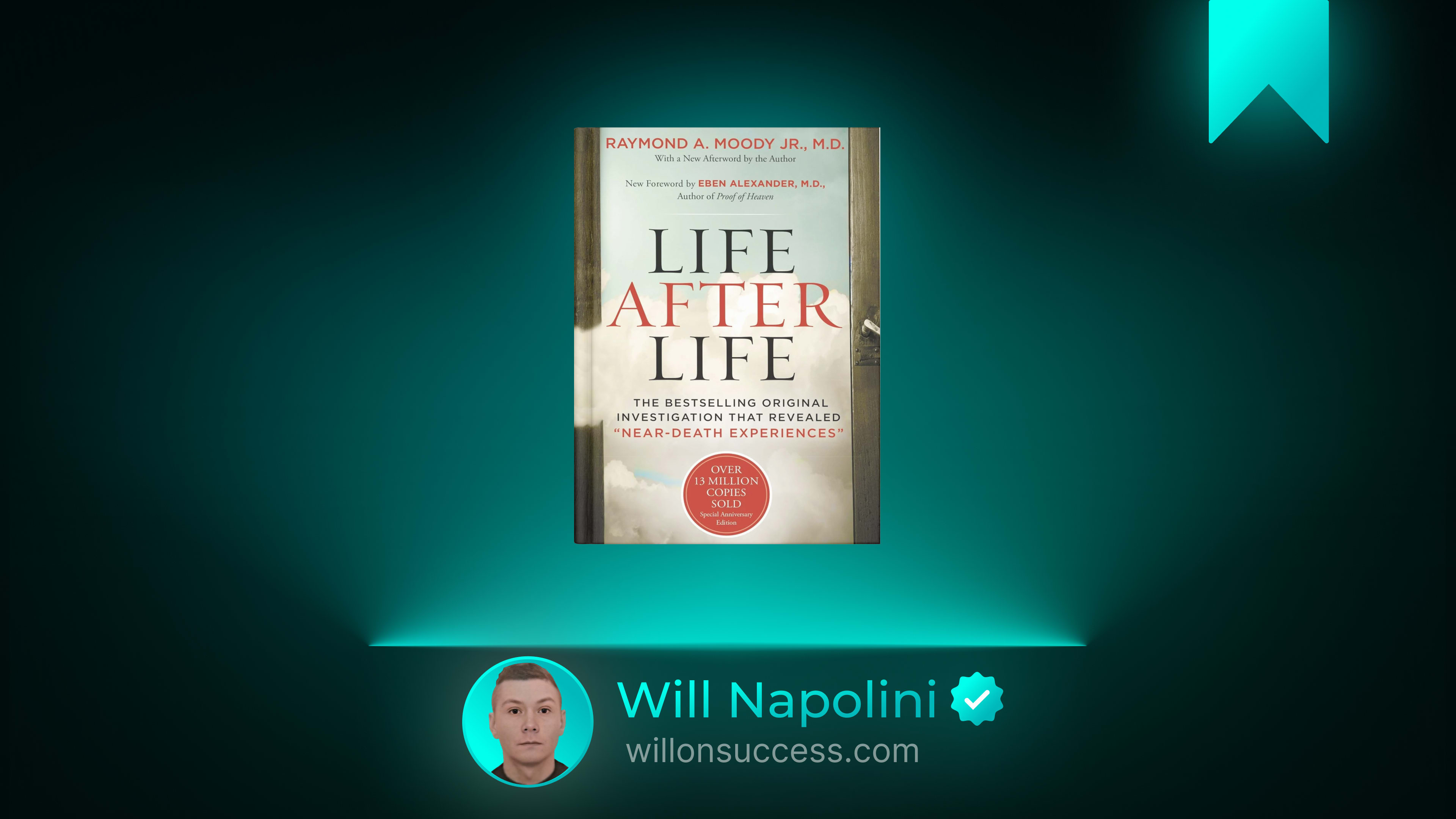
I want to ask you a question that most of us avoid until we are forced to face it: What if death is not an ending, but a transition?
You may have lost someone recently. You may be grieving, or you may simply be curious about what lies beyond the veil. Or perhaps you have had your own brush with mortality and found no language to describe it. If any of this resonates, I want you to know that your questions are valid, your experiences are real, and you are not alone in wondering whether consciousness survives the body.
Raymond Moody’s Life After Life does not offer religious doctrine or scientific proof. Instead, it offers something rarer: a compassionate collection of human testimony. First published in 1975, the book introduced the term “near-death experience” (NDE) into public discourse and compiled accounts from over one hundred people who were clinically dead or near death and returned with remarkably similar stories.
The central idea is simple but profound: Across differences of age, culture, religion, and background, people who approach death frequently report a consistent pattern of experiences that suggest consciousness may continue beyond physical life—and that this continuation is shaped less by dogma than by love, learning, and relationship.
This matters not because it proves an afterlife, but because it reframes how we might live this life. If the accounts Moody gathered point toward anything, it is that how we treat others, how we grow through suffering, and how we cultivate inner peace may matter far more than we typically assume.
The Pattern Behind the Stories
Moody did not set out to prove survival of consciousness. He was a philosopher and physician who noticed recurring themes in patient interviews. What he discovered was a composite pattern—not universal, but strikingly common—that includes elements such as:
- A sense of peace and freedom from pain
- An out-of-body perspective, sometimes observing one’s own resuscitation
- Movement through a dark space or tunnel toward a light
- Encounters with deceased loved ones or a being of light
- A panoramic life review experienced without judgment but with deep clarity
- A boundary or decision point followed by a return to the body
Importantly, Moody emphasized that no single person reported all these elements, and many reported only a few. The power lies not in uniformity, but in the repetition of core themes across vastly different lives.
I have read hundreds of NDE accounts since encountering Moody’s work decades ago. What stays with me is not the spectacle of tunnels or lights, but the emotional texture of the narratives. People do not come back preaching doctrine. They come back softer. More tender. Less afraid. That shift, more than any metaphysical claim, is what invites us to pay attention.
Consciousness May Not Be Confined to the Brain
One of the most unsettling implications of Life After Life is that subjective experience appears to persist when brain function is severely impaired or absent. Clinically dead patients have later described events during resuscitation with surprising accuracy—a fact that continues to challenge purely materialist models of mind.
I am not suggesting this constitutes proof. Science rightly demands rigor, and anecdotal reports cannot replace controlled study. But as a mentor who has sat with dying people and grieving families, I have learned to hold two truths at once: skepticism about unverified claims, and humility before mysteries that exceed current explanation.
What I would tell you is this: Whether or not consciousness survives death, the experience of NDEs undeniably transforms lives. People lose their fear of dying. They prioritize relationships over achievements. They forgive old grudges. They report a lasting sense of being loved unconditionally. These outcomes are measurable, meaningful, and available to us regardless of our metaphysical beliefs.
Your worldview need not collapse to accommodate these accounts. It can simply expand enough to include wonder alongside reason.
The Life Review as Moral Compass
Perhaps the most practically significant element in Moody’s research is the life review. In these accounts, individuals do not face a divine judge tallying sins and virtues. Instead, they re-experience their entire lives instantaneously, feeling not only their own emotions but also the impact of their actions on others.
Imagine seeing every moment of impatience with your child not just from your frustration, but from their small, wounded heart. Imagine feeling the relief your kindness brought to a stranger you’ve long forgotten. This is not punishment. It is education through empathy.
I have never had an NDE, but I have practiced a scaled-down version of this principle in my daily life. At day’s end, I sometimes pause and ask: How did my presence affect those around me today? Not as self-criticism, but as calibration. The life review, even as metaphor, teaches that our smallest interactions ripple outward in ways we rarely perceive.
You do not need to wait for death to begin living as though your actions matter eternally. You can start tonight.
Love and Knowledge as the Only Currencies
Across Moody’s case studies, two themes emerge as paramount in the post-death realm: love and knowledge. Material success, status, and even religious affiliation fade in significance. What endures is how deeply we loved and how sincerely we sought understanding.
This is not sentimental platitude. It is a radical reordering of values. In a culture obsessed with productivity and accumulation, the NDE narrative suggests that our true wealth is relational and intellectual—not financial or reputational.
I have watched high-achievers reach the end of their lives and regret time spent chasing validation while neglecting presence. Conversely, I have seen people with modest external markers of success die with profound peace because they invested in connection and curiosity.
If you are exhausted from striving for things that leave you hollow, consider this: The metrics of the world may not be the metrics of meaning. What if the person you are becoming matters more than what you are producing?
Why Skeptics and Believers Both Need This Book
Life After Life is often claimed by spiritual communities as evidence of the afterlife, and dismissed by skeptics as neurological artifact. Both responses miss the book’s deeper gift.
For believers, Moody’s work cautions against dogmatism. The beings of light encountered in NDEs are interpreted through the experiencer’s cultural lens—Christians see Jesus, Hindus see Yamaraja, secular individuals see radiant energy. The message transcends form. This should humble certainty, not reinforce it.
For skeptics, the book challenges reductionism. Even if NDEs arise from brain chemistry under stress, the resulting transformations are real and beneficial. Dismissing the phenomenon because its mechanism is debated ignores its human impact. As a mentor, I care less about proving origins than about honoring outcomes.
You do not need to resolve the metaphysics to benefit from the wisdom. The value lies in the invitation to live with greater compassion, presence, and courage—regardless of what awaits beyond.
Who Should Read This Book (And Who Might Not)
Life After Life will resonate most with:
- Those grieving a loss and seeking comfort without platitudes
- Individuals who have had anomalous experiences and feel isolated
- Seekers open to mystery but wary of dogma
- Healthcare professionals working with dying patients
- Anyone questioning the ultimate significance of daily choices
It may be less useful for:
- Readers demanding empirical proof or statistical analysis (later researchers like Bruce Greyson and Pim van Lommel offer more rigorous methodologies)
- Those committed to strict materialism who view subjective experience as irrelevant
- People seeking detailed theological frameworks (Moody deliberately avoids doctrinal interpretation)
The book’s strength is its accessibility and humanity, not its academic rigor. Read it as a doorway, not a destination.
One Small Step You Can Take Today
You do not need to believe in an afterlife to apply the wisdom of Life After Life. You only need to believe that how you live matters.
Here is what I invite you to do before you sleep tonight:
Conduct a five-minute compassionate life review.
Sit quietly. Breathe. Recall three interactions from your day. For each, gently imagine experiencing it from the other person’s perspective. Do not judge yourself. Simply notice. Then ask: What does this teach me about how I wish to show up tomorrow?
This is not guilt. It is growth. It is the life review made accessible to the living.
You may find nothing dramatic. Or you may feel a quiet shift in your chest—a softening, a clarification, a resolve to listen more deeply next time. That shift is the point.
Death may or may not be a passage to another realm. But awareness, practiced daily, is always a passage to a fuller life.
How you live today is the only afterlife you can build with your own hands.