Jonathan Livingston Seagull: Why Your Deepest Longing Is Not Selfish
There is a specific kind of loneliness that comes not from being abandoned, but from outgrowing the world that once held you.
You may know this feeling well. It arrives when the goals everyone else is chasing suddenly feel hollow to you. It whispers during meetings, family gatherings, or quiet evenings when you realize that what satisfies the crowd no longer satisfies your soul. You are not broken. You are not ungrateful. You are simply hearing a frequency that others have tuned out.
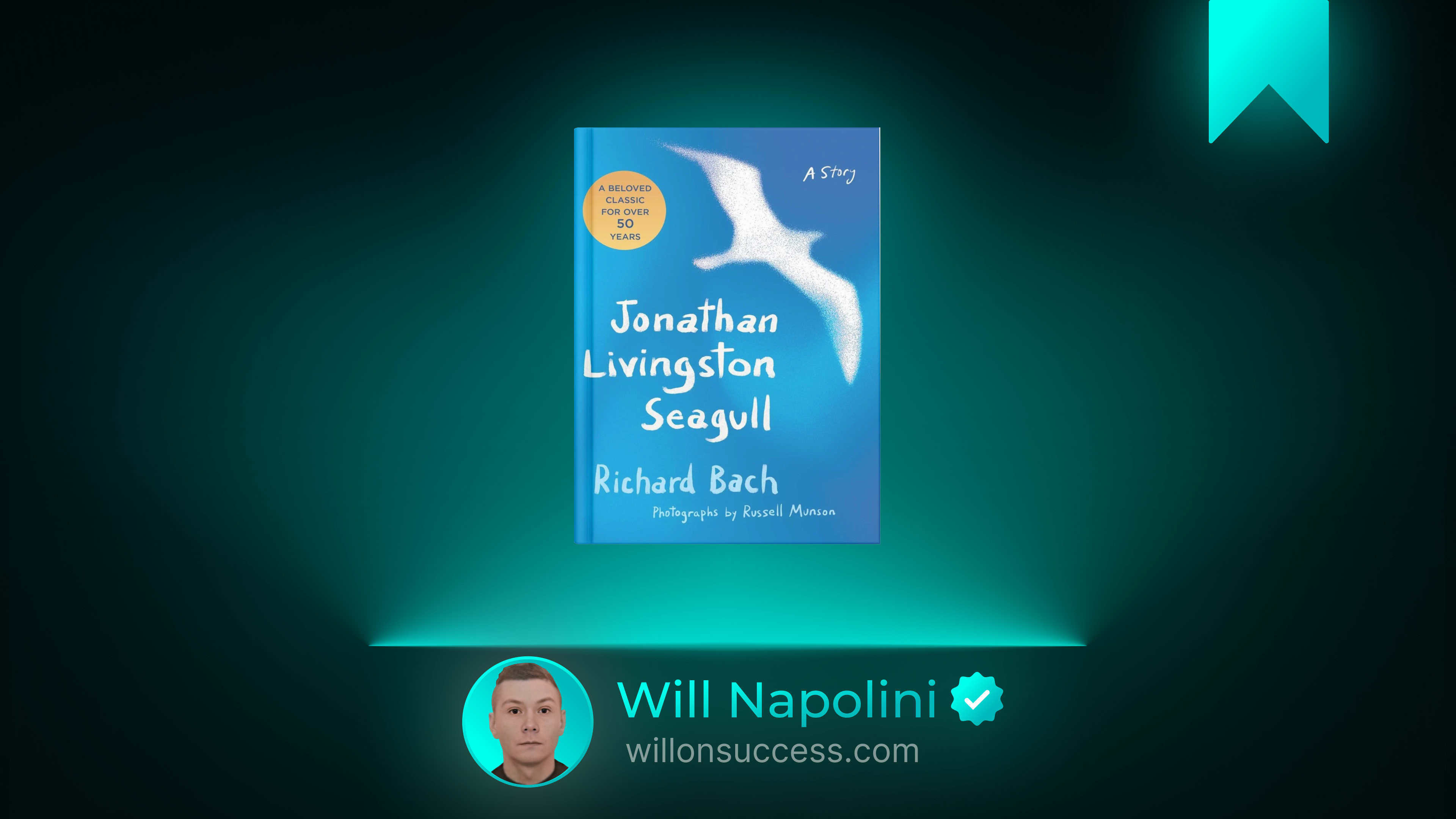
I want to show you an idea that changed the way I think about that restlessness. It comes from a small book that many people dismissed as a relic of the 1970s, yet its message cuts through modern noise with startling precision. Jonathan Livingston Seagull by Richard Bach is not really about a bird. It is a mirror for anyone who has ever felt that there must be more to life than mere survival, and who has been told that wanting “more” is arrogant, impractical, or wrong.
If you have ever been made to feel guilty for your own growth, this story is for you.
The Big Idea: Perfection Is an Act of Love, Not Ego
The central thesis of Bach’s fable is deceptively simple: Your highest potential is not a betrayal of your community; it is your greatest gift to it.
Most of us have been conditioned to believe that standing out is dangerous and that fitting in is virtuous. We are taught that ambition should be tempered by modesty and that personal excellence is suspect unless it serves an immediately visible, collective utility. Jonathan challenges this directly. He suggests that the pursuit of perfection—of doing something simply because it is beautiful and true—is the most honest form of living.
But here is the crucial distinction that separates this philosophy from narcissism: Jonathan does not seek mastery to prove he is better than others. He seeks it because the act of flying perfectly is an expression of his true nature. And ultimately, his mastery only finds its meaning when he returns to serve those who are still trapped in limitation.
Growth without love is just vanity. Love without growth is often just codependency disguised as loyalty. Bach argues that you must become free before you can truly help others become free. You cannot lead someone to a horizon you have never seen yourself.
The Story of the Outcast Who Returned
To understand why this matters, you have to understand the arc of Jonathan’s journey. It is not a linear ascent to glory. It is a cycle of exile, transcendence, and return.
Jonathan is born into a flock that values eating over flying. For them, flight is merely transportation—a means to get from the shore to the garbage barge. But Jonathan is obsessed with the mechanics of flight itself. He practices dives, stalls, and aerobatics not to catch fish, but to understand the limits of his own body and the laws of the air.
When he presents his discoveries to the flock, hoping to elevate their lives, he is met not with curiosity but with condemnation. He is labeled reckless and irresponsible. In a ceremony of rejection, he is cast out to the Far Cliffs, condemned to solitude.
This is the moment where most stories would end in bitterness or triumphant isolation. But Jonathan’s exile becomes his classroom. Alone, he pushes past pain and fear until he discovers that his physical limitations were largely mental. He eventually transcends his earthly form entirely, entering a realm of pure thought and speed where he learns from elder gulls who share his passion.
Yet even in this paradise of perfection, Jonathan remains restless. His instructor, Chiang, teaches him the ultimate lesson: “Heaven is not a place. Heaven is being perfect.” But Jonathan realizes that perfection in isolation is incomplete. Against the advice of his new peers, he chooses to return to the earthly flock—not to boast, but to teach. He gathers a band of fellow outcasts, shows them their own forgotten potential, and eventually passes leadership to another so he can continue his own journey upward.
The story refuses to let Jonathan stay on the mountain. True mastery always bends back toward service.
Your Restlessness Is Data, Not Defect
What I have learned from watching people struggle with this same tension is that we often pathologize our own longing. When you feel dissatisfied with a comfortable life, your first instinct might be to medicate that dissatisfaction with distraction, or to shame yourself into gratitude.
Bach offers a different interpretation: Your discomfort is information.
The flock called Jonathan “irresponsible” because he threatened their sense of normalcy. When you begin to change, you will inevitably threaten the equilibrium of the systems around you. People may call you selfish, unrealistic, or difficult. They are not necessarily malicious. They are protecting a worldview that your growth has rendered unstable.
Here is what I would tell you if we were sitting across from each other: Do not confuse the flock’s discomfort with your own wrongdoing. The fact that your aspirations make others uneasy does not mean they are wrong. It may simply mean they are necessary.
However, this principle requires honesty. Not every restless impulse is a divine calling. Some restlessness is merely boredom or avoidance. The test is this: Does your longing pull you toward discipline, practice, and eventual service? Or does it merely pull you toward escape and self-indulgence? Jonathan’s obsession demanded everything of him. It was not a hobby. It was a vocation. If your restlessness leads you to deeper commitment rather than chronic distraction, trust it.
Exile Is Often the Price of Clarity
One of the hardest truths in this book is that growth sometimes requires separation. We romanticize community, and rightly so, but we rarely acknowledge that certain communities are designed to keep us small.
I have seen this happen in careers, families, and friendships. You reach a point where the very people who once supported you now subtly discourage your evolution. They reminisce about who you used to be. They offer warnings disguised as concern. They stop inviting you to things because you’ve become “too intense” or “different.”
This hurts. It is supposed to hurt. But Bach reframes this pain as part of the curriculum. The Far Cliffs were not a punishment; they were a sanctuary. Only away from the constant pressure to conform could Jonathan hear his own wings.
You do not need permission to outgrow a container that no longer fits.
This does not mean you must burn bridges or declare war. Sometimes exile is geographical. More often, it is internal. It is the quiet decision to stop seeking validation from sources that cannot understand your language. It is building a new circle of people who speak the dialect of your becoming. Jonathan found Fletcher Lynd Seagull and others not by convincing the old flock, but by being visible enough that other seekers could find him.
Your environment is quietly shaping your behavior. If your current environment makes your deepest aspirations feel shameful, the problem is not your aspirations. The problem is the environment.
Mastery Requires Breaking Your Own Limits Repeatedly
Jonathan did not achieve transcendence in a single epiphany. He achieved it through thousands of failed attempts, broken feathers, and moments of despair. There is a scene where he crashes into the water at high speed, battered and ready to give up, only to discover in his recovery that he had been practicing with unnecessary tension. The breakthrough came not from trying harder, but from letting go.
This is the rhythm of real growth. Breakthroughs are usually preceded by breakdowns.
We live in a culture that sells transformation as a product you can purchase or a hack you can implement. But genuine mastery is a relationship with failure. Jonathan’s instructors did not coddle him. They demanded precision. They corrected him relentlessly. They loved him enough to refuse to accept his excuses.
If you are working toward something meaningful and you feel stuck, consider whether you are avoiding the necessary friction. Are you practicing safely within your existing capabilities, or are you genuinely risking failure? Comfort is the enemy of altitude.
But also remember Jonathan’s realization about effort. At a certain point, striving becomes its own prison. He had to learn that he was already perfect in essence, and that his practice was merely the removal of illusions. This paradox is essential: You must work as if everything depends on effort, while trusting that your worth is not contingent on the outcome. Discipline without self-compassion leads to burnout. Self-compassion without discipline leads to stagnation. The path is the integration of both.
Freedom Is Found in Service, Not Escape
Perhaps the most countercultural idea in this book is that heaven is not a destination where you finally get to rest. When Jonathan reaches the higher plane, he expects eternal bliss. Instead, he finds more learning, more challenge, and eventually, a summons to return.
Sullivan, one of his teachers, tells him that they move from one world to the next not because the previous one was bad, but because they have learned all it can teach. And the reason they keep moving is so they can bring what they’ve learned back to those still struggling below.
Your freedom is not complete until it is shared.
I have noticed that people who pursue growth purely for self-optimization eventually hit a ceiling. They become technically excellent but spiritually arid. Their achievements feel like trophies in an empty room. The missing element is contribution. Not performative charity, but the genuine offering of your hard-won wisdom to those who need it.
This redefines success. Success is not arriving at a peak and planting your flag. Success is becoming a bridge. It is using your clarity to illuminate paths for others. It is remembering the taste of struggle even after you have transcended it.
When you view your development through this lens, setbacks take on new meaning. Every difficulty you overcome becomes material you can later use to help someone else navigate the same terrain. Your scars become maps. Your failures become curriculum. You are not just building a better life for yourself; you are gathering resources for a community that does not yet exist but will need what you are becoming.
Who Needs This Book (And Who Might Not)
Jonathan Livingston Seagull speaks most directly to the person who feels chronically misunderstood in their pursuit of excellence. If you have been called too much, too intense, or too idealistic, this book will feel like being recognized. It is also essential reading for leaders, artists, entrepreneurs, and anyone in a transitional season where old identities are dissolving and new ones have not yet formed.
It is less useful for readers seeking tactical advice, historical context, or psychological realism. This is a fable, not a manual. Its power lies in metaphor, not methodology. If you require empirical evidence or step-by-step frameworks, you may find it frustratingly abstract. Read it as poetry, not as prescription.
It is also worth noting that the book reflects the individualistic spiritual ethos of its era. Some readers may find its emphasis on transcendence over earthly responsibility unbalanced. I would encourage you to read it alongside works that emphasize community, justice, and embodied presence. Jonathan’s journey is vital, but it is not the whole map.
Still, for the specific ache of feeling called beyond the familiar, few books articulate the remedy with such luminous simplicity.
One Small Step Today
Understanding Jonathan’s journey changes nothing until you embody a fraction of it.
Here is what I invite you to do today: Identify one area where you have been dimming your light to avoid making others uncomfortable, and take one honest action in that direction before sunset.
This does not mean announcing your ambitions publicly or confronting anyone. It might mean spending thirty minutes practicing a skill you love but have neglected because it seemed impractical. It might mean writing down a truth you’ve been afraid to admit. It might mean declining an obligation that drains you so you can honor a commitment to your own growth. It might mean reaching out to one person who seems to understand the language you’re trying to speak.
Do it quietly. Do it imperfectly. Do it not because you are certain of the outcome, but because the act itself is an affirmation of who you are becoming.
Your wings were not given to you to fold them in apology.
The flock may never fully understand why you fly. That is not their failure, and it is not yours. Your task is not to convince them. Your task is to fly so truly that your flight becomes an invitation for anyone else who has ever looked at the sky and felt the same inexplicable pull.
Start today. Not when you are ready. Not when you have permission. Start because the wind is already rising, and you have waited long enough to remember that you belong to it.