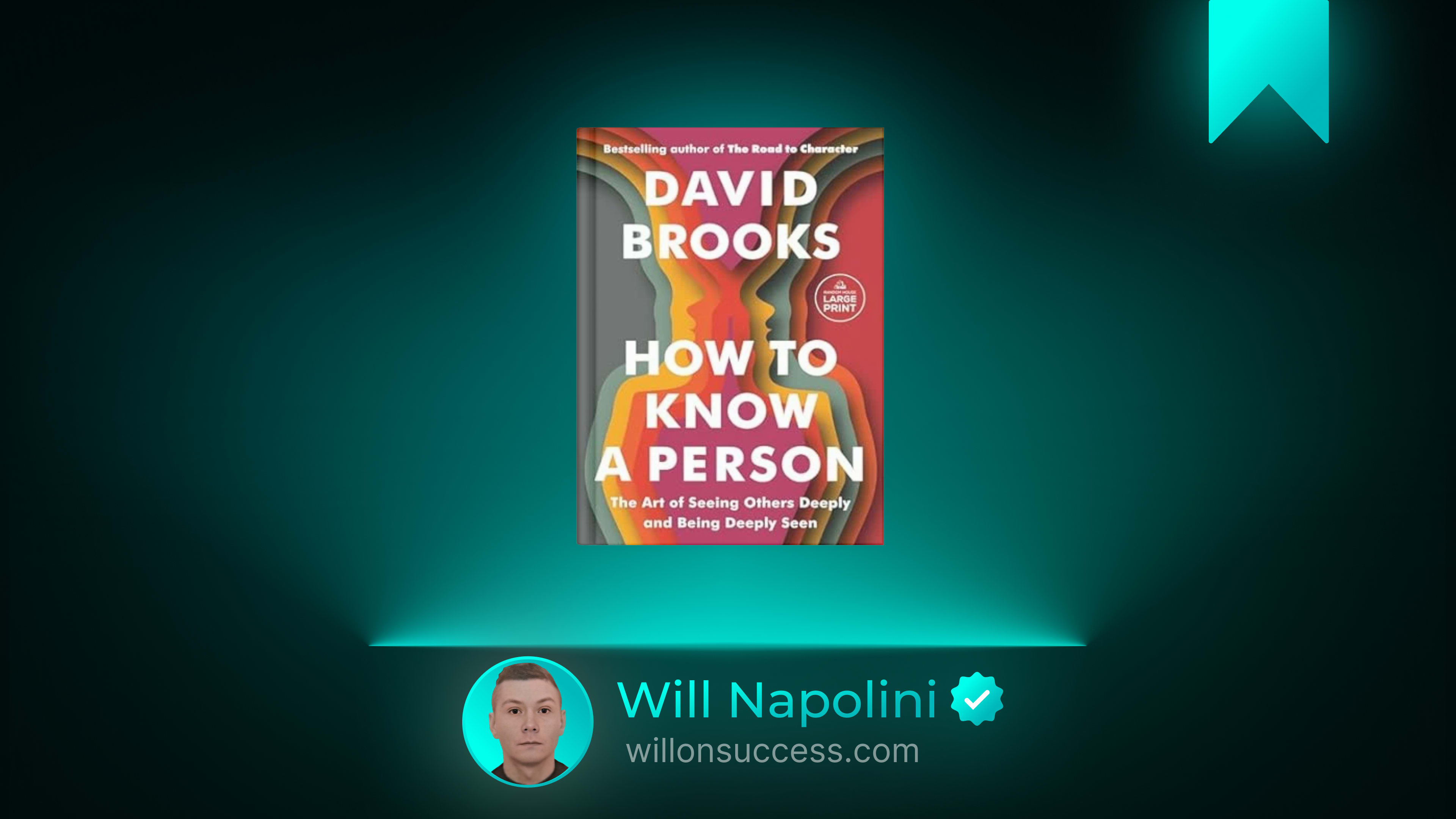
How to Know a Person: The Art of Seeing Others Deeply
Have you ever sat across from someone at a coffee shop, or across a dinner table from a spouse, or even stood in the breakroom with a colleague, and felt completely invisible?
You are talking, but they are not really hearing you. They are waiting for their turn to speak. They are looking at their phone. Or worse, they are looking at you but seeing a stereotype, a job title, or a reflection of their own anxieties instead of the living, breathing human being sitting in front of them.
We are living through a crisis of disconnection. We have more ways to communicate than any generation in history, yet millions of people go through their days feeling unseen, misunderstood, and profoundly lonely.
If I could sit across the table from you right now, I would tell you something I have learned the hard way: the antidote to this loneliness is not finding someone who perfectly understands you. It is learning how to truly understand others.
The Big Idea: Connection Is a Craft, Not a Gift
In his profoundly moving book How to Know a Person: The Art of Seeing Others Deeply and Being Deeply Seen, David Brooks challenges a dangerous assumption we all carry. We assume that being a good friend, a good partner, or a good leader is a matter of innate personality. We think some people are just “good with people,” and the rest of us are awkward or introverted.
The central truth of this book is that knowing another person is a learnable craft. It is a skill, much like carpentry or playing the piano. You are not born knowing how to do it, but with intention and practice, you can master it.
When you master this craft, you do not just improve your relationships. You become what Brooks calls an “Illuminator”—someone who makes others feel larger, more capable, and deeply valued. And in the process of shining a light on others, you find that your own life becomes richer, more grounded, and more meaningful.
The Tale of Two Observers: Illuminators and Diminishers
To understand what it means to truly see someone, we have to look at the two ways people move through the world. Brooks divides our social interactions into two distinct categories: Diminishers and Illuminators.
Diminishers are those who make you feel small. When you interact with them, you feel stereotyped, ignored, or reduced to a data point. They suffer from what Brooks calls “bore bombs”—they drop a monologue on you, lecturing you about their opinions, completely unaware that a conversation is supposed to be a two-way street. They use people as mirrors to reflect their own egos.
Illuminators, on the other hand, are people who light you up. When you leave a conversation with an Illuminator, you feel smarter, funnier, and more alive. They possess a quiet, steady curiosity. They do not just look at you; they see you. They act as a spotlight, directing their energy outward to illuminate the person in front of them.
Brooks shares a brilliant historical example of this dynamic at Bell Labs. In the mid-twentieth century, executives at Bell Labs were trying to figure out why a small handful of researchers were vastly out-patenting everyone else. These researchers were not necessarily the ones with the highest IQs. When the executives dug deeper, they found a common denominator. All the most productive researchers regularly ate lunch with a quiet, unassuming engineer named Harry Nyquist.
Nyquist was not a loud, charismatic genius who commanded the room. He was an Illuminator. When he spoke to his colleagues, he asked the right questions. He drew out their best thinking. He made them feel that their ideas mattered. By simply seeing them deeply, he elevated their work.
You do not need to be the smartest person in the room to change the room. You just need to be the person who pays the most attention.
The Core Principles of Seeing Deeply
How do you become an Illuminator? How do you move from being a passive observer of the people in your life to an active participant in their unfolding? Here are the core principles that will change the way you relate to everyone around you.
1. Recognize the Diminisher Traps
Before you can illuminate others, you must recognize the habits that make you a Diminisher. Brooks outlines several traps we all fall into, often without realizing it.
- Egotism: Being too self-absorbed to be genuinely curious about someone else’s inner life.
- Anxiety: Failing to listen because your mind is too loud, worrying about how you sound or rehearsing what you will say next.
- Lesser Minds: The arrogant assumption that other people do not think as deeply or feel as intensely as you do.
- Objectivism: Seeing people as data points, stereotypes, or job titles rather than complex emotional beings.
Recognizing these traps is the first step to dismantling them. You cannot change a habit you refuse to see in yourself.
2. Practice “Loud Listening”
Most of us think of listening as a passive act. We sit quietly, nod occasionally, and wait for a gap in the noise so we can insert our own thoughts.
Brooks suggests we need to practice “loud listening.” This means listening so actively, so energetically, that you are practically burning calories. Loud listening is visible. The other person can feel your attention. You lean in. Your eyes are engaged. You are burning away the mental noise of your own anxieties to fully inhabit their reality.
When you listen loudly, you are sending a powerful, unspoken message: You are the most important person in this room right now. This is the foundation of all trust.
3. Ask for Stories, Not Summaries
The psychologist Jerome Bruner noted that humans process the world in two modes: the paradigmatic mode (looking for facts, data, and logic) and the narrative mode (looking for stories, struggles, and meaning). If you want to know a person’s resume, you use the paradigmatic mode. But if you want to know a person’s soul, you must engage the narrative mode.
Most conversations fail because we ask the wrong questions. We ask closed, analytical questions that yield one-word answers.
- Don’t ask: “What do you think about your job?”
- Instead, ask: “How did you come to choose your career path?”
- Don’t ask: “What are your values?”
- Instead, ask: “Tell me about the person who shaped your values the most.”
When you ask “how” and “why” questions, you invite the other person to tell a story. Stories reveal the unique topography of a person’s inner life. They show you the scars, the triumphs, and the turning points that analytical questions can never reach.
A question is a key. If you ask the right one, it opens a door you never knew was there.
4. Master the Art of Accompaniment
We often believe that deep connection only happens during massive, emotionally charged moments—deep confessions, crying on a shoulder, or intense late-night philosophical debates.
But Brooks reminds us that the most natural way to get to know someone is through accompaniment. This is the practice of simply doing life alongside someone. It is found in ordinary routines, shared tasks, and the quiet rhythm of small talk.
When you accompany someone, you are not trying to fix them, interview them, or outshine them. You are just walking with them. Think of the relationships in your own life that feel the most secure. They are rarely built on a single dramatic conversation. They are built on hundreds of car rides, walks around the block, and shared cups of coffee where nothing profound was said, but everything was felt.
Presence is not always about deep words. Sometimes, it is just about showing up and staying.
5. Step Outside Your Own Mental Model
One of the greatest traps we fall into is what Brooks calls “naïve realism.” This is the unconscious assumption that you see the world objectively, and anyone who disagrees with you is either uninformed, biased, or irrational.
To truly know a person, you have to realize that they are operating from a completely different mental model of reality. Their reactions, their fears, and their joys are filtered through a lifetime of unique experiences, childhood wounds, and cultural contexts that you do not share.
When a colleague reacts defensively to a simple piece of feedback, a Diminisher labels them as “difficult.” An Illuminator pauses and wonders, What past experience is this feedback triggering in them? What is their mental model telling them right now?
You do not have to agree with someone’s mental model to respect it. But you cannot connect with them until you acknowledge that their subjective reality is just as vivid and real to them as yours is to you.
Why This Matters in Your Daily Life
Why does this matter on an ordinary Tuesday? Because the quality of your life is inextricably tied to the quality of your relationships.
If you are a leader, your team does not just need your strategy; they need your illumination. When employees feel unseen, they disengage. They quiet-quit. When they feel seen, they bring their full creative energy to their work. You cannot lead people you do not know.
If you are a parent, your children do not just need your provision; they need your accompaniment. They need to know that you see the unique person they are becoming, not just the child you expect them to be.
And if you are struggling in your own life, feeling isolated or misunderstood, the most counterintuitive but effective path forward is to turn your attention outward. Depression and anxiety often trap us inside our own heads, creating a prison of self-focus. Becoming an Illuminator forces you to step outside yourself. By making someone else feel seen, you begin to heal your own invisibility.
We are all walking around carrying heavy, invisible burdens. The greatest relief in the world is having someone look at you and say, “I see how heavy that is.”
Who Should Read This Book
How to Know a Person is a masterpiece for anyone who has ever felt the sting of loneliness or the frustration of shallow relationships. It is essential reading for leaders, managers, and teachers who want to build environments of trust. It is deeply valuable for couples who feel they are drifting apart and simply going through the motions.
However, if you are looking for a quick, manipulative guide on “how to win friends and influence people” using superficial psychological tricks, this book will frustrate you. Brooks is not interested in hacking human behavior. He is interested in moral transformation. He is asking you to become a more compassionate, patient, and selfless human being. And that kind of growth takes time, humility, and repeated effort.
One Small Step to Take Today
Understanding the art of connection is beautiful, but understanding without action changes nothing. You do not need to overhaul your entire personality today. You just need to change your next conversation.
Here is your challenge for today: Choose one person you interact with regularly—a spouse, a coworker, a friend, or even a barista. Commit to practicing “loud listening” for just five minutes. Put your phone away. Look them in the eye. And ask them one story-based question:
“What is something you are working on right now that you are genuinely excited about?”
Then, do not interrupt. Do not relate it back to yourself. Just listen until they are finished. Watch how their posture changes. Watch how their eyes light up.
You have the power to change the trajectory of someone’s day, simply by giving them the gift of your attention. Go and turn on the light.