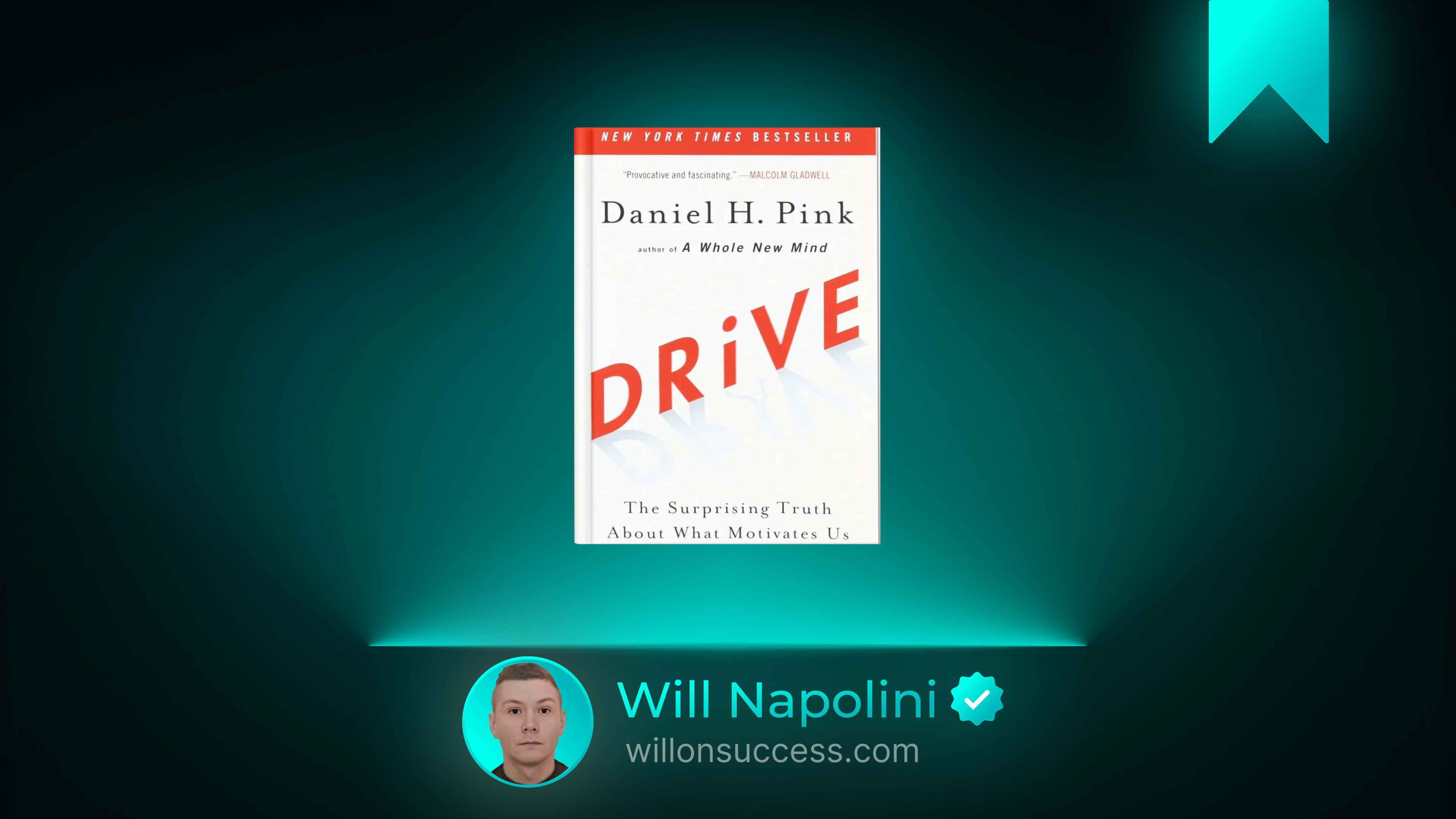
The Motivation You're Chasing Doesn't Exist: What Daniel Pink's Drive Actually Teaches Us
I want you to remember a time when you were so absorbed in something that you forgot to eat, forgot to check the clock, forgot that anyone else existed in the world. Maybe you were writing something, or building something, or solving a problem that had been nagging you for weeks. Maybe you were teaching a child to ride a bicycle, or planting a garden, or fixing an engine with your hands. You were not thinking about a reward. You were not calculating whether the effort would earn you a bonus or a promotion or a compliment. You were simply inside the work, and the work was enough.
Now I want you to remember a different moment. A moment when someone dangled a reward in front of you—a bonus, a grade, a commission, a gold star—and suddenly the work that had once felt alive became mechanical. You performed. You calculated. You did the minimum required to collect the prize. And something in the doing went flat.
If you have lived both of those moments, you already know what Daniel H. Pink spent an entire book arguing: the system most of us use to motivate ourselves and others is not merely incomplete. In many cases, it is actively harmful.
Drive: The Surprising Truth About What Motivates Us is not a book about discipline or willpower. It is a book about architecture—about designing the conditions under which human beings naturally want to do good, creative, meaningful work. And it argues that those conditions look almost nothing like what most workplaces, schools, and families are currently building.
The Big Idea
Pink’s central claim is this: for the kind of work that defines the modern economy—work that requires creativity, judgment, problem-solving, and emotional intelligence—the traditional “carrot and stick” model of motivation does not just fail to help. It often makes performance worse.
The carrot-and-stick model operates on a simple assumption: people are fundamentally lazy, and you must either reward them to move or punish them to prevent them from stopping. Pink calls this “Motivation 2.0,” and he argues it was designed for an era of repetitive, algorithmic labor—assembly lines, data entry, tasks with a single correct answer. For those tasks, extrinsic rewards work reasonably well.
But the economy has changed. The work that now matters most is heuristic, not algorithmic. It requires people to think, experiment, connect ideas, and take creative risks. And for that kind of work, Pink argues, three intrinsic drives matter far more than any external reward: Autonomy—the desire to direct our own lives. Mastery—the urge to get better at something that matters. Purpose—the yearning to do what we do in service of something larger than ourselves.
These are not soft ideas. They are not motivational slogans. Pink presents them as observable, research-supported patterns in human behavior. And he argues that the people and organizations that thrive in the coming decades will be those that build their days, their teams, and their lives around these three forces rather than around the promise of a bigger carrot.
The Candle Problem: Why Rewards Can Make You Dumber
One of the most important experiments Pink discusses is based on a puzzle originally designed by the psychologist Karl Duncker in the 1930s, and later used in motivation research by Sam Glucksberg.
The setup is simple. You are shown a candle, a box of thumbtacks, and a book of matches. Your task: attach the candle to a wall so that it burns without dripping wax onto the table below. The solution requires you to see the box not as a container for the tacks but as a platform—empty the box, tack it to the wall, and set the candle on it. It requires what psychologists call “functional fixedness” to be overcome. You must see an object not as what it is, but as what it could become.
Glucksberg’s experiment split participants into two groups. One group was told they were simply being timed to establish norms. The other group was offered cash rewards for speed—real money for finishing quickly.
The rewarded group performed worse. Significantly worse.
This is not a trivial finding. It has been replicated in various forms across decades of research. And it points to something deeply counterintuitive: when you narrow someone’s focus with an external reward, you also narrow their thinking. You make it harder for them to see the box as a platform, the constraint as an invitation, the problem as something that requires creative reinterpretation. The reward says, “Focus. Perform. Earn.” And that very instruction shuts down the open, exploratory thinking that creative work demands.
Pink does not argue that all rewards are toxic. He is careful to distinguish between what he calls “if-then” rewards (“If you do this, then I’ll give you that”) and “now-that” rewards (unexpected recognition after the work is done). The first type tends to undermine intrinsic motivation. The second, because it is not anticipated and not contingent, can affirm effort without corrupting it.
But the broader point stands: for work that requires imagination, judgment, or emotional presence, the promise of a prize is often worse than no prize at all.
Autonomy: The Need to Steer Your Own Ship
The first of Pink’s three drives is autonomy, and he is careful to define it precisely. Autonomy is not independence. It is not isolation or the absence of structure. It is the feeling that you have genuine say over the what, the when, the how, and the who of your work.
Pink identifies four dimensions of autonomy that matter most:
- Task—what you actually do.
- Time—when you do it.
- Technique—how you do it.
- Team—who you do it with.
You do not need total control over all four to feel autonomous. But you need meaningful input over at least some of them. And the absence of all four—the experience of being told exactly what to do, exactly when to do it, exactly how to do it, and exactly who to do it alongside—is a slow poison for motivation.
I have seen this in my own life and in the lives of people I care about. The person who is talented and capable but who has been micromanaged into a kind of learned helplessness. The student who once loved learning but who has been so controlled by schedules, tests, and rigid instructions that the love has been squeezed out. The employee who stops bringing ideas to meetings because every idea is rewritten by someone above them until it is no longer theirs.
Autonomy is not a luxury. It is the soil in which initiative grows. Remove it, and you do not get compliance. You get quiet withdrawal. You get people doing exactly what is asked and nothing more, because the part of them that would go further has been trained to believe that going further is not wanted.
A plant does not grow because you pull it upward. It grows because you give it light, water, and room, and then you leave it alone.
Mastery: The Current That Never Reaches the Sea
The second drive is mastery—the deep, sometimes painful satisfaction of getting better at something that matters to you.
Pink draws on the work of Mihaly Csikszentmihalyi and the concept of “flow”—that state of total absorption in a task that stretches your abilities just beyond their current edge. Flow does not happen when a task is too easy (you get bored) or too hard (you get anxious). It happens in the narrow channel between, in what Pink calls the “Goldilocks zone” of challenge.
But mastery, as Pink presents it, is not a destination. You do not “achieve” mastery the way you achieve a promotion or a degree. Mastery is asymptotic—you can approach it endlessly, but you never fully arrive. The pianist who has played for thirty years still finds new depths in a familiar sonata. The writer who has published ten books still faces the blank page with a healthy uncertainty. The craftsman who has shaped wood for a lifetime still learns from the grain.
This is important because it reframes the entire question of progress. If mastery has no finish line, then the reward is not at the end. The reward is in the practice itself. The Tuesday evening spent struggling with a difficult passage. The early morning run where your body is learning a new rhythm. The conversation where you finally find the words for something you have been trying to say for years.
Pink also emphasizes that mastery requires a “growth mindset”—the belief that your abilities are not fixed but can be developed through effort. This is not naive optimism. It is the understanding that struggle is not evidence of failure. Struggle is the mechanism by which growth occurs. If you interpret difficulty as proof that you are not good enough, you will quit. If you interpret difficulty as proof that you are at the edge of your current ability and about to expand, you will continue.
The river does not reach the sea and stop. It becomes the sea, and then it rises as rain, and then it begins again. Mastery is not a place you arrive at. It is a direction you travel.
Purpose: The Star You Navigate By
The third drive is purpose, and Pink argues it is the one most often missing from modern work.
For most of the twentieth century, the dominant model of business was that the sole purpose of a company was to maximize shareholder value. Pink argues that this model is not only morally limited but motivationally bankrupt. People do not sustain their best effort over years simply to increase a number on a balance sheet. They sustain it when they believe their work contributes to something that matters beyond themselves.
Purpose, in Pink’s framework, is not necessarily grand. It does not require you to cure a disease or found a movement. It requires only that you can see a line between what you do on a Wednesday afternoon and some outcome that improves a life, solves a problem, or adds something genuine to the world.
The absence of purpose is what turns work into mere labor. You can endure difficulty if you understand why it matters. You can tolerate frustration if you can see what the frustration is building toward. But if the work is disconnected from any meaning larger than your own paycheck, the difficulty becomes unbearable and the frustration becomes corrosive.
I think about this in terms of craftsmanship. The person laying bricks who sees only bricks will burn out. The person laying bricks who sees a cathedral will endure. The bricks are the same. The hands are the same. The hours are the same. But the orientation—the sense of what the work is for—changes everything about the experience of doing it.
Purpose is the compass that makes the long, slow work of mastery bearable. Without it, autonomy becomes aimlessness, and mastery becomes an exercise in vanity.
Why This Matters on an Ordinary Tuesday
You may be thinking that these are fine ideas for a CEO redesigning a company culture, but what do they have to do with your actual life?
More than you might expect.
If you are a parent, Pink’s research suggests that offering your child a cash reward for every good grade may be teaching them that learning is a transaction rather than a discovery. The child who reads because the story is wonderful and the child who reads because they will earn five dollars are developing fundamentally different relationships to knowledge. One builds curiosity. The other builds a calculator.
If you are a leader or manager, the question is not “How do I incentivize my team?” but “Am I creating the conditions under which my team can direct their own work, grow in their craft, and see the purpose behind their effort?” Micromanagement does not produce excellence. It produces compliance and quiet resentment.
If you are building a career or a creative practice, the question is not “What will I be rewarded for?” but “What work puts me in the channel between boredom and anxiety? What work makes me lose track of time? What work connects to something I believe matters?” The answers to those questions are more reliable guides than any salary projection.
If you are feeling stuck or unmotivated, the first thing to examine is not your discipline. It is your architecture. Do you have any genuine autonomy in your days? Are you working at the edge of your ability, or are you coasting in tasks too easy to engage you? Can you articulate, in one sentence, why your work matters beyond your own comfort?
Practical Application
Understanding these three drives is valuable, but understanding without action changes nothing. Here are some concrete ways to bring Pink’s ideas into your daily life.
Conduct a small autonomy audit. For one week, notice where in your day you have genuine choice and where you are operating on pure obligation. You do not need to overthrow every constraint. But look for one area—perhaps the order in which you tackle your tasks, or the time of day you do your most creative work, or the method you use to solve a recurring problem—where you can reclaim a small measure of self-direction.
Find your Goldilocks task. Identify one activity in your life that is currently either too easy (you are bored, going through the motions) or too hard (you are anxious, avoiding it). Adjust it. If it is too easy, add a constraint or raise the standard. If it is too hard, break it into a smaller component that stretches you without breaking you. The goal is the channel where effort feels alive rather than punishing.
Articulate your purpose in one sentence. Not a mission statement. Not a five-year plan. One sentence. “I do this work because it helps people feel less alone.” “I build this because it makes a complicated thing simple.” “I teach because I remember what it felt like not to understand.” Write it down. Put it where you can see it. When the work is tedious—and it will be—that sentence is the thread that connects the tedium to something that matters.
Replace one “if-then” reward with a “now-that” celebration. Instead of telling yourself, “If I finish this report, I’ll buy that thing I want,” try finishing the work first, and then acknowledging your effort afterward without having pre-negotiated the reward. Let the satisfaction of completion be the primary experience. Let the treat be a surprise you give yourself, not a bribe you offered before you started.
Who Should Read This Book
Drive is written for a broad audience, and it delivers on that promise. It is clear, well-structured, and grounded in research without becoming academic.
It will be most valuable for managers, teachers, parents, and anyone in a position of designing the conditions under which other people work or learn. If you are responsible for motivating others—employees, students, children—this book will challenge assumptions you may not even realize you hold.
It is also valuable for anyone who feels a persistent, low-grade dissatisfaction with their work—the sense that you are going through the motions, that the external rewards are not compensating for the internal emptiness, that you are performing rather than creating.
It may be less useful for someone in a highly repetitive, algorithmic job where the work genuinely is mechanical and the primary challenge is endurance rather than creativity. Pink acknowledges that extrinsic rewards still have a place in those contexts. And readers looking for a step-by-step productivity system may find the book more philosophical than tactical.
But for anyone asking the question, “Why don’t I feel motivated, and what would actually change that?”—this book is a strong, honest starting point.
One Small Step
You do not need to redesign your career or overhaul your organization today. But you can do one thing, today, that honors what Pink’s research points toward.
Tomorrow, choose one task that you normally approach with dread or avoidance. Before you begin, spend two minutes asking yourself a single question: “What is one small part of this task that I have genuine choice over?”
It might be the order in which you do the steps. It might be the physical location where you do it. It might be the tool you use, or the music you play while doing it, or the person you ask for input. The choice does not need to be large. It needs to be real.
Then do the task. And when you finish, do not immediately rush to the next obligation. Sit for thirty seconds and notice what it felt like to do the work with even a small degree of self-direction.
That small feeling—the sense that you were not merely executing an order but making a choice—is the seed of everything Pink describes. It is the first green shoot of a motivation that comes from within rather than being imposed from without.
Final Thought
The world has spent a very long time telling you that the way to get things done is to bribe yourself or punish yourself. That you are, at bottom, a creature who must be lured forward with treats or driven forward with threats. That if you are not motivated, it is because the reward is not large enough or the punishment is not sharp enough.
Pink’s book is a quiet, well-evidenced correction to that story. You are not a donkey requiring a carrot. You are a living mind that wants to steer, to grow, and to matter. And when those three needs are met—when you have room to choose, a worthy challenge to meet, and a reason that reaches beyond your own comfort—you do not need to be motivated. You simply begin.
The motivation you have been chasing outside yourself has been waiting, patient and steady, on the inside.
You do not need a bigger reward. You need a worthy task, a small measure of freedom, and a reason that makes the effort feel like yours. Start there, and the rest follows.