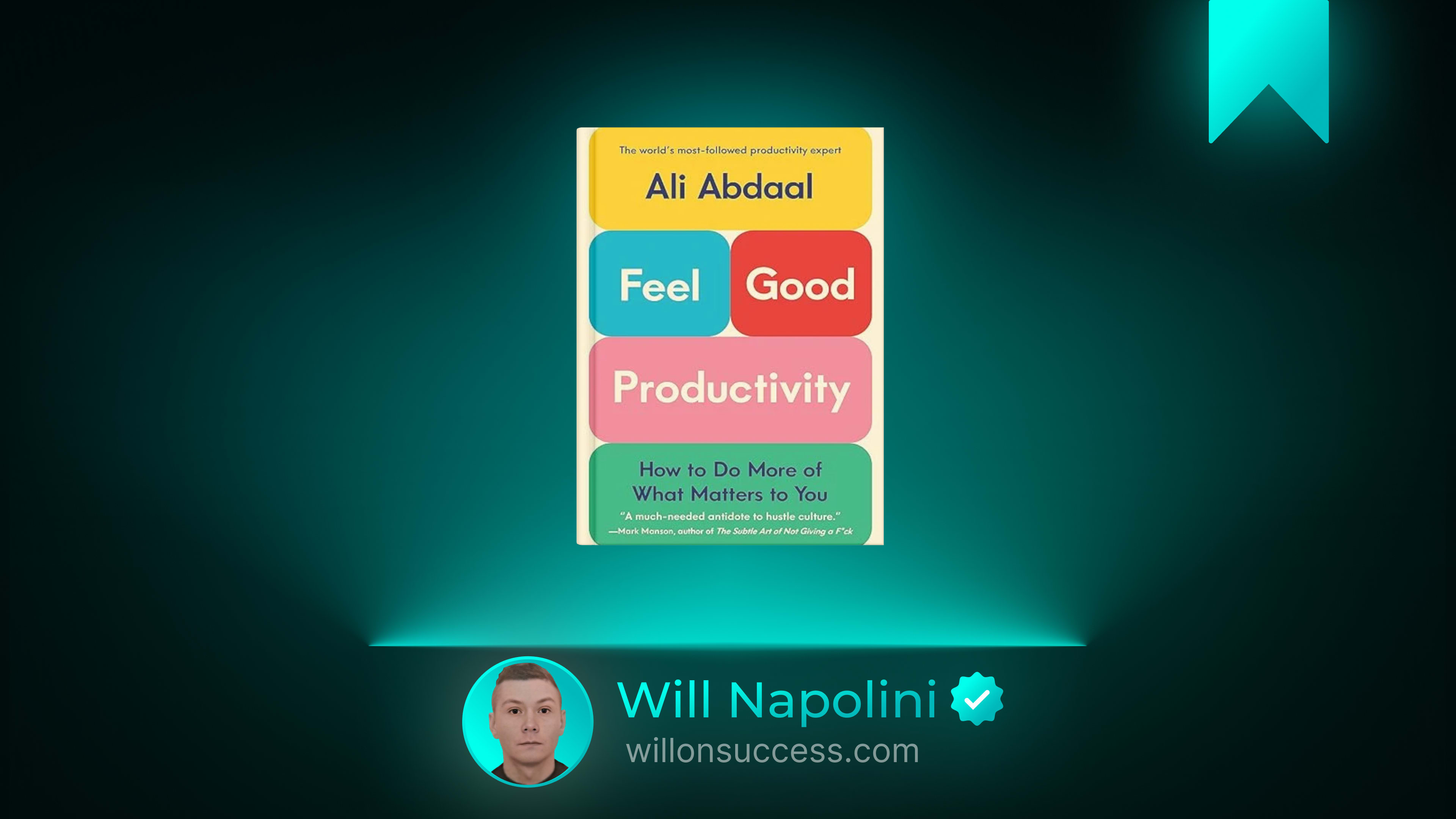
Feel-Good Productivity by Ali Abdaal: Why Grinding Yourself Down Is the Wrong Strategy for Getting Things Done
There is a quiet lie most of us carry around about getting things done. It goes something like this: If I could just discipline myself harder, push through the resistance, white-knuckle my way past the discomfort—then finally I would be productive. Then finally I would feel proud of my days.
And so you grind. You set punishing alarms. You make lists so long they feel like indictments. You call yourself lazy on the days you stall, as though naming the problem will solve it.
Then you burn out. You rest just long enough to feel guilty about resting. And the cycle starts again.
I have watched this pattern play out in so many lives—sometimes in my own—and what strikes me most is how unnecessary the suffering is. Not the effort. Effort is real, and meaningful work is often hard. But the suffering—the sense that you must punish yourself into progress—that is optional. And more than optional: it is counterproductive.
Ali Abdaal’s Feel-Good Productivity is built on that exact insight, and I think it is one of the most useful reframe a person can encounter. Let me walk you through what the book actually teaches, why it works, and what you can do with it starting today.

The Central Idea: You Don’t Need More Discipline. You Need More Energy.
Abdaal’s core argument is deceptively simple, but it upends a lot of what popular culture tells us about achievement. He says: productivity is not primarily a discipline problem. It is an energy problem.
Think about it. When you are genuinely excited about something—a conversation you are looking forward to, a project that lights you up, a game, a creative idea you cannot stop thinking about—you do not need a motivational speech to begin. You do not need a strict morning routine. You do not need accountability software blocking your favorite websites. You simply go. The energy is already there, pulling you forward.
The reason most tasks feel like pushing a boulder uphill is not that you lack willpower. It is that the task, as you have framed it or structured it, feels bad. It triggers dread, boredom, fear of failure, or a vague sense of meaninglessness. And your brain, doing what brains do, steers you away from discomfort.
Abdaal’s answer is not to ignore the discomfort and muscle through. His answer is to redesign the experience of working so that the process itself generates energy rather than draining it. He calls this “feel-good productivity,” and the book is essentially a toolkit for making that shift.
The Three Energizers: Play, Power, and People
The book organizes its positive framework around three sources of energy that Abdaal calls the three energizers. I have found this structure genuinely useful, because it gives you three distinct levers to pull when a task feels heavy.
Play: Making the Process Itself Enjoyable
This is not about turning your job into a circus. It is about introducing small elements of curiosity, novelty, and enjoyment into the act of doing.
Abdaal suggests that we often approach work with the grim seriousness of someone serving a sentence. But research on motivation consistently shows that people perform better and persist longer when they experience even a small degree of enjoyment in the activity itself. You can inject play by varying your environment, turning a task into a challenge or experiment, pairing it with music or a pleasant setting, or simply asking, “What would make this 10 percent more fun?”
A small shift. But small shifts compound.
Power: Feeling Capable and In Control
One of the fastest ways to drain your energy is to feel helpless—that the task is too big, too vague, or controlled by someone else’s expectations. Abdaal emphasizes that the feeling of agency is a powerful fuel. You generate energy when you can see a clear next step, when you have some autonomy over how you approach the work, and when you feel yourself making visible progress.
This is why breaking a project into absurdly small first steps matters so much. Not because the task magically becomes easier, but because a clear, small action restores your sense of control. You are no longer staring at a mountain. You are placing one foot on the first rock.
People: Connection as Fuel, Not Distraction
We often treat relationships and productivity as opposing forces—socializing is what you do after the real work. Abdaal pushes back on this. He points out that working alongside others, sharing progress, asking for help, or simply having a friendly face nearby can dramatically increase both energy and follow-through.
This does not mean every task needs a team. It means that isolation, when it becomes your default working mode, quietly starves you of a renewable energy source. A five-minute conversation with someone who believes in what you are doing can change the entire texture of your afternoon.
The Three Blockers: Why You Stall Even When You Want to Move
The energizers explain how to build momentum. But Abdaal is honest enough to address what stops us in the first place. He identifies three primary blockers: procrastination, perfectionism, and burnout. And his treatment of each one is refreshingly free of shame.
Procrastination Is Not Laziness
This may be the most important reframe in the entire book. Abdaal argues that procrastination is an emotional regulation problem, not a character flaw. You avoid the task because, in this moment, the task triggers an unpleasant feeling—anxiety, boredom, self-doubt, overwhelm. Your brain offers you a faster escape: scrolling, snacking, reorganizing the bookshelf.
Once you see procrastination this way, the solution changes. You stop asking, “Why am I so undisciplined?” and start asking, “What about this task feels bad, and can I change the conditions so it feels less bad?” Maybe you need a smaller starting point. Maybe you need to work for only ten minutes with permission to stop. Maybe you need to do the ugliest version first and give yourself permission to make it imperfect.
The goal is not to eliminate discomfort entirely. It is to lower the emotional cost of starting below the threshold where avoidance becomes the easier choice.
Perfectionism Is Fear Wearing a Nice Suit
Abdaal treats perfectionism not as high standards but as a protection strategy. You set impossibly high bars because, as long as you never finish, you never have to face judgment. The unfinished draft cannot be rejected. The unreleased project cannot be criticized.
The antidote he offers is not “lower your standards.” It is to separate the act of creating from the act of evaluating. Give yourself permission to produce rough, messy, incomplete first versions. Judge later. Or better, let someone else help you judge later. The perfectionist’s paralysis breaks the moment you decide that a flawed, finished thing is more alive and more useful than a flawless, imaginary one.
Burnout Is Not the Price of Ambition
Abdaal pushes back against the cultural narrative that exhaustion is a badge of honor. He frames burnout not as the inevitable result of working hard, but as the result of working in ways that chronically deplete you without adequate recovery, meaning, or enjoyment.
The practical implication: rest is not a reward you earn after the work is done. Rest is part of the system that makes the work possible. You build recovery into your days the way you build structural supports into a bridge—not as decoration, but as engineering.
Why This Matters on an Ordinary Tuesday
Let me bring this down from principle to practice, because ideas that stay abstract do not change lives.
Imagine a Tuesday. You have a report due, a difficult email to write, a project that has been sitting half-finished for two weeks, and a nagging sense that you should be further along in your career than you are.
The old approach: you sit down, feel the weight of all of it, call yourself lazy, force yourself to open the document, stare at the cursor, feel worse, open your phone for “five minutes,” lose an hour, feel ashamed, and finally start at 4 p.m. with depleted energy and self-recrimination.
The feel-good approach: you notice the dread and ask yourself what specifically feels bad. You realize the report feels vague—you do not actually know what the first paragraph should say. So you shrink the task: “I will write three bullet points of what I roughly want to say.” You put on music you enjoy. You text a colleague and say, “I’m finally tackling this report, wish me luck.” You give yourself fifteen minutes and permission to write something ugly.
Same Tuesday. Same report. But the emotional architecture around the task has changed. And that changes everything.
You are not tricking yourself. You are not avoiding difficulty. You are removing the unnecessary friction that was never part of the actual work. The report still requires thought, effort, and time. But now you are spending your energy on the report rather than on fighting yourself about the report.
A Word About Guilt
One thing Abdaal addresses that I think more productivity books should address: guilt.
So many people carry a low-grade, persistent guilt about not doing enough. This guilt does not produce action. It produces paralysis. You feel bad, so you avoid the work that would make you feel less bad, which makes you feel worse, which increases the avoidance.
If you recognize yourself in that loop, hear me on this: guilt is not a productivity tool. It has never been a productivity tool. It is a tax you pay on your energy before you have even begun. Setting it down is not laziness. It is maintenance.
You do not need to earn the right to feel okay while you work. You are allowed to build a process that feels humane.
Practical Steps You Can Take This Week
Understanding the idea is valuable. But understanding without action is just entertainment. So here are a few concrete experiments drawn from the spirit of the book:
The Ten-Minute Start. Choose one task you have been avoiding. Commit to working on it for exactly ten minutes. Give yourself full permission to stop after ten minutes. The point is not the output. The point is proving to your nervous system that starting is survivable. Most of the time, once you have started, continuing feels easier than stopping. But even if you stop at ten, you have broken the avoidance cycle.
The Fun Audit. At the end of your workday, spend two minutes writing down: What drained me today? What gave me even a small spark of energy? Over a week, patterns emerge. You will see where you can add play, reduce friction, or restructure tasks around your natural energy rhythms.
The Permission Slip. For one project this week, write yourself explicit permission to produce a rough, imperfect first version. Write it down. “This is allowed to be bad. I will revise later.” Then start. You are not lowering your standards. You are separating creation from criticism so that creation can actually happen.
The Connection Check. Identify one task you have been doing alone that might benefit from a partner, an accountability conversation, or simply working in a shared space—even a virtual one. Reach out. You do not need to explain your whole system. A simple “Hey, want to work on this together Thursday afternoon?” is enough.
Who This Book Is For—and Who Might Want Something Different
Feel-Good Productivity will resonate most with people who are caught in the guilt-and-grind cycle, who feel like they should be doing more but cannot summon the energy, and who are exhausted by productivity advice that essentially says “try harder.” If you have read five productivity books and still feel stuck, this one offers a genuinely different angle.
It is also useful for people recovering from burnout who need a framework for re-engaging with work without immediately falling back into the patterns that depleted them.
Where it may be less useful: if you are in a situation where the problem is genuinely structural—an exploitative workplace, a role that fundamentally conflicts with your values, a life circumstance that requires practical problem-solving rather than emotional reframing—then no productivity philosophy, however warm, will fix the root issue. Abdaal’s framework assumes you have some degree of agency over how you approach your work. If you do not, the first step may be a different conversation entirely.
The book is also lighter on deep psychological exploration than some readers might want. If your procrastination is tangled with trauma, chronic anxiety, or ADHD, this book can be a helpful companion, but it is not a substitute for professional support.
One Small Step for Today
If everything else in this article fades from memory, keep this:
Pick one task you have been putting off. Not the biggest one. Not the most important one. Just one. Shrink it until the first step feels almost too easy. Give yourself ten minutes. Make the environment pleasant—good lighting, a drink you enjoy, music if it helps. Then begin.
You do not need to feel motivated first. You do not need to feel disciplined. You just need to make starting feel less painful than avoiding.
And if ten minutes turns into forty, wonderful. If it stays at ten, also wonderful. You moved. The boulder shifted. And tomorrow, the second push will be easier than the first, because you will have evidence—small, quiet, personal evidence—that you can begin without punishing yourself first.
A life built from ten-minute acts of gentle starting looks nothing like a life built from heroic, grinding sprints. But it lasts. And it compounds. And one day you look back and realize that the person you became was not forged in a single dramatic effort.
They were built in a thousand small moments where you chose curiosity over criticism, and began.