Four Thousand Weeks by Oliver Burkeman: Why You Will Never Get Everything Done (And Why That Is Good News)
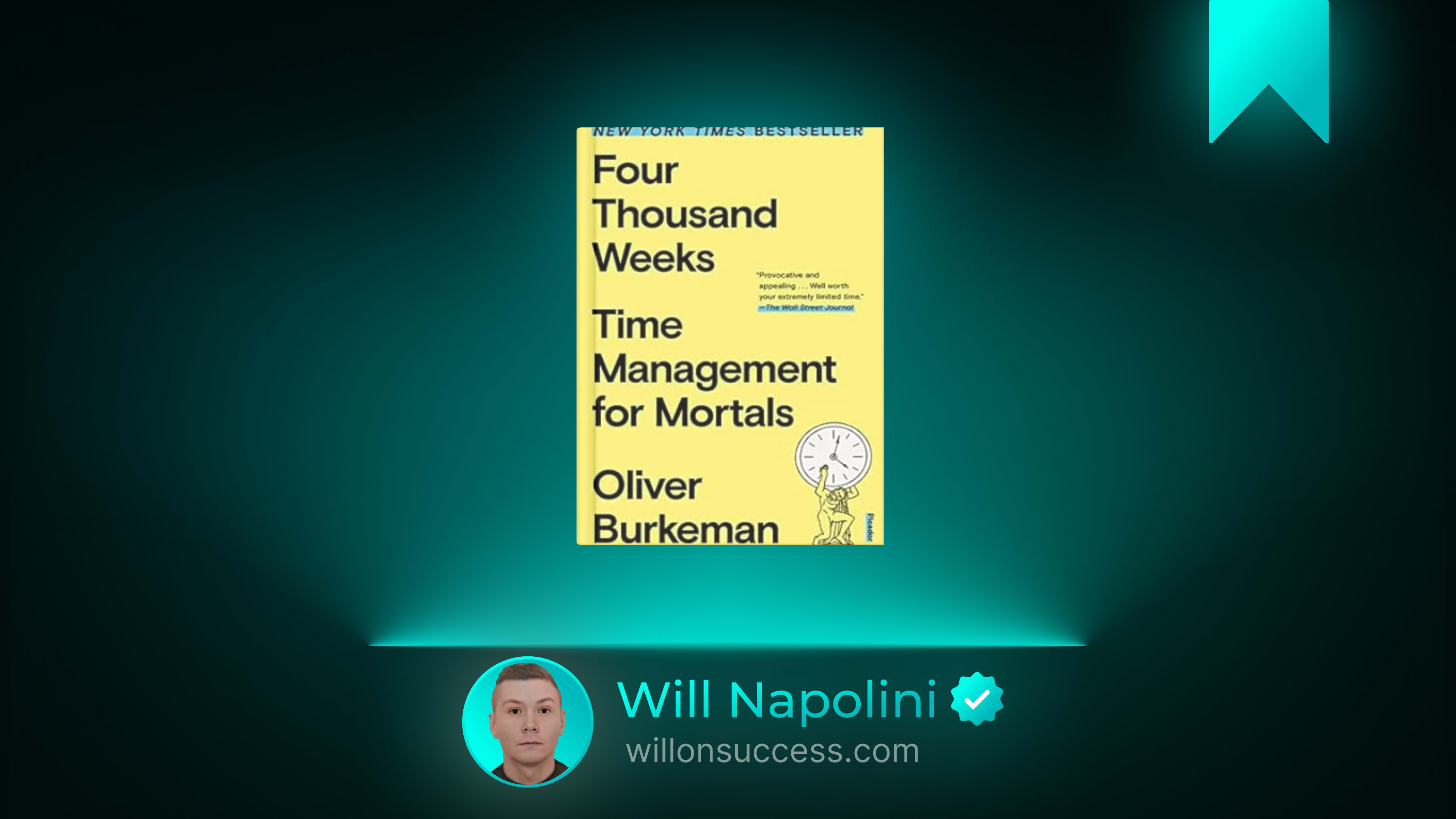
Let us do a little math. It is the kind of math that changes the way you breathe.
If you live to be eighty years old, you have roughly four thousand weeks.
Four thousand.
That is not a lot. You can hold that number in your mind. If you were to draw four thousand little dots on a single sheet of paper, it would fit on a standard postcard. And if you are reading this, a significant portion of those dots are already behind you, spent on sleeping, working, commuting, and worrying about things that never happened.
Most productivity books look at that terrifyingly small number and say: Hurry. Optimize. Squeeze more out of every hour. Here is a system to help you do it all.
Oliver Burkeman, a journalist who spent years writing about psychology and the self-help industry, looked at that same number and came to a radically different conclusion. He realized that the entire modern project of “time management” is a trap. You are not failing at time management because you have the wrong app, the wrong morning routine, or the wrong color-coded planner. You are failing because the goal itself is impossible.

The Big Idea: The Freedom of Giving Up
The central thesis of Four Thousand Weeks: Time Management for Mortals is a hard pill to swallow, but it tastes like medicine: You will never get everything done.
The supply of things demanding your attention is infinite. Your time is strictly finite. Therefore, the feeling of “falling behind” is not a temporary state you will eventually fix if you just work hard enough. It is the permanent, unchangeable condition of being a human being.
Burkeman argues that true peace does not come from finally clearing your plate. It comes from accepting that the plate will never be clear, and consciously choosing what you are willing to leave undone. The goal of time management should not be to reach a mythical state of relaxed, empty-handed leisure where all your tasks are complete. The goal is to become better at deciding what to fail at.
The Efficiency Trap
Have you ever noticed that the faster you reply to emails, the more emails you receive?
If I could sit across the table from you right now, I would ask you to think about the last time you had a truly productive day. You crossed off ten items. You felt a surge of triumph. And what was your reward? Did the universe hand you a medal and tell you to go take a nap? No. Your reward was that your colleagues noticed your responsiveness and sent you five more requests. Your boss noticed your capacity and handed you a new project.
Burkeman calls this the efficiency trap. We treat our time like a conveyor belt, believing that if we just process tasks fast enough, we will eventually reach the end and arrive at a state of perfect control.
But the world does not reward efficiency with rest. The world rewards efficiency with more demands. The more efficient you become, the more you accelerate the treadmill. You do not buy yourself freedom; you buy yourself a heavier workload. The only way off the treadmill is to stop trying to run faster, and instead decide which destinations you are simply not going to visit.
The Tyranny of “Someday”
One of the most insidious habits we fall into is our tendency to treat the present moment as a mere stepping stone to a better future.
We tell ourselves: Once I get this promotion, then I can relax. Once the kids are in school, then I will start painting. Once I clear this backlog, then I will finally feel in control.
We live for “someday.” But Burkeman points out a devastating truth: someday never arrives. The future is just a concept in your mind. The only place you actually exist is right now, in the messy, incomplete, overwhelming present.
When you treat the present as an obstacle to be overcome on the way to a perfect future, you drain your actual life of its meaning. You spend your four thousand weeks preparing to live, rather than actually living. The work you are doing right now, the people sitting across from you right now, the imperfect Tuesday you are currently enduring—this is not the waiting room. This is the event.
Cosmic Insignificance Therapy
If the idea of never getting everything done fills you with dread, Burkeman offers a remedy he calls “cosmic insignificance therapy.”
Look up at the night sky. Think about the age of the universe. Think about the billions of humans who have lived and died, the empires that have risen and turned to dust, the stars that have burned out before our planet even cooled.
Against that backdrop, your unread emails do not matter. The awkward thing you said in a meeting five years ago does not matter. The fact that you did not launch your side business this year does not matter. Your grandest ambitions and your most embarrassing failures are, cosmically speaking, entirely irrelevant.
This is not meant to depress you. It is meant to liberate you.
When you realize that your mistakes do not echo through eternity, the crushing weight of expectation lifts. You are free to do things simply because they are meaningful to you and the small circle of people you love, not because they will secure your legacy in the annals of history. You are free to just be a person, living a small, finite life, doing a few good things with the time you have.
The Lost Art of Doing Nothing
We have forgotten how to just be. We treat every spare moment as an opportunity for optimization. If we are waiting in line at the grocery store, we pull out our phones to answer messages. If we are walking to the car, we listen to an educational podcast. We are terrified of the void, so we fill every gap with input.
But some of the most important human experiences require what philosophers call “atelic” activities—activities that have no end goal, no final destination, and no metric of success. Going for a walk just to walk. Listening to music just to hear it. Sitting on the porch just to sit.
When you strip away the need to optimize every waking second, you allow your mind to wander, to synthesize, to rest. You reclaim the texture of your own life. You stop treating your days as a resource to be mined, and start treating them as an experience to be inhabited.
Why This Matters in Real Life
This philosophy is not an excuse to be lazy, nor is it a permission slip to abandon your responsibilities. It is an invitation to take radical responsibility for your choices.
If you accept that you cannot do everything, you are forced to ask the only question that actually matters: What am I choosing to do, and what am I choosing to neglect?
Every time you say yes to something, you are saying no to a thousand other things. When you stop pretending you can have it all, your “yes” becomes heavier, more deliberate, and more meaningful. You stop scattering your four thousand weeks across a hundred shallow commitments, and you start investing them in the three or four things that actually make your life feel like your own.
Practical Application: The Strategy of Underachieving
Burkeman suggests a brilliant, counterintuitive practice: decide in advance where you are going to fail.
You cannot be a perfect employee, a perfect parent, a perfect partner, a perfect friend, and a perfect citizen all at the same time. The math simply does not work. So, choose one or two areas where you are going to deliberately underachieve.
Maybe this month, you decide you are going to be a mediocre gardener. Your lawn will be a little long. Your flowers might not bloom perfectly. And that is fine. You are trading your gardening excellence for the energy you need to be fully present with your children, or to finally write that book, or simply to sleep eight hours a night.
By consciously choosing your failures, you reclaim the power of your attention. You stop letting the world dictate where you fall short, and you start deciding for yourself.
Who Should Read This Book
Four Thousand Weeks is essential reading for anyone who feels perpetually behind, anyone suffering from burnout, and anyone who has tried every productivity system on the market only to find themselves exhausted and still overwhelmed.
It is less useful if you are looking for a tactical, step-by-step guide to organizing your calendar or optimizing your morning routine. Burkeman is not interested in helping you clear your inbox faster. He is interested in helping you question why you feel the need to clear it at all.
If you are ready to stop fighting your own finitude and start making peace with it, this book will feel like a long, deep exhale.
One Small Step
Tonight, I want you to do something that goes against every instinct of the modern productivity mindset.
Look at your to-do list for tomorrow. Find one task that you have been carrying around for weeks—something you feel you “should” do, but that does not actually bring you joy, serve your deepest goals, or matter to anyone you love.
Cross it off the list. Not with the intention of doing it later. Cross it off with the intention of never doing it.
Feel the slight spike of anxiety that arises, and then feel the quiet space that opens up behind it.
You just bought back a piece of your life. You just honored your finitude.
You only have four thousand weeks. Stop trying to fit the universe into them. Choose your few beautiful things, let the rest fall away, and step fully into the time you actually have.