Essentialism by Greg McKeown: Why Doing Less Is the Path to Doing What Truly Matters
You have probably felt it. That slow, quiet exhaustion of saying yes to so many things that you no longer remember which ones you actually chose. Your calendar is full. Your task list keeps growing. You are busy from morning until night. And yet, at the end of the week, you look back and wonder: Did any of that actually move me toward what matters?
If that question stings, I want you to sit with it for a moment. Because the discomfort it creates is not a sign of failure. It is a signal. It means something in your life has become cluttered with obligations that do not belong there, and you are paying for that clutter with the one resource you can never earn back: your attention.
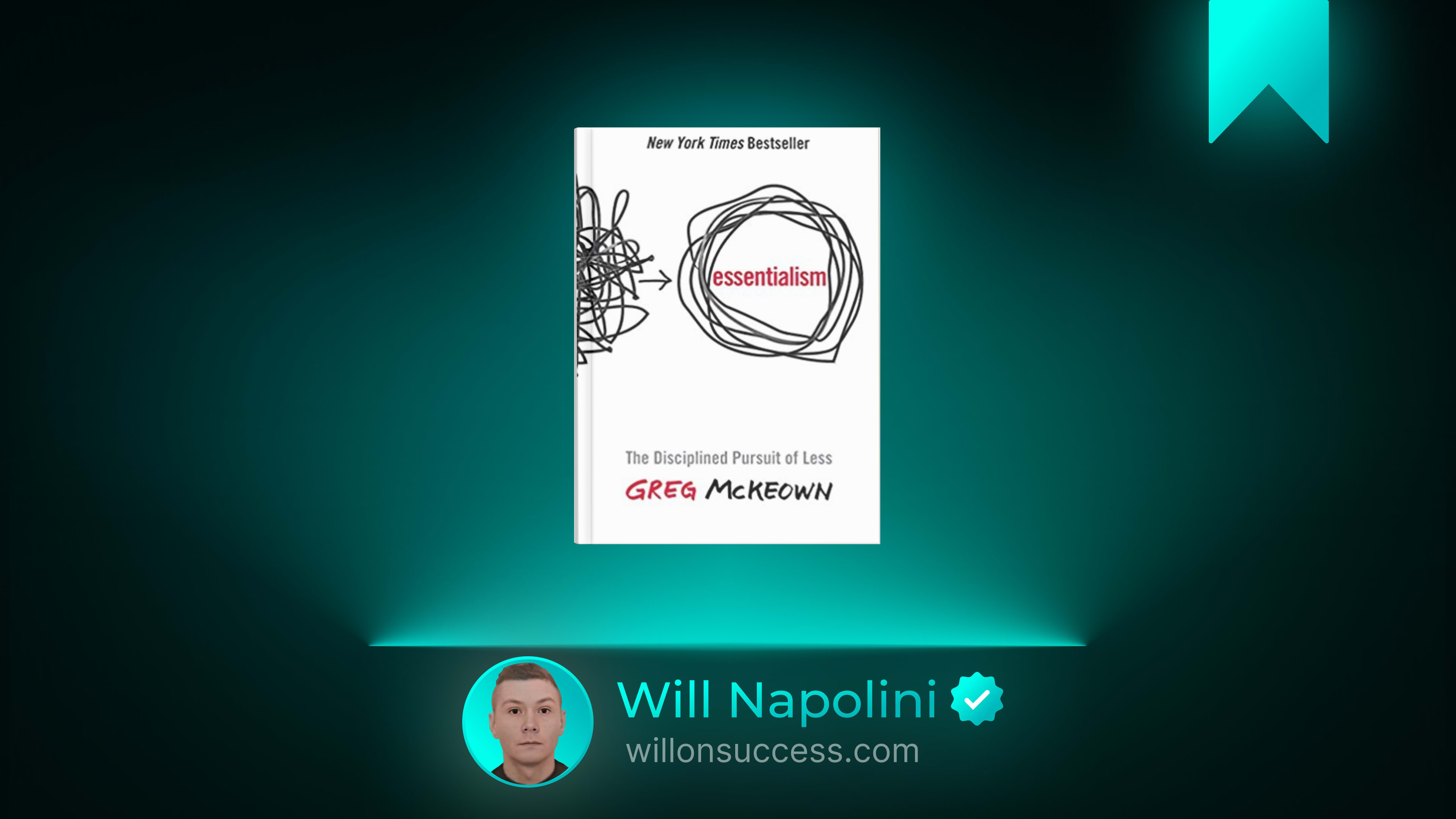
Greg McKeown wrote Essentialism: The Disciplined Pursuit of Less to address exactly this problem. Not as a productivity hack. Not as a time-management trick. But as a fundamental rethinking of how we decide what deserves our energy in the first place.
I have returned to this book more than once, and each time I do, I notice another place where I have been trading depth for breadth without realizing it. That is what I want to walk through with you now.

The Big Idea: Less, but Better
The entire philosophy of this book rests on four words McKeown keeps returning to: less, but better.
That sounds simple. It is not easy.
Most of us operate under an unspoken assumption: if I can do more, I should do more. More projects. More commitments. More responsibilities. More visibility. We treat our capacity like a container we keep trying to overfill, and we call the overflow “ambition” or “dedication.”
McKeown challenges that assumption directly. He argues that the undisciplined pursuit of more—more tasks, more obligations, more directions—actually reduces our contribution. When we spread ourselves across everything, we make a millimeter of progress in a million directions instead of a meaningful advance in one.
The Essentialist, as he defines the term, does not simply do fewer things. The Essentialist makes a disciplined, ongoing practice of asking: Is this the very most important thing I should be doing with my time and energy right now? And if the answer is not a clear yes, the Essentialist treats it as a no.
That last part is where the book becomes genuinely challenging. Because most of us do not operate with clear yeses and clear nos. We operate in a fog of “maybe” and “I suppose” and “I probably should.” And that fog is where our lives quietly fill up with things we never truly wanted.
The Trade-Off You Cannot Avoid
One of the ideas in this book that I found most clarifying is McKeown’s treatment of trade-offs.
He points out something we intellectually know but emotionally resist: you cannot do everything. Not because you lack talent. Not because you lack effort. Because time and energy are finite, and every yes is a no to something else.
When you say yes to the committee meeting that vaguely interests you, you are saying no to the deep work session you had planned. When you say yes to the social obligation you feel guilty declining, you are saying no to the evening you wanted to spend reading, thinking, or resting.
McKeown does not frame this as deprivation. He frames it as honesty. The trade-off exists whether you acknowledge it or not. The only question is whether you decide what gets sacrificed, or whether the decision gets made for you by default.
I think about this like pruning a tree. A gardener does not cut branches because the tree has done something wrong. The gardener cuts so that the remaining branches can receive more light, more nutrients, more room to grow. What is removed is not punished. It is released. And what remains grows stronger because of the removal.
Your commitments work the same way. Removing the non-essential is not loss. It is the condition that allows the essential to thrive.
The Power of a Graceful No
If there is one practical skill this book teaches better than almost anything else I have read, it is the art of saying no.
McKeown devotes significant attention to why we say yes when we should not. Fear of disappointing someone. Fear of missing out. Fear of seeming unhelpful or difficult. The social pressure of the moment overriding the clarity we might have felt five minutes earlier.
And then he offers something I found genuinely freeing: the idea that a no, delivered with grace, is actually a form of respect. Respect for the other person’s right to find someone who can fully commit. Respect for your own capacity. Respect for the work that actually matters.
He suggests a filter so simple it almost feels too strict: If it is not a clear yes, it is a clear no.
Think about what that does to your decision-making. No more “well, it might be useful.” No more “I’ll probably regret not going.” No more vague obligation dressed up as opportunity. The bar becomes: Does this make me feel genuinely, unmistakably compelled? Is this aligned with what I have decided matters most?
If not, you decline. Politely. Warmly. Without elaborate excuses.
I will be honest with you: the first few times you do this, it feels uncomfortable. You may feel selfish. You may worry people will think less of you. But McKeown’s observation, and one I have seen confirmed in my own experience, is that the respect you gain from clear boundaries far outweighs the temporary awkwardness of setting them.
Creating Space to Think
Here is something the book emphasizes that surprised me the first time I read it: the Essentialist deliberately builds in empty space.
Not just margins in the schedule. Actual time for thinking. For exploring. For play. For sleep. McKeown argues that our best discernment—our ability to separate the vital few from the trivial many—does not happen while we are rushing between tasks. It happens in stillness. In unhurried reflection. In the kind of mental quiet that most of us have engineered out of our lives.
He writes about the importance of sleep not as indulgence but as fuel for high-level thinking. He writes about play as a source of creative exploration, not a distraction from serious work. He writes about the need to simply sit with a question before deciding.
This resonated with me deeply. I have noticed that my clearest decisions never come when I am overwhelmed. They come after a walk. After a night of rest. After an afternoon where I allowed myself to think without producing.
If your life has no white space—no unstructured time where nothing is demanded of you—then you have no room to notice what is actually essential. You are simply reacting. And reaction is the enemy of intention.
Editing Your Life Like a Craftsman Edits a Manuscript
One of the metaphors McKeown uses that stayed with me is the idea of editing.
A good editor does not add to a manuscript. The editor removes. Cuts the sentences that do not serve the argument. Deletes the paragraphs that wander. Trims the adjectives that clutter. And what emerges is not less story. It is more story, because what remains is sharp and purposeful and unobstructed.
McKeown invites you to edit your life the same way. Look at your commitments, your routines, your obligations, and ask: If I were starting from zero, would I choose this? Does this serve the one or two things I have decided matter most?
This is not a one-time purge. It is an ongoing practice. Life will keep handing you new obligations. New requests will arrive every week. The editing never stops. But each time you edit, you are choosing clarity over accumulation. You are choosing depth over sprawl.
Progress Over Perfection: Small Wins Compound
Toward the latter part of the book, McKeown addresses execution. Once you have identified what is essential, how do you actually do it without it feeling like an impossible climb?
His answer is refreshingly unglamorous: start small. Build routines. Remove obstacles before they appear. Celebrate small progress rather than waiting for a grand breakthrough.
He talks about creating buffers—extra time, extra margin—so that when the unexpected happens, and it will, your essential work does not collapse. He talks about the power of routine to make execution feel almost effortless, removing the daily decision fatigue of “should I work on this now?”
And he emphasizes what he calls the power of small wins. Not the dramatic, overnight transformation. Just the quiet, daily movement forward. One page written. One conversation had. One task completed before the noise of the day begins.
This principle matters because perfectionism is often the enemy of essentialism. We identify what matters, then freeze because we cannot do it flawlessly, so we do nothing, and the non-essential fills the vacuum.
You start small. You stay consistent. You let the direction become the destination.
What This Looks Like on an Ordinary Tuesday
Let me bring this down from philosophy to practice, because that is where it actually lives.
Imagine a Tuesday. You wake up. Before checking your phone, you ask yourself McKeown’s guiding question: What is the most important thing I need to do today? Not five things. One. Maybe two. You write it down.
You protect a block of time for that work. You do not schedule a meeting over it. You do not check messages during it. You treat it as non-negotiable, the way you would treat a doctor’s appointment.
Three requests come in during the day. A colleague asks for help on something that is not urgent. An email invites you to a meeting with no clear agenda. A friend suggests a weekend plan that sounds fun but would drain the energy you need for your priority project.
You pause. You apply the filter. Two of them are not clear yeses. You decline warmly. You offer an alternative where appropriate. You do not owe a lengthy explanation.
In the evening, you do not collapse into scrolling. You give yourself thirty minutes of genuine rest. A walk. A book. A conversation. Something that restores rather than numbs.
This is not a dramatic life overhaul. It is a Tuesday. But a Tuesday lived with intention rather than reaction. And a thousand such Tuesdays, stacked one after another, become a life that feels chosen rather than accumulated.
Who Should Read This Book
If you feel stretched thin—if you are competent, hardworking, and saying yes to too many things while wondering why your most important work keeps getting pushed to “later”—this book will speak directly to you.
It is especially useful for people in roles where requests come constantly: managers, freelancers, parents, entrepreneurs, anyone whose time is treated by others as a shared resource.
It is less useful if your current problem is a lack of direction rather than an excess of it. If you do not yet know what matters to you, Essentialism gives you the framework for protecting what matters, but you may need to do some exploratory work first to identify your priorities. McKeown touches on this, but the book’s greatest strength is in the discipline of elimination, not the discovery of purpose.
The writing is clear, warm, and practical. McKeown uses stories and examples generously without becoming preachy. The book does not demand that you overhaul your life overnight. It asks for a shift in orientation. A decision to stop treating your attention as infinite.
One Small Step You Can Take Today
Here is what I would ask you to do. Not tomorrow. Today.
Take five minutes. Sit with a blank piece of paper or an empty note on your phone. Write down every commitment, obligation, project, and recurring task currently occupying your mental space. Do not filter. Just list them.
Then look at that list and ask one question: If I could only keep three of these, which three would I choose?
Circle those three. Everything else is not gone forever. You do not need to quit your job or cancel every plan tonight. But you now have a map. You know what the vital few are. And you know where the trivial many live.
Tomorrow, when the first non-essential request arrives—and it will—you will already know what your answer is.
That is where essentialism begins. Not with a grand declaration. Not with a dramatic life redesign. With one honest look at where your energy is actually going, and one quiet decision to redirect it.
You do not need to do more to matter. You need to do less, with more intention, in the direction that is truly yours.
The life you want is not buried under a lack of effort. It is buried under a surplus of everything else. And you are allowed—more than allowed, you are invited—to clear the ground.
One no at a time. One clear yes at a time. One Tuesday at a time.
The path is not wide. But it is yours. And it is enough.