I Will Teach You to Be Rich: The Art of Designing a Life You Actually Want
Have you ever sat in a coffee shop, sipping a six-dollar latte, and felt a quiet, nagging guilt that you should be investing that money instead?
We have all heard the sermon. You know the one: “If you just stopped buying a five-dollar coffee every day, you’d be a millionaire by retirement.” It is the most repeated cliché in the history of personal finance, and it is almost entirely responsible for making millions of intelligent, hardworking people feel like failures.
If I could sit across the table from you right now, watching you calculate whether you can afford to add an extra shot of espresso to your cup, here is the first thing I would tell you: The financial industry profits from your guilt. They want you to feel bad about your daily habits so you will pay them to “fix” you.
But what if the problem isn’t your coffee? What if the problem is that you are playing a game with rules that were designed to keep you small, anxious, and perpetually dissatisfied?

The Big Idea: The End of Financial Deprivation
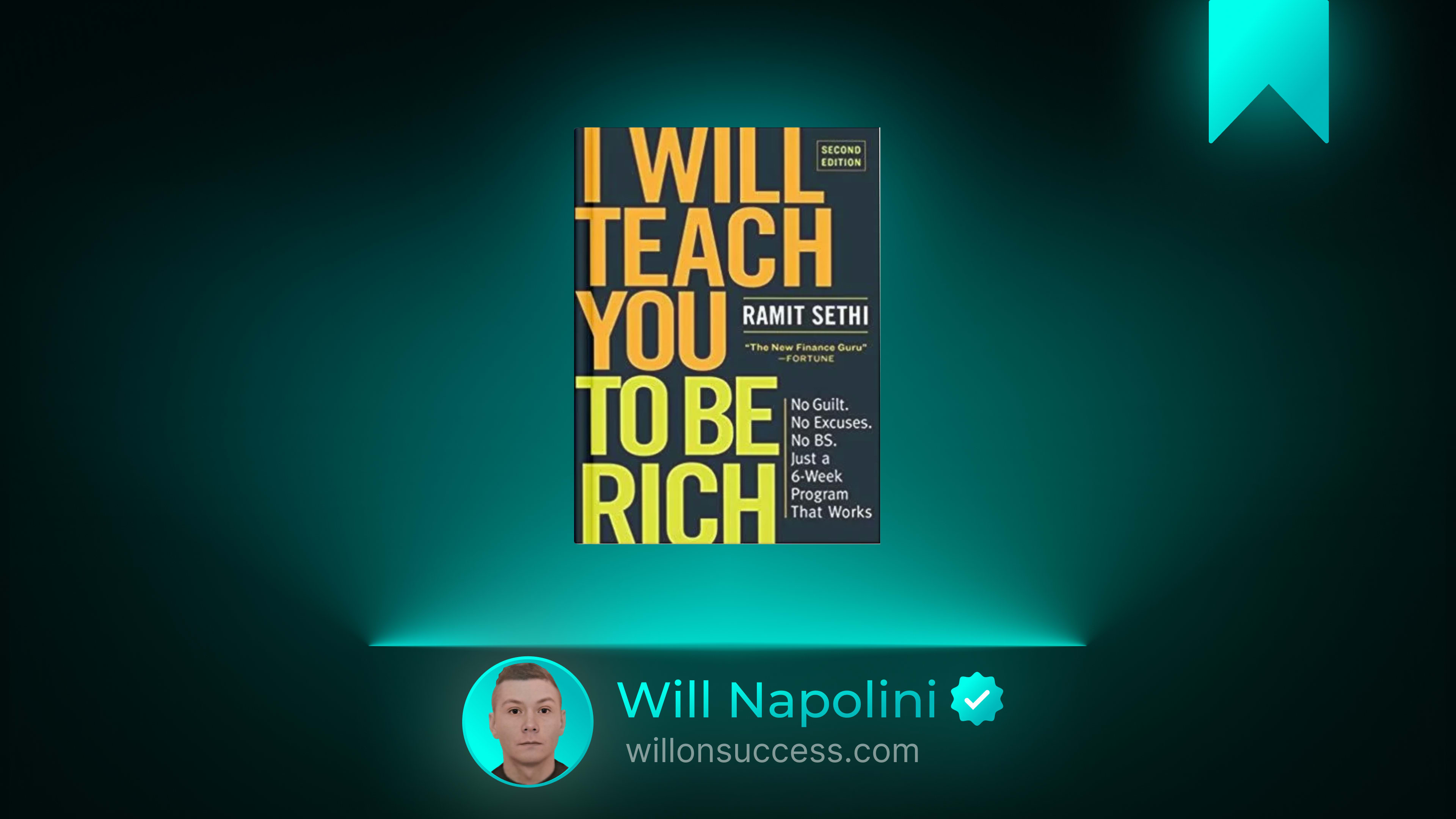
In his brilliant, unapologetic, and deeply practical book, I Will Teach You to Be Rich, Ramit Sethi sets out to destroy the traditional, joyless approach to money management.
Most financial advice is rooted in deprivation. It tells you to track every penny, to feel guilty for wanting nice things, and to live a life of quiet misery today so you can retire to a golf course in Florida when you are seventy-five. Sethi calls this out for what it is: a psychological trap.
His central thesis is both radical and profoundly liberating: True wealth is not about restricting your life; it is about designing it. You can absolutely buy the six-dollar coffee, take the expensive vacation, and eat at the nice restaurant—as long as you have ruthlessly cut costs on the things you don’t care about, and automated your investments in the background.
Sethi defines a “Rich Life” not as a generic number in a bank account, but as a highly specific, deeply personal vision of how you want to live.
Wealth is not measured by the money you refuse to spend, but by the life you build with the money you do.
The Story of the Latte Fallacy and the Invisible Architecture
To understand why traditional budgeting fails, we have to look at human nature.
Imagine you are trying to lose weight. A guru tells you that you must never eat sugar, you must weigh your chicken breast down to the gram, and you must run five miles every morning at 5:00 AM. What happens? You last three weeks. Then, you get tired, you eat a piece of cake, you feel immense shame, and you quit entirely.
Traditional budgeting works the same way. It demands perfection. It demands that you log into a spreadsheet every Sunday and categorize your grocery receipts. It relies entirely on willpower. And willpower is a finite resource. When you have a bad day at work, your willpower is gone, and your budget collapses.
Sethi realized that you cannot out-willpower your own human nature. Instead, you must build an invisible architecture around your money. He advocates for a system where your financial decisions are made exactly once, and then automated forever.
While the personal finance gurus are screaming at you to stop buying lattes, Sethi is quietly setting up a system that automatically diverts 10% of your income into low-cost index funds before you even see it. He focuses on the massive, life-changing wins—like negotiating your salary or avoiding high-fee mutual funds—rather than agonizing over a $5 cup of coffee.
You cannot buy your way out of a psychological problem with a financial solution. You must build a system that works even when you are tired, lazy, and distracted.
The Core Principles of a Rich Life
How do you transition from a state of financial anxiety to a state of empowered, conscious living? Here are the core principles Sethi outlines to help you master the psychology and mechanics of wealth.
1. Define Your “Money Dials”
This is perhaps the most visually powerful concept in the book. Sethi asks you to imagine that your spending habits are controlled by a series of dials, like the knobs on a stereo receiver. These dials represent categories like Travel, Convenience, Eating Out, Hobbies, Health, and Clothing.
Most traditional advice tells you to turn every single dial down to zero to save money. But Sethi points out that a life with all the dials turned down is sterile, joyless, and ultimately unsustainable.
Instead, you must identify what you truly love. If you love traveling, your “Travel” dial might be turned all the way up to a 10. You should fly first class, stay in beautiful hotels, and take the extra excursions. But to afford that, you must turn other dials down to a 1 or a 2. If you don’t care about clothes, buy them at a discount store. If you don’t care about having a brand-new car, drive a ten-year-old Honda.
The goal is to spend extravagantly on the things you love, and cut costs mercilessly on the things you don’t.
2. The Conscious Spending Plan
Sethi despises the word “budget.” A budget is a cage; it tells you what you cannot do. Instead, he advocates for a “Conscious Spending Plan.” This is a map; it tells you where your money is going, giving you total permission to spend what is left.
A healthy Conscious Spending Plan generally breaks your net income down into four buckets:
- Fixed Costs (50-60%): Rent, utilities, groceries, car payments. These are the non-negotiables required to keep your life running.
- Investments (10%): Money sent directly to your 401(k), Roth IRA, or brokerage accounts to build your long-term wealth engine.
- Savings (5-10%): Money set aside for specific goals—a down payment on a house, an emergency fund, or a wedding.
- Guilt-Free Spending (20-35%): This is the magic category. This is your “fun money.” Once your fixed costs, investments, and savings are paid, you can spend this money on literally anything you want, without a single ounce of guilt.
When you know your future is secure and your bills are paid, that $6 latte isn’t a financial mistake. It is a dividend of your conscious spending plan.
3. The 85% Solution
We live in a culture that demands perfection. When people decide to start investing, they fall down a rabbit hole. They read hundreds of articles, they debate the merits of Roth vs. Traditional IRAs, they argue over which specific tech stock is going to boom, and they get completely paralyzed by the complexity.
Sethi introduces the “85% Solution.” He argues that getting your finances 85% right and actually taking action is infinitely more valuable than doing nothing while you research the “perfect” strategy.
You do not need to be a stock-picking genius. You do not need to time the market. By simply opening a Roth IRA, buying a low-cost Target Date Index Fund, and automating your monthly contributions, you have achieved the 85% solution. You have outsmarted the vast majority of highly paid Wall Street professionals who charge massive fees to underperform the market.
Perfection is the enemy of progress. The best time to start investing was ten years ago. The second best time is today, with an imperfect plan.
4. The Power of the Script
Money is deeply emotional, which means negotiating for it is terrifying. Whether you are calling your credit card company to waive an annual fee, negotiating your rent, or asking your boss for a raise, your anxiety will convince you to just accept the status quo.
Sethi provides literal, word-for-word scripts for these exact scenarios. He teaches you how to get past the first-line customer service rep, how to use silence to your advantage, and how to frame your requests as a win-win. He removes the need for you to be “charismatic” and replaces it with a proven system. When you know exactly what to say, the fear evaporates.
Why This Matters on an Ordinary Tuesday
Why does this matter when you are just trying to get through the work week? Because financial anxiety is a low-level hum that drains your energy every single day.
When you do not have a system, every purchase requires a micro-decision. Can I afford this dinner? Should I be saving this instead? Am I falling behind? This decision fatigue bleeds into your work, your relationships, and your mental health.
When you implement Sethi’s principles, the noise stops. You wake up knowing that 10% of your income is automatically buying you a piece of the global economy. You know your emergency fund is quietly growing in a high-yield savings account. You have reclaimed your mental bandwidth. You are no longer surviving your finances; you have automated them so you can actually live your life.
Practical Application: Building Your Wealth Engine
Understanding these principles is a beautiful start, but reading without action changes nothing. You must build a system that removes willpower from the equation.
- Define Your Rich Life: Take out a piece of paper. Do not write “I want to be a millionaire.” Write down the specific texture of your life. I want to take a two-week trip to Italy every year. I want to buy the expensive coffee beans without checking the price. I want to tip 25% when the service is great. Make it vivid.
- Audit Your Dials: Look at your spending over the last three months. Where are you a 10? Where are you a 1? Are you spending money on things you don’t actually care about, just out of habit? Cut the 1s mercilessly to fund the 10s.
- Automate the Big Wins: Log into your bank today. Set up an automatic transfer of $50 (or whatever you can afford) to be moved into a high-yield savings account or an investment account on the exact day after you get paid. Pay your future self first, before you have the chance to spend it.
Who Should Read This Book
I Will Teach You to Be Rich is a masterclass for the young professional, the millennial, or the Gen Z-er who feels paralyzed by the complexity of the financial world. It is essential reading for anyone who hates the idea of “budgeting,” clipping coupons, and living a life of quiet deprivation. It is a brilliant guide for people who want to enjoy their money today while still being responsible for tomorrow.
However, if you are looking for a book on how to day-trade options, pick the next hot cryptocurrency, or get rich quick by flipping real estate with zero money down, this book will deeply frustrate you. Sethi is not a gambler, and he does not respect gamblers. He is an advocate for slow, steady, boring, and highly effective wealth creation. He requires you to embrace the mundane power of consistency over the flashy allure of the quick buck.
One Small Step to Take Today
You do not need to overhaul your entire financial life today. You just need to prove to yourself that you can take control of the system.
Here is your one small step for today: Find a credit card or a recurring subscription (like cable or internet) that you have been paying for without question. Call the customer service number. When they answer, use this exact script:
“Hi, I’ve been a loyal customer for a while, and I’m looking at my budget. I see I’m paying an annual fee (or a high monthly rate). I’d like to have that waived (or lowered), or I will have to look at moving my business to a competitor. What can you do to help me stay?”
Then, close your mouth and wait. Let the silence do the heavy lifting.
Watch how easily the system bends when you simply ask. In that single, five-minute phone call, you will realize that the rules of money are not made of stone; they are made of paper, and you have the power to rewrite them.
The world does not reward the people who hoard their pennies in fear; it rewards the people who design their lives with intention, and build the systems to sustain them.