Meditations by Marcus Aurelius: How to Build an Unconquerable Mind
There is a profound irony in the way most of us seek peace. We imagine that tranquility is a destination we will finally reach once the storm passes. We tell ourselves, “I will be calm when the project launches. I will be at peace when the bank account is full. I will relax when the kids are grown or the market stabilizes.”
But if I have learned one undeniable truth from studying the lives of those who navigated immense suffering, it is this: the storm never truly passes. The weather of life simply changes forms.
If you are waiting for the world to become quiet before you allow yourself to be at peace, you will wait forever.
Two thousand years ago, a man who possessed more absolute power, wealth, and responsibility than almost anyone in human history sat in a freezing, mud-soaked military tent on the edge of the known world. He was exhausted. His empire was being torn apart by betrayal, a devastating plague was wiping out his citizens, and endless wars threatened to collapse his borders. Yet, in the flickering candlelight, he did not write a manifesto on how to conquer his enemies. He wrote a private journal on how to conquer himself.
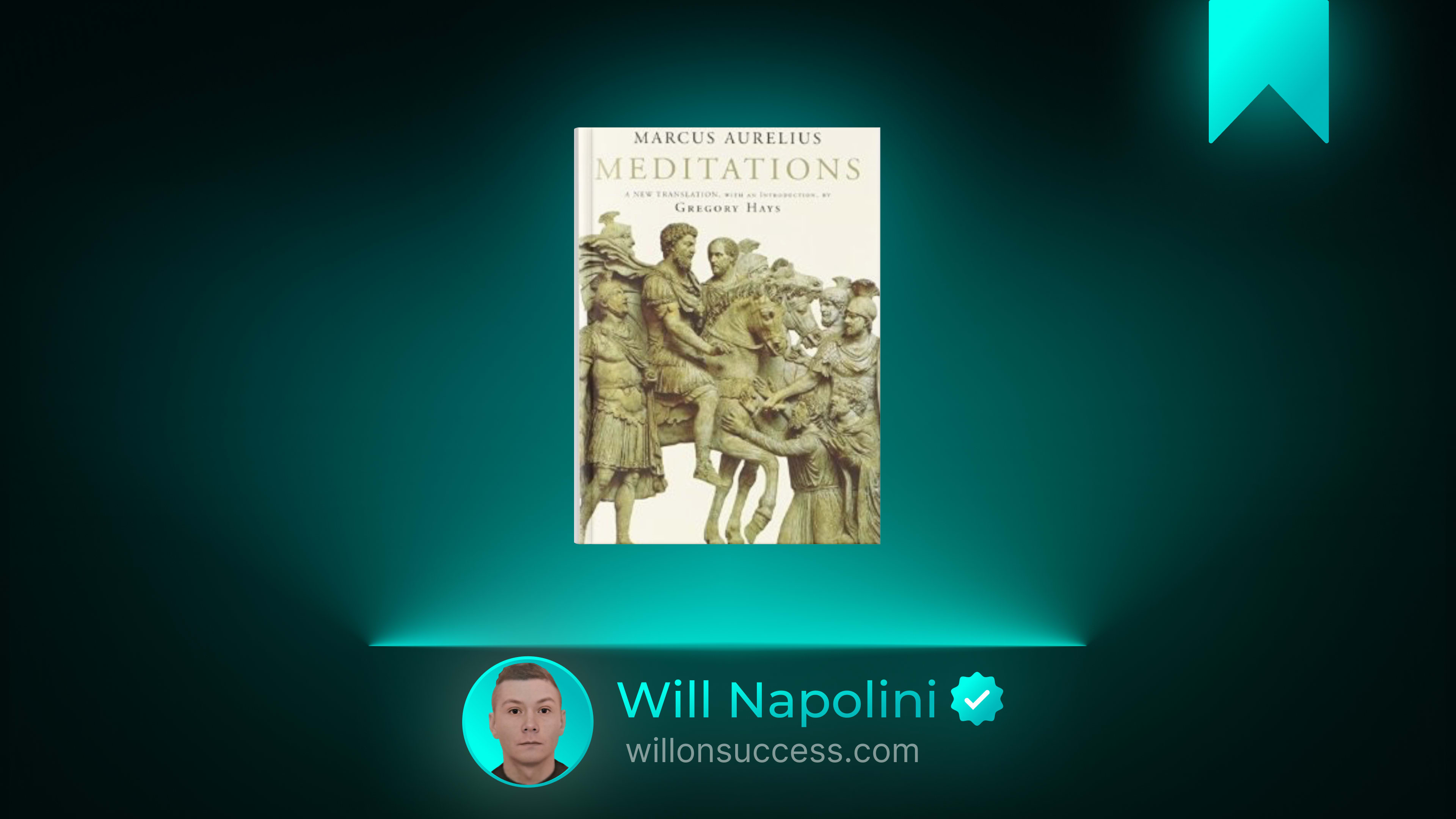
That man was Marcus Aurelius, Emperor of Rome. And his private journal is known to us today as Meditations.

The Big Idea
The central thesis of Meditations is not a secret hack for productivity or a formula for getting what you want. It is a radical, life-altering realization: External events have absolutely no power over your mind unless you grant them permission.
Marcus was a practitioner of Stoicism, a philosophy often misunderstood in the modern world as the suppression of emotion. True Stoicism is not about becoming a cold, unfeeling robot. It is about understanding the boundary between what is up to you and what is not. It is the practice of building an inner fortress so secure that the chaos of the outside world cannot breach its walls.
Happiness and peace are not the results of favorable circumstances. They are the results of accurate judgments. When you stop demanding that the universe conform to your preferences, and instead train your mind to meet the universe exactly as it is, you become virtually unconquerable.
The Story of the Emperor in the Tent
To truly grasp the weight of this book, you must understand the context in which it was written.
Meditations was never intended for publication. Its original Greek title translates roughly to “To Himself.” Marcus was writing these notes as a spiritual exercise, a way to coach himself through the crushing weight of his reality.
Imagine the pressure. If a modern CEO makes a mistake, a company’s stock drops. If Marcus Aurelius lost his focus, millions would starve, and the barbarian hordes would slaughter his people. During his reign, the Antonine Plague killed up to a third of the Roman population. His most trusted general, Avidius Cassius, betrayed him and declared himself emperor. His wife, Faustina, was rumored to be unfaithful.
If anyone had a right to be bitter, anxious, or paralyzed by despair, it was Marcus.
Yet, when he opened his journal, he did not write about his grievances. He wrote reminders. “Do not act as if you were going to live ten thousand years,” he warned himself. “Death hangs over you. While you live, while it is in your power, be good.”
He used his journal to strip away the emotional narratives his exhausted brain was trying to attach to his circumstances. He realized that the betrayal of a general was not a cosmic injustice; it was simply the nature of human beings acting according to their own flawed understanding. The plague was not a personal attack; it was the natural cycle of biology. By removing the story of his suffering, he removed the sting of his suffering.
The Major Principles
The Architecture of the Inner Citadel
Marcus frequently refers to the mind as a fortress, or a citadel. He writes, “People look for retreats for themselves, in the country, by the coast, or in the hills… There is nowhere that a person can find a more peaceful and trouble-free retreat than in his own mind.”
This is the foundation of Stoic psychology: the dichotomy of control. You do not control the economy. You do not control what people say about you on the internet. You do not control the traffic, the weather, or the eventual decay of your physical body.
You only control one thing: your assent.
When an event happens, your brain receives an “impression.” Someone cuts you off in traffic. The impression is the car swerving in front of you. But immediately, your mind adds a judgment: “This person is a disrespectful idiot who is trying to ruin my day.”
The event is a fact. The suffering is a choice. Marcus teaches us to stand at the gates of our inner citadel and inspect every impression before we let it inside. You have the power to say to your own mind, “I see the car swerved. But I refuse to accept the story that this is a personal attack.” When you withdraw your assent from the false story, the anger evaporates. You are left with a simple fact that you can navigate calmly.
The Art of Stripping Things Bare
One of the most practical techniques Marcus used to maintain his sanity was what we might call “objective representation.” He actively stripped away the glamorous or terrifying adjectives that human beings attach to physical reality.
When he was tempted by the luxuries of the palace, he would break them down into their raw components. He wrote that a roasted pig is just a dead animal. The fine Falernian wine he was served was merely fermented grape juice. The purple imperial robes he wore were just sheep’s wool dyed with the blood of a shellfish.
Why do this? Because our anxiety and our greed are almost always tied to the stories we tell about objects and events, not the things themselves.
Think about the things that currently cause you the most stress. A critical email from your boss is just pixels on a screen arranged in a specific pattern. A rejection letter is just ink on processed wood pulp. A bank account balance is just a digital abstraction. When you strip things down to their physical, undeniable reality, they lose their magical power to terrify you or inflate your ego. You see them for what they are, and you can deal with them rationally.
The Alchemy of the Obstacle
There is a famous metaphor in Meditations that I return to whenever I face a massive setback. Marcus writes: “A blazing fire makes flame and brightness out of everything that is thrown into it.”
A small candle is easily blown out by the wind. If your mind is small and fragile, the minor inconveniences of life will extinguish your motivation. But a massive, roaring bonfire consumes the wind. It takes the very thing that was meant to blow it out and uses it as oxygen to burn hotter and higher.
Marcus believed that every obstacle was simply fuel for the development of virtue. If you are faced with a difficult, unreasonable person, the universe has just handed you an opportunity to practice patience. If you face a sudden financial loss, you have been handed an opportunity to practice resilience and detachment. If you face a physical limitation, you have an opportunity to practice endurance.
The obstacle is not a wall blocking your path. The obstacle is the path. The fire of a well-trained mind turns every impediment into an opportunity for growth. What stands in the way becomes the way.
The View from Above
When the pressure of the day feels like it is crushing your chest, Marcus recommends an exercise of perspective. He asks you to imagine looking down at the earth from high above.
See the endless expanses of time that stretch behind you, and the infinite eternity that will follow after you are gone. See the vastness of the continents, the tiny scurrying of human beings, the armies fighting over lines drawn in the dirt, the people obsessing over their reputations.
From the “View from Above,” your current crisis—the missed deadline, the awkward conversation, the dented car—shrinks to its proper, microscopic size. This is not meant to make you feel nihilistic or depressed. It is meant to liberate you. It reminds you that the things you are agonizing over are fleeting shadows. It frees you to focus on the only thing that actually matters: acting with justice, courage, and kindness in the present moment.
Why It Matters
Why should a modern reader care about the diary of an ancient Roman emperor?
Because the human nervous system has not changed in two millennia. You still possess the same amygdala, the same fight-or-flight responses, and the same capacity for catastrophic thinking that Marcus had.
In our modern era, we are bombarded by an unprecedented volume of “impressions.” Every time you open your phone, you are assaulted by the outrage, the tragedies, and the curated perfections of millions of strangers. We are letting the entire world inside our inner citadel without checking their credentials at the gate. We are exhausted because we are carrying the weight of global events that we have absolutely zero control over.
Mastering the principles of Meditations allows you to reclaim your attention. It stops you from being a leaf blown around by the winds of public opinion and market fluctuations. It transforms you from a victim of circumstance into the architect of your own character.
You cannot calm the storm, but you can build a shelter that the storm cannot breach.
Practical Application
Philosophy is useless if it remains trapped in the intellect. It must be moved into the muscles. Here are three ways to practice the wisdom of Marcus Aurelius this week.
1. The “Pause and Strip” Protocol The next time you feel a surge of anger, anxiety, or intense desire, force a physical pause. Take one deep breath. Then, strip the situation of its emotional adjectives. Instead of: “My colleague just sent me a deeply passive-aggressive and insulting email that undermines my entire project.” Strip it down to: “My colleague sent me a text-based message containing 140 words regarding the project timeline.” Deal only with the raw fact. Respond to the fact, not the ghost of the story your ego created.
2. The Morning Preparation (Premeditatio Malorum) Marcus knew that the world would inevitably test him. Every morning, before you look at your phone, take two minutes to mentally rehearse the day. Tell yourself: “Today I will meet people who are selfish, impatient, and rude. They act this way because they cannot tell good from evil. But I have seen the beauty of goodness, and they cannot truly harm my soul.” When you expect the friction, you are not shocked by it. You meet it with grace instead of outrage.
3. The Evening Audit Before you close your eyes at night, review your day without judgment. Ask yourself three questions:
- Where did I let my emotions override my reason today?
- Where did I act with courage and integrity?
- How can I govern my inner citadel better tomorrow?
Who Should Read This Book
Meditations is essential reading for leaders, creators, parents, and anyone who feels the heavy burden of responsibility. It is the ultimate manual for emotional resilience. If you are prone to anxiety, overthinking, or taking the actions of others too personally, this book will feel like a cool hand on a fevered forehead.
However, it is important to note what this book is not. It is not a light, breezy read. It is repetitive, dense, and deeply personal. Marcus is often arguing with his own weaknesses, which means the text can feel fragmented. It is not a narrative story, nor is it a step-by-step guide to achieving external wealth. If you are looking for motivational cheerleading or “manifestation” techniques, the stoic demand for radical self-responsibility will feel cold and uninviting. It requires a reader who is willing to do the hard, quiet work of self-mastery.
One Small Step
I want you to think of one specific anxiety that is currently living rent-free in your head. Perhaps it is a conversation you are dreading, a financial metric you are obsessing over, or a fear about the future.
Here is your one small step for today: Take out a piece of paper and draw a line down the middle. On the left side, write down everything about this situation that is outside of your control (the other person’s reaction, the economy, the past). On the right side, write down only what is within your control (your preparation, your honesty, your next physical action).
Once the lists are written, physically cross out the left side.
Look only at the right side. That is your domain. That is your empire.
You are not drowning in the river of time; you are the rock that breaks the current. The world will always be loud, chaotic, and demanding. But within you, there is a quiet, unshakeable room. The door is unlocked. You only need to walk inside and close it behind you.