The Daily Stoic by Ryan Holiday and Stephen Hanselman: How to Build an Unshakable Mind One Morning at a Time
I want to ask you about the first five minutes of your day.
Before your feet even hit the floor, what happens in your mind? For most of us, the moment we wake up, the world rushes in. We remember the email we forgot to send. We anticipate the difficult conversation waiting for us at the office. We check our phones and let the outrage of the global news cycle, or the curated perfection of our friends’ lives, dictate our mood before we have even brushed our teeth.
We start the day on the defensive. We are immediately reacting, bracing, and managing the chaotic demands of a world that never stops asking things of us.
If this sounds like your morning, I want to introduce you to a different way to begin. Not with a complicated new routine that requires an hour of meditation and a cold plunge. But with a single page of text. A thought. A quiet anchoring of the mind before the storm begins.
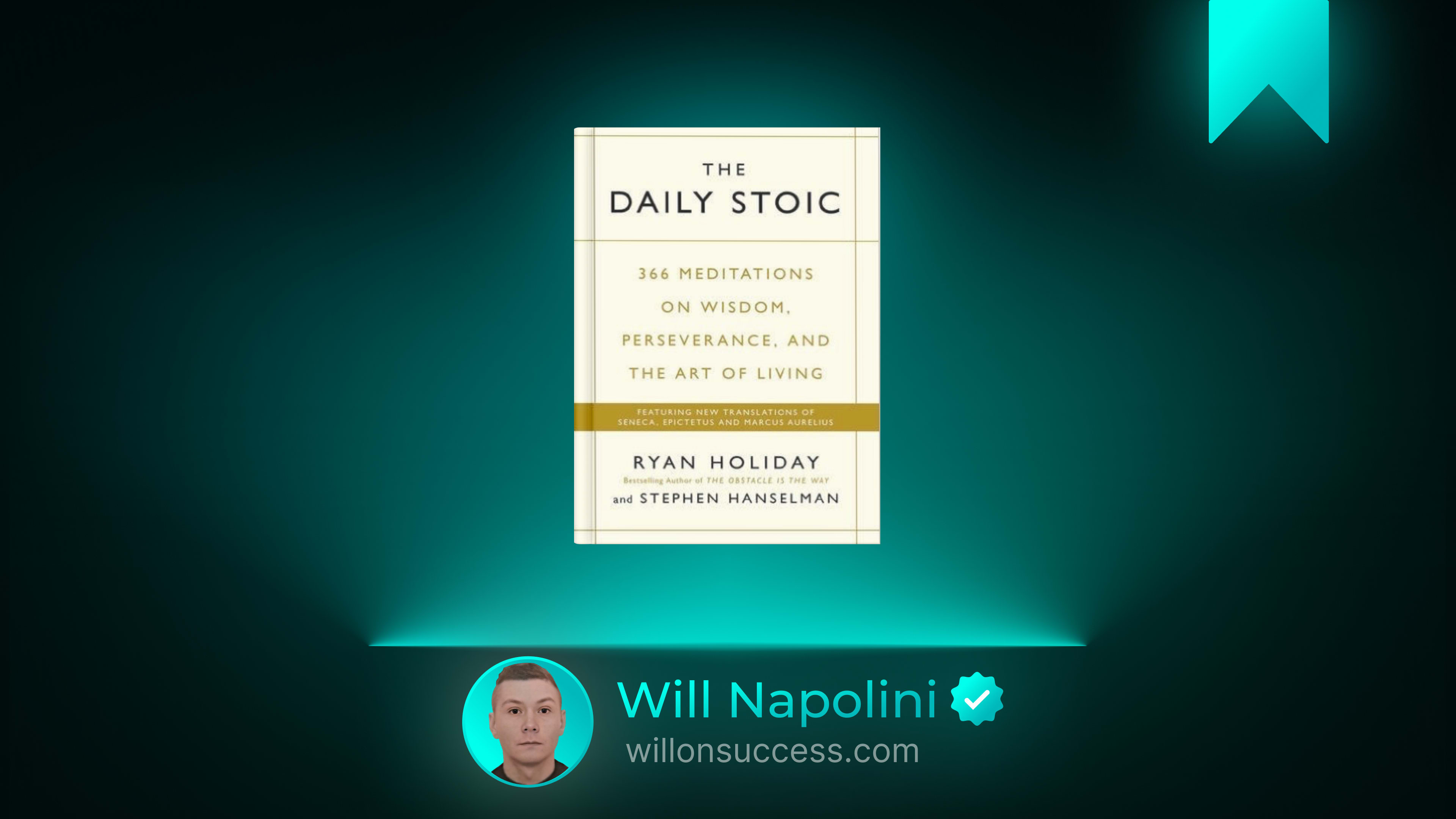
Ryan Holiday and Stephen Hanselman compiled a book called The Daily Stoic. On the surface, it is a devotional. It offers one page for every day of the year, including leap years. But beneath the surface, it is a training manual for the human mind. It is an attempt to take the most battle-tested psychological operating system in human history and hand it to you, one morning at a time.
Let us sit down and look at how this ancient wisdom can change the way you walk through your modern life.

The Big Idea: Wisdom Is Not a Destination; It Is a Daily Practice
There is a profound misconception about Stoicism. When people hear the word, they imagine a person with a heart of stone. Someone who suppresses their emotions, grits their teeth, and endures misery without complaint.
That is not Stoicism. That is just repression.
True Stoicism, as practiced by the ancient Greeks and Romans and translated brilliantly by Holiday and Hanselman, is not about eliminating emotion. It is about eliminating the unnecessary suffering that comes from our judgments about the world. It is an operating system designed to help you thrive in a chaotic, unpredictable, and often unfair world by focusing relentlessly on the only thing you actually possess: your own character and your own choices.
The central thesis of The Daily Stoic is that you cannot read a book on philosophy once and expect it to change your life. You cannot attend a weekend seminar and return home permanently transformed. The mind is a muscle, and the world is heavy. If you do not exercise your perspective daily, the weight of the world will pull you out of alignment.
You do not build an unshakable mind through one grand, intellectual revelation. You build it by laying one small, deliberate brick of perspective every single morning.
The Story: Three Men in the Arena
To understand why this book works, you have to understand the voices it draws from. Holiday and Hanselman did not invent these ideas; they curated them from three primary figures who lived roughly two thousand years ago. And what makes their wisdom so piercing is that none of them were academics sitting in quiet libraries. They were men in the arena, dealing with immense pressure, grief, and betrayal.
First, there is Marcus Aurelius. He was the Emperor of Rome, the most powerful man on earth. Yet his personal journal, which we now know as Meditations, was never meant to be published. It was written in military tents on the freezing frontier, while he fought off plagues, betrayals, and invading armies. He was writing to himself, trying to coach himself into being a good man while carrying the weight of the world.
Second, there is Epictetus. He was born a slave. He walked with a permanent limp, likely the result of a master breaking his leg. He had no wealth, no political power, and no formal status. Yet he became one of the most sought-after teachers of his time, demonstrating that true freedom is entirely internal and cannot be taken by any external master.
Third, there is Seneca. He was a playwright, a wealthy statesman, and an advisor to the erratic and dangerous Emperor Nero. He navigated the treacherous, corrupt politics of Rome, dealt with severe asthma and illness, and eventually faced his own forced execution with remarkable calm.
When you read The Daily Stoic, you are not reading theories. You are reading the survival strategies of a man trying to lead an empire, a man trying to survive slavery, and a man trying to navigate a corrupt court. They were dealing with the exact same human hardware you are dealing with: fear, anger, ego, grief, and the desire for a good life.
The Architecture of an Unshakable Mind
Holiday and Hanselman organize the year around the core disciplines of Stoic practice. Let us translate these from ancient philosophy into the reality of your Tuesday afternoon.
The Dichotomy of Control: Drawing the Line in the Sand
The foundational principle of Stoicism, taught fiercely by Epictetus, is the dichotomy of control. Some things are up to us, and some things are not.
It sounds incredibly simple. Almost too simple to be useful. But I have watched incredibly talented, well-meaning people burn themselves to the ground because they refused to draw this line.
You cannot control the economy. You cannot control the traffic. You cannot control the algorithm, the weather, the past, or the mood your boss woke up in. You cannot even fully control your own body’s health, though you can influence it.
What can you control? Your opinions. Your judgments. Your impulses. Your desires. Your character. Your response to what happens to you.
When you tie your peace of mind to things outside your control, you become a hostage to fortune. You are constantly anxious, waiting for the world to behave the way you want it to. The Stoics teach us to ruthlessly withdraw our emotional investment from the external world and pour it entirely into our internal domain.
Peace does not come from forcing the world to behave. Peace comes from strictly minding the boundaries of your own domain.
Amor Fati: Loving the Weather You Are Given
It is one thing to tolerate a bad situation. It is another thing entirely to embrace it.
The Stoics practiced a concept that the philosopher Friedrich Nietzsche would later call Amor Fati—a love of fate. Marcus Aurelius wrote that a blazing fire turns everything thrown into it into flame and brightness. A small candle might be extinguished by a strong wind, but a roaring fire uses the wind to burn hotter.
When your flight is canceled, when the client pulls out, when the diagnosis comes back positive—the default human response is to ask, Why me? We argue with reality. We exhaust ourselves wishing the past were different.
Amor Fati is the radical decision to stop arguing with reality. It is looking at the obstacle, the failure, or the delay, and saying, Good. This is the material I have been given. How can I use this? What does this teach me? How can I turn this into fuel?
You do not have to pretend the obstacle is pleasant. You just have to refuse to let it be useless.
The Discipline of Assent: Guarding the Gates
If I could sit across the table from you right now, I would ask you to think about the last time you were truly angry.
Someone cut you off in traffic. A colleague made a passive-aggressive comment. Your partner forgot to do the one thing you asked them to do.
Epictetus taught that it is not things that upset us, but our judgments about things. The event itself is just an event. A car changing lanes. A string of words spoken in a room. The anger does not come from the event; it comes from the story you instantly attach to the event. They did that to disrespect me. They don’t care about my time. They are doing this on purpose.
The Discipline of Assent is the practice of standing at the gates of your mind and checking the credentials of your thoughts before you let them in. It is the ability to strip an event down to its bare, objective facts, removing the emotional narrative you have layered on top of it.
When you master this, you create a tiny, vital space between the stimulus and your response. And in that space, your freedom lives. You are no longer a puppet pulled by the strings of external triggers. You become the author of your own reactions.
Memento Mori: The Urgency of the Ticking Clock
We spend most of our lives living as though we have an infinite supply of time. We postpone our dreams. We hold onto grudges. We scroll through our phones for hours, assuming there will always be a tomorrow to do the things that actually matter.
The Stoics kept death close. Memento Mori—remember you must die.
This is not meant to be morbid. It is not meant to induce despair. It is meant to be the ultimate clarifying filter. When you truly internalize the fact that your time here is finite, and that it is depleting every single second, the trivial things simply burn away.
You stop caring about the petty opinions of people you do not even like. You stop delaying the difficult conversation. You stop waiting for the “perfect moment” to start the project.
Death is not the opposite of life; it is the framing device that gives life its shape and urgency.
Why This Matters on an Ordinary Tuesday
Philosophy is useless if it only works on a mountaintop. It has to work in the grocery store line when the person in front of you is arguing with the cashier. It has to work when your teenager is screaming at you. It has to work when you open your laptop and see that your hard drive has crashed.
I have found that the greatest value of The Daily Stoic is not that it gives you new information. You likely already know that you should be patient. You already know you should focus on what you can control. You already know you should not let petty things ruin your day.
The problem is not ignorance. The problem is forgetting.
Under the friction of daily life, we forget. We slip back into old habits. We react. We complain. We worry.
This book matters because it acts as a daily whetstone for your mind. You do not sharpen a knife once and expect it to stay sharp forever. You must hone it regularly. Reading one page of this book every morning takes two minutes. But those two minutes remind you of who you want to be, and more importantly, they give you the tools to catch yourself when you start slipping back into who you used to be.
Practical Application: The Morning and Evening Bookends
Understanding the theory is valuable, but understanding without action changes nothing. How do you actually integrate this into a busy life without it becoming just another chore on your to-do list?
The Morning Preparation: Do not check your phone when you wake up. Before you let the world in, read the daily passage. Do not rush it. Read the quote. Read Holiday and Hanselman’s brief explanation. Then, ask yourself one question: How can I apply this specific idea today? If the passage is about patience, set an intention to be patient in the afternoon meeting. If it is about focusing on what you can control, write down the one thing you are going to let go of today. Close the book and go to work.
The Evening Review: Seneca had a beautiful nightly practice. When the day was done and his wife was asleep, he would examine his entire day. He would ask himself: What bad habit did I cure today? What failing did I resist? Where did I fall short?
He did not do this to shame himself. He did it to learn. He acted as a compassionate but honest judge of his own behavior.
Who Should Read This Book
You should read The Daily Stoic if you feel constantly reactive, as though your emotional state is entirely dependent on the whims of the people and circumstances around you. You should read it if you are carrying a heavy load of responsibility and need a framework to keep from collapsing under it. You should read it if you are tired of modern self-help books that offer empty affirmations and are craving a philosophy that demands something of you.
I want to be honest about what this book is not. It is not a narrative. There is no continuous story pulling you from chapter to chapter. It is a reference book, a tool, a curriculum. If you try to sit down and read it cover to cover in a weekend, you will miss the point entirely. It is designed to be lived with, not consumed.
It also requires a willingness to take absolute responsibility for your life. If you prefer to view yourself primarily as a victim of your circumstances, the Stoics will offer you very little comfort. They will offer you agency, but agency is a heavy thing to carry.
One Small Step
I am not going to ask you to overhaul your entire life today. I am just going to ask you to borrow Seneca’s evening practice.
Tonight, about ten minutes before you go to sleep, leave your phone in another room. Sit in a quiet chair with a physical notebook. Take three minutes to review your day, and write down the answers to just two questions:
- Where did I let my emotions override my reason today?
- Where did I act with the character I am trying to build?
Do not judge yourself harshly. Just observe. Treat yourself like a scientist observing an experiment.
When you do this, you stop sleepwalking through your life. You begin to see the patterns in your behavior. You begin to notice the triggers. And slowly, day by day, you begin to change them.
The world will always be loud. The demands will never stop. The traffic will not clear up, and people will continue to be difficult, unreasonable, and flawed. You cannot build a wall high enough to keep the chaos out.
But you can build an inner citadel. You can fortify your mind so that when the chaos arrives, it breaks against your walls and leaves your peace intact.
Tomorrow morning, the sun will rise, the world will make its demands, and you will have a choice to make. The bricks are waiting.