The Diary of Anne Frank: What a Thirteen-Year-Old's Words Can Teach You About Remaining Fully Human When the World Tries to Erase You
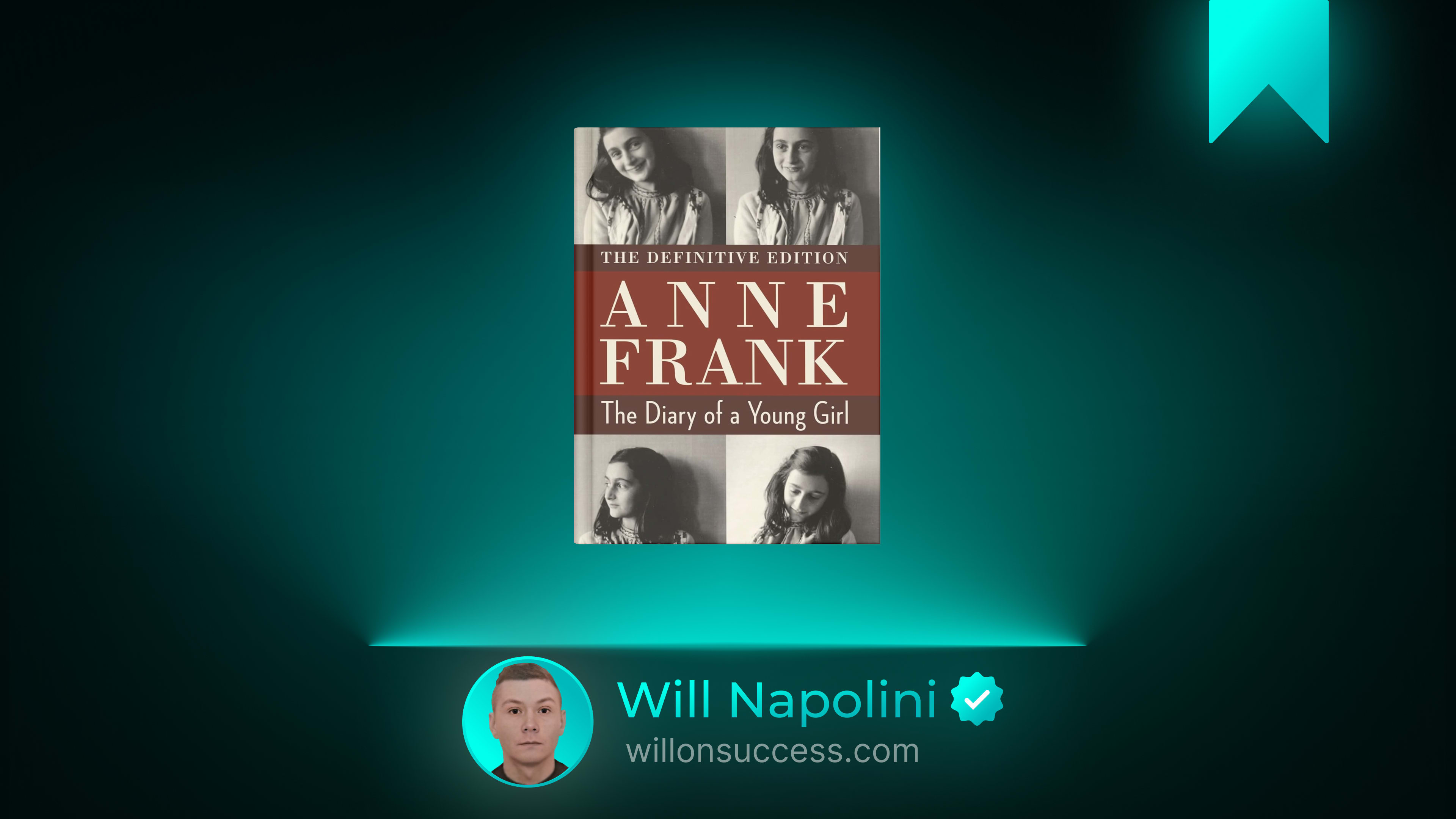
I want to begin by asking you to hold two things in your mind at the same time. They do not fit easily together. You will need to sit with the discomfort of holding them both.
The first: a thirteen-year-old girl receives a red-and-white checked autograph book for her birthday. She is pleased. She decides to use it as a diary. She addresses her entries to an imaginary friend named Kitty. She writes about her school friends, her teachers, the boys she finds interesting, the small social dramas of her classroom. She is ordinary. She is alive. She is beginning.
The second: within a few weeks of receiving that diary, she and her family are forced into hiding. They climb the stairs to a concealed annex above a business in Amsterdam. They will not go outside again. They will not feel rain on their faces, or walk freely down a street, or look at the sky without the filter of curtained windows. They will live in rooms so small that the sound of a single cough, a dropped shoe, a flushed toilet could mean their death. They will live this way for twenty-five months.
And then they will be taken.
Anne Frank will die in Bergen-Belsen in February or March of 1945, a few weeks before the camp is liberated. She is fifteen years old.
The diary survives. Her father, Otto Frank, the only one of the eight people in the annex to survive the camps, publishes it. And the words of a teenage girl, written in a cramped back room while the world tried to erase her, become one of the most widely read documents in human history.
I am not going to summarize this diary as though it were a self-help book. It is not that. It is a record of a life. It is evidence. It is a girl talking to herself in the dark, trying to make sense of who she is while everything around her is being dismantled. But within those pages, there are truths about the human spirit—about growth, about words, about the stubborn refusal to let hatred have the final word—that I have carried with me for a long time. And I want to share them with you, carefully, with the weight they deserve.
The Big Idea: The Inner Life Is the One Territory No One Can Take
The annex is small. The rules are suffocating. Eight people share a few rooms. They cannot move freely. They cannot speak loudly during the hours when the warehouse workers are downstairs. They cannot open the curtains. They cannot go outside. Their physical world has been reduced to almost nothing.
And yet. Within that tiny, airless space, Anne Frank’s inner life is vast.
She reads. She studies. She writes. She examines herself with a honesty that most adults never achieve. She argues with herself about her own character. She watches her feelings change. She notices the way her thoughts about her mother shift over time—anger one week, tenderness the next. She tracks her growing awareness of the war, of politics, of the world beyond the annex walls. She dreams about trees, about rain, about riding a bicycle.
What Anne discovered, perhaps without fully naming it, is something I have come to believe is one of the most important truths a person can learn: your circumstances can confine your body, but they cannot confine your mind unless you let them. The inner life—your thoughts, your curiosity, your capacity to observe, to question, to create, to love—remains yours. It is the one room that no one can lock from the outside.
Anne writes with an intensity of attention that takes my breath away. She describes the light on a wall. The sound of an airplane overhead and the terror it brings. The taste of a potato. The exact quality of silence when everyone in the annex is trying not to breathe too loudly. She is not merely surviving. She is living, inside the only territory that remains available to her.
And that is a lesson I think about when I feel trapped. Not in the way Anne was trapped—I want to be clear about that. The comparison would be obscene. But in the small, ordinary ways we all feel confined. The job that has become a cage. The relationship that has gone cold. The season of life where the walls seem close and the options seem few. The feeling that your external circumstances have narrowed so much that you have forgotten you are still a person with a mind, a will, an imagination, a capacity to choose your response.
Anne did not choose the annex. She did not choose the war. She did not choose the world that wanted her dead. But she chose, every single day, to remain curious. To remain observant. To remain herself. And that choice, made in the smallest possible room, is one of the most extraordinary acts of freedom I have ever encountered.
Writing as a Way of Staying Whole
Anne did not write the diary for publication. She wrote it because she needed to talk. And there was no one to talk to—not really. There were seven other people in the annex, but they were all under the same crushing pressure, all carrying their own fear, their own exhaustion, their own need. A thirteen-year-old girl, then fourteen, then fifteen, needed a space where she could be contradictory, uncertain, angry, tender, confused, and hopeful all at once, without having to manage anyone else’s feelings.
The diary gave her that space. She wrote that paper has more patience than people. And she was right. The page does not judge. The page does not interrupt. The page does not say, You should not feel that way. You should be grateful. You should be quieter. You should not be so difficult.
Through writing, Anne became the author of her own experience. In a world where every decision about her body, her safety, her future was being made by forces beyond her control, the act of writing was the one thing she could govern. She chose the words. She chose the structure. She chose what to say and how to say it. She chose to call her imaginary friend Kitty. She chose to be honest.
And something remarkable happened. Over two years, you can watch Anne grow. The entries change. The vocabulary deepens. The self-awareness sharpens. The early entries are the observations of a clever, slightly vain schoolgirl. The later entries are the reflections of a young woman who has examined her own character with unflinching honesty, who has thought seriously about what kind of person she wants to become, who has begun to articulate a philosophy of life under the most extreme pressure imaginable.
She wrote that she wanted to go on living even after her death. She wanted to be a journalist, a writer. She wanted her life to mean something beyond the walls of the annex.
I think about that when I consider the power of putting words on paper. Not for an audience. Not for social media. Not for publication. Just for yourself. The act of naming your experience—writing down what you felt, what you noticed, what confused you, what made you angry, what made you grateful—is an act of self-preservation. It says: I was here. This happened. I felt it. It mattered.
You do not need to be in hiding to need that. You do not need to be facing death to benefit from the simple, radical act of writing down your truth in a private space where no one will correct you.
The Complexity of People Under Pressure
One of the things that makes Anne’s diary so enduring—and so honest—is that she does not turn the people in the annex into saints. She does not flatten them into symbols of suffering. She shows them as they are: complicated, irritable, sometimes petty, sometimes generous, always human.
She clashes with her mother. She feels misunderstood by her. She writes about it with a teenage ferocity that will be familiar to anyone who has been fifteen and certain that no one in the family understands them. She adores her father, but even that adoration is complicated, shifting, examined. She finds Mrs. van Pels exhausting. She finds Mr. Dussel difficult. She is drawn to Peter van Pels, the quiet teenage boy in the annex, and then questions whether she really likes him or simply likes having someone her own age to talk to.
And the others are not patient with her either. She is told she is too loud, too talkative, too much. She is criticized. She is corrected. She is reminded to be quiet, to be smaller, to take up less space.
This is important. Because the alternative—the version where eight people in hiding are always noble, always gentle, always unified—would be a lie. And Anne was too honest to lie. She shows you that even in the most extreme circumstances, people are still people. They still get on each other’s nerves. They still have preferences and moods and small grievances. They still need space and silence and the dignity of being allowed to be imperfect.
I think about this when I am frustrated with the people I live with, work with, or love. The small irritations. The accumulated friction of shared space. The feeling that someone is taking up too much room, or not enough, or the wrong kind. Anne’s diary reminds me that this friction is not a sign of failure. It is a sign of humanity. Even in the annex, even facing death, the people were still themselves. Still complicated. Still difficult. Still worthy of patience, even when patience was the hardest thing to give.
Hope as an Act of Will, Not a Feeling
There is a passage in the diary—perhaps the most widely known—where Anne writes that in spite of everything, she still believes people are truly good at heart. She says she cannot build her hopes on a foundation of confusion, misery, and death. And yet she holds on.
I want to be careful with this, because I do not want to turn Anne’s words into a greeting card. I do not want to smooth them into a platitude about optimism. Because the context matters. This is not a person saying, Everything will be fine. This is a girl who has heard the sirens, who has listened to the radio reports, who knows what is happening to people like her across Europe, who lives in terror of the sound of footsteps on the stairs. She knows the darkness is real. She is not ignoring it.
And yet she chooses, deliberately, to believe in goodness. Not because the evidence supports it. Because the alternative—to give in entirely to hatred, to despair, to the belief that humanity is irredeemable—would be a second death. The first death the world was trying to impose on her body. The second would be the death of her spirit. And she refuses to grant it.
Hope, in Anne’s diary, is not a mood. It is not a feeling that arrives when circumstances improve. It is a decision. An act of will. A refusal to let the worst of what people do erase the possibility of the best.
I think about that when I feel the pull of cynicism. When the news is relentless. When the people around me are exhausted and angry. When it feels easier to believe that nothing will change, that nothing matters, that the arc of the world bends toward cruelty and we are fools to think otherwise. Anne’s voice, from a room she could not leave, from a war she could not stop, from a future she would not live to see, says: You can choose differently. You can look at the darkness and still decide to plant something.
That is not naivety. That is the hardest kind of courage.
The Helpers: The Quiet Architecture of Courage
I want to mention the people who kept the annex alive. Miep Gies, Johannes Kleiman, Victor Kugler, Bep Voskuijl. They were Otto Frank’s employees and friends. They brought food. They brought books. They brought news of the outside world. They climbed the stairs to the annex every day, knowing that if they were discovered, they would be arrested, deported, killed.
They did not do it for recognition. They did not do it because it was easy. They did it because they looked at the people in that annex and saw human beings. And they decided, quietly, without fanfare, that they would act as though those human beings mattered.
Miep Gies later said, when people called her a hero, that she was not a hero. She said she had simply done what anyone would do. I think she was wrong. Not everyone would have done it. The evidence of history shows that clearly. But I think her modesty points to something important: that courage, in its most essential form, is not always dramatic. Sometimes it is showing up with groceries. Sometimes it is keeping a secret. Sometimes it is climbing a staircase, day after day, carrying bread and potatoes and the unbearable weight of knowing what will happen if you are caught.
You do not need a stage to be brave. You need a person who needs you, and the willingness to show up.
Who Should Read This Diary
Everyone. I mean that. This is not a book to be assigned and forgotten in a school curriculum. It is a book to be read slowly, carefully, with attention. It is a book to be returned to at different ages, because you will hear different things in it as you grow.
If you are young—thirteen, fourteen, fifteen—read it as the diary of a girl your age. Read it and recognize yourself in her. Her frustrations with her parents. Her self-consciousness. Her desire to be understood. Her growing awareness that the world is larger and more complicated than her family has told her. Anne is not a symbol. She is a person. She is funny, and sharp, and sometimes unkind, and sometimes vain, and often lonely, and always, always alive.
If you are an adult, read it for what it reveals about the human capacity to grow under pressure. Read it for the writing itself—for the way a girl who had never been taught to write at a high level somehow produced sentences of startling clarity and emotional precision. Read it for the history. Read it for the helpers. Read it as a reminder of what happens when a society decides that some people are less human than others, and what it costs to resist that decision.
I will be honest: this is not an easy read. Not because the language is difficult—Anne’s prose is clear, direct, and often funny. But because you know the ending. You know, from the first page, that the girl writing these words will not survive. And you have to sit with that knowledge while she writes about her hopes for the future, her plans to become a journalist, her belief that she will live a long and meaningful life. The gap between her hope and what you know is almost unbearable.
But I think that is why the diary must be read. Because it forces you to hold that gap. To feel the weight of what was lost. To understand that the Holocaust was not an abstraction, not a statistic, not a historical era. It was a girl. It was her words. It was her specific, irreplaceable, unrepeatable life, ended at fifteen.
One Small Step
I am not going to give you a productivity exercise. I am not going to ask you to optimize your morning routine. That would be obscene, given what this diary holds.
Instead, I will ask you this.
Tonight, or tomorrow morning, take ten minutes. Find a quiet space. Take a piece of paper or open a blank document. And write down one true thing about your life right now. Not a performance. Not something for anyone else to read. One honest sentence about what you are feeling, or what you have noticed, or what you are afraid of, or what you are grateful for, or what you want to become.
That is all. One true sentence.
Anne Frank wrote hundreds of true sentences in a room she could not leave, in a world that wanted her silent. She wrote them because the act of writing them was a way of saying, I am here. I am thinking. I am feeling. I am not nothing.
You are here. You are thinking. You are feeling. You are not nothing.
Write the sentence. Let it be small. Let it be imperfect. Let it be yours.
The world will try to make you smaller than you are. It will try to reduce you to a function, a category, a productivity metric, a role. It will try to convince you that your inner life does not matter, that your observations are not worth recording, that your voice is not needed.
You can refuse. You can pick up the pen. You can open the diary. You can say, in whatever small way is available to you, I am here, and I am paying attention, and I will not be erased.
The curtains do not have to be drawn. The sky is visible. The rain is falling. And you are still here, still capable of noticing, still capable of choosing what you will say about the life you are living.
That is not nothing. That is everything. And it is yours.