Wild Swans: How to Keep Your Humanity When the World Loses Its Mind
Have you ever watched the foundational rules of your world change overnight?
Not just a difficult Tuesday, and not a standard career setback. I mean a shift so profound that the map you were using to navigate your life suddenly no longer matched the territory. The company you gave your best years to is suddenly restructuring. The political climate of your country fractures in a way you cannot comprehend. A global event locks you inside your home and rewrites the rules of human connection.
When the ground rules change, our instinct is to panic. We scramble to find the old map. We demand that the world make sense again.
But what if the map is gone forever? What if the storm is not a temporary weather system, but the new climate?
If you have ever felt swept up in forces entirely beyond your control, I want to talk to you about a book that I believe is one of the most important documents of the twentieth century. It is not a business book. It is not a psychology manual. It is a memoir.
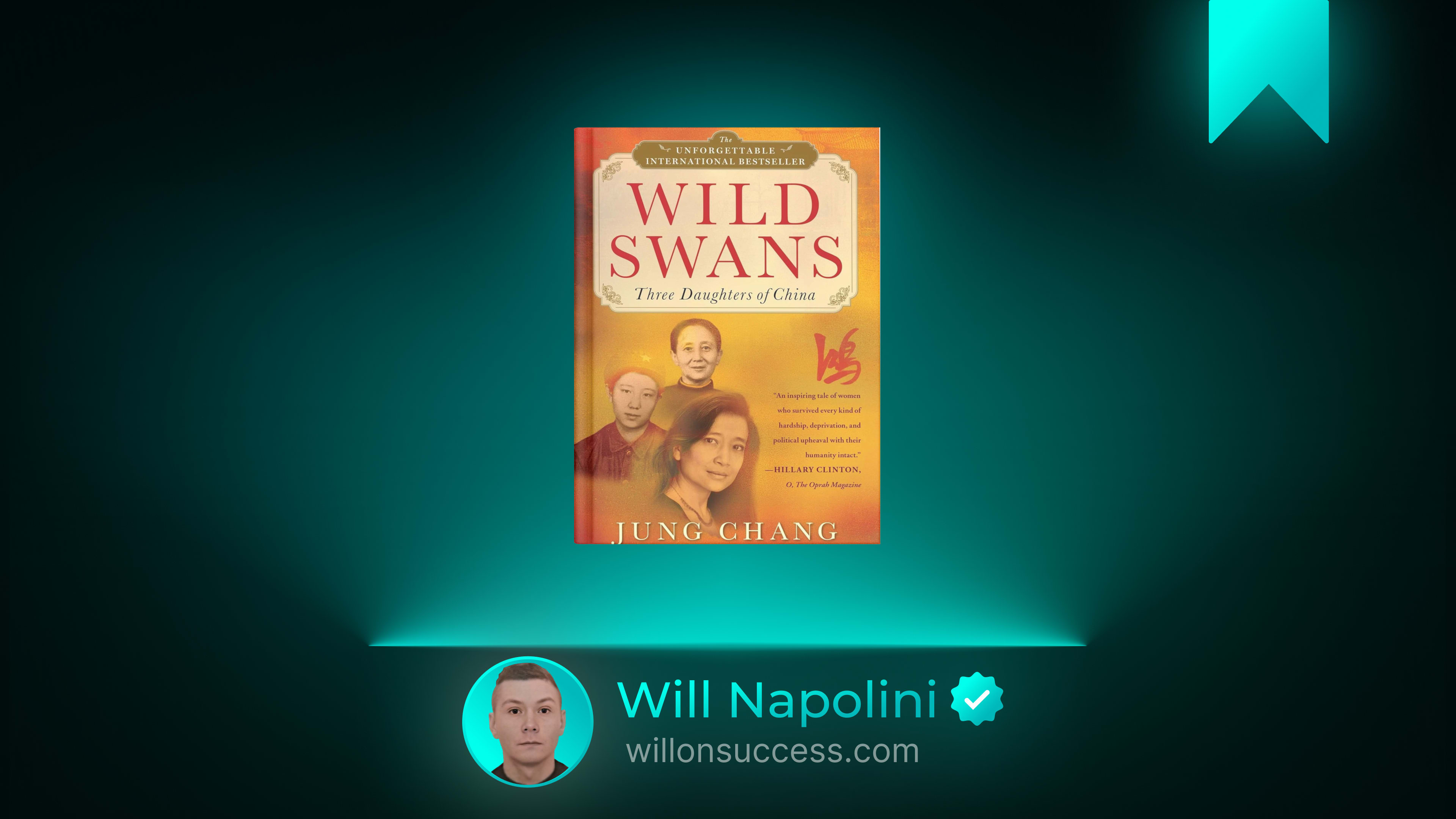
Wild Swans: Three Daughters of China by Jung Chang is a sweeping, heartbreaking, and ultimately triumphant account of three generations of women in her family. It covers the warlord era, the Japanese occupation, the Communist revolution, and the devastating fanaticism of the Cultural Revolution.
But beneath the immense weight of Chinese history, this book holds a quiet, urgent message for you and me today. It is a masterclass in how to keep your humanity intact when the world around you loses its mind.
The Big Idea: The Inner Citadel
Here is the principle at the center of this epic story, and I want you to let it settle into your bones:
You cannot control the macro-forces of history, politics, or systemic collapse. But your ultimate freedom, and your ultimate power, lies in what you refuse to surrender internally.
Jung Chang’s family lived through regimes that demanded total ownership of the individual. They were told what to think, what to read, who to love, and who to hate. The state attempted to colonize their minds.
Yet, across three generations, these women managed to preserve a core of self that the state could not touch. They did this not through grand, suicidal rebellions, but through a fierce, quiet commitment to their own dignity, their love for their family, and their relentless pursuit of the truth.
The book teaches us that resilience is not merely the ability to endure suffering. Resilience is the refusal to let the cruelty of your circumstances extinguish your character.
The Three Daughters and the Architecture of Survival
To understand the depth of this lesson, you have to meet the three women at the heart of the story. Jung Chang structures the book around her grandmother, her mother, and herself. Each woman faced a different kind of cage, and each found a different way to keep her soul alive.
The Grandmother (Yu-fang): Born in 1909, she was made a concubine to a powerful warlord general. She lived in a gilded cage of immense wealth but zero autonomy. She endured the agonizing physical trauma of foot-binding (and the subsequent, equally painful unbinding). She had no political power, no legal rights, and no voice. Yet, she maintained an unshakeable inner grace. She poured all her fierce, quiet love into her daughter, ensuring the next generation would have the freedom she was denied. Her power was the power of endurance and quiet dignity.
The Mother (De-hong): Born in 1931, she was a passionate idealist. She joined the Communist underground, risking her life to help overthrow the corrupt old system. She married a dedicated, high-ranking Communist official (Jung’s father). For a time, she believed she was building a utopia. But when the paranoia of the Cultural Revolution took hold, the revolution turned on its own. Her husband was brutally tortured, and she was publicly humiliated and forced into hard labor. Her test was not just physical survival, but moral survival: how to keep believing in goodness when the ideology she worshipped became a monster.
The Daughter (Jung Chang): Born in 1952, Jung grew up entirely inside the fanaticism of Mao’s China. As a teenager, she was a Red Guard. She participated in the mob mentality, believing she was serving a glorious cause. But slowly, agonizingly, she began to see the cracks. She witnessed the senseless cruelty, the destruction of culture, and the starvation of her people. Her journey was one of awakening. She had to find the courage to dismantle her own indoctrination, eventually learning English in secret and securing a scholarship to leave China.
Through their lives, Jung Chang reveals several profound principles for navigating our own turbulent times.
The Most Dangerous Cage Is the One You Are Taught to Defend
One of the most chilling aspects of Wild Swans is watching Jung’s transformation as a Red Guard. As a young girl, she did not feel oppressed. She felt exhilarated. She was part of a movement. She had a uniform, a purpose, and a clear enemy.
It is only later, looking back, that she realizes how completely her mind had been colonized. She had surrendered her critical thinking to the crowd. She had traded her individual moral compass for the intoxicating warmth of belonging to the mob.
I want to speak directly to you about this, because the mechanics of groupthink have not changed, even if the uniforms have.
We do not have Red Guards in our modern streets, but we have digital mobs. We have corporate echo chambers. We have the intense, quiet pressure in our social circles and our workplaces to nod along, to repeat the approved phrases, and to signal our allegiance to the current orthodoxy.
It is incredibly tempting to surrender your mind to the crowd. It feels safe. It feels like solidarity. But Jung’s story is a warning: the moment you stop asking questions, the moment you let the group do your thinking for you, you have handed over the keys to your inner citadel.
You must protect your capacity for independent thought. It is the most valuable asset you own. When everyone around you is shouting the same slogan, the most radical, self-preserving act you can commit is to pause, step back, and ask, Is this actually true?
Dignity Is an Inside Job, Especially When You Have No Power
It is easy to be dignified when you are in charge. It is easy to have strong boundaries when you hold the leverage. But what do you do when you are entirely powerless?
Jung’s grandmother, Yu-fang, had no power. She was a concubine in a patriarchal, warlord-ruled society. She could be discarded, punished, or ignored on a whim. Yet, she refused to let her circumstances dictate her posture. She maintained her routines. She treated her servants with kindness. She held her head high. She created a small, ordered world inside her own mind and her own household that the chaos outside could not breach.
I have seen this principle play out in the lives of people I mentor. You may not be able to stop the merger that is about to eliminate your department. You may not be able to cure the illness that has entered your family. You may not be able to control the toxic manager who makes your daily life miserable.
When you face those immovable walls, you still have a choice about how you stand in front of them.
Dignity is not granted by your circumstances; it is forged in your response to them. It is the decision to treat the junior staff with respect even while the company burns down around you. It is the decision to keep your physical space clean and beautiful even when you are grieving. It is the refusal to let the ugliness of your environment turn you into an ugly person.
You cannot always control the storm. But you can always control the architecture of your own character.
Awakening Requires the Courage to Grieve Your Illusions
Perhaps the most painful part of Jung Chang’s journey is her awakening to the truth about the Cultural Revolution. For years, she had believed that Chairman Mao was a living god and that the revolution was the salvation of humanity. To realize that the system she had dedicated her youth to was actually a nightmare of paranoia and cruelty was not just an intellectual shift. It was a profound psychological rupture.
She had to grieve the death of her illusions. She had to accept that she had been wrong, that she had been used, and that the heroes she worshipped were flawed or monstrous.
This is a deeply uncomfortable process, but it is a necessary one for anyone who wants to live an authentic life.
At some point in your life, you will likely face a similar, albeit smaller, reckoning. You will realize that the career path you spent a decade climbing is fundamentally hollow. You will realize that the marriage you are in is no longer a partnership. You will realize that the mentor you idolized does not actually have your best interests at heart.
The temptation in these moments is to double down. To ignore the evidence. To keep pretending, because admitting the truth means admitting that you invested years of your life into a mirage.
But growth demands the death of our illusions. You must be willing to look at the wreckage of your old beliefs, grieve the time you lost, and bravely step into the terrifying, liberating light of what is actually real. The truth may break your heart, but it is the only ground solid enough to build a real life upon.
The Stories We Tell Are the Armor We Pass Down
Throughout the book, the most powerful force for survival is the bond between the women. Even when it was dangerous, even when the state demanded that children report on their parents, Jung’s mother and grandmother found ways to pass down their history, their values, and their love.
During the darkest days of the Cultural Revolution, when Jung’s father was being tortured and the family was starving, her mother did not just offer empty platitudes. She offered context. She shared stories of their family’s past. She modeled a quiet, unbreakable moral core. She gave Jung the internal resources she would need to eventually question the regime and find her way out.
This brings us to a question I want you to consider seriously: What armor are you building for the people who love you?
We spend so much time trying to give our children, our partners, and our friends external advantages—better schools, better networks, better financial security. But the most vital inheritance you can pass down is your own resilience.
Do the people in your life see you handle failure with grace? Do they hear you tell the truth when it is difficult? Do they know the stories of your own struggles, and how you navigated them? When the world inevitably shifts beneath their feet, they will not remember the advice you gave them. They will remember the way you stood when the wind was howling.
Why This Matters on an Ordinary Thursday
You might be thinking, This is an incredible history, but my life is not a Chinese historical epic. I am just trying to get through my workweek.
That is exactly why this book matters.
We have a habit of thinking that “resilience” is something you only need when a tragedy strikes. But the micro-storms of daily life require the exact same internal architecture as the macro-storms of history.
When your industry is disrupted by artificial intelligence and you feel the panic of obsolescence, you are facing a shift in the ground rules. When the cultural discourse in your country becomes so polarized that you feel alienated from your neighbors, you are facing a crisis of belonging. When a personal betrayal shatters your trust, you are facing an ideological collapse in your own heart.
Wild Swans teaches us that we do not need to be fearless to be brave. Jung Chang and her mother were terrified for much of their lives. But they kept moving. They kept loving. They kept reading in secret. They kept holding onto the small, human truths that the state could not confiscate.
You do not need to have all the answers for the next ten years. You only need to know how to protect your inner citadel today.
Who Should Read This Book, and Who Might Need to Wait
I want to be entirely honest with you about the weight of this book, because it is not a casual read.
Wild Swans is a masterpiece, and it is essential reading for anyone who wants to understand the modern world, the nature of totalitarianism, and the depths of human endurance. If you are feeling overwhelmed by the news cycle, if you are navigating a toxic institutional culture, or if you are trying to understand the intergenerational trauma and strength in your own family tree, this book will give you profound perspective. It will make your own problems feel manageable, and it will inspire a deep, quiet awe for the human spirit.
However, if you are currently in the acute, raw stages of your own trauma, or if you are in a season where your emotional bandwidth is entirely depleted, you may want to wait. The book contains graphic descriptions of torture, starvation, public humiliation, and profound cruelty. It is unflinching. It requires emotional stamina to read. Do not force yourself to carry the weight of 20th-century China if you are currently struggling to carry the weight of your own Tuesday.
Give it time. Read it when you are ready to be challenged, stretched, and ultimately elevated.
A Question Worth Sitting With
If you are willing to look at the current landscape of your life, I would offer you this question to journal about or ponder on a long walk:
Where in my life have I surrendered my independent judgment to the comfort of the crowd?
Is there a belief you hold just because your political tribe holds it? Is there a practice at your company that you know is unethical, but you stay silent because everyone else does? Is there a standard you have lowered in your personal life because “that is just how things are now”?
Notice where you have stopped asking questions. And then, gently, ask yourself what it would cost you to reclaim your own mind in that specific area.
You do not have to launch a public rebellion. You just have to quietly, firmly, take back the keys to your own thoughts.
One Small Step for Today
Here is what I want you to do before this week ends. It is small, it is deeply human, and it connects directly to the lifeblood of Jung Chang’s memoir.
Reach out to an elder in your life. A parent, a grandparent, an aunt, an uncle, or an older mentor. Someone who has lived through a season of history that you only know from textbooks or stories.
Ask them this specific question: “What was the hardest season of your life, the one where you thought the ground was going to give way, and how did you actually get through it?”
Do not ask for advice. Do not ask for a polished lesson. Just ask for the story. Listen to how they speak about the fear, the confusion, and the small, daily choices they made to keep going.
When you do this, you are doing more than just having a conversation. You are gathering the armor you will need for your own future storms. You are reminding yourself that the human race has survived impossible things before, and that the blood of survivors runs in your veins.
The storms will come. The maps will change. The ground rules will shift. They always do.
But you are built from the same enduring material as the wild swans. You know how to fly through the dark.