Who Moved My Cheese? – Why Fighting Change Keeps You Hungry, and What to Do Instead
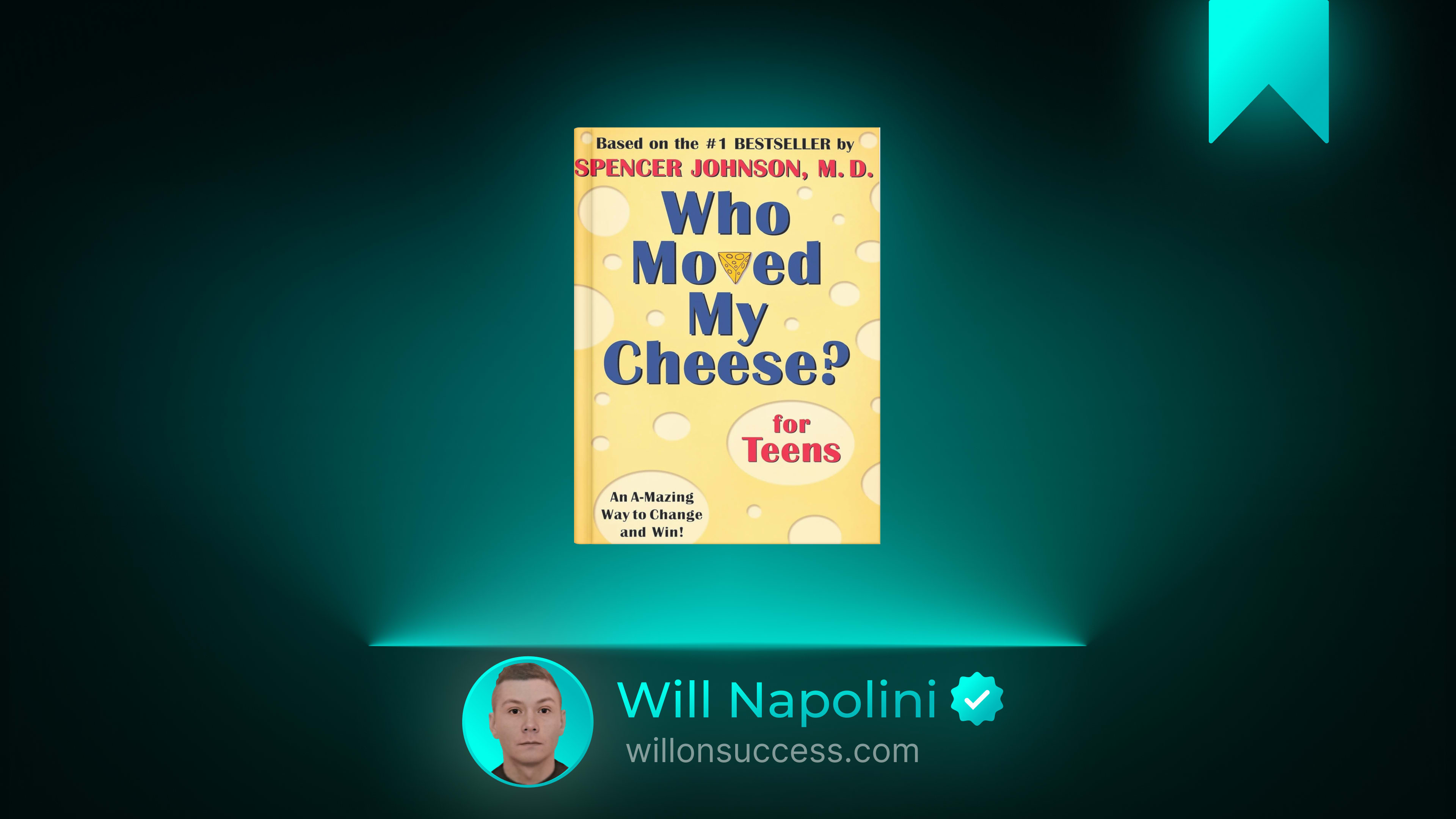
Have you ever held tightly to something—a job, a relationship, a routine, a version of yourself—long after it stopped nourishing you? Not because you were foolish. Not because you lacked courage. But because it was familiar, and familiarity felt safer than stepping into a corridor where you could not yet see the walls?
I have. More than once. And I have watched people I care about do the same thing for years, standing in an empty room, waiting for what used to be there to come back.
If that image stirs something in you, I want to talk about a very small book. Ninety-six pages. You could read it in an afternoon. And yet, since its publication in 1998, Who Moved My Cheese? by Spencer Johnson has reached tens of millions of readers for a reason. Not because it is complex. Because it names something true that most of us would rather not look at directly.
And sometimes the simplest mirror is the one we need most.

The Big Idea, Stripped to the Bone
Here is the principle at the center of the book, and I want you to sit with it before we go further:
Change is not something that happens to you. It is the permanent condition of the ground you walk on. Your task is not to prevent it. Your task is to learn how to move with it.
Johnson’s insight is not that change is bad or good. It is that our suffering almost never comes from the change itself. It comes from the gap between what is and what we insist should still be. The longer that gap persists, the more we starve—not because there is no nourishment left in the world, but because we are standing in one empty spot, staring at the floor where nourishment used to sit.
That gap is where most of us lose years. Not decades of effort wasted, but years of standing still inside our own denial.
The Maze, the Cheese, and Four Very Different Creatures
Johnson tells his lesson as a fable, and I think that is the right choice. Stories bypass our defenses. Arguments raise walls; parables walk around them.
Imagine a maze. Not a sinister one—just a large, complicated network of corridors and rooms. Inside this maze live four characters searching for cheese:
Sniff and Scurry, two mice. They are simple creatures. They do not overthink. They sniff around, they scurry forward, they follow their instincts, and when the cheese is gone, they move.
Hem and Haw, two “littlepeople”—small beings roughly the size of mice but with complex human minds. They think. They plan. They build identities around their cheese. They believe they deserve it. They believe it will last.
All four find a generous supply at a place called Cheese Station C. For a while, everyone is content. The littlepeople build their lives around this station. They decorate the walls. They measure their self-worth by the pile of cheese. They stop paying attention to whether the supply is shifting, shrinking, aging.
Then one morning, the cheese is gone.
The mice, who had been paying attention all along—who had noticed the supply thinning, the smell changing—simply lace up their tiny running shoes and head into the maze to find new cheese. No drama. No grievance. They go.
Hem and Haw freeze. They rage. They demand to know who moved their cheese. They return day after day to the empty station, hoping it will reappear. They grow weaker. They grow bitter. They tell themselves stories about how unfair this is, how they were owed this, how the maze has wronged them.
Eventually—after long suffering—Haw decides to venture back into the unknown corridors. Hem refuses. Haw is terrified. But he moves anyway. And as he moves, he writes small lessons on the maze walls for himself, and perhaps for Hem if Hem ever decides to follow.
Haw finds new cheese. More than before, actually. And he learns something that reshapes him: the fear of the search was always worse than the search itself.
The Resistance Is Not Laziness—It Is Identity
I want to pause here, because I think this is where the book quietly does its most important work.
Hem is not a villain. Hem is not stupid. Hem is you, and Hem is me, in the seasons when we have tied our sense of self so tightly to one outcome, one role, one arrangement, that losing it feels like losing a limb.
When your career path collapses due to restructuring, the grief is not only financial. It is existential. If I am not this role, who am I? When a relationship ends after years, the loss is not only companionship. It is the entire architecture of daily meaning you built around another person. When an industry shifts and your hard-won expertise suddenly seems irrelevant, the wound is not only professional. It is the feeling that your past was wasted.
Johnson understood this. He did not write a book that says “just adapt, you coward.” He wrote a book that says: I see how much it hurts. I see why you want to stand still. And I am gently, firmly telling you that standing still will not return what you lost.
The cheese will not come back to Station C.
That sentence is not cruel. It is liberation. Because once you truly accept it, your energy stops flowing backward into grief and begins flowing forward into possibility.
Anticipate the Shift Before It Arrives
One of the quiet lessons Haw scrawls on the wall is the idea of “smelling the cheese often.” In plain terms: pay attention to the conditions of your life while they are still good.
This does not mean living in anxious vigilance. It means honest observation.
If I could sit across the table from you right now, I would ask you gently: Is there an area of your life where you have stopped paying attention because things feel stable? A role at work that is slowly being automated. A relationship where the conversations have grown thinner month by month. A skill set that the market is quietly outgrowing. A body that has been sending small signals you keep postponing.
The mice noticed the cheese was getting older. They noticed the pile shrinking. They were not panicked. They were simply observant. And because they observed, they were not shocked. And because they were not shocked, they could act.
You do not need to live in fear of change. You need to live in awareness of it. Those are very different postures. Fear paralyzes. Awareness prepares.
Letting Go Is Not Losing—It Is Making Room
The hardest sentence in the book, for me, is the principle that the quicker you let go of old cheese, the sooner you find new cheese.
Notice it does not say “the quicker you forget.” It does not say “the quicker you pretend it did not matter.” Letting go is not erasing. You are allowed to grieve what you had. You are allowed to sit in the empty station for a while and feel the loss.
But there is a difference between grieving and camping. Grief is a passage. Camping is a decision to make your home in the passage.
I have seen people grieve a lost career for six months, process it, and walk forward with new clarity. I have also seen people grieve the same lost career for eight years, returning to the empty station every morning in their mind, replaying the injustice, rehearsing the argument about who took their cheese and why.
Both responses are human. Only one leads forward.
You do not owe your past the rest of your future.
Fear Is Loudest at the Threshold
Haw’s journey into the maze is not triumphant from the first step. He is afraid. He doubts himself. He wonders if he is being foolish. Part of him wants to turn back to the familiar emptiness of Station C, because at least that emptiness is known.
Johnson writes this honestly, and I am grateful he does. Because the lesson is not “brave people feel no fear.” The lesson is: you can be afraid and still put one foot forward. Courage is not the absence of trembling. Courage is trembling and walking anyway.
What Haw discovers—and what I have seen confirmed in my own life and in the lives of people I have mentored through transitions—is that the imagined maze is always more terrifying than the real one. The corridors we dread in our minds are longer, darker, and more labyrinthine than the corridors we actually walk. The anticipation of the search tortures us more than the search ever does.
You have probably felt this. The weeks before the difficult conversation. The months before the career leap. The year of anxiety before the change that, once it arrived, was manageable. Hard, yes. But manageable. Not the monster your mind constructed in the dark.
The fear shrinks in the presence of motion.
The Practical Shape of This in Your Life
Let me bring this down from parable to Tuesday.
In your career: If your industry is shifting, do not wait for the layoff email to begin retraining. Spend thirty minutes a week learning an adjacent skill. Update your network before you need it. The mice did not wait until the cheese was completely gone. They noticed the thinning and prepared. You can too.
In your relationships: If the dynamic with someone important has changed—a friend who has grown distant, a partner whose needs have shifted, a parent who is aging—do not stand at the old station demanding the old interaction return. Ask yourself what the relationship needs now. Adapt. Reach out differently. Grieve the old shape if you must, but do not freeze inside it.
In your habits and identity: If you have built your self-image around being a certain kind of person—the reliable one, the strong one, the one who never asks for help—and life is now asking you to become someone slightly different, that is not a betrayal of who you are. That is growth. The maze is asking you to find a new corridor. You are allowed to walk down it.
In your daily routines: Sometimes the “cheese” is small. A morning ritual that no longer energizes you. A weekly obligation you keep honoring out of guilt. A project you continue because you started it three years ago, not because it still serves you. You are permitted to set it down. You are permitted to walk toward something that fits who you are becoming, not only who you were.
What This Book Is, and What It Is Not
I want to be honest with you about the book’s limits, because I think that honesty makes its strengths more trustworthy.
Who Moved My Cheese? is not a deep psychological exploration of trauma or loss. If you are in the middle of profound grief—the death of someone you love, the aftermath of abuse, a serious health crisis—this little parable will not be enough, and you do not need it to be. You need time, support, and often professional care. There is no shame in that. The book is not a substitute for those things.
It is also not a political or economic analysis. It does not address the very real structures and injustices that constrain people’s choices. Sometimes the cheese is moved by forces that are genuinely unfair, and acknowledging that unfairness is important. You are not required to be grateful for every disruption.
What the book is—and does well—is a gentle, memorable nudge for the person who has the capacity to move but is stuck in resistance. It is for the Tuesday when you know, somewhere beneath the denial, that you need to walk into the maze but keep telling yourself tomorrow will look like yesterday.
It is best read quickly, in one sitting, and then sat with for a week. Let the images settle. See which character you recognize in yourself this month. You might be Haw on Monday and Hem on Thursday. That is normal. The goal is not to be the mouse forever. The goal is to notice when you have planted your feet at the empty station and gently, firmly, begin to walk.
A Question Worth Writing Down
If you keep a journal, or even if you simply think in long walks, here is a question I would offer you:
What am I standing in front of, waiting for it to come back, that has already moved?
Do not rush the answer. You might not know today. But the asking changes something. It cracks the seal on the denial just enough to let a little fresh air in.
And if the answer comes and it frightens you—if the cheese that moved was something you loved, something you built, something you thought was permanent—let yourself feel the sadness. Then ask the next question:
What is one small step into the maze I could take this week?
Not a grand reinvention. Not a five-year plan. One step. One phone call. One class enrollment. One honest conversation. One permission slip you write yourself to want something new.
You start small. You let go of the empty room. You walk toward what you cannot yet see.
One Small Step for Today
Here is what I would ask you to do before this day ends. It is small. It is specific. And it matters more than it looks.
Choose one area of your life where you have been saying, “This will go back to how it was,” or “I will deal with this eventually.” You know the area. It surfaced in your mind the moment you read that sentence.
Now take out your phone or a piece of paper and write down one action—small, concrete, doable within the next forty-eight hours—that acknowledges the change rather than resisting it. It might be updating a résumé. It might be texting a friend you have been avoiding. It might be researching a class. It might be simply writing the sentence: I accept that this has changed, and I am going to look for what comes next.
You do not have to solve the whole maze today. You only have to take the first step away from the empty station.
The cheese will keep moving. It always has. It always will. That is not a threat. That is the nature of a living world. And you—capable, adaptable, braver than you believe in the moments when you are still—are built to find new corridors. You have done it before, even if you have forgotten. You will do it again.
The maze is large. The corridors are many. And somewhere past the fear you are feeling right now, there is a station you have not yet imagined, full of something that will fit the person you are becoming.
Put on your running shoes. Walk toward it.