The Glass You Don't Have to Pour: What Annie Grace's 'This Naked Mind' Teaches About Freedom
Have you ever poured yourself a glass of wine at the end of a long day, taken that first sip, and thought, I needed this?
Not because the wine tasted extraordinary. Not because it genuinely dissolved the tension in your shoulders. But because somewhere deep in your mind, a quiet voice told you that this was the moment the day finally became bearable. The moment you earned the right to exhale.
I have spoken with so many thoughtful, accomplished people who feel a small, persistent tension around that nightly ritual. They don’t feel out of control. They don’t feel dependent. But they feel a whisper of doubt—a quiet question they push away because the answer feels too heavy to carry. Am I doing this because I want to, or because I believe I have to?
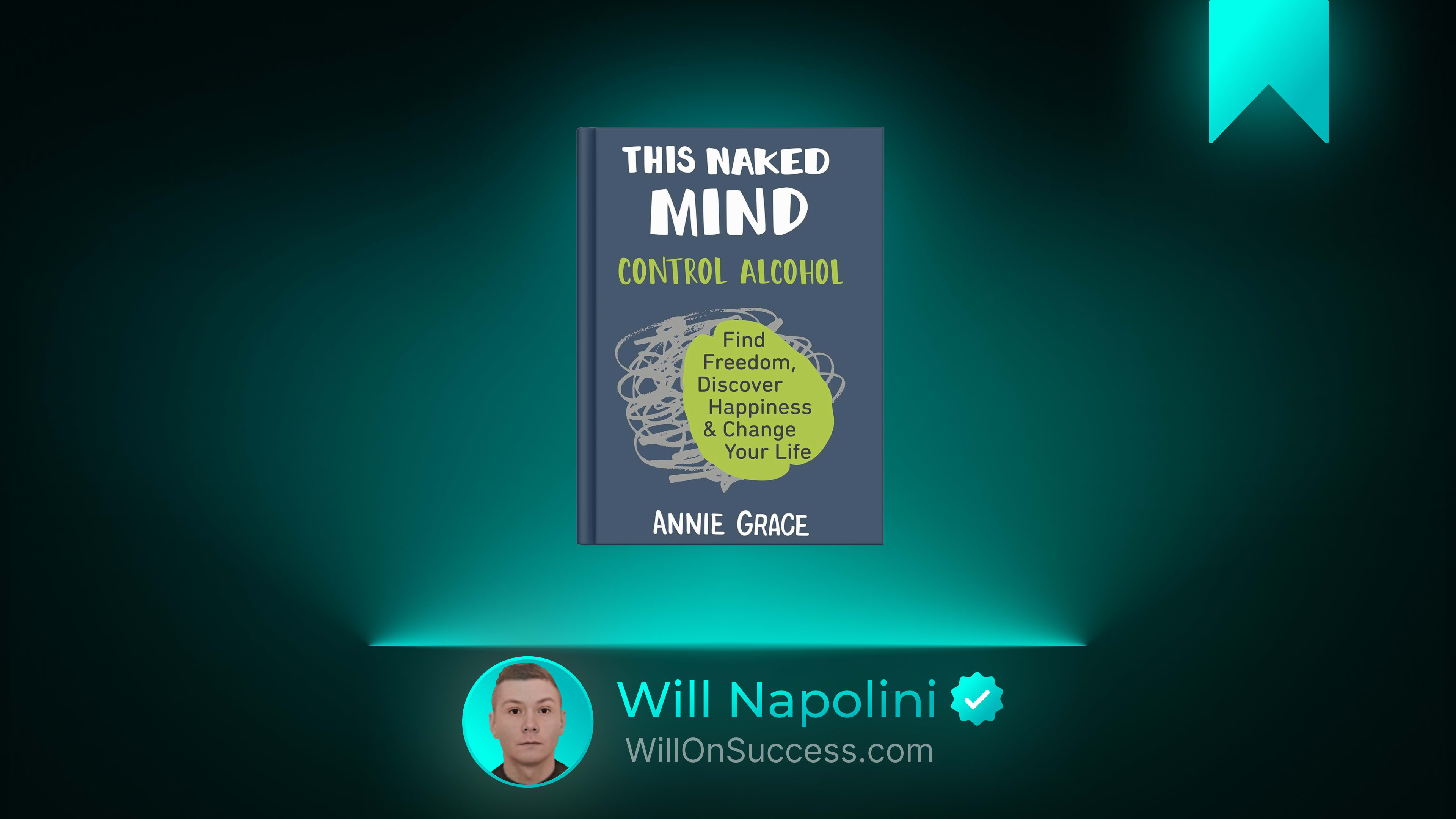
If I could sit across from you right now, with no judgment and no agenda, I would tell you this: the question itself is not the enemy. The question is the door. And Annie Grace’s book, This Naked Mind, is one of the clearest, most compassionate keys I have ever seen to open it.
The Big Idea: You Don’t Drink Because You Enjoy It
Here is the central, radical claim of this book, and I want you to let it land before you decide whether to agree or disagree.
Annie Grace argues that the reason you reach for a drink is not because alcohol provides you with genuine pleasure, relaxation, or comfort. You reach for a drink because you have been taught—by culture, by advertising, by the quiet repetition of thousands of small moments—that it provides those things. The desire is not natural. It is learned.
And here is the part that changes everything: if the desire is learned, it can be unlearned. Not through suffering. Not through white-knuckling. Not through a daily war against yourself. But through understanding. Through seeing clearly.
Grace calls this the “naked mind”—the mind stripped of the illusions and conditioning that make alcohol seem necessary. The mind that looks at the glass and sees it for what it actually is, rather than what it has been told to believe.
This is not a book about willpower. It is a book about perception. And that distinction is everything.
The Story: A High Achiever Who Couldn’t Walk Away
Annie Grace was not someone who hit a dramatic, cinematic bottom. She was a high-performing professional, a vice president of sales, someone who was doing well by every external measure. She drank what she considered moderately. She was functional. She was fine.
But she noticed something she couldn’t ignore. The drinking was creeping. Not in volume, necessarily, but in presence. It was becoming the punctuation mark at the end of every difficult sentence in her day. The reward she needed after the meeting. The permission she gave herself to stop working. The thing that made the evening feel like it had officially begun.
When she tried to stop using willpower, she felt exactly what most people feel: deprived. Resentful. Like she was giving something up. Like she was losing a friend. And that feeling of loss made her want it more. The cycle tightened.
What changed for Grace was not a change in discipline. It was a change in understanding. She began to study what alcohol actually does in the brain, what it actually provides, and what the craving mechanism really is. And as she dismantled each belief, one by one, something remarkable happened. The desire didn’t just weaken. It dissolved. Not because she forced it away, but because there was nothing left to desire.
The glass lost its glow. And she was free.
The Illusion of Pleasure: What Alcohol Actually Gives You
One of the most powerful sections of this book is where Grace systematically examines the reasons we believe alcohol helps us. Stress relief. Confidence. Fun. Social ease. Coping. Celebration.
For each one, she asks a simple, piercing question: Does it actually deliver what it promises?
Take stress relief. Grace explains that alcohol is a depressant. It does not reduce stress; it sedates your awareness of it. The tension is still there, waiting for you the next morning, often amplified by the disrupted sleep and the mild chemical withdrawal. What you experienced was not relief. It was a postponement. A borrowing against tomorrow’s peace.
Take confidence. Alcohol lowers inhibition, yes. But it does not create confidence. It removes the filter that lets you see your own awkwardness, your own slurring, your own repetition. The confidence you felt was not the arrival of something new. It was the departure of your self-awareness. And the person across from you at dinner noticed the difference, even if you didn’t.
This is not meant to shame you. Grace is not standing over you with a wagging finger. She is doing something far more powerful. She is turning on the lights in a room you have been sitting in for years, asking you to look around and see what is actually there.
When you see clearly, the spell breaks. And when the spell breaks, the need evaporates.
Why Willpower Fails: The Trap of Deprivation
If you have ever tried to cut back on drinking using sheer determination, you know this feeling. You decide tonight is the night. You will not pour the glass. You will drink tea instead. You will go for a walk. You will be strong.
And for the first hour, you feel proud. Then the evening stretches out, and something shifts. You start to feel like you are missing something. Like everyone else is enjoying their wine while you sit with your tea, performing a small, private martyrdom. The deprivation becomes louder than the discipline. And eventually, you pour the glass. Not because you wanted it, but because you felt you deserved it. You had been so good for so long.
Grace identifies this as the fundamental flaw of the willpower method. Willpower works by saying no to something you still believe is valuable. It asks you to resist a reward. And no human being can resist a reward forever. The brain is not built for permanent deprivation.
The solution Grace offers is not stronger willpower. It is removing the belief that there is something to resist. If you truly understand that the glass of wine is not giving you what you think it gives you, there is nothing to say no to. You are not giving up a pleasure. You are putting down a weight you didn’t realize you were carrying.
Think of it this way. If someone offered you a beautiful, ripe apple, you wouldn’t need willpower to refuse it. You would simply say, “No thank you, I’m not hungry.” The refusal is effortless because there is no desire. Grace’s method is about reaching that point with alcohol. Not through force. Through clarity.
The Craving Cycle: Understanding the Mechanism
One of the most liberating chapters in the book is where Grace explains how cravings actually work. Because once you understand the mechanism, it loses its authority over you.
A craving is not a need. It is not your body asking for sustenance. It is a learned association, a neurological pathway carved by repetition. You had a stressful day, so you poured a glass. The glass became linked to the feeling of release. Now, the stress triggers the thought of the glass, and the thought of the glass creates the feeling of desire. The craving is not asking for alcohol. It is asking for the feeling you have associated with alcohol.
And here is the critical insight: cravings are temporary. They rise, they peak, and they fall. They are not permanent states. They are waves. Most cravings last only a few minutes before they begin to subside, regardless of whether you act on them.
When you understand this, you stop fearing the craving. You stop treating it as an emergency. You can watch it rise, acknowledge it, and let it pass, knowing that it will pass. You are not fighting a war. You are watching weather move through the sky.
Grace also addresses the physical side. She explains how alcohol disrupts sleep, depletes certain nutrients, and creates a mild withdrawal cycle between drinks. That restless, unsettled feeling you get in the late afternoon is not a genuine desire for alcohol. It is your body adjusting to the absence of a substance it has grown accustomed to. It is the echo of last night’s drink, asking to be repeated. And once you understand that the cycle is self-perpetuating, you can choose to step off the loop.
The Fear of Life Without: Facing the Deepest Obstacle
If I could name the single biggest barrier that keeps thoughtful people from changing their relationship with alcohol, it would be this: fear.
Not fear of withdrawal. Not fear of judgment. Fear of what life will feel like without it.
Who will I be at dinner parties if I’m not holding a glass? How will I unwind after a brutal week? How will I celebrate the good news? How will I sit with the difficult feelings if I can’t soften them?
These questions are not weakness. They are honest. And Grace meets them with honesty.
She does not pretend that the first weeks will feel effortless. She acknowledges that there is an adjustment period, a recalibration, a learning curve. You will need to find new rituals, new ways to mark the transition from work to rest, new ways to sit with discomfort. The evening will feel different for a while. It will feel spacious in a way that might initially feel like emptiness.
But she also paints a vivid picture of what grows into that space. Clearer mornings. Deeper sleep. A steadier mood. The ability to feel your feelings fully, without the fog of a sedative muting the edges. A sense of pride that comes not from deprivation, but from alignment. The quiet, growing realization that you are not missing anything. That you were never missing anything. That the life you thought required a glass to be bearable is, in fact, more bearable without it.
The fear is real. But the fear is a story you learned. And stories can be rewritten.
Why This Matters on an Ordinary Tuesday
Why should you care about a book that challenges your relationship with alcohol, especially if you don’t consider yourself to have a “problem”?
Because this book is not really about alcohol. It is about the stories we tell ourselves to justify habits that no longer serve us. It is about the gap between what we believe we are getting and what we are actually receiving. It is about the quiet, daily erosion of choosing comfort over clarity, again and again, until comfort becomes a cage.
This applies far beyond the glass.
- In your work: Are you reaching for a distraction at 3 p.m. because you genuinely need a break, or because you have conditioned yourself to believe that you cannot focus without a ritual?
- In your relationships: Are you using a drink to lower your guard, or are you avoiding the harder work of being present and vulnerable without a chemical buffer?
- In your personal growth: How many of your habits are genuine choices, and how many are inherited scripts you never examined?
Grace’s framework teaches you to look at any habit and ask: Is this giving me what I think it is giving me? That question, asked honestly, can dismantle more than just a drinking habit. It can change the architecture of your entire life.
Practical Application: Seeing Clearly in Real Time
Understanding these ideas is powerful. But understanding without action changes nothing. Here is how you translate Grace’s principles into your actual life, starting today.
1. The Three-Day Observation (A Small Experiment) For the next three evenings, do not change your behavior. Do not try to stop drinking. Simply observe. Before you reach for the glass, pause for ten seconds. Ask yourself: What am I actually feeling right now? Am I stressed? Bored? Tired? Lonely? Habituated? Write the answer down. You are not judging. You are collecting data. You are turning on the lights.
2. Name the Belief (A Journaling Practice) Write down the three biggest reasons you believe alcohol helps you. Maybe it’s “It helps me relax after work.” Maybe it’s “It makes social situations easier.” Now, for each one, write a paragraph examining the evidence. Does it actually relax you, or does it sedate you? Does it make you more social, or does it make you less self-aware? Be honest. Be gentle. But be honest.
3. Design the Transition (A Habit to Build) The hardest moment is often the transition from work to evening. The moment you walk through the door, or close the laptop, and the old ritual whispers. Design a new ritual. Not as a replacement, but as a genuine pause. Make a cup of tea. Take a ten-minute walk. Sit outside and watch the sky change. Light a candle. The goal is not to distract yourself from the craving. The goal is to give yourself a real moment of arrival.
4. The Five-Minute Wave (A Behavior to Practice) The next time a craving hits, do not fight it. Do not negotiate with it. Set a timer for five minutes. Tell yourself: I will sit with this feeling for five minutes, and then I will decide. Breathe. Notice where the craving lives in your body. Is it in your chest? Your throat? Your hands? Watch it rise, peak, and begin to fall. You will be surprised how quickly the wave loses its force when you stop running from it.
5. Rewrite the Evening Story (A Decision to Make) Ask yourself: What would my ideal evening look like if I weren’t trying to change anything? Not the evening where you resist the drink. Not the evening where you feel deprived. The evening where you simply do not want it. What would you do with that time? Who would you call? What would you read? What would you build? Write that evening down. That is the life you are moving toward.
Who Should Read This Book
This Naked Mind is for the person who is curious. The person who doesn’t feel out of control but feels a quiet question they can’t quite silence. The person who wants to understand their relationship with alcohol before they decide whether to change it.
It is especially powerful for high-achieving, thoughtful people who have resisted the idea that they need to “quit” because they don’t identify with the language of addiction. Grace speaks to you not as a patient, but as a thinker. She respects your intelligence. She asks you to examine the evidence.
It may be less useful for someone in the acute stages of physical alcohol dependence, where medical supervision is necessary. Grace’s approach is primarily psychological and educational. If your body is in a state of physical withdrawal, please seek medical guidance first. This book is a companion for the mind, not a substitute for medical care.
It is also less useful if you are looking for a strict, step-by-step program with daily checklists. Grace offers a framework for understanding, not a rigid protocol. She trusts you to apply the principles in the way that fits your life.
One Small Step
I want to leave you with something you can do tonight. Not tomorrow. Not on Monday. Tonight.
The next time you reach for a drink—or the next time you think about reaching for one—pause. Just for ten seconds. Do not judge yourself. Do not make a grand decision. Just pause.
In those ten seconds, ask yourself one question: What do I believe this will give me?
And then, honestly, ask: Does it actually give me that?
You do not have to act on the answer tonight. You do not have to change anything tonight. You just have to see. Because seeing is where it starts. Seeing is where the spell begins to loosen. Seeing is where the naked mind begins to open.
The glass on the counter is not your enemy. The illusion is. And illusions, once seen clearly, cannot survive.
You do not have to fight your way to freedom. You just have to open your eyes.