Stop Waiting for Permission: The Audacious Wisdom of Edward Druce’s 'This Is Where to Start'
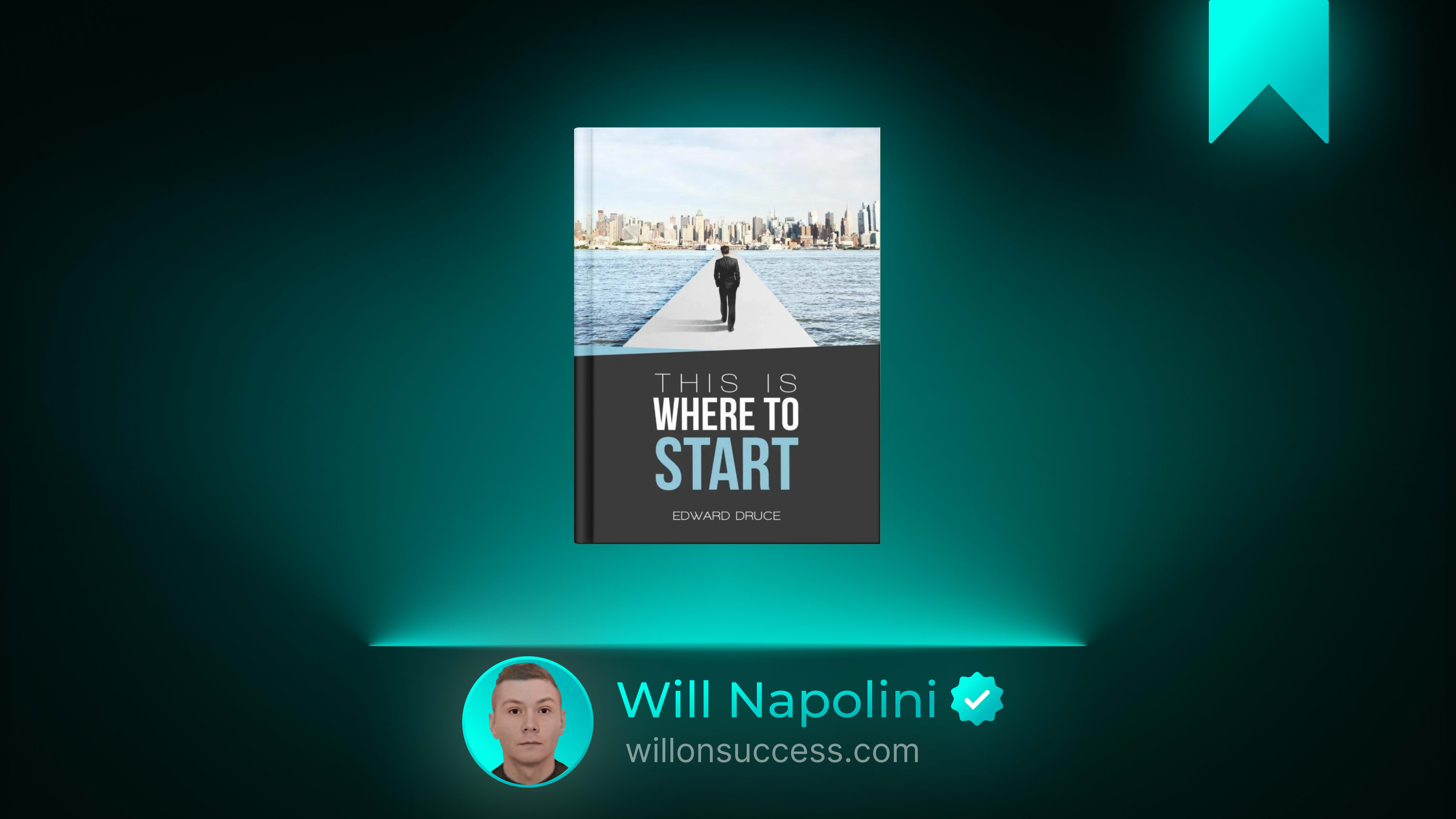
What if the most dangerous thing you can do for your future is wait for someone to hand you a map?
We are conditioned from a very young age to follow a very specific script. Go to school. Get the degree. Send your resume into the digital abyss. Wait for a gatekeeper to decide you are worthy of an opportunity. I have watched countless brilliant, capable people waste their best years standing in this exact line, waiting for permission to begin their actual lives. They believe that if they just follow the rules, the right doors will eventually open.
If I could sit across the table from you right now, I would tell you the truth that the traditional system will never admit: the gatekeepers are guarding a door that you can simply walk around.
This is the rebellious, deeply practical premise of Edward Druce’s book, This Is Where to Start: Find Superstar Mentors, Master All They Know, and Get Ahead in Your Career. Druce is not an academic theorizing about career paths from the safety of a university office. He is a practitioner. At just seventeen years old, he dropped out of school to apprentice under Matthew Hussey, a world-renowned speaker and coach. He didn’t wait for a university to validate him or a corporation to promote him. He simply decided that the people doing the work he wanted to do were his true teachers, and he figured out how to get in the room with them.
The central idea of his book is that mentorship is not a magical relationship that falls into your lap. It is a strategic, proactive pursuit. Your career is not a ladder you climb by checking institutional boxes; it is a network you build by audaciously reaching out to those who have already walked the path, offering your sweat equity, and extracting their hard-won wisdom.
The Power of One Email and the Myth of the Gatekeeper
Imagine standing outside a massive, locked fortress. Inside are the people who have built the life, the business, or the mastery you desire. Most people stand at the front gate, handing their resumes to the guards, hoping to be let in. They submit to the traditional hiring process, hoping their credentials are impressive enough to catch the eye of a stranger.
Druce’s approach is to find a loose stone in the wall.
He famously shared his core philosophy in a TEDx talk titled “How to Land Your Dream Job with One Email,” which perfectly encapsulates the mechanism of his strategy. The concept is simple but terrifying for most: the distance between you and the person you most want to learn from is often just one well-crafted message.
But this is not about spamming celebrities or begging for a job. It is about the concept of the apprenticeship. Druce realized early on that highly successful people are incredibly busy, but they are always looking for reliable, hungry, capable hands to help them solve their immediate problems. By offering to do the unglamorous work—the research, the organizing, the heavy lifting—you earn the right to observe how a master operates. You trade your time for proximity. And in the economy of personal growth, proximity to excellence is the most valuable currency in the world.
The Currency of the Apprentice
Many people approach mentorship with a consumer mindset. They ask, “What can this person do for me? Will they introduce me to their friends? Will they read my manuscript and make me famous?” This is a fast track to being ignored.
True mentorship is an exchange of value. The principle here is sweat equity. When you approach someone who is highly successful, you must understand that their time is their most scarce and fiercely protected resource. You cannot ask for their time; you must offer to buy it with your effort.
What tedious task do they hate doing? What problem is keeping them up at night? If you can step in and solve a small, annoying problem for them, you instantly separate yourself from the thousands of people asking for favors. You become an asset. And once you are an asset, they will naturally begin to invest in your growth. You do not demand a seat at the table; you build the chair they need, and they invite you to sit.
The Anatomy of the Perfect Cold Outreach
You might be thinking, “But if I email a successful person, they will just ignore me.” They will ignore you if your email looks like everyone else’s. If you send a generic template asking to “pick their brain” over coffee, you are asking them to do the heavy lifting of entertaining you.
A masterful cold email—the kind Druce advocates for—follows a strict, respectful architecture:
- Extreme Brevity: Successful people read emails on their phones between meetings, in transit, or late at night. If they have to scroll, you have lost them.
- Demonstrated Knowledge: Prove you actually know their work. Do not send a generic template. Reference a specific, obscure project they did three years ago. Show them you have done your homework.
- The Value Offer: Do not ask for a “virtual coffee chat.” That is a demand for their time. Instead, offer something specific and tangible.
This shifts the dynamic from a beggar asking for a coin to a peer offering a gift. You are no longer a liability to their schedule; you are a potential solution to their problems.
Extracting the Master’s Mind
Getting in the room is only ten percent of the battle. The other ninety percent is what you do once you are there.
When you finally secure an apprenticeship or a mentorship, your job is to become a mirror. You must observe not just what they do, but how they make decisions. How do they handle a crisis when a client is angry? How do they structure their morning before the chaos begins? What opportunities do they confidently say “no” to?
The goal of mentorship is not to copy your mentor’s exact path. Their path was built for their specific talents, their specific era, and their specific network. The goal is to download their operating system. You want to acquire the mental models they use to navigate the world, so that when you inevitably face a storm they never encountered, you have the internal compass to navigate it. You are studying the roots of the tree, not just tracing the shape of the leaves.
Why This Matters in Your Real Life
Why should you care about a strategy built on cold emails and unpaid apprenticeships? Because the traditional career ladder is rusting.
We are living in an era where industries change faster than university curriculums can be updated. The skills you need to thrive in the next five years are likely being invented right now by individuals, not taught in lecture halls. The theoretical knowledge you gain in a classroom is often obsolete by the time you graduate.
When you apply Druce’s principles, you bypass the theoretical and go straight to the practical.
- In your career: Instead of waiting for a promotion from a manager who barely knows your name, you identify the person three levels above you, find out what their biggest bottleneck is, and offer to take it off their plate. You become indispensable through action, not tenure.
- In entrepreneurship: Instead of paying for a generic business course, you find a founder who successfully navigated the exact pivot you are trying to make, and you offer to do their customer support research for a month. You learn the reality of their business, not the sanitized version they put in a podcast interview.
- In personal growth: You stop hoping a savior will appear to guide you, and you take the profound, empowering responsibility of choosing your own guides. You realize that the world is full of people who are willing to teach you, provided you are willing to work.
You transition from a passive passenger waiting for a train, to the engineer laying your own tracks. The anxiety of “waiting to be chosen” is replaced by the quiet confidence of choosing yourself.
Practical Application: The Value-First Outreach
Understanding that you need to take initiative is valuable, but understanding without action changes nothing. If we were working together, I would challenge you to execute a “Value-First” outreach this week. I want you to move from intention to behavior.
1. Identify the Lighthouse (Decision to Make) Choose one person in your field who is roughly five to ten years ahead of you. Do not pick the billionaire CEO who receives ten thousand emails a day; they are insulated by layers of assistants. Pick the “lighthouse”—the person who has recently achieved the exact milestone you are striving for. They are close enough to the struggle to remember it, but far enough ahead to guide you.
2. Find the Friction (Observation) Spend an hour researching their work. Listen to their interviews. Read their blog. Look for the friction. Are they complaining about how long it takes to edit their videos? Are they struggling to organize their newsletter archives? Is their website broken on mobile devices? Find one specific, tangible problem they have.
3. Do the Work Before the Ask (Action) Do the work before you ever send the email. Create a sample, fix a broken link on their site and document it, or write a one-page summary of their competitor’s recent strategy. Prove your competence before you ask for their attention.
4. The 75-Word Email (System to Create) Draft your email. Keep it under 75 words. Subject: I fixed [Specific Problem] for you Hi [Name], I loved your recent piece on [Specific Topic]. I noticed [Specific Friction Point]. I took the liberty of doing [The Work You Did] to solve it. It’s attached. No need to reply. If you ever need help with this on an ongoing basis, I’d love to be a resource. Best, [Your Name] Send it. Then, let it go. You are no longer hoping; you are acting. You have shifted the power dynamic entirely.
Who Should Read This Book
This Is Where to Start is a vital manifesto for young professionals, aspiring entrepreneurs, and anyone who feels suffocated by the traditional education-to-corporate pipeline. It is incredibly useful for those who are willing to hustle, face rejection, and do the unglamorous work required to earn a seat at the table. If you are someone who believes that hard work and audacity can bridge the gap between where you are and where you want to be, this book will give you the blueprint.
However, it may be less useful for you if you are looking for a highly technical manual, a guide to navigating complex corporate HR politics, or a gentle, therapeutic approach to finding your “passion.” This book is a battering ram. It works best when you know exactly what door you want to break down, and you just need the courage to swing it. It is also less applicable if your desired field strictly requires institutional accreditation—you cannot cold-email your way into performing open-heart surgery, and that is a good thing.
One Small Step
I want to leave you with a challenge you can execute the moment you finish reading this sentence.
Think of the one person whose career or life you admire most—the person who makes you think, I wish I could learn how they did that.
Open a blank document right now. Do not write a polite, deferential letter asking for fifteen minutes of their time. Instead, write down one specific problem they might be facing, and write down exactly how you could help them solve it today.
The door to your future is not locked. You just have to be willing to turn the handle.
Your trajectory is not determined by the credentials you hold, but by the audacity of your next step.