The Divine Comedy by Dante Alighieri: Why the Only Way Out of the Dark Wood Is Through It
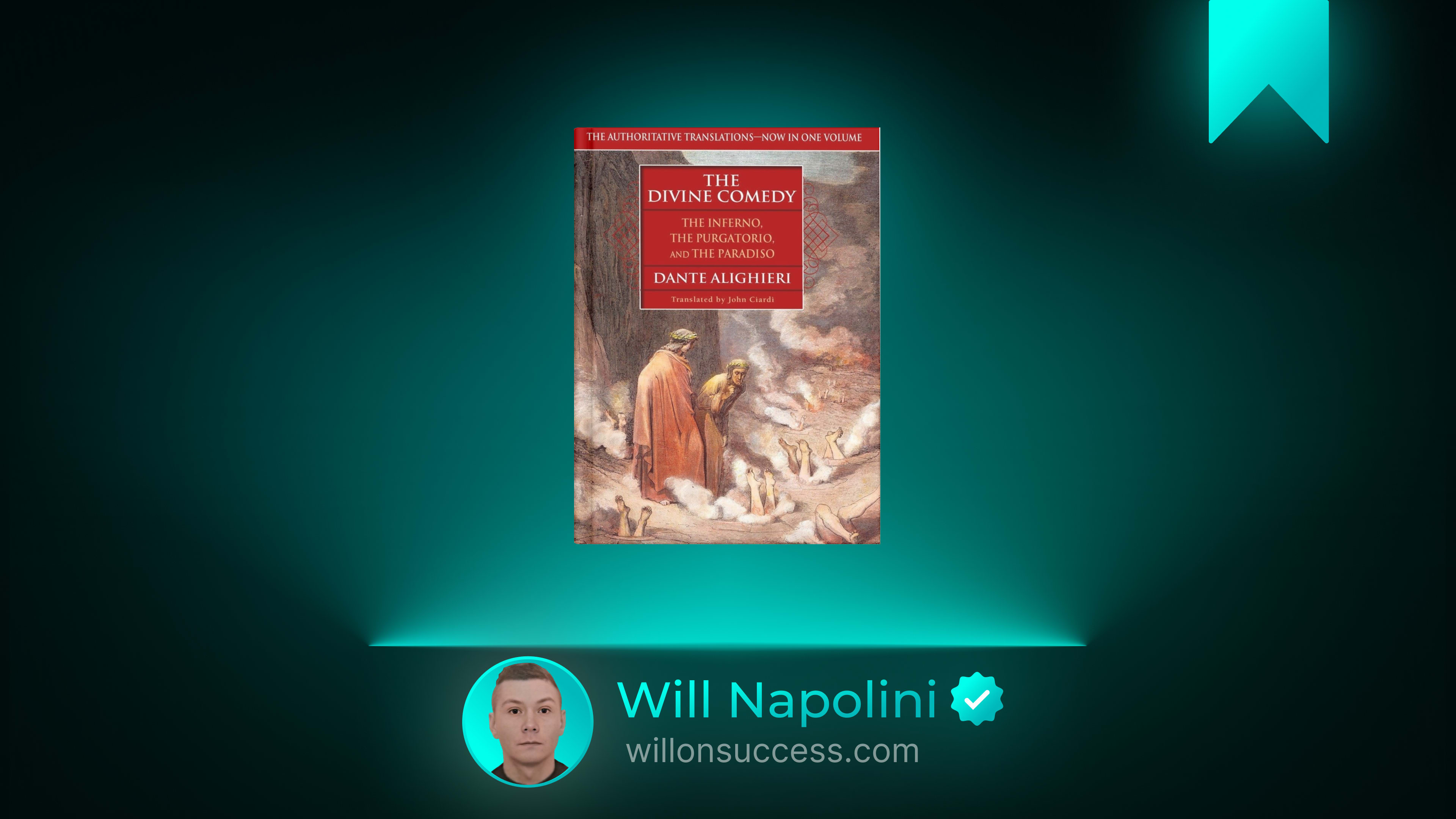
In the middle of the journey of our life, a man finds himself in a dark wood. He does not know how he got there. He does not know which path led him astray. He knows only that the straight way is lost, that the trees are thick and trackless, and that the fear they produce is not much less than death.
This is how Dante Alighieri begins the Divine Comedy. Not with a triumph. Not with wisdom. Not with a map or a plan or a confident stride toward the summit. With a man, thirty-five years old, standing in a forest he cannot navigate, looking for a way out, and finding none.
I want you to sit with that image for a moment. Because if you are reading this, there is a chance—perhaps more than a chance—that you know the dark wood. Not a literal forest. But the feeling of waking up in the middle of your life and realizing you do not recognize where you are. The career that looked right from the outside but feels hollow from the inside. The relationship that has gone quiet. The slow accumulation of small compromises that have led you somewhere you never intended to go. The Tuesday morning when you look at your calendar and think, How did I get here? When did I lose the path?
Dante was there. And the poem he wrote in exile, in poverty, in the aching grief of a man who could never go home, is not a religious treatise. It is not a theology lesson. It is a map. The most precise, most honest, most terrifyingly beautiful map ever drawn of what it takes to walk from lostness to wholeness.
It took him roughly thirteen years to write. It is fourteen thousand lines long. It is dense with medieval politics, classical mythology, scholastic philosophy, and personal vendetta. It is, by any honest measure, one of the most difficult poems ever written.
And yet. Its central argument can be held in one sentence, and it is a sentence I think you need to hear: You cannot go around the dark wood. You cannot skip it, explain it away, or wait for it to clear on its own. The only way out is through. Down into the worst of what you are. Up the long, slow mountain of becoming something better. And then, if you are faithful to the climb, out into the light.
Let me walk the road with you.
The Big Idea: The Soul’s Journey Has Three Movements, and You Cannot Skip Any of Them
The Comedy is structured in three parts: Inferno, Purgatorio, and Paradiso. Hell. Purgatory. Paradise. Each is thirty-three cantos long (with one extra in Inferno to make the total one hundred). Each ends with the word “stars.”
But these are not merely locations. They are movements of the soul. They are the three phases of any genuine transformation, whether that transformation is spiritual, psychological, creative, or deeply personal. And Dante’s radical insistence is that you must pass through all three, in order, without skipping. You cannot arrive at peace without first facing what you have done. You cannot arrive at freedom without first doing the slow, grinding work of changing. You cannot arrive at love without first passing through the fire.
The journey begins on Good Friday, the day of death. It ends on Easter Sunday, the day of resurrection. Between those two days, everything is broken and rebuilt.
That is the architecture. Let us walk through it.
The Dark Wood and the Guide: You Cannot Make This Journey Alone
Dante stands in the dark wood, terrified. He sees a hill bathed in sunlight ahead of him and tries to climb toward it. But three beasts block his path—a leopard, a lion, a she-wolf. He cannot pass. He is driven back into the darkness.
And then Virgil appears. The Roman poet. The author of the Aeneid. The voice of the classical tradition, of reason, of human wisdom at its highest. Virgil says, in essence: You cannot get up that hill by yourself. The beasts will stop you. But I know another way. A longer way. A harder way. Down first. Then up. Follow me.
This is the first great lesson of the poem, and I think it is the one most people resist. You cannot transform yourself through willpower alone. You cannot white-knuckle your way out of the dark wood. You cannot simply decide to be better, climb the hill, and arrive at the sun. The obstacles are too deep, too old, too woven into the structure of who you have become.
You need a guide. Someone who has walked ahead. Someone who knows the terrain because they have already crossed it. For Dante, that guide is Virgil—reason, tradition, the accumulated wisdom of those who came before. Later, it becomes Beatrice—love, grace, the force that reaches beyond what reason alone can accomplish.
I have seen this in my own life. The seasons where I tried to fix myself through sheer determination. Where I read the books, set the goals, built the systems, and still found myself, weeks later, back in the same patterns, the same fears, the same quiet failures. And the seasons where change actually came—not through effort alone, but through the influence of a person. A mentor. A friend who said the thing I needed to hear. A book that arrived at the right moment. A therapist, a teacher, a stranger whose words landed like a key in a lock I did not know existed.
You do not have to walk alone. You were not designed to walk alone. And the belief that you should be able to figure it out by yourself is not strength. It is the last, stubborn wall between you and the help that is waiting.
The Descent: Facing What You Have Done
Virgil leads Dante down. Into Hell. Nine circles, descending toward the center of the earth, where Satan himself is frozen in a lake of ice, chewing on the three great traitors of history. Each circle corresponds to a different failure of the human soul. Lust. Gluttony. Greed. Wrath. Fraud. Treachery. Each punishment fits the sin—not as arbitrary cruelty, but as the sin’s own logic, extended to its final, terrible conclusion.
The lustful are blown forever on a wind, because they let passion blow them wherever it would. The greedy push great weights against each other, because they spent their lives accumulating and hoarding. The fraudulent are submerged in filth, because they made their words into filth. The punishments are not imposed from outside. They are the sins themselves, made visible, made eternal, made inescapable.
This is the hardest part of the poem. And it is the hardest part of any honest transformation. Because before you can become better, you must look clearly at what you have been. Not to punish yourself. Not to wallow. But to see. To name the patterns. To acknowledge the damage. To look at the specific ways you have been greedy, or cruel, or cowardly, or dishonest, and say, without flinching, Yes. I did that. I chose that. It was mine.
I know how tempting it is to skip this step. To go straight to the improvement plan. The new habit. The fresh start. The motivational framework. To say, I will be better from now on, without first looking honestly at what “from now on” is replacing. But Dante will not let you skip it. The poem insists: you must descend before you ascend. You must name the dark before you can walk into the light. You must grieve what you have done before you can become what you are meant to be.
And here is the strange grace hidden inside the descent: Dante weeps. He pities the souls he meets. He faints when he sees Francesca and Paolo, the lovers blown on the wind. He is not hardened by the journey. He is made more tender. More aware of the cost of every choice. More alive to the weight of what it means to be human and fallible and capable of terrible things.
The descent does not make you cruel. If you walk it honestly, it makes you compassionate. Because you see yourself in every circle. Every failure is one you recognize. Every soul is a version of you, had you made different choices, had you been a little less careful, a little less lucky, a little more afraid.
The Mountain: The Slow, Unglamorous Work of Becoming
If Hell is the confrontation, Purgatory is the work. And it is the part of the poem I love most, because it is the part most like real life.
Purgatory is a mountain. A great, solitary island-mountain rising out of the sea. And on its slopes, the souls are climbing. Not passively. Not being punished. Climbing. Moving upward, terrace by terrace, shedding the weight of their old selves, one failing at a time.
The mountain has seven terraces, one for each of the deadly sins. Pride. Envy. Wrath. Sloth. Greed. Gluttony. Lust. On each terrace, the souls do the work of undoing what that sin built in them. They carry stones to humble their pride. They have their eyes sewn shut to cure their envy. They run endlessly to overcome their sloth. It is painful. It is slow. It is repetitive. It is unglamorous.
And yet. There is something in Purgatory that is entirely absent from Hell: hope. The souls in Hell are fixed. They will be what they are forever. The souls on the mountain are moving. They are in the process of becoming. They are not yet what they will be, but they are no longer what they were. And that in-between state—that long, slow, effortful becoming—is where the poem locates the deepest dignity of the human soul.
I think about this when I am in the middle of my own slow work. The habit I am trying to build, which keeps collapsing. The pattern I am trying to break, which keeps reasserting itself. The person I am trying to become, who keeps being interrupted by the person I used to be. The days when the progress is invisible. The weeks when it feels like walking in place. The months when the mountain seems no closer to the summit than it was when I started.
Purgatory says: This is the work. This is what transformation looks like from the inside. Not a lightning bolt. Not a single dramatic moment of conversion. But the slow, daily, unglamorous act of climbing. Of carrying the weight one more terrace. Of shedding one more layer. Of choosing, again, in the small and ordinary hours, to move upward.
You do not become free in a moment. You become free in ten thousand small refusals to remain what you were.
And at the top of the mountain, Virgil disappears. Reason has brought Dante as far as it can. The rest of the journey requires something else. Something beyond logic, beyond effort, beyond the will. It requires grace. It requires love. It requires Beatrice.
The Stars: Love as the Organizing Principle of Everything
Paradiso is the hardest part of the poem to summarize, and the hardest to read. It is abstract. It is luminous. It is full of theology and light and music and the geometry of spheres. Dante rises through the heavens, guided now by Beatrice—the woman he loved from the age of nine, who died at twenty-four, who became, in his imagination, the embodiment of divine love made personal.
And the poem’s final argument—the one it builds toward across fourteen thousand lines, through all the horror and all the climbing and all the light—is this: the force that holds the universe together, the force that moves the planets and ignites the stars and keeps the whole vast machinery of existence turning, is love. Not power. Not knowledge. Not justice alone. Love. The love that moves the sun and the other stars.
This is not sentimental. Dante is not saying love is soft, or easy, or sufficient to explain away suffering. He has just walked through Hell. He has seen what happens when love is twisted, or hoarded, or refused. He has climbed the mountain. He knows the cost.
What he is saying is that at the bottom of everything—beneath the pain, beneath the effort, beneath the long, slow, grinding work of becoming—there is not a void. There is not a mechanism. There is not a cold, indifferent universe grinding forward without purpose. There is a warmth. A pull. A gravity that draws all things toward their fulfillment. And that gravity is love.
You do not have to read this as theology. You can read it as a claim about the structure of human experience. That the deepest, most durable force in a life is not achievement, or status, or the accumulation of things. It is the quality of your attention toward others. The depth of your care. The willingness to be moved by something beyond your own survival. The choice, made daily, to orient your life toward what you love rather than what you fear.
Dante ends the poem not with an argument, but with a vision. A moment of silence. A surrender. The mind reaching the limit of what it can comprehend, and then letting go. And in the letting go, finding not emptiness, but fullness. Not an ending, but a beginning.
Why This Matters to You, Wherever You Are
You are not in medieval Florence. You are not writing a fourteen-thousand-line poem in exile. You are not navigating scholastic theology or settling scores with the Pope.
But you are alive. And being alive means you will, at some point, find yourself in the dark wood. You will lose the path. You will look up and not recognize the life you have built. You will feel the fear that Dante felt—the sense that the trees are closing in, that the straight way is gone, that you cannot find your way back to where you started.
And when that happens—and it will happen, because it happens to everyone who lives long enough and honestly enough—you will face a choice. You can stay in the wood. You can pretend the darkness is not there. You can wait for someone to find you, to rescue you, to hand you the map you lost.
Or you can walk. Down into the hard country. Into the confrontation with what you have done and what you have become. Up the long, slow mountain of changing. Toward the light that is not guaranteed, not easy, not free, but real.
You will need a guide. Find one. A book. A person. A tradition. A practice. Something that has walked ahead of you and can say, I know the way. It is longer than you think. It is harder than you want. But it goes somewhere. Follow me.
You will need patience. The mountain is not climbed in a day. The terraces are not shed in a week. The old self does not fall away in a single dramatic gesture. It falls away in ten thousand small choices, made in the ordinary hours, when no one is watching, when no one will reward you, when the only evidence of progress is the faint, stubborn feeling that the weight on your shoulders is a little lighter than it was yesterday.
Who Should Read This Poem
I want to be honest: the Divine Comedy is not an easy read. It is dense. It is allusive. It is full of references to Florentine politics, classical mythology, and medieval theology that will require footnotes unless you happen to be a scholar of the period. If you pick it up expecting a fast-paced narrative, you will be frustrated. The poem asks for patience. For attention. For a willingness to sit with difficulty.
That said, you do not need to read it in the original Italian (though if you do, you will hear music that no translation fully captures). There are excellent modern translations—John Ciardi’s is clear and muscular; Allen Mandelbaum’s is lyrical and precise; Robert and Jean Hollander’s is richly annotated. Any of these will bring you into the poem.
You should read it if you are in a season of transition. If you feel lost, or stuck, or aware that the life you are living no longer fits the person you are becoming. You should read it if you want to understand why transformation is never quick, never painless, and never purely intellectual. You should read it if you want to encounter one of the great arguments in human history for the proposition that love is not a weakness but the fundamental structure of reality.
You may find it less useful if you are looking for a tight, plot-driven narrative, or if the medieval Christian framework feels too distant from your own worldview to be meaningful. The poem is deeply embedded in its theological context, and some readers will find the specific doctrine difficult to separate from the universal human truths. But I would encourage you to try. The truths are there, beneath the doctrine, and they are vast.
One Small Step
I am not going to ask you to read fourteen thousand lines of poetry this week. I am not going to ask you to overhaul your spiritual life or begin a decade-long process of moral purification.
Here is what I would ask. One thing. Small. Honest. Achievable today.
Tonight, before you sleep, take five minutes. Sit quietly. And ask yourself one question, the same question Dante asks at the beginning of the poem:
Where am I right now? Not where do I want to be. Not where do I think I should be. Where am I actually, honestly, at this moment?
And then ask a second question:
What is one small thing I am carrying that I could set down?
Not solve. Not fix. Not transform. Just set down. One weight. One grudge. One obligation you have been carrying out of guilt rather than love. One story about yourself that is no longer true but that you keep repeating because it is familiar.
Name it. Say it out loud if you can. Write it down if that is easier. Acknowledge that it is there. And then, gently, without drama, without a grand gesture, give yourself permission to set it at the base of the mountain. You do not have to carry it up. You do not have to carry it anymore.
The dark wood is real. The mountain is long. The work is slow and unglamorous and no one will give you a medal for climbing it. But the stars are there. They have always been there. And the love that moves them is not distant. It is in the next conversation you choose to have with tenderness. In the next morning you choose to begin again. In the next moment you decide that the path is worth walking, even though you cannot see the summit, even though the trees are thick, even though you are afraid.
You do not have to see the whole road. You only have to take the next step.
And then the one after that.
The wood will thin. The mountain will rise. And the stars, when you finally look up, will be closer than you thought.