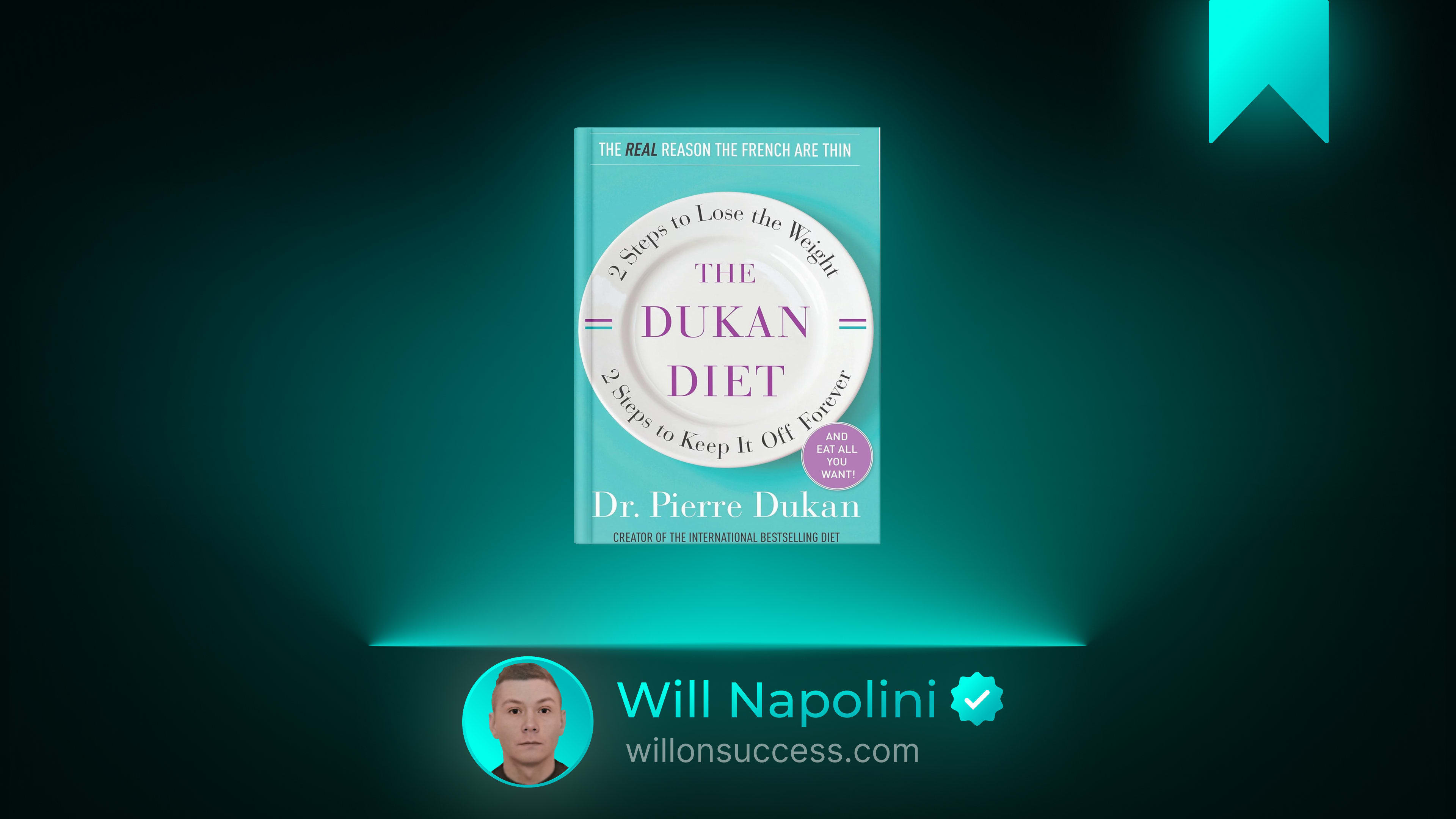
The Dukan Diet by Pierre Dukan: Why Willpower Fails and How to Build a System That Actually Carries You Home
I want to ask you about a specific feeling. You know it well.
It happens on a Sunday evening, or perhaps on a Tuesday afternoon when you are standing in the kitchen, tired, hungry, and staring into the refrigerator. You have a goal. You want to be healthier, lighter, stronger, or simply more at peace in your own body. You have read the articles. You know what you are “supposed” to eat.
And yet, in that moment of fatigue, the sheer volume of choices paralyzes you. Should I have the chicken or the fish? Is this sauce allowed? What about the carbohydrates? Did I eat too much yesterday? The cognitive load becomes too heavy. You abandon the plan. You eat the easiest, most comforting thing in front of you. And then the guilt arrives, whispering that you simply lack discipline.
If you have ever stood in that kitchen and felt that shame, I want to offer you a different perspective.
Pierre Dukan, a French physician, spent decades listening to this exact story from thousands of patients. And he arrived at a conclusion that changed the way millions of people approach not just food, but change itself: You do not lack willpower. You are just asking willpower to do a job it was never designed to do.
Willpower is a finite resource. It depletes as the day goes on. When you rely on willpower to make dozens of micro-decisions about what to consume, you are building a house on sand. Dukan’s central thesis is that lasting change does not come from trying harder. It comes from building a system that temporarily removes the burden of choice, followed by a deliberate, structured reintroduction of freedom.
Before we walk through his framework, I need to make an honest confession. As a mentor, I care about your long-term health, not just a quick result. The specific nutritional prescriptions in The Dukan Diet—which heavily emphasize animal protein and severely restrict carbohydrates and fats in the early stages—have been heavily criticized by modern dietitians and medical professionals. The science of nutrition has evolved significantly since this book was published, and I am not here to hand you a rigid meal plan or offer medical advice.
What I am here to do is extract the profound behavioral architecture hidden inside this book. Dukan understood the psychology of human habit formation better than almost anyone in his field. Let us look at the engine of human behavior he mapped out, and how you can apply its mechanics to your life in a way that is safe, balanced, and sustainable.
The Big Idea: Structure Must Precede Freedom
We live in a culture that worships freedom. We believe that the ultimate goal of any diet, career, or lifestyle is to have infinite options and the discipline to navigate them perfectly.
Dukan argues the exact opposite. He suggests that when you are trying to break a deeply ingrained cycle, freedom is actually your enemy. Infinite options lead to decision fatigue, which leads to paralysis, which leads to relapse.
To change your life, you do not start with more freedom. You start with extreme, almost artificial structure. You build a narrow bridge with high guardrails. You walk across it until the new behavior becomes automatic. Only then do you slowly dismantle the guardrails, plank by plank, until you are walking on your own.
The Story: The Patient Who Demanded a Map
Dukan did not develop his four-phase protocol in a sterile laboratory. He developed it in a messy, frustrating clinic in Paris.
A patient came to him, exhausted by years of yo-yo dieting. The patient looked at Dukan and said, essentially: I will follow any rules you give me. I will eat whatever you tell me to eat. But do not ask me to make choices. Tell me exactly what to do, and I will do it.
That conversation was the catalyst. Dukan realized that his patients were not failing because they lacked knowledge; they were failing because they were drowning in choices. He designed a system that removed the need to think. He broke the journey down into four distinct phases: Attack, Cruise, Consolidation, and Stabilization.
Each phase has a specific psychological purpose. And while the food lists are specific to his protocol, the phases themselves are a masterclass in how humans navigate any major life transition.
The Four Phases of Change
1. Defining Your “True Weight” (Le Juste Poids)
Before you take a single step, Dukan insists you must define your destination. But he does not let you choose a fantasy.
Most people set goals based on a ghost. They want to weigh what they weighed at eighteen. They want the waistline of a magazine cover. Dukan calls this a trap. Instead, he calculates what he calls your “True Weight.” This is a mathematically and historically realistic target based on your age, your genetics, your past weight fluctuations, and the actual life you have lived.
This is a profound psychological intervention. You cannot build a sustainable future on a foundation of self-rejection. If your goal requires you to be a person you have never been, fighting a biology you do not possess, you are setting yourself up for a lifetime of war with your own body. Accepting your “True Weight” is an act of radical self-compassion. It is saying, I will strive for the healthiest, most vibrant version of the body I actually have, not the phantom of a body I wish I had.
2. The Architecture of Elimination (Attack and Cruise)
The first two phases of the diet are highly restrictive. The “Attack” phase allows only pure protein. The “Cruise” phase alternates pure protein days with protein and vegetable days.
From a purely nutritional standpoint, this is controversial. But from a behavioral standpoint, it is brilliant. By severely limiting what is allowed, Dukan entirely eliminates decision fatigue. You do not stand in the grocery store wondering if a specific brand of yogurt is acceptable. The rules are absolute.
When you are trying to break a powerful addiction or a deeply rooted habit, moderation rarely works in the beginning. The brain is too used to the dopamine hit. You need a circuit breaker. You need a period of extreme clarity where the answer to every temptation is a simple, unambiguous “No.” The restriction is not meant to be permanent; it is meant to quiet the noise so you can hear your own thoughts again.
3. The Danger Zone of Freedom (Consolidation)
This is the phase where 95% of diets fail, and Dukan names it explicitly as the most dangerous part of the journey.
You have reached your goal. The immediate crisis is over. And now, Dukan slowly reintroduces the foods you love: a piece of fruit, a slice of bread, a portion of cheese. He calls this the Consolidation phase.
Why is it dangerous? Because the brain rebels against the new normal. When you are in the strict “Attack” phase, your identity is clear: I am someone who does not eat that. But when a slice of cake is suddenly “allowed” in moderation, the burden of choice returns. The guardrails are coming down, and you are terrified of falling off the bridge.
Dukan navigates this by introducing “Celebration Meals” and strictly portioned reintroductions. He teaches that freedom is not a switch you flip; it is a muscle you train. You do not go from a cage to the open ocean. You go from a cage to a large room, then to a fenced yard, and finally to the wild.
4. The Anchor Habits (Stabilization)
The final phase is not a diet. It is a lifestyle. Dukan knows that if you return to your old environment with your old habits, the old weight will return. So, he institutes three non-negotiable “Anchor Habits” for the rest of your life:
- One day a week of pure protein (a weekly reset).
- Three tablespoons of oat bran every day (a physical anchor).
- Twenty minutes of walking, and taking the stairs instead of the elevator (a movement anchor).
These anchors are not meant to be punishing. They are meant to be reminders. They are the small, daily rituals that keep you connected to the person you fought so hard to become. They prevent the slow, invisible drift back into old patterns.
Why This Matters Beyond the Kitchen
You might be reading this and thinking, I am not trying to lose weight. I am trying to build a business, write a book, or save my marriage.
The mechanics of change do not care about the context. They are universal.
When you start a new business, you do not give yourself infinite options. You enter an “Attack” phase. You restrict your focus to one single product, one specific audience, and you say “no” to every distraction. You build the bridge.
When you are trying to heal from a toxic relationship or a burnout, you do not slowly introduce new stressors. You eliminate. You take a sabbatical. You step away from social media. You create a season of extreme, protective structure until your nervous system resets.
And when you achieve the goal—when the business launches, when the book is published, when the relationship heals—you enter the “Danger Zone of Freedom.” This is when the ego swells, when the distractions return, when the old habits whisper that you have “earned” the right to be sloppy again. This is when you need your Anchor Habits. The morning routine you refuse to skip. The weekly review you refuse to cancel. The boundaries you refuse to compromise.
Structure is not the opposite of freedom. Structure is the scaffolding that makes freedom possible.
Who Should Read This Book
I want to reiterate my earlier caveat: do not read The Dukan Diet as a modern, peer-reviewed nutritional bible. If you have kidney issues, a history of disordered eating, or a need for high-fiber, plant-forward nutrition, the specific food lists in this book may be actively harmful to you. Please consult a registered dietitian or a medical professional for advice tailored to your biology.
However, you should read this book if you are fascinated by the psychology of habit formation. You should read it if you are a chronic starter-and-stopper who needs to understand why you always fail in the “messy middle” of a project. You should read it if you want to understand how to design a system that protects you from your own decision fatigue.
Read it for the architecture. Extract the behavioral genius. Leave the controversial menu behind.
One Small Step
I am not going to ask you to overhaul your pantry today. I am going to ask you to apply Dukan’s concept of “True Weight” to one area of your life where you have been fighting a losing battle against reality.
Think of a goal you have been chasing that feels perpetually out of reach. Maybe it is a financial target, a productivity metric, or a fitness goal.
Take ten minutes today to write down your “True Goal.” Strip away the fantasy. Strip away the ghost of who you were ten years ago. Strip away the expectations of your parents or your industry. Look at your actual history, your current resources, and your real, lived reality.
What is the most ambitious, yet entirely realistic and sustainable version of this goal? Write it down.
Once you have your True Goal, identify one “Anchor Habit” that will support it. Not a massive, exhausting overhaul. Just one small, non-negotiable action you can take every single day, regardless of how tired you are, that keeps you tethered to that reality.
You do not need more motivation. You do not need to be harder on yourself. You just need to stop asking your willpower to carry a load it was never meant to bear.
Build the bridge. Set the guardrails. Take the first step. And trust that the freedom you are looking for is waiting for you on the other side of the structure.