Stop Relying on Willpower: The Hidden Mechanics of Making Change Actually Stick
Think about the last time you knew exactly what you needed to do, but you just could not make yourself do it.
You knew you needed to eat the salad, but you ordered the burger. You knew you needed to have the difficult conversation with your colleague, but you sent a vague email instead. You knew you needed to wake up early and work on the project that matters to you, but you hit snooze until the last possible second.
We have a default explanation for this failure. We call it a lack of willpower. We tell ourselves we are lazy, undisciplined, or fundamentally flawed. We try to white-knuckle our way through the resistance, and when we inevitably exhaust ourselves, we feel a deep, quiet shame.
But what if the problem is not your character? What if the problem is that you are using the wrong map for the territory of human behavior?
I have watched brilliant, capable people fight themselves for years over habits they cannot break and goals they cannot reach. And what I have discovered is that they are not failing because they are weak. They are failing because they are trying to solve an engineering problem with a moral one.
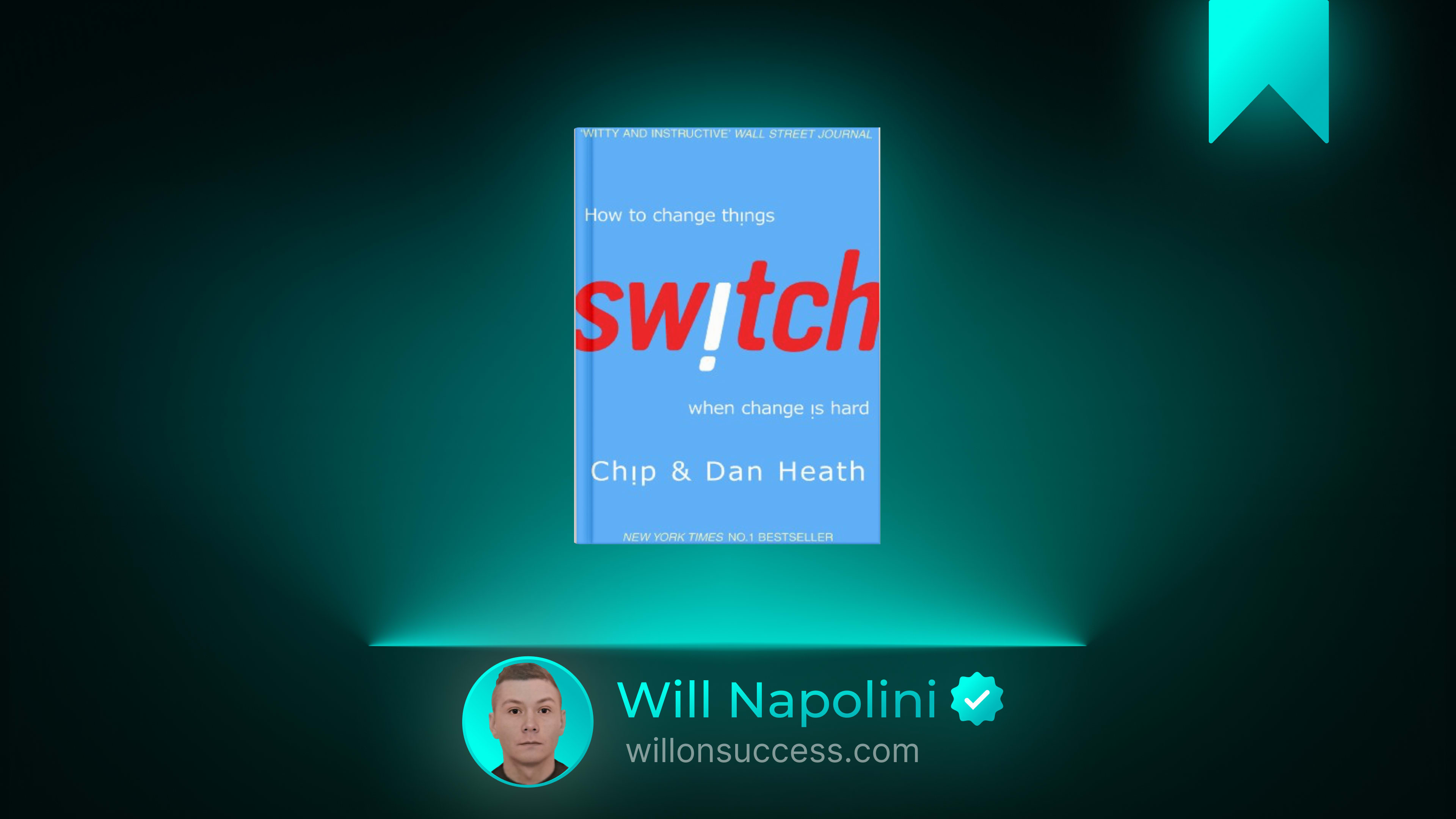
Chip and Dan Heath wrote Switch: How to Change Things When Change Is Hard to dismantle the myth of brute discipline. Drawing on decades of psychological research, they argue that successful change—whether you are trying to transform a corporation, raise a resilient child, or simply go to the gym three times a week—does not come from forcing yourself to be stronger. It comes from understanding the hidden mechanics of how human beings actually operate.
The central idea is this: Change is not a test of willpower. It is an alignment problem. When you understand the three distinct forces driving your behavior, you stop fighting yourself and start designing a life that pulls you forward.
The Core Metaphor: The Rider, The Elephant, and The Path
To understand why change is so hard, the Heath brothers borrow a brilliant metaphor from psychologist Jonathan Haidt.
Imagine your mind is a Rider sitting on top of a massive Elephant.
The Rider is your rational, analytical mind. It holds the reins. It plans for the future, analyzes data, and sets the goals. I am going to lose twenty pounds. I am going to save for retirement. I am going to stop losing my temper.
The Elephant is your emotional, instinctive mind. It is powerful, easily spooked, driven by immediate gratification, and deeply resistant to discomfort.
And then there is the Path—the environment and the situations surrounding you.
Here is the fundamental problem with how we try to change: We spend all our time yelling at the Rider. We read books, we make spreadsheets, we lecture ourselves with logic. But the Rider is tiny compared to the Elephant. If the Elephant wants to stop and eat the peanuts by the side of the road, the Rider can pull on the reins all day, but the Elephant will win. The Rider will eventually get exhausted, let go of the reins, and the Elephant will do whatever it wants.
And if the Path is a muddy, uphill slog, even a willing Elephant and a focused Rider will eventually quit.
To create lasting change, you cannot just rely on the Rider. You must do three things simultaneously: Direct the Rider, Motivate the Elephant, and Shape the Path.
Direct the Rider: Give the Rational Mind a Clear Map
The Rider’s greatest weakness is that it loves to analyze, but it easily gets paralyzed by choices. When you tell the Rider, “I want to eat healthier,” it immediately faces a thousand ambiguous decisions. Is this healthy? What about that? How many carbs? Ambiguity is the silent killer of change. The Rider burns out trying to figure out what to do.
Find the Bright Spots
When we want to fix a problem, our instinct is to look for what is broken. We analyze our failures. We ask, What is wrong with me? But the Heaths suggest a radical pivot: look for what is already working, and clone it.
They tell the story of Jerry Sternin, who was tasked with fighting childhood malnutrition in Vietnam in the 1990s. He had no money, no staff, and no time. Instead of bringing in outside experts to diagnose the systemic poverty, he went into the villages and asked a simple question: Are there any very poor families who have healthy, well-nourished kids?
There were. He studied what those specific mothers were doing differently. He discovered they were collecting tiny sweet potato tops and shrimp from the rice paddies and mixing them into their children’s meals—things the rest of the village considered inappropriate for kids. Sternin did not invent a new nutritional science. He just found the “bright spots” that were already working in the community and taught everyone else to do it. Malnutrition dropped dramatically.
When you are stuck, stop analyzing your failures. Start asking, When do I naturally get this right? Find your bright spots and reverse-engineer them.
Script the Critical Moves
If you want the Rider to succeed, you must eliminate ambiguity. You must script the critical moves.
The Heaths share the story of two professors who wanted to improve the American diet. They knew telling people to “eat healthier” was useless. So they scripted one highly specific move: When you go to the grocery store, buy 1% milk or skim milk instead of whole milk. That was it. It was so specific, so unambiguous, that the Rider did not have to spend any energy deciding. It worked beautifully, shifting the saturated fat intake of millions of people.
Do not tell yourself you are going to “be more productive.” Script the move: When I sit at my desk at 8:00 a.m., I will close all browser tabs except the one for my current project. Give the Rider a script so clear it cannot fail.
Motivate the Elephant: Give the Emotional Mind a Reason to Move
You cannot logic an Elephant into moving. The Rider knows that smoking causes cancer, but the Elephant likes the immediate stress relief of a cigarette. The Rider knows the report is due Friday, but the Elephant wants the comfort of scrolling social media right now.
To move the Elephant, you have to speak its language. And its language is feeling.
Find the Feeling
We operate under a flawed assumption about how change happens. We think the sequence is: Analyze -> Think -> Change. But the Heaths prove that in almost all successful change efforts, the sequence is actually: See -> Feel -> Change.
They tell the story of a manager at a large corporation who needed to convince the executive board that their purchasing process was wildly inefficient. He did not build a PowerPoint with charts and cost-savings projections. The Elephant does not care about pie charts.
Instead, he went to every factory floor, collected every single type of work glove the company purchased from different vendors, and dumped a massive pile of 424 different gloves onto the boardroom table. He pointed to the tags: some cost $3, some cost $15, all for the exact same glove.
The executives stared at the pile. They felt the absurdity. They felt the embarrassment. The Elephant woke up, and the purchasing policy changed the next week.
If you want to change your own life, stop trying to convince yourself with logic. Find the feeling. Put the physical evidence of your bad habits on the table. Let yourself feel the sting of the current reality, or the deep, warm pull of the future you want to build.
Shrink the Change
The Elephant is easily spooked by big, overwhelming tasks. If you tell the Elephant, “We are going to clean the entire house today,” it will panic and hide under the covers.
You have to shrink the change until it is so small that the Elephant does not even register it as a threat.
Do not commit to an hour-long workout. Commit to putting on your gym shoes and stepping outside the front door. Do not commit to writing a chapter. Commit to writing one terrible paragraph. Once the Elephant takes that first, tiny step, momentum takes over. The hardest part of any journey is overcoming the static friction of starting. Shrink the start.
Shape the Path: Make the Right Choice the Easy Choice
We love to attribute behavior to character. If someone is messy, we call them lazy. If someone is disorganized, we call them undisciplined. But the Heaths draw on decades of social psychology to prove a humbling truth: What looks like a people problem is often a situation problem.
Tweak the Environment
They cite a famous study involving moviegoers and popcorn. People were given either a medium or a massive bucket of stale popcorn. The people with the giant buckets ate 53% more popcorn than the people with the medium buckets.
Did the people with the giant buckets lack willpower? No. The environment dictated the behavior. When you make the container bigger, people eat more.
If you want to stop checking your phone in the morning, do not rely on the willpower to ignore it on your nightstand. Shape the path. Put the phone in the kitchen overnight. If you want to eat less junk food, do not rely on resisting it in the pantry. Shape the path. Do not bring it into the house.
You are not a victim of your environment, but you are deeply influenced by it. Design your surroundings so that the behavior you want is the path of least resistance, and the behavior you want to stop requires a massive detour.
Build Habits and Rally the Herd
Finally, the Path is shaped by the people around you. Behavior is contagious. If you are trying to change, but your “herd” is standing still, the Elephant will feel deeply uncomfortable moving in a new direction.
Find a herd that is already moving where you want to go. Join the running club. Sit in the room with the writers. When the people around you are doing the thing you want to do, the Elephant feels safe. It thinks, This is what we do here.
Why This Matters on an Ordinary Tuesday
This framework is not just for corporate turnarounds or public health campaigns. It is the operating system for your daily life.
Think about your relationships. If you are constantly fighting with your partner about chores, you are probably relying on the Rider (lecturing them about fairness) while ignoring the Elephant (their exhaustion) and the Path (the fact that the laundry hamper is in an inconvenient corner). Shape the path. Move the hamper. Shrink the change.
Think about your career. If you are trying to learn a new skill but keep failing, stop blaming your lack of discipline. Direct the Rider by scripting the exact 15 minutes you will study. Motivate the Elephant by visualizing the specific feeling of confidence you will have in your next meeting. Shape the path by leaving the textbook open on your desk the night before.
When you stop viewing yourself and others as “lazy” and start viewing behavior as a product of the Rider, the Elephant, and the Path, you replace judgment with engineering. You become a designer of your own life.
Who Should Read This Book
If you are a leader, a manager, or a teacher trying to get a group of people to adopt a new way of working, this book is a masterclass in change management. It bridges the gap between academic psychology and practical, boots-on-the-ground leadership.
If you are someone who has read dozens of habit books but still struggles to make them stick, Switch will give you the missing diagnostic tools. It will help you identify exactly which part of the system—Rider, Elephant, or Path—is failing you.
It is less useful if you are looking for a deeply personal, emotional memoir about the author’s own struggles. The Heath brothers are researchers and storytellers; they use case studies and experiments to make their points. It is highly readable, deeply engaging, and relentlessly practical, but it is fundamentally a book about mechanics, not memoir.
Practical Application: Designing Your Own Switch
Let’s turn this into a system you can use immediately. The next time you face a change that feels impossibly hard, run it through this three-part audit.
1. Direct the Rider: Where is the ambiguity? What is the “bright spot” where this is already working? Script the exact, specific next move. (e.g., “I will walk for 10 minutes immediately after I pour my morning coffee.”)
2. Motivate the Elephant: What is the feeling I need to tap into? How can I shrink this change so small that my emotional mind will not resist it? (e.g., “I only have to walk to the end of the driveway. If I want to stop there, I can.”)
3. Shape the Path: What in my environment is making this hard? How can I tweak the situation so the right choice is the default choice? (e.g., “I will put my walking shoes directly in front of the bedroom door tonight so I literally trip over them in the morning.”)
One Small Step
I want you to pick one small friction point in your life right now. Something you do every day that annoys you, or a good habit you keep forgetting to do.
Do not try to use willpower to fix it. Willpower is a battery, and it drains as the day goes on.
Instead, I want you to Shape the Path. Spend exactly five minutes altering your physical environment to make the good behavior easier or the bad behavior harder.
Move the fruit to the front of the fridge. Put the television remote in a drawer in another room. Set up the coffee maker so it only requires the push of a single button in the morning.
Do the environmental engineering today, so that tomorrow, you do not have to rely on your character.
We spend so much of our lives believing that change is a measure of our moral worth. We think that if we just wanted it badly enough, we would do it. But the truth is far more forgiving, and far more empowering.
You do not need a stronger will. You need a clearer map, a motivated heart, and a smoother road.
Stop pulling on the reins until your hands bleed. Start paving the path.
The Elephant is ready to walk. You just have to show it the way.