You Are Held Up by a Thousand Invisible Hands: The Life-Changing Mechanics of Radical Gratitude
I want you to think about the first thing you consumed this morning.
Maybe it was a cup of coffee. Maybe it was a glass of tap water, or a piece of toast, or a vitamin. Think about the moment you took that first sip or bite. You were likely half-awake, scrolling through your phone, mentally rehearsing an argument with a coworker, or worrying about a bill. You consumed it without a single thought about how it arrived in your hand.
We treat the objects in our daily lives as if they materialize out of the ether. We swipe a card, and the coffee appears. We turn a handle, and the water flows. We live inside a profound, unquestioned illusion of independence, believing that we are self-sufficient actors navigating the world alone.
But what if that illusion is the exact thing making you feel so isolated, so anxious, and so easily frustrated?
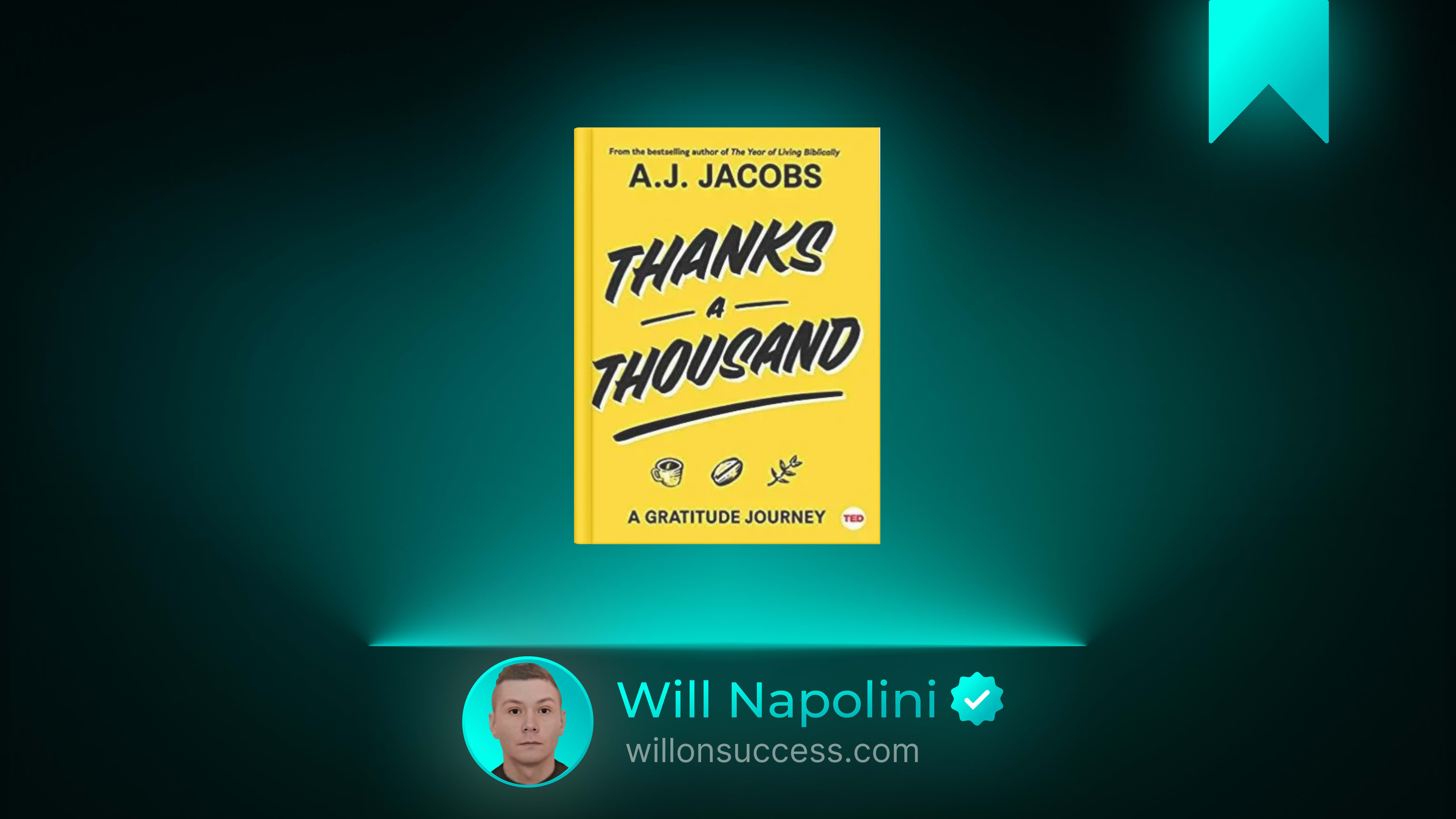
A.J. Jacobs, a journalist and author known for immersing himself in radical life experiments, decided to shatter that illusion. In his book Thanks a Thousand: A Journey Through Gratitude, he set himself a seemingly simple but practically impossible task: he was going to track down and personally thank every single person who made his morning cup of coffee possible.
What begins as a humorous, slightly obsessive journalistic stunt quickly transforms into one of the most grounding, perspective-shifting explorations of human interdependence you will ever read. Jacobs discovers that gratitude is not a soft, sentimental emotion reserved for greeting cards. It is a cognitive intervention. It is a deliberate, muscular practice that rewires your brain, cures your entitlement, and reconnects you to the hidden web of humanity that sustains your life every single day.
Let me show you how tracing a single cup of coffee can change the way you walk through the world.
The Big Idea: You Are Not Self-Made; You Are Sustained
Jacobs starts his journey where most of us start: at the local coffee shop. He thanks the barista. But then he asks, Where did the beans come from? He tracks down the roaster. Then he flies to Colombia to meet the farmers who picked the cherries.
But he doesn’t stop there. He realizes that to brew the coffee, he needs water. So he travels to the Catskill Mountains to thank the workers who maintain the reservoirs that supply New York City’s tap water. He realizes he needs a mug, so he thanks the ceramicists. He realizes the roasting machines are made of steel, so he tracks down the iron miners who pull the ore from the earth. He thanks the truck drivers, the warehouse workers, the pest control operators who keep the bugs out of the storage facilities, and the designers who created the logo on the cup.
By the end of the project, Jacobs has thanked over a thousand people.
The central thesis of the book emerges from this staggering chain of human effort: You are held up by thousands of invisible hands.
Every time you take a sip of coffee, turn on a light switch, or drive on a paved road, you are the beneficiary of a massive, intricate, global collaboration of human beings waking up, doing their jobs, and keeping the machinery of civilization running.
When you truly internalize this, something profound shifts in your psychology. The modern disease of entitlement—the exhausting belief that the world owes you convenience and that any friction is a personal insult—begins to dissolve. You realize that the baseline of your life is not a guarantee. It is a miracle of logistics, labor, and cooperation. And the only rational response to a miracle is gratitude.
The Negativity Bias: Why We Focus on the One Rude Barista
If we are surrounded by thousands of people working hard to sustain us, why do we so rarely feel grateful? Why is our default state often one of mild irritation?
Jacobs leans on evolutionary psychology to explain this. Our brains are not wired for happiness; they are wired for survival. And for survival, noticing threats is far more important than noticing blessings. This is the negativity bias.
Imagine you walk into a coffee shop. The farmer grew the beans perfectly. The roaster nailed the temperature. The truck driver navigated traffic safely. The barista smiles, makes your drink, and hands it to you. But the lid is on slightly crooked, and a single drop of coffee spills onto your thumb.
What do you focus on for the rest of the morning? The drop of coffee. The slightly incompetent barista. The minor inconvenience. Your brain effortlessly filters out the flawless execution of ten thousand people to hyper-focus on the one thing that went slightly wrong.
Jacobs argues that gratitude is the manual override for the negativity bias. It is the conscious, deliberate act of forcing your brain to acknowledge the baseline of goodness that you normally ignore. You do not practice gratitude because everything in your life is perfect. You practice gratitude to remind yourself of the massive amount of effort that is quietly working in your favor, even on the days when the lid is on crooked.
Gratitude Is a Lens, Not a Mood
One of the most liberating ideas in Thanks a Thousand is the dismantling of the myth that you have to “feel” grateful to practice gratitude.
We often treat gratitude as a passive emotion, a warm feeling that washes over us when something good happens. I feel grateful today because the sun is shining and I got a promotion. But if gratitude is just a feeling, then you are at the mercy of your circumstances. When the rain comes, or the layoff happens, or the diagnosis lands, the gratitude evaporates.
Jacobs discovered through his journey that gratitude is not a mood. It is a lens. It is a way of directing your attention.
When he sat down with the workers who maintain the New York City water supply—people who spend their days in damp tunnels ensuring millions of people don’t get cholera—he didn’t necessarily feel a soaring, emotional high. But by forcing himself to look closely at their work, to ask them questions, to understand the complexity of their jobs, he generated a deep, abiding respect.
You do not need to wait for a wave of warmth to say thank you. You simply need to pay attention. You look at the clean floor of the grocery store and you direct your lens toward the person who mopped it at 5:00 a.m. You look at the software that organizes your calendar and you direct your lens toward the developers who debugged it. The action of looking creates the feeling of appreciation, not the other way around.
The Ripple Effect: What Happens When You Actually Say It
As Jacobs travels the globe thanking people, he notices a fascinating phenomenon in the people he is thanking. Many of them are doing “invisible work.” They are miners, pest control workers, warehouse packers. They are people who are rarely looked in the eye and told that their labor matters.
When Jacobs sits down with them and explains, “I am here because I want to thank you for the role you played in my morning routine,” their physical posture changes. They sit up a little straighter. Their eyes light up. They suddenly see their own job not as a grind, but as a vital link in a chain.
This reveals a beautiful, practical truth about human connection: A genuine “thank you” is a transfer of dignity.
When you thank someone specifically and sincerely, you are doing more than being polite. You are validating their existence. You are telling them, I see you. I see your effort. You are not invisible to me. In a world where so many people feel like cogs in a machine, being seen as a vital contributor is a profound psychological gift.
And the beautiful irony is that the giver of the gift receives just as much as the receiver. Jacobs notes that every time he expressed genuine gratitude, his own anxiety dropped. His own sense of isolation faded. You cannot feel deeply connected to the web of humanity and feel lonely at the same time. The two states cannot occupy the same mind.
Savoring: The Enemy of Gratitude Is Speed
There is a mechanical reason we fail to appreciate the things we have: we are moving too fast to experience them.
Jacobs introduces the concept of savoring, which is the active, deliberate prolongation of a positive experience. You cannot be grateful for a cup of coffee if you chug it while simultaneously reading an angry email and walking to the subway. In that scenario, the coffee is just caffeine delivery. It is fuel.
Savoring requires you to pause. It requires you to engage your senses. What does the ceramic mug feel like in your hand? What is the exact aroma of the roast? What is the temperature?
I have learned that speed is the great eraser of joy. When we rush, we flatten our experiences into mere tasks to be completed. Savoring is the act of adding a third dimension back into your life. It is the decision to take three extra minutes to actually taste your breakfast, to actually listen to the song playing in the car, to actually look at the face of your partner across the table.
Gratitude requires a target, and you cannot aim at what you are blurring past. If you want to cultivate a deeper appreciation for your life, you do not necessarily need a better life. You just need to slow down enough to actually inhabit the one you have.
Why This Matters on an Ordinary Tuesday
It is easy to read about a journalist flying to Colombia and think, That’s a nice story, but I have a mortgage to pay and a toddler screaming in the next room.
But the mechanics Jacobs uncovers are most vital precisely when life feels heavy and mundane.
Think about your workplace. It is very easy to fall into an adversarial relationship with your colleagues, to view the IT department as the people who block your software requests, or the janitorial staff as invisible ghosts who empty the trash. But what if you applied the “Thanks a Thousand” lens to your office? What if you recognized that the reason you have a safe, climate-controlled place to earn a living is because of the HVAC technicians, the building inspectors, the electrical grid workers?
When you zoom out, the petty annoyances of daily life shrink to their proper size. The coworker who replied-all to an email is still annoying, but they are also a human being participating in a massive, fragile web of cooperation. Your anger loses its absolute grip on you. You gain perspective.
Furthermore, practicing this kind of radical gratitude builds immense resilience. When a crisis hits—when you lose a job, or face a health scare—the foundation of your mental health is not built on the fragile hope that things will always go perfectly. It is built on the deep, unshakeable knowledge that even in the dark, you are still being held up by thousands of invisible hands. The doctors, the nurses, the researchers who developed the medicines, the friends who bring you soup. You are never truly alone.
Who Should Read This Book
If you are someone who rolls their eyes at “toxic positivity,” who feels cynical about corporate gratitude initiatives, or who thinks mindfulness is just a buzzword for the privileged, this book is for you. A.J. Jacobs is a skeptic. He is neurotic, funny, and deeply grounded in reality. He does not ask you to pretend that the world is perfect or that bad things don’t happen. He simply asks you to look at the data of your own life and acknowledge the massive amount of good that is quietly happening in the background.
It is a wonderful book for anyone feeling burnt out, disconnected, or trapped in the modern bubble of hyper-individualism. It will gently pull you out of your own head and reconnect you to the species.
It will be less useful if you are looking for a clinical, step-by-step psychological workbook. Jacobs is a storyteller and a journalist. The book is a narrative journey, full of quirky encounters and humorous observations. The lessons are woven into the story, rather than presented as a rigid twelve-step program. You read it to shift your perspective, not to fill out worksheets.
Practical Application: Building Your Gratitude Muscle
Understanding that you are part of a web is beautiful. But to change your life, you have to turn that understanding into behavior. Here is how you can start practicing radical gratitude this week.
1. The “Trace One Thing” Exercise Once a week, pick one ordinary object in your house. A cotton t-shirt. A smartphone. A wooden spoon. Spend ten minutes tracing it back. Think about the farmers who grew the cotton, the weavers who spun it, the dyers, the sailors who shipped it across the ocean, the truck drivers who delivered it to the store. You don’t need to track them all down, but simply visualizing the chain of human effort required to bring that object to your hands will fundamentally alter how you view your possessions. You will stop seeing them as commodities and start seeing them as the end result of human labor.
2. The “Invisible Worker” Acknowledgment Identify one person in your daily life whose work makes your life possible, but who rarely receives praise. The person who cleans your office building. The delivery driver who drops off your packages. The IT support worker who keeps your network running. The next time you see them, do not just offer a passing nod. Stop. Look them in the eye. Say, “I just want to tell you that I notice the work you do, and I really appreciate it. You make my day easier.” Watch what happens to their face. Watch what happens to your own chest.
3. The Savoring Pause Choose one routine activity you do every single day on autopilot. Drinking your morning tea, taking a shower, walking from your car to your front door. For the next seven days, commit to doing that one activity 20% slower. Engage your senses. Feel the temperature of the water. Smell the air. Notice the texture of the mug. Do not let your mind jump to the next task until the current one is finished. Reclaim your experience from the rush of the clock.
One Small Step
I want to leave you with a challenge that will take you exactly three minutes, but will alter the emotional temperature of your day.
Think of one person who did something for you recently that made your life easier, smoother, or better, but whom you never properly thanked. Maybe it was a colleague who covered for you when you were sick. Maybe it was a friend who listened to you vent. Maybe it was a stranger who held a door or returned a lost item.
Open your phone right now. Send them a text, an email, or a voice note.
Do not just say, “Thanks!” Be specific. Tell them exactly what they did, and tell them the impact it had on you. “Hey, I just wanted to say thank you for handling that client call yesterday. I was incredibly stressed, and your calm approach completely defused the situation. It made my whole week easier. I really appreciate you.”
Hit send.
When you do this, you are doing more than being polite. You are pulling a thread in the hidden web that holds us all together. You are proving to yourself, and to them, that our actions matter, that our effort is seen, and that we are not navigating this chaotic world alone.
We spend so much of our lives looking up, waiting for a grand, cinematic moment of salvation. We wait for the big promotion, the perfect relationship, the windfall that will finally make us feel secure and happy.
But the security you are looking for is already beneath your feet. It is in the paved roads, the clean water, the harvested crops, and the millions of strangers who wake up every day and do their part to keep the world spinning for you.
You are held up by a thousand invisible hands.
The only thing left to do is to look down, see them, and say thank you.