The Mindful Day by Laurie J. Cameron: How to Find Calm Without Changing Your Schedule
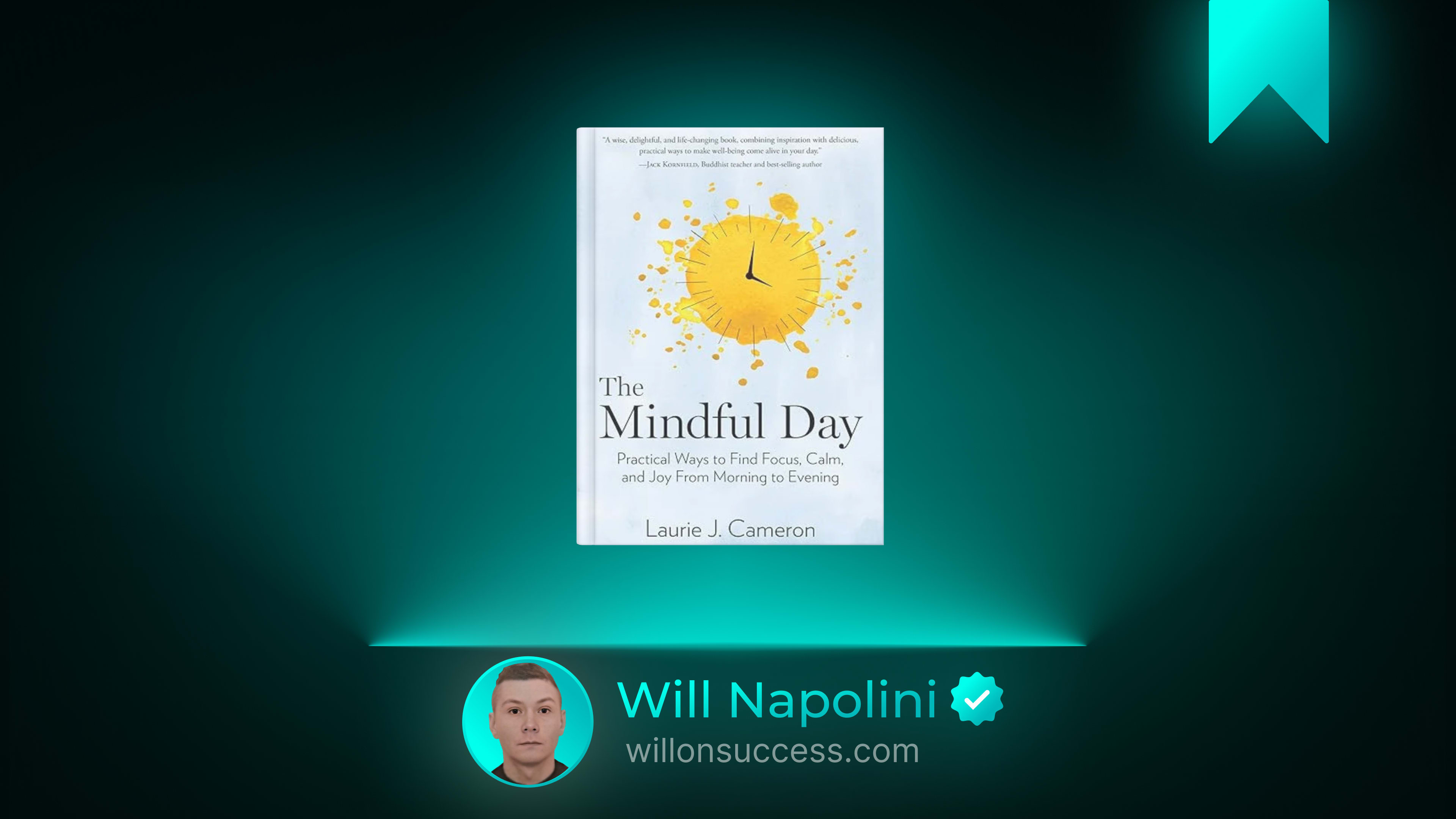
You already have the time you need. I know that sounds absurd. You have a calendar that looks like a battlefield, a phone that will not stop vibrating, and a mind that starts negotiating tomorrow’s problems before you have finished tonight’s dinner. The last thing you need, it seems, is someone telling you to add stillness to the pile.
But here is what Laurie J. Cameron understood when she wrote The Mindful Day: the problem was never that your life lacked open space. The problem was that you were not actually in your life while living it. You were on autopilot, physically present but mentally three meetings ahead, replaying a conversation from lunch, or rehearsing an argument you might have tomorrow. The hours passed. You were not in them.
Cameron spent years teaching mindfulness inside corporations, boardrooms, and leadership programs—places where nobody has forty-five minutes to sit on a cushion and watch their breath. What she discovered, and what this book teaches with unusual clarity, is that mindfulness does not require a retreat, a monastery, or a restructured morning. It requires something far smaller and far more radical: a willingness to arrive inside the moment you are already in.
This book will not ask you to overhaul your life. It will ask you to inhabit it.
The Central Idea: Your Ordinary Tuesday Is the Practice Ground
Most people treat mindfulness as a destination they will reach once conditions improve. When the project ends. When the kids are older. When I finally get that quiet weekend. Cameron dismantles that fantasy gently but firmly. The structure of The Mindful Day follows a single, unremarkable day—waking, brushing teeth, commuting, working, eating lunch, attending meetings, driving home, cooking dinner, lying in bed. There is nothing exotic here. That is the point.
The thesis underneath every chapter is this: awareness is not something you add to your life. It is a quality of attention you bring to whatever is already happening. Washing a dish can be an act of complete presence. Walking from the parking lot to the office can be a meditation. Listening to a colleague without mentally drafting your response can be a profound practice.
You do not need more time. You need more attention inside the time you already have.
This distinction matters because it removes the most common excuse people use to avoid inner work: I simply don’t have the space for it right now. Cameron’s answer is compassionate but honest. You do not need space. You need to stop leaving the room while you are still sitting in it.
The Autopilot Problem: Why You Miss Your Own Life
Cameron describes something most of us recognize but rarely name. We spend the majority of our waking hours in what she calls a kind of automatic pilot. The body performs the action—driving, typing, chewing, nodding in a meeting—while the mind is somewhere else entirely. Planning. Worrying. Reliving. Fantasizing. Anything other than here.
The cost is not dramatic. You do not lose your job or your marriage in one spectacular autopilot failure. The cost is quieter and, in some ways, sadder. You lose texture. You lose the actual taste of your coffee. You lose the specific quality of light on a Wednesday afternoon. You lose the sound of your child’s laughter because you were mentally composing an email while they were talking. You lose years, not to tragedy, but to inattention.
I have seen this pattern in my own life more times than I can count. Periods where I was so oriented toward the next task, the next goal, the next problem to solve, that the present moment became merely a hallway I walked through to get to the next room. And then one day I realized I had walked through hundreds of hallways and never once stopped to notice the walls, the light, the air.
Cameron does not frame this as a moral failure. You are not broken because your mind wanders. Wandering is what untrained attention does. But you can train it. Slowly. Gently. Without drama.
The Pause: The Smallest Revolution You Can Practice
If there is one practical tool that runs through this book like a thread through a needle, it is the pause. Not a long, dramatic, cinematic pause. A small one. Two seconds. Maybe three.
Between the alarm ringing and your hand reaching for the phone. Between a colleague’s sharp comment and your defensive reply. Between the urge to open a social media app and the actual opening of it. Between finishing one task and immediately lunging into the next.
Cameron teaches that this tiny gap is where your freedom lives. Without the pause, you are reactive—a stimulus hits and a behavior follows, automatic as a reflex. With the pause, you insert a sliver of choice. You can notice the anger before it becomes a sentence. You can feel the anxiety before it becomes avoidance. You can sense the exhaustion before you override it with another cup of coffee and another hour of grinding.
This is not suppression. You are not stuffing the feeling down. You are simply meeting it one beat before it hijacks your behavior. And in that one beat, you remember that you are the one choosing, not the impulse.
A small pause, repeated dozens of times a day, gradually rewires the relationship between what happens to you and what you do next. That rewiring is not dramatic. It is more like the slow turning of a ship—barely perceptible at first, but over weeks and months, you realize you are heading somewhere entirely different.
You Sense Your Way Into Presence; You Cannot Think Your Way There
One of the most useful distinctions Cameron makes is between thinking about the present moment and actually sensing it. These are not the same thing. You can sit in a garden and think, I should be enjoying this. This is peaceful. I am being mindful right now. And none of it lands because you are narrating the experience rather than having it.
Cameron’s practices throughout the book consistently return attention to the body. The feeling of water on your hands while washing them. The pressure of your feet against the floor while standing in line. The warmth of a mug against your palms. The sound of a door closing. The texture of food in the first three bites of a meal.
This is not mystical. It is mechanical. The thinking mind is the mind that time-travels—it rehearses the future and replays the past. The sensing body is always, without exception, in the present. You cannot feel the warmth of water on your hands yesterday. You cannot feel the ground under your feet next Thursday. Sensation anchors you here in a way that thought never can.
If you have tried meditation before and felt like you were failing because your mind would not go quiet, this reframe may release you. The goal was never to silence thought. The goal was to shift the channel from thinking to sensing, even for thirty seconds. And thirty seconds is enough to begin.
Small Moments Compound Like Interest in a Quiet Account
Cameron does not ask you to meditate for an hour. She suggests practices that last thirty seconds, one minute, three breaths. A single mindful walk from your desk to the break room. One meal where you actually taste the first few bites. One meeting where you listen without preparing your response.
Individually, these moments feel almost too small to matter. And I think that is exactly why most people dismiss them. They feel insignificant next to the scale of our stress, our exhaustion, our sense that life is moving too fast. What can three conscious breaths do against a twelve-hour workday?
But Cameron understands something about change that many people miss: transformation rarely arrives as a single dramatic event. It arrives as accumulation. A river does not carve a canyon in one storm. It carves it through ten thousand patient passes over the same stone.
Each small moment of presence is a deposit. You will not feel different after one. You may not feel different after twenty. But over months, something shifts in the baseline. You become slightly less reactive. Slightly more able to notice tension before it becomes a headache. Slightly more present in conversations. Slightly less haunted by the feeling that life is happening to you rather than with you.
You start small. You stay consistent. You let the accumulation do what intensity never could.
Mindfulness at Work: Presence as a Professional Skill
Cameron’s background teaching inside organizations gives the book a practical edge that many mindfulness books lack. She addresses the specific textures of work life: the back-to-back meetings, the email avalanche, the colleague who triggers you, the Sunday-evening dread, the temptation to eat lunch over a keyboard.
Her suggestions are not abstract. She talks about how to arrive in a meeting with two conscious breaths before speaking. How to listen fully to one person in a conversation rather than scanning the room for the next person you need to talk to. How to take three breaths between finishing one task and starting the next, so you are not carrying the residue of the last hour into the next one.
She also addresses something I think many professionals feel but rarely articulate: the sense that being fully present at work is somehow less productive than being in constant motion. We have confused busyness with effectiveness. We believe that if we are not multitasking, we are falling behind. Cameron’s counter-argument, drawn from both contemplative tradition and the neuroscience she references lightly, is that attention is a finite resource. Fragmenting it across six tasks does not multiply your output. It dilutes the quality of everything you touch.
One focused hour often produces more than four scattered ones. And the focused hour leaves you less depleted at the end of the day.
Who Should Read This Book
If you are someone who has dismissed mindfulness because you picture it as incense, silence, and sitting cross-legged for an hour, this book is specifically for you. Cameron meets you in the parking lot, at the kitchen counter, in the middle of a conference call. She makes the practice small enough to fit inside a life that is already full.
If you are a professional carrying chronic low-grade stress—not a crisis, just the persistent hum of too much to do and not enough time—this book offers a way to change your relationship to that pressure without quitting your job or moving to a cabin.
If you have tried meditation apps and felt like you were failing because your mind would not empty, Cameron’s approach will likely feel like relief. She is not asking for silence. She is asking for notice.
Where the book may feel less useful: if you are in acute crisis—grief, trauma, severe anxiety—these gentle practices are not a substitute for professional support. Cameron’s work is preventive and strengthening, not therapeutic in the clinical sense. And if you are already an experienced meditator with a well-established daily practice, much of this material will feel familiar, though her workplace framing may still offer something fresh.
What to Do With This, Starting Tomorrow Morning
Understanding is not the same as change. You can read every book on mindfulness ever written and still spend the entire day in autopilot if the ideas never touch your behavior. So let me make this concrete.
Tomorrow morning, before you touch your phone, do this:
Sit up in bed. Place both feet flat on the floor. Feel the actual sensation of the floor—its temperature, its firmness, the pressure against your soles. Take three breaths. Not deep, performative breaths. Just three breaths where you actually feel the air entering and leaving. That is the entire practice. Ten seconds, perhaps fifteen.
Then, when you walk to the kitchen or the bathroom, feel your feet moving. Feel the shift of weight from one leg to the other. You do not need to walk slowly like a monk in a documentary. Walk at your normal pace. Just notice the walking.
At some point during the day—perhaps before a meeting, perhaps before opening your laptop after lunch—pause for two full breaths. Feel your hands on the desk or in your lap. Notice one sound in the room. Then continue.
That is it. You do not need to journal about it. You do not need to track a streak. You do not need to tell anyone. You are simply practicing arriving inside a moment you would otherwise sleepwalk through.
If you forget, that is not failure. Noticing that you forgot is the practice. You came back. That is the whole skill.
The Door Is Already Open
Cameron’s deepest teaching, the one underneath all the breathing exercises and body scans and mindful-walking instructions, is this: peace is not something you build in the future. It is something you notice in the present. It has been available to you all along, buried under the noise of planning and replaying and rushing toward the next thing. You do not need to earn it. You do not need to fix yourself before you are allowed to feel it. You only need to stop, briefly, and let the moment you are in actually register.
You have spent years believing that calm is something you will get after—after the promotion, after the house, after the children grow, after the debt clears. Cameron invites you to consider that the after never arrives, because there is only ever this breath, this step, this Tuesday afternoon with its particular quality of light coming through the window.
You do not need to change your life to find peace. You need to let your life find you, standing still for just a moment, paying attention.
Tonight, before you close your eyes to sleep, feel the weight of your body against the mattress. One breath in. One breath out. Notice the temperature of the air on your skin. That is enough. That is the whole practice. And it is already waiting for you.