The Miracle Morning: Why Your First Hour Decides More Than You Think
There is a version of your life that you keep postponing. You have a rough sketch of it in your mind—the energy, the focus, the sense of direction—and you tell yourself you will step into it once conditions improve. Once the job settles. Once the kids are older. Once you feel ready.
What if the gap between the life you are living and the one you keep describing to yourself is not a gap of circumstance, but a gap of first hour?
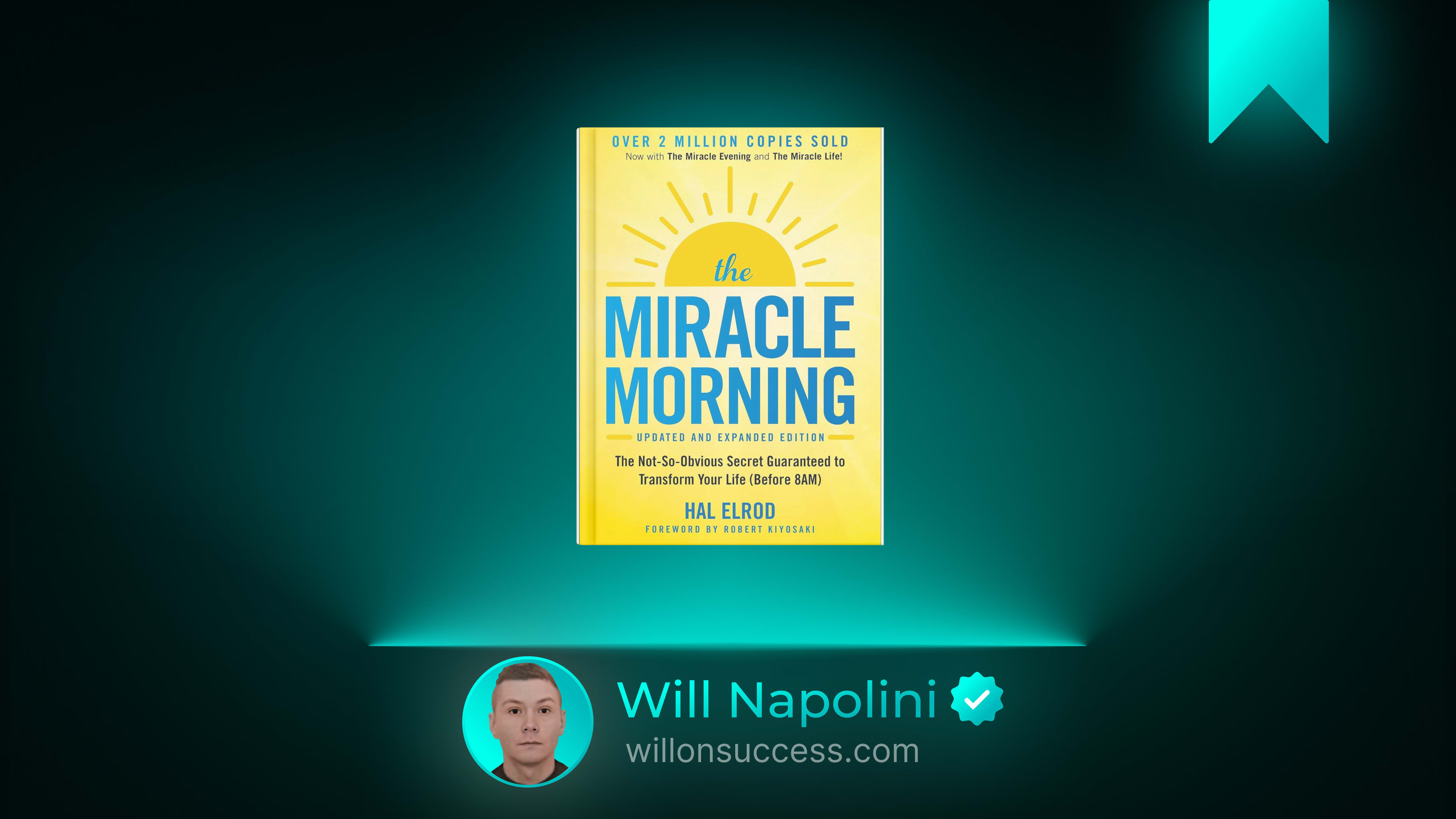
That is the question Hal Elrod spends an entire book pressing against your chest. Not politely. Not theoretically. He presses it the way a friend presses it after watching you circle the same problem for three years: You are not stuck because your life is too hard. You are stuck because you never gave yourself a quiet, deliberate beginning.
I want to walk you through what Elrod actually teaches, where the idea holds real weight, and—most importantly—what you can do with it before your feet hit the floor tomorrow morning.
The Wreck That Became a Foundation
Before the book became a bestseller, before the speaking tours and the global morning-routine community, Hal Elrod was a twenty-year-old college student driving home from a seminar when a drunk driver crossed the median and hit him head-on at seventy miles per hour. Elrod was clinically dead for six minutes. When they revived him, doctors told him he would never walk again.
He did walk again. Slowly, painfully, over months of rehabilitation. He rebuilt a career in sales. He built a life.
Then, years later, in the middle of what looked like stability, he faced a financial collapse during the 2008 recession and a diagnosis that threatened everything again.
I am telling you this not to turn his life into a motivational poster. I am telling you because it matters that the man writing about waking up at five in the morning has a body that reminds him every single day what it cost to stand up at all. The book is not written from a place of easy optimism. It is written from a place where optimism had to be constructed, plank by plank, in a life that had already been broken open.
That context changes how you read what comes next.
The Central Claim: Your Level of Success Will Never Exceed Your Level of Personal Development
This is the spine of the book. Elrod argues that most people chase results—a better income, a better relationship, a healthier body—without investing in the internal capacity required to create and sustain those results. They want the harvest without tending the soil.
His claim is straightforward: the quality of your external life tends to mirror the quality of your internal development. If you have not done the work of clarifying your values, training your focus, strengthening your body, and feeding your mind, then even when opportunity arrives, you will not have the architecture to hold it.
This is not a mystical idea. Think of it like craftsmanship. You cannot ask a carpenter to build a cathedral if he has only ever practiced cutting straight lines. The skill must precede the structure. Elrod’s argument is that your morning—the first waking hour—is the most reliable, most repeatable window you have to do that inner craftsmanship before the world starts pulling you in twelve directions.
Rearview Mirror Syndrome
One of the most useful concepts in the book is what Elrod calls “Rearview Mirror Syndrome.” The idea is simple but uncomfortable: most of us navigate our future while staring at our past.
You had a failure five years ago, and it still quietly sets the boundary of what you believe you deserve. You grew up in a household where ambition was mocked, so you learned to keep your goals small and quiet. You tried something once and it did not work, so you filed yourself under “the kind of person who can’t do that.”
Elrod’s point is not that the past is irrelevant. It is that most of us let the past drive while we sit in the passenger seat, narrating our own limitations as if they were fixed laws of nature. The morning routine he proposes is, in part, a deliberate practice of turning around in the seat. Facing forward. Choosing, each day, to define yourself by where you are going rather than by where you have been.
If you have ever caught yourself saying, “I’m just not a morning person,” or “I’ve never been disciplined,” or “That’s not how people like me do things”—that is the rearview mirror talking. And you can set it down.
The Life S.A.V.E.R.S.: Six Practices, One Hour
The practical core of the book is a framework Elrod calls the Life S.A.V.E.R.S.—six activities designed to fill that first hour:
Silence. Not empty sitting. Purposeful stillness. Meditation, prayer, slow breathing, or simply sitting with your thoughts before the noise begins. The goal is to lower the internal static so you can actually hear yourself think.
Affirmations. Spoken or written declarations of who you are becoming and what you intend to do. Elrod is careful to distinguish this from magical thinking. The point is not to chant your way into a million dollars. The point is to rehearse your commitments out loud so they stop being vague wishes and start becoming instructions you give yourself.
Visualization. Spending a few minutes seeing, in your mind, the day going well. The conversation handled with patience. The workout completed. The project moved forward. This is not fantasy. It is mental rehearsal, the same technique athletes and performers have used for decades.
Exercise. Moving your body. Even ten minutes. Walking, stretching, jumping jacks, yoga. The purpose is not a fitness goal. The purpose is to put energy into your system before the day starts drawing energy out of you.
Reading. Feeding your mind with something substantive. A chapter of a book. A long article. Something that stretches your thinking beyond the loop of your own worries.
Scribing. Writing. Journaling. Getting the swirl of thoughts, gratitude, plans, and frustrations out of your head and onto paper so they stop ricocheting around your skull all day.
You do not need sixty minutes for all six. Elrod acknowledges that even a compressed version—five minutes each—can shift the entire texture of a day. The point is not duration. The point is intention before reaction. Most people wake up and immediately react: to an alarm, to a phone notification, to the anxiety of the day’s obligations. The S.A.V.E.R.S. framework inserts a small, deliberate space between waking and responding.
Why the First Hour Carries So Much Weight
You might think this is overstatement. One hour out of sixteen waking hours. How much can it really change?
Here is what I have observed, and what Elrod’s framework points toward: the first hour does not just add something to your day. It sets the sequence. It determines whether you begin in a state of choice or a state of reaction. And that initial state has a disproportionate pull on everything that follows.
Think of it like the first few notes of a song. They establish the key, the tempo, the emotional register. If the opening notes are frantic and scattered, the rest of the song tends to follow that energy, even if the melody itself is beautiful. But if the opening notes are grounded, clear, deliberate—they give the rest of the music permission to breathe.
Your morning is the opening measure. You do not need to play a symphony in it. You just need to set the key.
The Thirty-Day Adjustment
Elrod is honest about one thing that many habit books gloss over: the first ten days will feel terrible. Your body will resist the earlier alarm. Your mind will generate a hundred rational-sounding reasons to sleep another hour. The routine will feel mechanical and maybe a little absurd.
He breaks the adjustment into three ten-day phases. The first ten days are about survival—just showing up, doing the motions, not judging yourself for feeling clumsy. The second ten days are where the discomfort starts to ease and you begin to feel small shifts in energy and focus. The third ten days are where the practice starts to feel less like an obligation and more like something you actually want.
This matters because most people quit in the first phase. They wake up at five, feel groggy, think “this isn’t working,” and go back to their old pattern by day four. Elrod’s advice is essentially: do not evaluate the experiment during the hardest part of the experiment. Give it the full thirty days before you decide whether it belongs in your life.
You start small. You stay consistent. You let the discomfort be information, not a verdict.
What This Looks Like on an Ordinary Tuesday
Let me make this concrete, because abstraction is where good ideas go to die.
Imagine it is Tuesday. You set your alarm for thirty minutes earlier than usual. Not two hours. Thirty minutes. You put the alarm across the room so you have to stand up to turn it off. You drink a glass of water. You sit on the edge of your bed and take ten slow breaths. You say out loud, quietly, one thing you intend to do well today. You stretch for five minutes. You read three pages of a book you have been meaning to finish. You write two sentences in a notebook: one thing you are grateful for, one thing you are going to focus on.
That is it. Twenty-five minutes. No dramatic transformation. No cinematic sunrise montage. Just a small, deliberate beginning instead of a reactive one.
Now multiply that by three hundred days. The compound effect is not in any single morning. It is in the accumulation. It is in the quiet, private repetition of choosing yourself before the world makes its demands.
What you repeat in the quiet of an early morning eventually becomes visible in the shape of your life.
Where the Book Is Strongest—and Where to Read With a Grain of Salt
Elrod’s greatest strength is his insistence that personal development is not a luxury or a hobby. It is infrastructure. You would not expect a house to stand without a foundation, and he argues you should not expect a meaningful life to stand without some daily investment in your own clarity, health, and mind. That reframe is genuinely useful.
The book is also refreshingly practical. It does not leave you floating in inspiration. It gives you a structure, a timeline, and permission to start imperfectly.
Where I would encourage you to read with balance: the book can occasionally drift toward the implication that if you just do your morning routine with enough faith and consistency, external circumstances will bend accordingly. Life is more complicated than that. A morning routine will not fix a broken workplace, a health crisis, or systemic barriers. What it can do is ensure that you meet those difficulties with more clarity, more resilience, and more self-respect than you would have had otherwise. That is no small thing. But it is not magic, and Elrod’s own life—marked by accident, illness, and financial collapse despite his discipline—proves that.
Read it as a framework for building inner capacity. Not as a guarantee of outer ease.
Who Will Benefit Most From This Book
If you have ever felt like your days happen to you rather than being shaped by you, this book will speak directly to that frustration. If you know you are capable of more focus, more patience, more follow-through, but you cannot seem to find the space to develop those qualities—this is your book.
It is especially useful for people in transition: starting a new career, rebuilding after a setback, stepping into a leadership role, trying to break a pattern of procrastination or low energy. The structure gives you something to hold onto while the ground is still shifting.
It may be less useful if you already have a well-established morning practice and are looking for deeper philosophical or psychological exploration. The book is an entry point, a spark. If you are already ten years into a meditation and journaling practice, the S.A.V.E.R.S. will feel basic. But “basic” and “foundational” are often the same word viewed from different angles.
Your One Small Step
I am not going to ask you to wake up at five tomorrow. That is not the point, and forcing an unrealistic shift will only set you up to quit by Thursday.
Here is what I would ask instead:
Tonight, before you go to sleep, set your alarm for fifteen minutes earlier than usual. Put the phone or alarm clock far enough away that you have to stand to turn it off. Then, when you stand, do not look at a screen. Sit on the edge of your bed. Take five slow breaths. Say one sentence out loud about what kind of person you want to be today. Then drink a glass of water.
That is the whole experiment for tomorrow. Fifteen minutes. One breath practice. One sentence. One glass of water.
You are not trying to overhaul your life by sunrise. You are trying to prove to yourself, in the smallest possible way, that you can choose your first moment instead of surrendering it.
A small decision becomes a direction, and a direction repeated long enough becomes a life. You do not need a dramatic reinvention. You need a beginning that belongs to you.
The morning is already waiting. The only question is whether you will meet it awake—not just in body, but in intention.
Set the alarm. Put it across the room. And when you stand up tomorrow, remember: you are not just starting a day. You are casting a quiet, private vote for the person you are becoming.
That vote counts. It always has.