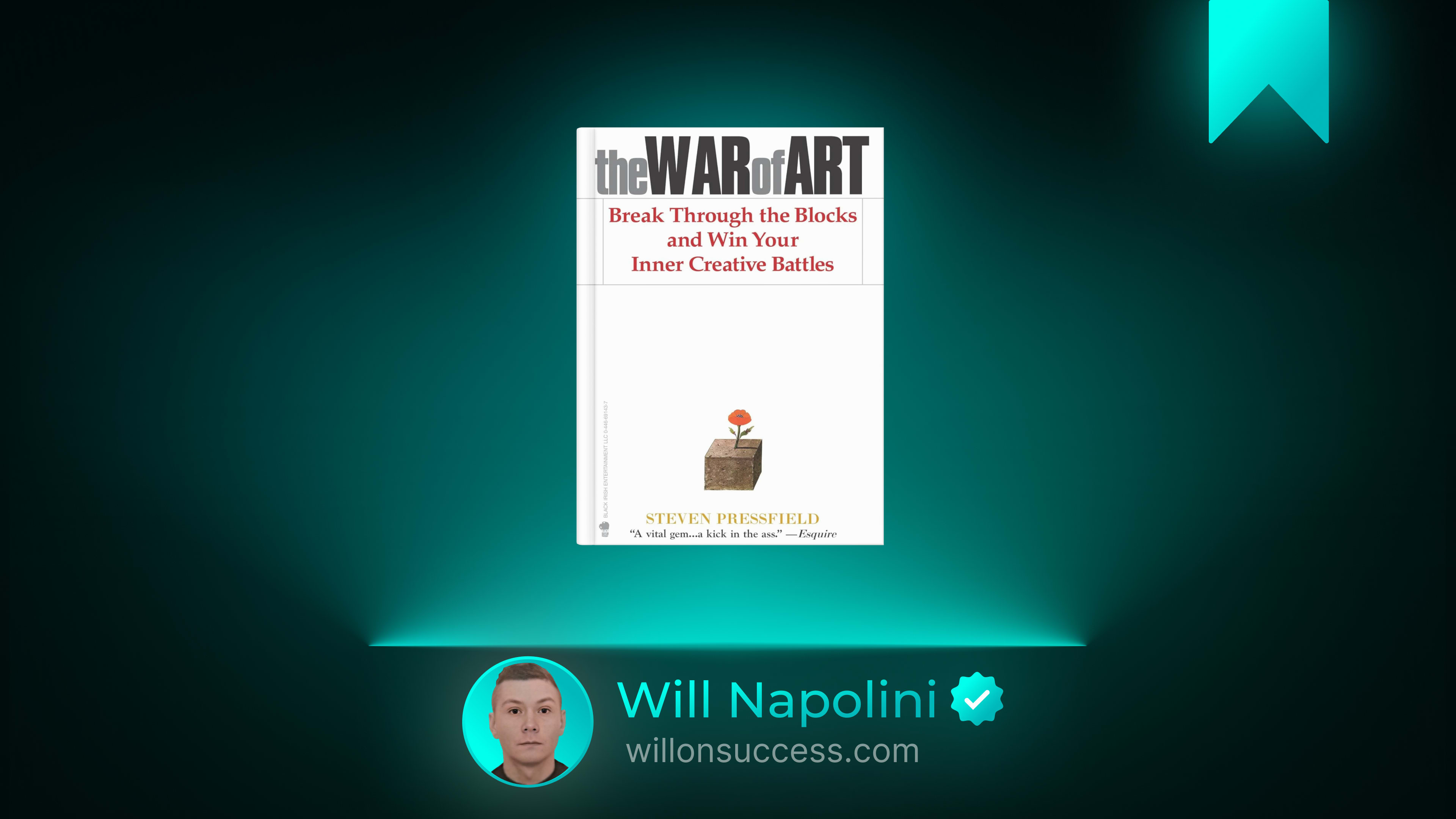
The War of Art: How to Defeat Your Inner Enemy and Do the Work That Matters
There is a dangerous assumption hiding inside the way most of us think about procrastination.
We tell ourselves we are just lazy, or tired, or waiting for the right moment. We believe that if we just find the perfect system, the perfect mood, or the perfect amount of free time, we will finally start that business, write that book, or make that difficult life change.
But what if the force keeping you from your most important work is not a flaw in your character, but a highly organized, intelligent adversary?
If I could sit across the table from you, I would tell you this: You are not broken. You are simply facing an opponent that every single person who attempts anything meaningful must face.
Steven Pressfield’s The War of Art is not a gentle pat on the back. It is a battle manual. It names the enemy, explains its tactics, and gives you the exact mindset required to defeat it. It will challenge you. It might make you uncomfortable. But it will also give you the clarity you need to stop waiting and start building the life you know you are capable of creating.

The Big Idea: Resistance Is the Enemy, and Work Is the Weapon
The central thesis of The War of Art is both simple and profound. Pressfield identifies a universal, destructive force that he calls “Resistance.”
Resistance is the internal force of self-sabotage. It is the voice that tells you to sleep in, to scroll through your phone, to doubt your abilities, or to wait until tomorrow. It is not just procrastination; it is an active, intelligent force that grows stronger the more important the task is to your soul’s evolution.
The goal of this book is not to help you eliminate Resistance. That is impossible. The goal is to help you recognize it for what it is, and to develop the discipline to do the work anyway.
External results often begin with internal development. You do not need more motivation. You need a fundamental shift in identity. You must stop acting like an amateur waiting for inspiration, and start acting like a professional who shows up and does the work.
The Core Concept: The Amateur vs. The Professional
To understand how to beat Resistance, Pressfield draws a sharp, unforgiving line between the amateur and the professional.
The amateur views their craft as a hobby. They work only when they feel inspired. When Resistance hits—and it always does—the amateur rationalizes it. “I’m just not in the zone today.” “I need to do more research first.” “I’ll start on Monday.” The amateur is governed by their emotions and seeks external validation.
The professional, however, views their craft as a vocation. They show up every day, at a set time, regardless of how they feel. They do not wait for the muse. They know that the muse only visits those who are already at work. The professional accepts that the work will often be difficult, boring, or frightening, and they do it anyway.
The professional does not let their feelings dictate their actions. They let their commitment dictate their actions.
The Major Principles
Resistance Targets What Matters Most
Resistance is not random. It is a compass. The more important a call or action is to our soul’s evolution, the more Resistance we will feel toward pursuing it.
If you feel a deep, irrational dread about starting a specific project, that is not a sign you should avoid it. It is a sign that it is exactly what you are meant to do. Resistance only shows up when you are on the verge of something meaningful. It never tries to stop you from watching another hour of television. It only attacks when you are about to level up.
Consistency Outperforms Intensity
We live in a culture that glorifies dramatic, heroic bursts of effort. We imagine the writer typing furiously through the night, fueled by coffee and sudden genius.
But the professional knows the truth: small actions repeated over time outperform dramatic bursts of effort. The professional clocks in. They sit down at their desk at 8:00 AM, whether they feel brilliant or completely blank. They put in the hours. They trust that showing up consistently is the only way to produce work of lasting value.
You start small. You stay consistent. You let time do its work.
Operate in Your Territory, Not the Hierarchy
Pressfield introduces a powerful distinction between “territory” and “hierarchy.”
A hierarchy is a system based on external validation: money, status, titles, and the approval of others. When you operate in a hierarchy, your self-worth is tied to outcomes you cannot fully control. This makes you highly vulnerable to Resistance, because the fear of failure or rejection becomes paralyzing.
Territory, on the other hand, is internal. It is the love of the craft itself. A person working in their territory does the work because the work is its own reward. They focus on the process, not the prize. When you shift your focus from what the world will think of your work to simply doing the work well, Resistance loses much of its power.
The Muse Rewards Action, Not Intention
There is a mystical element to creativity that Pressfield acknowledges. He calls it the Muse, the higher realm, or universal creative energy.
Many people believe they must feel inspired before they can create. Pressfield flips this entirely. He argues that inspiration is the result of work, not the prerequisite for it. When you sit down and begin to work, despite your fear, you send a signal to the universe that you are serious. That is when the ideas begin to flow. That is when you are “in the zone.”
Action precedes inspiration. You must build the fire before the warmth arrives.
Why This Matters in Your Daily Life
You may be working hard and still wondering why nothing is changing. You may have a list of goals you have carried for years, untouched. This is the cost of letting Resistance win.
Consider how this applies to your ordinary Tuesday:
- In Your Career: You have an idea for a new project or a business you want to start. Resistance tells you the market is bad, or you lack the credentials. The professional response is to dedicate 45 minutes before your day job to building the prototype, ignoring the inner critic.
- In Your Health: You want to get in shape. Resistance tells you that you are too tired after work, or that you should wait until the new year to start. The professional response is to lay out your workout clothes the night before and go to the gym at the same time every day, regardless of your mood.
- In Your Relationships: You need to have a difficult, honest conversation with a loved one. Resistance tells you to keep the peace and avoid the conflict. The professional recognizes that avoiding the conversation is a form of self-sabotage, and schedules the talk with compassion and clarity.
What you repeat in private eventually becomes visible in your life. If you repeatedly surrender to Resistance, you train yourself to be a victim of your own habits. If you repeatedly face it, you train yourself to be a professional.
Practical Application: Turning Concepts into Behavior
Understanding Resistance is only the first step. Action before intention is what changes your life. Here are three concrete ways to apply The War of Art immediately.
1. Name the Resistance
The next time you find yourself avoiding an important task, stop. Do not judge yourself. Instead, identify the specific fear driving the avoidance. Write it down: “I am avoiding writing this proposal because I am afraid it will be rejected and I will feel foolish.” Naming Resistance robs it of its shadowy power. It transforms a vague sense of dread into a specific, manageable problem.
2. Establish a Professional Schedule
Amateurs wait for time to appear. Professionals claim it. Choose one important project you have been putting off. Commit to working on it for 30 minutes a day, at the exact same time, in the exact same place. Treat this appointment with the same non-negotiable respect you would give a meeting with your most important client. When the time comes, you sit down and work, no matter how you feel.
3. Shift Your Focus to the Territory
For the next week, consciously detach your self-worth from the outcome of your work. Before you begin a task, remind yourself: “My job is not to be brilliant. My job is not to get a promotion or win an award. My job is simply to do this specific task to the best of my ability right now.” Focus entirely on the craft. Let the results take care of themselves.
Who Should Read This Book
The War of Art is essential reading for anyone who has a “someday” dream. If you are a writer, artist, entrepreneur, student, or simply someone who knows you are meant for more but feel perpetually stuck, this book will feel like a wake-up call. It is blunt, direct, and deeply liberating.
However, this book may be less useful for you if you are looking for a gentle, coddling approach to personal growth. Pressfield does not offer sympathy for excuses. If you are easily offended by tough love or if you believe your circumstances make it impossible to take any action, the tone of this book might feel abrasive.
But if you are ready to stop making excuses and start taking responsibility for your own potential, there is no better guide.
One Small Step
Do not wait for a grand epiphany. Do not wait until you feel ready. You will never feel entirely ready.
Here is your one small step: Tomorrow morning, before you check your phone, before you check your email, and before you consume any outside input, spend 20 minutes on the single most important project you have been avoiding.
Do not worry about the quality of the work. Do not worry about the outcome. Just sit down and do it.
You are declaring to yourself, and to the universe, that you are no longer an amateur waiting for permission. You are a professional.
The war is not fought in grand, dramatic battles. It is fought in the quiet, unglamorous moments when you choose to sit down and do the work.
Your resistance is strong, but your commitment can be stronger. Clock in. The world is waiting for what you have to create.