Do the Work: How to Survive the Messy Middle and Defeat the Invisible Force Holding You Back
There is a specific, quiet moment in every meaningful endeavor where the initial excitement evaporates, the finish line disappears, and you are left alone with the crushing weight of the work itself.
You know this moment. It usually arrives on a random Tuesday. It is the moment you sit down to write chapter four and realize the first three chapters are flawed. It is the moment you look at the business model you have been building for six months and wonder if anyone will actually care. It is the moment you lace up your running shoes, look out at the rain, and feel a profound, heavy certainty that you are simply not built for this.
When this moment arrives, most of us do what we have been conditioned to do: we stop. We tell ourselves we need more research. We tell ourselves the timing is wrong. We tell ourselves that if it were meant to be, it would feel easier.
If I could sit across the table from you right now, I would tell you the truth that took me years of painful failure to learn: You are not broken. You are not lazy. You are not lacking in talent. You have simply encountered the universal force that guards the gate to all meaningful growth.
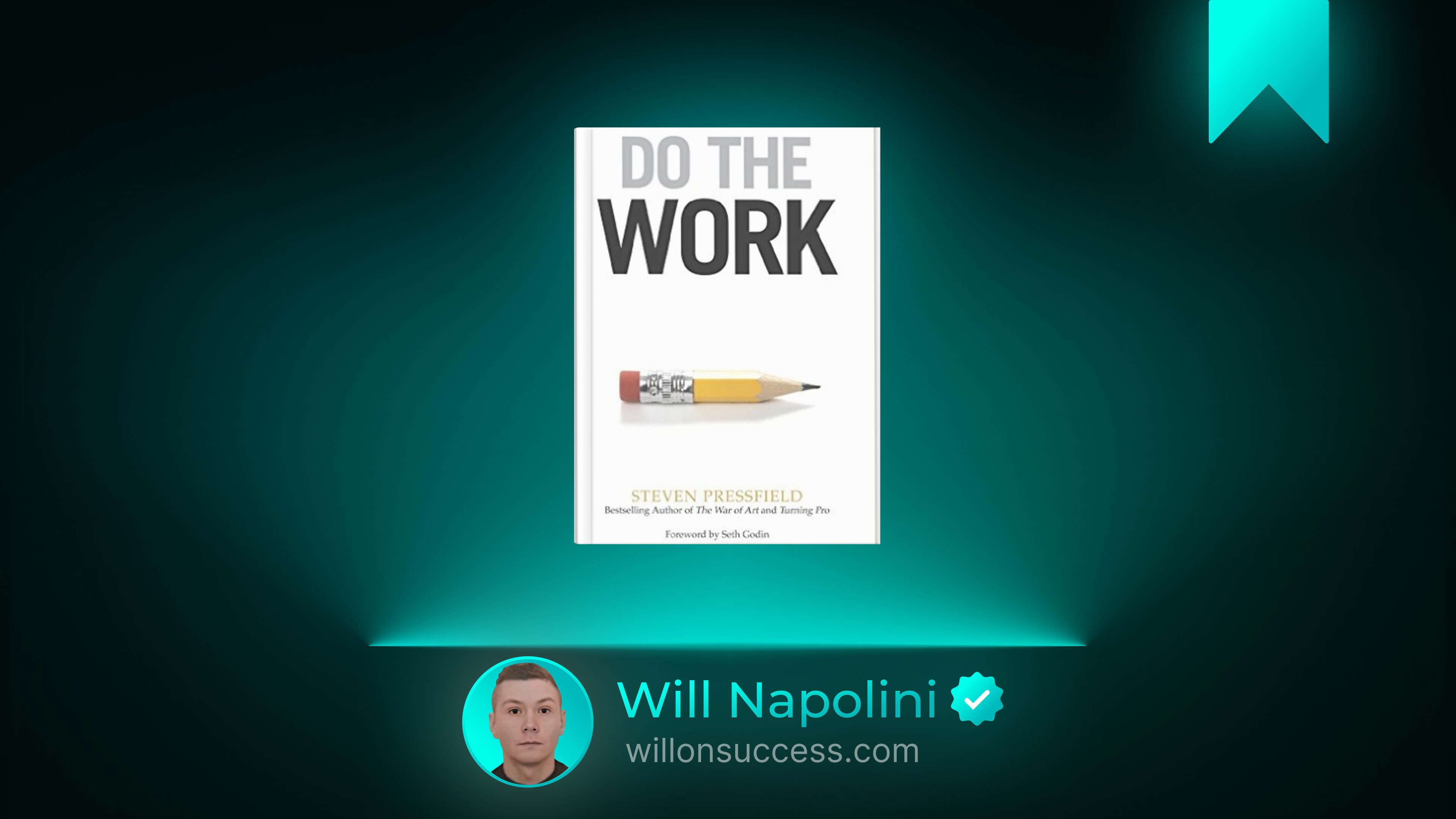
Steven Pressfield calls this force “Resistance.” And in his short, punchy, deeply necessary book Do the Work, he hands you the field manual for defeating it.

The Big Idea: The Enemy Is Real, But It Is Not You
The central thesis of Do the Work is a radical shift in how we view our own procrastination and self-doubt. Pressfield argues that Resistance is not merely a psychological quirk or a lack of willpower. It is an active, impersonal, and relentless force that exists solely to stop you from doing your work and evolving into the person you are meant to become.
Resistance is the voice that tells you to check your email one more time before you start. It is the sudden, overwhelming urge to clean the kitchen when you are supposed to be coding. It is the rationalization that whispers, “You can start fresh on Monday.”
What I have discovered in my own life, and what Pressfield articulates with brilliant clarity, is that once you realize Resistance is an external force trying to keep you small, you stop taking your self-doubt so personally. You stop asking, “What is wrong with me?” and start asking, “How do I outmaneuver the enemy today?”
The goal of the book is not to help you feel motivated. Motivation is a fleeting emotion, and Resistance easily defeats emotion. The goal is to help you become a warrior of the daily grind. To learn how to put your head down, ignore the noise in your head, and simply do the work.
The Concept: The Timeline of Creation and the Belly of the Beast
To understand how to fight Resistance, you have to understand the geography of any creative project or major life change. Pressfield maps out the journey into three distinct phases: the beginning, the middle, and the end.
The beginning is easy. The beginning is fueled by enthusiasm, novelty, and the dopamine of a fresh start. Anyone can start.
The end is also manageable. The end is fueled by the adrenaline of the finish line, the desperation to be done, and the visible proximity of the reward.
The danger zone is the middle. Pressfield calls this “The Belly of the Beast.”
The Belly of the Beast is the long, dark, unglamorous stretch where the initial excitement has burned off, but the results are not yet visible. It is the messy middle of writing the manuscript. It is the second year of a startup when the seed money is running out and the product still has bugs. It is the plateau in your physical training where you are working out every day but the scale has not moved in a month.
This is where Resistance sets up its fortress. In the Belly of the Beast, the work feels pointless. Your inner critic becomes a shouting megaphone. You are convinced that you have made a terrible mistake and that you should abandon the project immediately.
Pressfield’s great insight is that the Belly of the Beast is not a sign that you are failing. It is a feature of the process. It is the filter that separates the dabblers from the professionals. The pain you feel in the middle is not a stop sign; it is the exact friction required to forge the character capable of sustaining the success you are trying to build.
Fear Is Not a Wall; It Is a Compass
One of the most transformative principles in the book is how Pressfield redefines fear. We are taught to view fear as an indicator that we are doing something wrong, or that we are out of our depth. We use fear as a reason to retreat to safety.
Pressfield flips this entirely. He proposes a rule that I have returned to countless times when facing a terrifying decision: The more important a call or action is to our soul’s evolution, the more Resistance we will feel toward pursuing it.
Fear, in this framework, is not a wall. It is a compass.
If you are trying to decide between two paths, and one path feels safe, easy, and comfortable, while the other path makes your stomach tighten and your palms sweat, the compass is pointing directly at the second path. The magnitude of your fear is directly proportional to the importance of the work.
When you understand this, fear stops being a paralyzing agent and becomes a navigational tool. You stop running away from the things that scare you and start leaning into them, knowing that the terror is simply evidence that you are standing at the threshold of your own growth.
Outsmarting the Intellect: The Trap of Overthinking
If Resistance is the enemy, its favorite disguise is the intellect. We love to rationalize our procrastination by calling it “planning.” We tell ourselves we need to read three more books, take one more seminar, or build one more spreadsheet before we can possibly begin.
Pressfield offers a piece of advice that sounds almost absurd at first, but is profoundly liberating: Stay stupid.
He does not mean you should abandon your intelligence. He means you must not allow your conscious, analytical mind to hijack the creative process. The conscious mind is a brilliant editor, but it is a terrible creator. It wants everything to be logical, perfect, and safe. But creation is messy, irrational, and dangerous.
When you sit down to do the work, you have to bypass the inner critic. You have to give yourself permission to be stupid. Write the terrible first draft. Build the ugly prototype. Have the clumsy, awkward conversation.
You do not think your way into a new life. You act your way into it.
What you repeat in private eventually becomes visible in your life, but only if you allow the work to exist in its raw, imperfect form. You can always edit a bad page. You can always refine a clumsy prototype. You cannot edit a blank page, and you cannot refine an idea that never left your head. Action precedes inspiration, not the other way around.
The Invisible Allies: Why the Work Matters
If the book only taught you how to fight a brutal, invisible enemy, it would be a very grim read. But Pressfield introduces a beautiful counterbalance to Resistance. He calls it the Muse, or the unseen infantry.
The philosophical foundation of the book is that you are not actually doing this work alone. There is a universal principle—call it grace, call it providence, call it the unconscious mind—that rewards action.
Pressfield argues that when you sit down and do the work, especially when it is hard, especially when you are in the Belly of the Beast, invisible allies come to your aid. Ideas arrive out of nowhere. Coincidences align. The exact sentence you needed drops into your lap. The right person emails you at the exact moment you were about to quit.
This is not magical thinking; it is the lived experience of anyone who has ever committed deeply to a craft. When you show up consistently, your reticular activating system tunes into the frequency of your work. You begin to see opportunities you were previously blind to.
But the allies only show up for the worker. They do not visit the dreamer. They do not reward intention. They reward the sweat, the frustration, and the stubborn refusal to quit. The work does not require your perfection; it requires your presence.
Why It Matters on an Ordinary Wednesday
You might be reading this and thinking, “This sounds great for novelists and painters, but I am an accountant, a software engineer, or a parent. How does this apply to me?”
Resistance does not care about your job title. It attacks any arena where you are trying to move from a lower state of being to a higher one.
If you are a manager trying to transition from a micromanager to a leader who empowers their team, Resistance will attack you every time you try to delegate. It will whisper, “It will be faster if I just do it myself.”
If you are trying to heal a relationship, Resistance will attack you every time you try to be vulnerable. It will whisper, “If you show them you are hurt, they will use it against you. Stay angry. It is safer.”
If you are trying to get out of debt, Resistance will attack you every time you open your budget spreadsheet. It will whisper, “You have been good all week. You deserve this one expensive dinner.”
The principles of Do the Work apply to any area of your life where you are trying to build something that lasts. Character is built in the moments when you choose the hard, right action over the easy, comforting distraction.
Practical Application
Understanding the enemy is only the first step. You need a system to defeat it. Here is how you can translate Pressfield’s philosophy into daily behavior.
Name the Demon The next time you feel the urge to procrastinate, stop and literally name it. Say out loud, “This is Resistance.” By giving it a name, you separate it from your identity. You are not a lazy person; you are a dedicated person experiencing an attack from Resistance. This simple cognitive shift robs the feeling of its power.
Lower the Bar to the Floor When you are paralyzed by the scope of a project, your standards are too high. Lower them until the task becomes ridiculously easy to start. If you need to write a report, your goal is not to write a good report. Your goal is to open the document and write one terrible sentence. If you need to work out, your goal is not to crush a one-hour session. Your goal is to put on your shoes and stand on the porch. Once you cross the threshold of starting, momentum takes over.
The “No-Excuses” Morning Resistance is strongest when you are tired, and it is weakest when you are fresh. Identify your most important, most fear-inducing task, and schedule it for the very first hour of your day. Do not check your phone. Do not read the news. Do not answer emails. Give the first and best of your energy to the work that scares you. Win the morning, and you win the day.
Embrace the “Ugly Draft” Give yourself explicit, unconditional permission to make garbage. When you sit down to create, tell yourself, “I am going to make the worst version of this possible.” Remove the pressure of quality. Let the unconscious mind play in the mud. You can invite the conscious mind back into the room tomorrow to clean it up, but today, your only job is to generate raw material.
Who Should Read This Book
Do the Work is a short, aggressive, and deeply compassionate book. It is written for anyone who feels a calling to create, build, or evolve, but finds themselves perpetually stuck in the gap between their intentions and their actions.
It is essential reading for writers, entrepreneurs, artists, and anyone facing a massive life transition. If you have a hard drive full of unfinished projects, or a heart full of apologies for things you never started, this book will serve as a mirror and a battle cry.
However, I will offer one honest caveat. Pressfield’s tone is militant. He views the creative life as a war, and he uses the language of a drill sergeant. If you are in a season of life where you need gentle nurturing, soft self-care, or a slow, compassionate exploration of your inner child, this book might feel too abrasive. It is not a book about healing your wounds; it is a book about picking up your sword and marching into the arena despite them.
But if you are tired of your own excuses and ready to take radical responsibility for your potential, there is no better field manual.
One Small Step
You do not need to overhaul your entire life today. You just need to prove to yourself that you can win one small skirmish against Resistance.
Here is your assignment for the next fifteen minutes: Identify the one task you have been avoiding the most. The one that makes your chest tighten when you think about it.
Set a timer for ten minutes. Close your browser. Put your phone in another room.
For those ten minutes, do the ugliest, worst, most imperfect version of that task. Write the clunky email. Sketch the messy diagram. Make the awkward phone call.
When the timer goes off, you are allowed to stop. But you will rarely want to.
The distance between the person you are and the person you are meant to become is not measured in grand, cinematic leaps. It is measured in the quiet, unglamorous moments when you choose to sit back down in the chair.
The work is waiting for you. It does not care if you are ready. It only cares that you show up.
Pick up the pen. Open the laptop. Step into the arena. The only way out is through.