Create or Hate: Why the Act of Making Things Is the Ultimate Rebellion
I want to ask you a question that might feel a little uncomfortable. How many hours have you spent this week preparing to do the work, instead of actually doing it?
You have read the articles. You have listened to the podcasts. You have organized your desk, researched the perfect software, and outlined the perfect strategy. You feel busy. You feel productive. But at the end of the day, when you look at what you have actually brought into the world, the answer is often nothing.
If I could sit across the table from you, I would tell you something I had to learn the hard way: You are not lazy. You are not untalented. You are just caught in a very specific, very clever trap.
The Big Idea
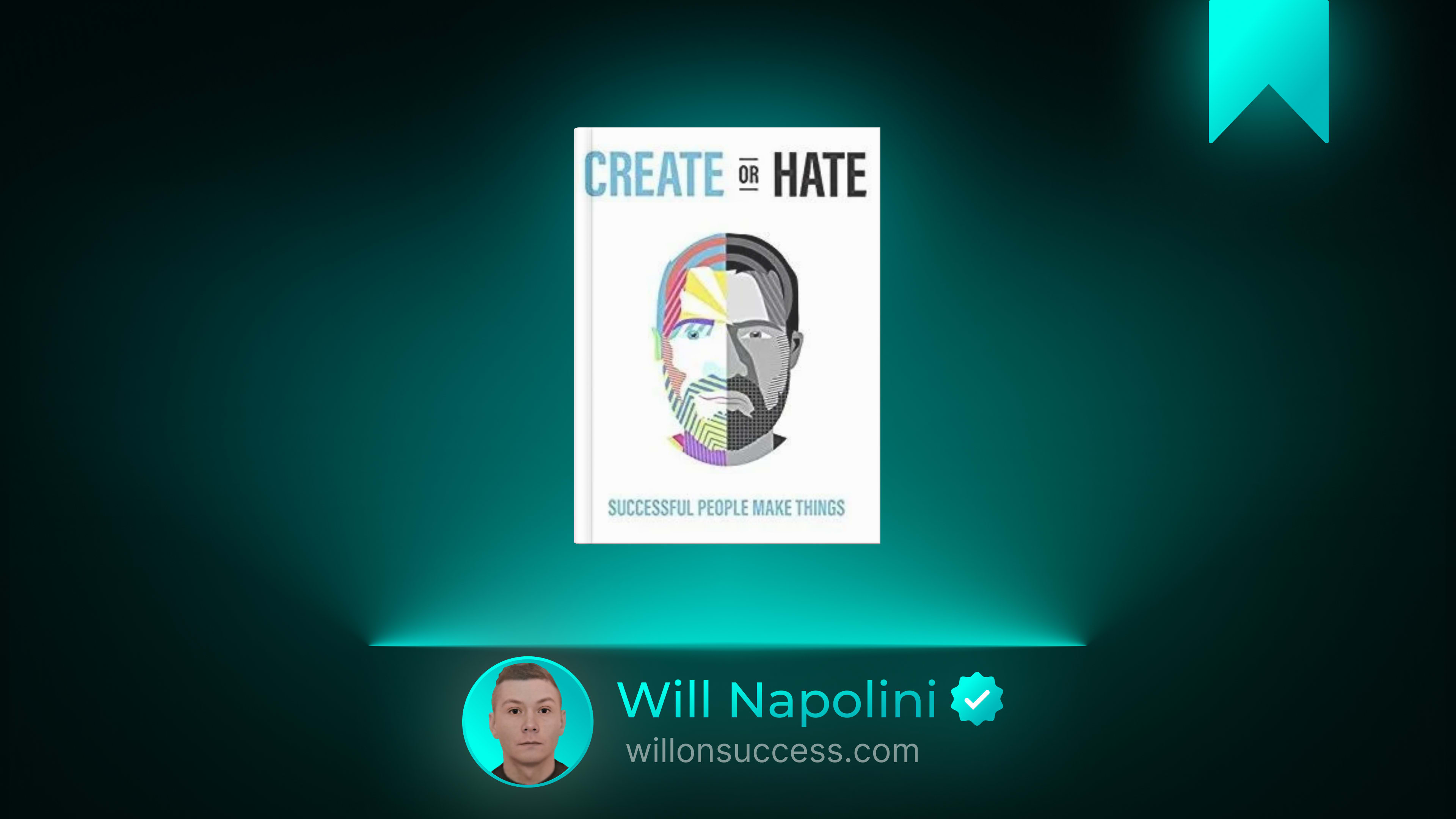
In his short but piercing book, Create or Hate, entrepreneur and author Dan Norris identifies the true enemy of our potential. He does not call it writer’s block, and he does not call it a lack of inspiration. He calls it “Hate.”
Hate is the internal force of self-doubt, fear, and resistance that rises up the moment you try to make something new. It is the voice that tells you your idea is not ready, your skills are not sharp enough, and your work will be judged.
The central thesis of the book is simple but profound: Successful people are simply those who make things. The difference between the person who dreams of writing a book, starting a business, or building a community, and the person who actually does it, is not a magical abundance of talent. It is the willingness to recognize “Hate” for what it is, and to choose the act of creation anyway.
The Disguise of Hate
When we think of self-sabotage, we usually picture obvious distractions. We think of scrolling through social media, watching television, or giving in to cheap dopamine.
But what I discovered in my own life—and what Norris highlights brilliantly—is that Hate rarely looks like laziness. Hate looks like preparation.
Hate tells you that you need to read three more books on marketing before you launch your website. Hate tells you that you need to wait until you have more life experience before you write your memoir. Hate convinces you that consuming the work of others is a necessary prerequisite to creating your own.
This is the trap of productive procrastination. We consume to avoid the vulnerability of creation. We hide behind research because research feels safe, while making something and putting it into the world feels terrifying. But consumption without creation is just a sophisticated way of hiding.
The Trap of Endless Consumption
We live in an era where information is infinite, but our time and energy are strictly limited. Norris draws a sharp line between consumption and creation, arguing that we must ruthlessly prioritize the latter.
When you spend all your time taking in, you leave no room for putting out. You become a passive observer of other people’s lives and other people’s ideas.
Think of your mind like a garden. If you only ever bring in new seeds—reading, watching, listening—but you never actually dig into the soil and plant them, the garden becomes overgrown with weeds. The seeds rot in their packets. To create is to plant. It requires you to close the browser tab, put down the book, and get your hands dirty in the soil of your own experience.
Empathy Is the Engine of Meaningful Work
One of the most grounding ideas in the book is the relationship between creation and empathy. We often think of creativity as a solitary act of genius. We imagine the lone artist in a garret, expressing their inner soul to the world.
But true creation is an act of service. Whether you are writing code, building a physical product, writing an essay, or raising a child, you are creating for someone else.
Great creators possess deep empathy for the people they are trying to help. They do not just ask, “What do I want to say?” They ask, “What does the person on the other side of this work need to feel, understand, or overcome?” When you shift your focus from your own ego to the person you are serving, the voice of Hate grows quieter. It is much easier to be brave when you are trying to help someone else than when you are trying to prove your own worth.
Shipping Is the Antidote to Perfectionism
Perfectionism is not a high standard. It is a shield. It is the armor we wear to protect ourselves from the pain of criticism.
Norris argues that the only way to defeat the internal critic is to ship your work. To “ship” means to finish it and release it into the world, regardless of how flawed it might be.
You start small. You stay consistent. You let time do its work.
When you ship, you break the spell of Hate. You realize that the world does not end when your work is imperfect. You get feedback. You learn. You iterate. The first thing you make will probably be clumsy. The tenth thing will be better. The hundredth thing will be remarkable. But you will never reach the hundredth thing if you refuse to ship the first. What you repeat in private eventually becomes visible in your life, but only if you allow it to leave the privacy of your own mind.
Why It Matters in Real Life
Why should you care about a short book on creativity? Because the battle between creating and hating is not just about art. It is about the trajectory of your entire life.
Every time you choose to consume instead of create, you are voting for the person you currently are, rather than the person you want to become.
If you apply this to your career, it means stopping the endless networking and researching, and finally building the portfolio piece that proves your skill.
If you apply this to your relationships, it means stopping the passive consumption of time together—sitting in the same room looking at different screens—and creating a shared experience, a difficult conversation, or a new tradition.
If you apply this to your leadership, it means recognizing that endless strategy meetings are often just Hate in a suit. Leaders who succumb to Hate create cultures of productive procrastination. They signal to their teams that looking busy is more important than shipping value. When you choose to create, you model the courage required to put imperfect work into the market, learn from it, and adapt.
Circumstances will never be perfect. You will never feel entirely ready. The realization that you must act before you feel ready is the turning point of a mature life.
Practical Application
Understanding this is valuable, but understanding without action changes nothing. Here is how you can translate these principles into behavior this week.
The Consumption Fast Choose one area of your life where you feel stuck. For the next seven days, implement a strict consumption fast in that specific area. If you are trying to write, you are not allowed to read books on writing, watch videos on writing, or listen to podcasts about writing. You are only allowed to write. Starve the distraction to feed the work.
The “Ugly First Draft” Rule Give yourself explicit permission to make something terrible. Set a timer for thirty minutes and create the worst possible version of your project. Write the clunky email. Code the messy prototype. Sketch the ugly logo. Once the pressure to be good is removed, the act of making becomes remarkably easy. You can always edit a bad page; you can never edit a blank one.
The “Creation Hour” Block out one hour on your calendar tomorrow morning. Treat this appointment with the same respect you would give a meeting with your most important client. During this hour, the only rule is output. No reading, no researching, no checking analytics. Just producing. If you stare at the wall for the first twenty minutes, that is fine. But you are not allowed to consume. You will be amazed at how quickly the mind surrenders to creation when the escape routes are closed.
The Empathy Audit Look at the project you are currently avoiding. Write down the name of one specific person who would benefit from it. Write down exactly how their life would be slightly easier, brighter, or better if you finished this work and gave it to them. Pin that name above your workspace.
Who Should Read This Book
Create or Hate is a short, punchy manifesto. It is not a dense, academic exploration of the neuroscience of creativity, nor is it a step-by-step technical manual for mastering a specific craft.
It is best suited for the stuck creator. If you are someone who has a hard drive full of half-finished projects, a notebook full of brilliant ideas that never saw the light of day, and a mind full of excuses about why “now isn’t the right time,” this book will serve as a much-needed mirror.
However, if you are already consistently shipping work and are looking for advanced strategies on marketing, distribution, or deep technical skill-building, you might find this book a bit too foundational. It is a book about starting, not about scaling.
One Small Step
Overhauling your entire life today is not the goal. Breaking the momentum of Hate is.
Here is your assignment for the next ten minutes: Identify one small thing you have been putting off because it isn’t “perfect” yet. It could be sending an email, posting a paragraph, making a phone call, or organizing a single drawer.
Do it right now. Do it badly if you have to. But push it out of your head and into the real world.
The voice of Hate will always be there. It does not disappear when you become successful; it just gets quieter as your evidence of past successes grows louder. You will never reach a magical destination where the fear of making things simply vanishes.
But you do not need the fear to vanish. You just need to refuse to let it drive.
The world does not need your perfect, hidden potential. It needs your messy, imperfect, courageous action.
The distance between the person you are and the person you want to become is measured entirely by the things you are willing to make.