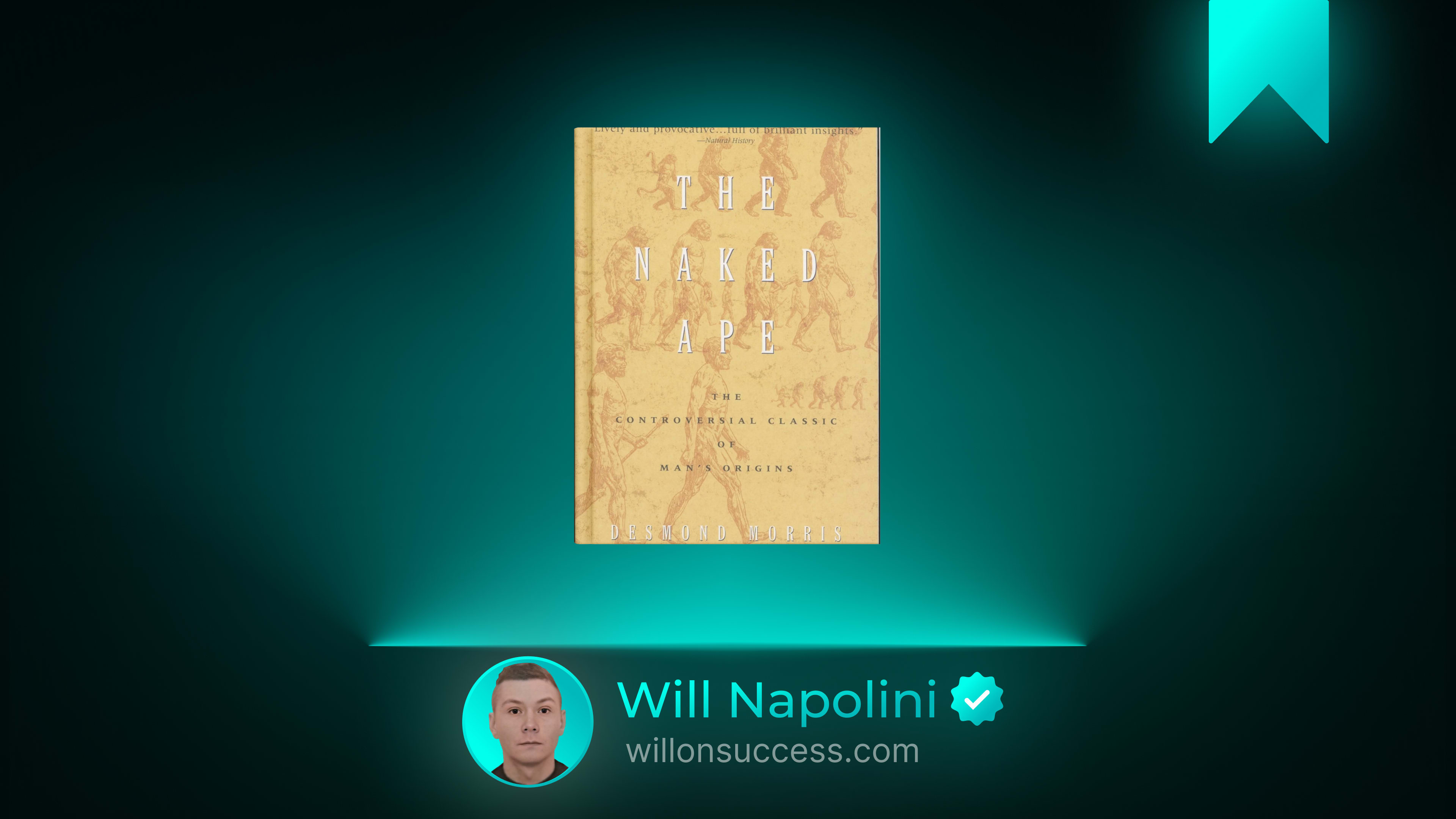
The Naked Ape: Why Treating Yourself Like a Machine Is Making You Miserable
Have you ever sat in a perfectly climate-controlled room, staring at a glowing rectangle, and felt a profound, inexplicable sense of exhaustion?
Not the good, heavy exhaustion of a hard day’s physical work, but a hollow, buzzing fatigue. You have done everything right. You are safe, you are fed, and you are connected to the entire world. Yet, something inside you feels like it is vibrating at the wrong frequency. You feel restless, irritable, and strangely out of place in your own life.
I know that feeling well. For a long time, I treated that restlessness as a personal failure. I thought I just needed more discipline, a better schedule, or a stronger mindset. I thought I needed to optimize myself. I read books on productivity, downloaded new habit trackers, and tried to turn my daily routine into a flawless, frictionless machine.
But the machine kept breaking down.
What I eventually discovered, and what Desmond Morris so brilliantly articulated decades ago, is that the problem was never my mindset. The problem was my habitat.
I want to show you an idea that changed the way I think about human struggle. It is an idea that strips away the pressure to be perfect, the shame of feeling overwhelmed, and the exhausting demand to constantly “level up.” It asks you to look in the mirror and see something entirely different than what modern culture tells you to see.
The Big Idea: You Are an Animal, Not an Algorithm
The central, startling claim of The Naked Ape is this: You are not a rational mind trapped in a clumsy body. You are a deeply biological creature trying to navigate a concrete jungle with Stone Age hardware.
Morris, a zoologist who spent his life studying the behavior of fish, birds, and mammals, decided to turn his binoculars on his own species. He asked a simple, disruptive question: What happens if we study humans exactly the way we study other animals?
When you look at humanity through the lens of zoology, the polite veneer of civilization fades. You stop seeing people as consumers, employees, or users, and you start seeing them as a highly evolved, largely hairless primate. You see mating dances in our courtship rituals. You see territorial posturing in our office politics. You see grooming behaviors in our small talk.
Morris’s thesis is not meant to degrade us. It is meant to ground us. He argues that much of our modern misery—our anxiety, our chronic stress, our feelings of alienation—comes from a fundamental denial of our own nature. We have built a world that feeds our intellect but starves our biology. We try to intellectualize our way out of physical realities, and we wonder why we feel so empty.
You do not need to be fixed. You need to be remembered.
The Story of the Zookeeper Looking Inward
To understand the power of this book, you have to understand where it came from. Desmond Morris was not a philosopher sitting in an ivory tower. He was the curator of the London Zoo. He spent his days observing the raw, unfiltered behavior of primates. He watched how they established hierarchies, how they resolved conflicts, how they cared for their young, and how they bonded through physical touch.
Then, he walked out of the primate house and looked at the crowds of human visitors.
He noticed that the humans were doing the exact same things. They were forming tribes. They were displaying status through their clothing. They were engaging in complex social rituals to avoid conflict. They were desperately seeking connection.
When Morris published The Naked Ape in 1967, it caused a sensation. It was controversial because it dared to suggest that our most cherished human traits—our art, our religion, our complex societies—were deeply rooted in our evolutionary survival strategies.
While modern science has updated and corrected some of his specific biological claims over the last sixty years, the philosophical core of his work remains remarkably potent. The core truth he pointed to is undeniable: we are animals who have built a zoo for ourselves, and we are suffering from the mismatch.
The Major Principles of the Human Animal
If we accept that we are biological creatures, how does that change the way we live, work, and relate to ourselves? Morris’s framework highlights several vital principles that explain why we struggle, and how we can find our footing again.
The Concrete Zoo and the Paleolithic Hardware
Your brain and body evolved over millions of years in a very specific environment: the African savanna. You were built to walk long distances, to read the subtle shifts in the weather, to hunt, to gather, and to live in a tight-knit tribe of perhaps fifty to a hundred people. Your nervous system was calibrated for immediate, physical threats—a predator in the grass, a rival tribe, a sudden storm.
Today, you live in a world of abstract, chronic threats. Your nervous system does not know the difference between a lion in the bushes and a hostile email from your boss. The physiological response is identical. Your heart rate spikes, your cortisol floods your system, and your muscles tense for a fight or a flight.
But there is no lion to fight. There is no savanna to run across. You just sit in your ergonomic chair, absorbing the chemical surge of a survival response that has nowhere to go.
This is the evolutionary mismatch. We have placed Paleolithic hardware into a digital environment. When you feel a sudden wave of panic or a deep, unexplainable dread, it is rarely because you are weak. It is because your ancient biology is sounding an alarm in a modern room. Recognizing this does not make the stress disappear, but it removes the shame. You are not failing at being human; you are succeeding at being an animal in the wrong habitat.
The Biology of Belonging: Why We Groom
In the primate world, survival depends on the tribe. But tribes are not held together merely by shared goals; they are held together by physical proximity and mutual grooming. Primates spend hours picking through each other’s fur. This is not just about hygiene. It is a profound biological mechanism for lowering heart rates, releasing oxytocin, and signaling safety.
Humans, lacking thick fur, had to adapt. We replaced physical grooming with conversation, humor, and shared experiences. But the underlying biological need remains identical. We require deep, reciprocal, low-stakes social friction to feel safe in the world.
Look at how we socialize today. We “network” in loud rooms. We exchange curated updates on screens. We text instead of calling. We have optimized our social lives for efficiency, but we have starved our biological need for grooming.
When you feel lonely despite having a thousand followers, or when you feel exhausted after a day of Zoom meetings, it is because the ape in you is looking for the tribe. You cannot hack your way out of loneliness with more digital connection. You need the messy, inefficient, physical reality of sitting across from another human being and sharing the weight of the day.
The Curious Ape: The Necessity of Play
One of the most fascinating concepts Morris explores is neoteny—the retention of juvenile traits into adulthood. Compared to other primates, humans are born incredibly premature and remain dependent for a long time. But more importantly, we retain our juvenile curiosity, our playfulness, and our drive to explore well into our old age.
Other animals largely stop playing once they reach maturity. Their behavior becomes rigid, focused entirely on survival and reproduction. Humans do not. We paint, we invent, we climb mountains, we write poetry, we build complex machines just to see if we can.
This endless curiosity is our greatest evolutionary advantage. It is how we adapted to every climate on earth. But in our modern pursuit of achievement, we often view play and curiosity as frivolous. We tell ourselves that once we achieve our goals, then we will have time to explore. We reduce our lives to mere production.
When you cage the curious ape, it becomes depressed. That feeling of being “stuck in a rut” is rarely a lack of discipline. It is a biological rebellion against a life that has no room for exploration. You were not built just to produce. You were built to wander, to tinker, and to marvel.
Taming the Shadow: Territory and Aggression
We like to think of ourselves as entirely rational, peaceful beings. Morris reminds us that we are also territorial, hierarchical, and capable of intense aggression. These are not evils to be eradicated; they are survival mechanisms that kept our ancestors alive.
When we repress these instincts, pretending we are above them, they do not vanish. They go underground. They manifest as passive-aggression, as toxic office politics, as a desperate need to control our environment, or as sudden, explosive anger.
Acknowledging our animal nature allows us to channel it constructively. Your territorial instinct is what allows you to set fierce boundaries to protect your time and your family. Your capacity for aggression is what gives you the courage to stand up to injustice, to fight for a loved one, or to aggressively pursue a meaningful goal. The goal is not to kill the shadow. The goal is to put a leash on it and teach it to guard the house.
Why This Matters on an Ordinary Wednesday
Philosophy is useless if it does not change how you navigate a random Wednesday afternoon.
Imagine you are sitting at your desk. It is 3:00 PM. The fluorescent lights are humming. You have three reports to finish, your inbox is full, and you suddenly feel an overwhelming urge to quit your job, move to the woods, or just put your head on the desk and cry.
Under the old model of personal development, you would judge yourself. You would tell yourself to push through, to drink more coffee, to practice gratitude, to “grind.” You would treat your exhaustion as a lack of willpower.
Under the framework of The Naked Ape, you pause and look closer. You realize that your nervous system has been staring at a flat, glowing screen for six hours without moving. You realize you have not seen the sky, you have not engaged your large muscle groups, and you have not had a meaningful, face-to-face interaction all day.
Your biology is not failing you; it is screaming at you.
When you understand the mechanism, the solution changes. You do not need a better time-management app. You need to stand up. You need to walk outside. You need to look at a tree. You need to call a friend and hear the actual timbre of their voice. You need to honor the animal before you can expect the professional to perform.
What you deny in your nature will eventually control you. What you acknowledge and respect becomes a source of deep, quiet strength.
Practical Application: Honoring the Ape
How do we move this from evolutionary theory to daily behavior? Here is a practical system for bridging the gap between your Paleolithic hardware and your modern life.
1. Re-wild Your Senses Your senses were built for the complex, fractal patterns of nature, not the flat, geometric lines of a spreadsheet. Every day, give your sensory system a break from the artificial. Step outside without your phone. Look at the clouds. Listen to the wind. Touch the bark of a tree. Let your eyes focus on something far in the distance to relax the ciliary muscles that have been locked onto a screen. This is not “woo-woo” spirituality; it is biological maintenance.
2. Schedule Inefficient Connection Stop trying to optimize your relationships. Dedicate time to “grooming” your tribe. This means having conversations that have no agenda. It means sitting in the same room with someone you love, doing nothing in particular. It means physical touch—a long hug, a hand on the shoulder, sitting close on the couch. These inefficient moments are the glue that holds your nervous system together.
3. Protect Your Territory Your territorial instinct is a tool for boundary setting. Identify the physical and temporal spaces that are sacred to you. It might be your bedroom, your morning hour, or your Sunday afternoons. Defend those spaces with the quiet ferocity of an animal protecting its den. When you protect your territory, you signal to your own nervous system that you are safe.
4. Feed the Curious Ape Carve out time for an activity that has no economic value and no metric for success. Learn to whittle. Study the history of ancient Rome. Try to bake the perfect loaf of bread. Paint poorly. Play a game. Give your brain permission to explore without the pressure of monetization. Play is the language the ape uses to tell itself that life is good.
Who Should Read This Book
The Naked Ape is a profound, paradigm-shifting read, but it requires a certain readiness.
You will benefit immensely from this book if you are suffering from modern burnout, if you feel deeply alienated by hustle culture, or if you carry a lot of shame around your “irrational” emotions and urges. It is deeply valuable for anyone who feels like they are constantly fighting their own nature and wants to understand the biological roots of their behavior. It offers a massive dose of self-compassion by reminding you that your struggles are shared by the entire species.
However, if you are looking for a quick, breezy read filled with life hacks, morning routines, and step-by-step productivity templates, this book will frustrate you. Furthermore, because it was written in the late 1960s, some of Morris’s specific claims about human evolution, gender roles, and anthropology reflect the science and cultural biases of his time. You must read it with a critical eye, taking the broad philosophical lens while letting go of the outdated specifics. It is a book for shifting your perspective, not for providing a flawless scientific textbook.
Your One Small Step
I am not going to ask you to overhaul your life, move to the woods, or throw away your smartphone. The modern world is here to stay, and we must learn to navigate it.
But I am going to ask you to give the ape a moment to breathe.
Here is your one small step for today: Find a window, or better yet, step outside. Look at the sky, a tree, or a cloud for exactly two minutes. Do not listen to a podcast. Do not check your messages. Do not try to “mindfully meditate.” Just stand there and let your eyes track the movement of the natural world. Let your shoulders drop. Take three slow breaths.
You are not trying to achieve anything in those two minutes. You are simply reminding your nervous system that the world is vast, that you are a part of it, and that you are safe.
You do not need to conquer your nature to be successful. You need to collaborate with it.
We spend so much of our lives trying to build a better machine, forgetting that we were never machines to begin with. You are not a broken algorithm waiting for the right code. You are a creature, ancient and resilient, waiting to be let out of the cage.
Open the door. Step into the light. And remember what you are.