The Neverending Story and the Quiet War Between Who You Are and Who You Could Become
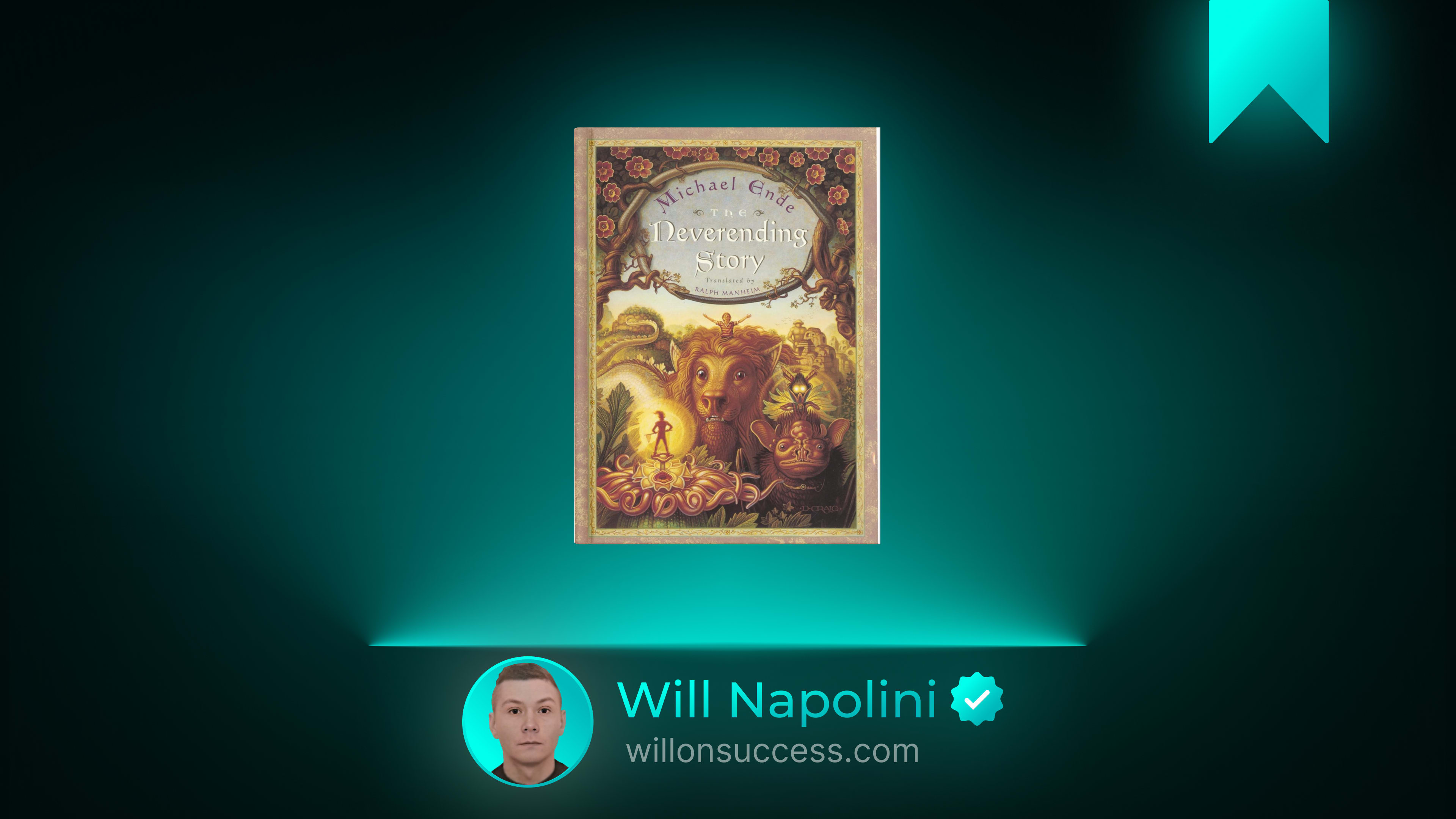
There is a force in Michael Ende’s The Neverending Story that has stayed with me longer than any dragon, any quest, any battle scene. It is not a villain with a face. It does not carry a weapon. It simply arrives, and wherever it touches, everything vanishes. No rubble. No ruins. Just absence.
Ende calls it The Nothing.
And if I could sit across the table from you right now, over a cup of coffee that has gone slightly cold because we have been talking too long, I would ask you a question that I think matters more than most people realize:
Where is The Nothing showing up in your life?
Not in a fantasy realm. In yours. In the slow erosion of curiosity you used to feel. In the conversations that used to light you up and now feel like obligations. In the creative impulse you used to trust before someone told you it was impractical. In the quiet, spreading blankness where meaning used to live.
Ende wrote this book in 1979, and yet the question it asks has never been more urgent.
The Boy in the Attic, Hiding From a World That Hurt Him
Before we go further, you need to meet Bastian Balthazar Bux.
Bastian is a round, awkward boy who is bullied at school. His mother has died. His father, drowned in his own grief, has become a stranger in their own home—present in body, absent in every way that matters. Bastian does not know how to ask for help, so he does what lonely, hurting children often do. He disappears into stories.
One rainy morning, fleeing from classmates who are chasing him, he ducks into the bookshop of a stern old man named Carl Conrad Coreander. There, he steals a book bound in copper-colored silk with an emblem on the cover: two snakes, one light, one dark, each swallowing the other’s tail. An ouroboros. A circle with no end.
He hides in the school attic and begins to read.
And here is where Ende does something structurally brilliant. The book Bastian reads is called The Neverending Story. It tells of a realm called Fantastica, which is being devoured by The Nothing. A young warrior named Atreyu is sent on a great quest to save the Childlike Empress who rules that realm. But as Bastian reads, something shifts. The story begins to address him. The characters seem to know he is watching. And eventually, Bastian realizes that the story cannot be saved from the outside.
He must step in.
I want you to feel the weight of that moment. A grieving, frightened child realizes that watching from the margins is no longer enough. He must enter the story. He must speak. He must give the Empress a new name—Moon Child—and in doing so, he remakes an entire world.
That is the first great idea Ende offers us. But it is not the last, and it is not the most difficult.
The Power to Create Is Also the Power to Lose Yourself
The second half of the book is where most summaries stop, and where I think the real wisdom begins.
Bastian enters Fantastica and is given the Auryn, a medallion that grants him the power to create. Every wish he speaks becomes real. He conjures forests, cities, creatures. He becomes strong, admired, celebrated. For a while, it is intoxicating.
But every wish costs him a memory of his former life.
He does not notice at first. Who would? The new world is so vivid, so responsive, so flattering. He begins to reshape Fantastica not to heal it but to glorify himself. He builds a false throne. He demands to be called emperor. He pushes away Atreyu, the one friend who tells him the truth.
And slowly, Bastian forgets who he was before he arrived. He forgets his father. He forgets his mother’s voice. He forgets the attic, the rain, the bookshop. He is becoming no one, dressed in the costume of everyone.
I have seen this pattern play out in so many forms outside the pages of a novel. The person who builds an impressive career and realizes, somewhere around the third promotion, that they cannot remember what originally drew them to the work. The person who crafts a careful image online and starts to confuse the image with the self. The person who escapes into achievement, or entertainment, or fantasy, because the real world asks something harder of them: to sit with who they actually are, in all their unfinished, unglamorous truth.
Ende understood something that I think many self-improvement books skip over entirely. Growth is not only about gaining. Sometimes the most important act of courage is not creating something new but remembering what you already had and lost along the way.
Bastian’s journey home is not a victory lap. It is a slow, humbling descent. He must strip away the grandiosity, the false power, the need to be admired. He must reach the Waters of Life not to become more, but to become himself again. And when he finally returns to the real world, he does not come back as a hero. He comes back as a boy who can finally look at his grieving father and say, “I’m here.”
That sentence, in the context of everything Bastian has been through, is more powerful than any dragon or empire.
The Nothing Is Not a Monster. It Is a Choice You Stop Making.
Now I want to talk about The Nothing directly, because I think it is the most important metaphor in the book, and I think you already recognize it.
The Nothing does not attack Fantastica with armies. It does not burn or destroy. It simply spreads, and where it passes, things cease to have ever existed. Characters who fall into it do not die in any dramatic sense. They become lies. They become false stories, hollow repetitions, disconnected from any truth.
Ende is describing what happens when a world—or a person—stops making meaning. When imagination is replaced by cynicism. When wonder is traded for efficiency. When the inner life is neglected so thoroughly that it simply evaporates.
You may have felt this. Not as a dramatic crisis, but as a slow dimming. You used to care about things. You used to be curious, or tender, or excited by an idea that kept you up past midnight. And then, gradually, you stopped. Not because something terrible happened, but because you stopped feeding the part of yourself that needed feeding. You stopped telling yourself stories about what was possible. You stopped giving your experience a name.
And The Nothing crept in.
Here is what I have learned, and I want to say it gently because I know how easy it is to hear this as blame: The Nothing is not something that happens to you. It is what grows in the space where your own creative engagement with life has gone quiet. You are not powerless against it. But the antidote is not more distraction. The antidote is naming. Creating. Choosing, deliberately, to give shape and language to what you feel, what you want, what you believe.
When Bastian speaks the Empress’s new name, he does not just save Fantastica. He performs an act of authorship over his own life. He says, in effect: I am not just watching. I am participating. I am giving this moment a name, and in naming it, I am making it real.
You can do that. Not with a fantasy realm. With your Tuesday. With the conversation you have been avoiding. With the small, unnamed dream you have been carrying around for three years because you are afraid that saying it out loud will make it vulnerable.
Name it. Give it language. That is where it begins.
Every Wish Costs You Something. Choose What You Are Willing to Spend.
The economy of wishes in Fantastica is one of the most honest ideas Ende puts on the page. You get what you wish for, but each wish erases a memory. Each creation costs a piece of your history.
This is not a fantasy mechanic. This is how life works.
Every path you choose closes other paths. Every hour you pour into one pursuit is an hour you do not pour into another. Every version of yourself you build is, in part, a version you chose not to become. That is not a tragedy. That is the structure of a finite life.
The problem is not that wishes cost something. The problem is making wishes unconsciously—letting circumstance, habit, or other people’s expectations make the choices for you, and then waking up years later unable to remember how you got here.
Bastian’s mistake was not that he wished. It was that he wished without knowing what he was losing. He wished for admiration because he had never been given love at home, and he did not realize that the admiration was costing him the very memories that might have led him back to the love he needed.
If I could offer you one question from this book to carry into your week, it would be this:
What are you currently wishing for, and what is it quietly costing you?
Not in a fearful way. In a clear-eyed way. Because the goal is not to stop wanting things. The goal is to want them with your eyes open, so that the trade you are making is one you would actually choose.
The Hardest Part of the Journey Is Coming Home
There is a reason the second half of The Neverending Story is harder to read than the first. The first half is an adventure. The second half is a reckoning.
Bastian does not just need to save Fantastica. He needs to leave it. He needs to return to a world where he is not magical, not powerful, not celebrated. A world where he is a round, awkward boy with a grieving father and no easy answers.
And that return is the whole point.
Ende is telling us that imagination, creativity, inner work, vision—these are not meant to be permanent residences. They are meant to be places you visit so that you can come back to ordinary life with more depth, more tenderness, more capacity to love. If you stay in the fantasy, you lose yourself. If you never visit it, you starve. The wisdom is in the rhythm between the two.
I think about this when I consider how people approach personal development. They read the book, attend the seminar, build the vision board, and then they wait for their outer life to transform. But the transformation was never the point. The point was to return to your actual life—your actual kitchen, your actual work, your actual relationships—and show up differently. More honestly. With more presence. With the courage to be unfinished.
Bastian returns and says to his father, simply, “I’m here.” And his father, who has been frozen in grief, finally breaks open. They hold each other. They weep. And the story does not promise that everything will be easy after that. It only promises that they are no longer alone in it.
That is enough. That is, in fact, everything.
Where This Meets Your Ordinary Tuesday
You do not need to steal a book from a bookshop or ride a luck dragon for any of this to apply.
The principles are quieter than that.
Name what you feel. Bastian saves Fantastica by speaking a name. You save pieces of your own life by refusing to leave your experience vague and unnamed. When something hurts, give it words. When something calls you, give it language. Write it down. Say it to someone you trust. Naming is the first act of creation.
Notice where The Nothing is spreading. Where in your life have you stopped making things, asking questions, trying new approaches? Where has routine calcified into resignation? You do not need to fix it all today. You need to notice it. Awareness is the first boundary you draw against erasure.
Ask what your wishes are costing. Before you commit to a new project, a new identity, a new pursuit, pause. Ask yourself what you will have to set aside. Make the trade consciously rather than accidentally.
Come home from your own Fantastica. If you have been living in planning mode, in preparation mode, in “someday I will actually begin” mode, this is your signal. The vision is not the destination. The destination is the real, imperfect, unglamorous life you are building with your hands, today, among people who need you to show up as yourself rather than as an emperor.
Who This Book Is For
If you have ever felt that the world is asking you to be smaller, quieter, less imaginative than you actually are, this book will feel like a hand on your shoulder.
If you grieve someone and do not know how to grieve in a world that wants you to move on quickly, Bastian’s story will meet you there.
If you work with children, teach, write, lead, or create in any form, Ende’s meditation on the power and responsibility of storytelling will sharpen your thinking.
This is not, however, a book for someone looking for a fast, linear plot. The pacing is deliberate. The second half is stranger and darker than the first. Some readers who loved the 1984 film adaptation may be surprised by how different the novel is in structure, theme, and emotional depth. The film covers roughly the first half and omits the most psychologically complex material.
Read it slowly. Let it be odd. Let it take its time with you.
One Small Step
Tonight, before you go to sleep, take two minutes. Take a piece of paper or open the notes app on your phone. And write down one thing you have been feeling but have not yet named.
Not a solution. Not a plan. Just the name.
“I am lonely.” “I miss being curious.” “I am afraid I chose the wrong path.” “I want to make something, and I don’t know what.”
Do not fix it. Do not solve it. Just give it language. Speak the name into the small silence of your own evening.
Bastian saved an entire world by doing exactly that. You do not need to save a world tonight. You only need to save one small truth from being swallowed by The Nothing.
And tomorrow, that named truth will be easier to carry than the unnamed one was today.
You start by naming. You continue by showing up. You let the story you are living become, slowly, one you would choose again.
The ouroboros on the cover of Bastian’s book has no beginning and no end. Your story is the same. It does not matter where you are in it right now. What matters is that you are still in it, still capable of giving the next moment a name, still capable of stepping out of the attic and back into the rain, where someone is waiting to hear you say, simply and honestly, “I’m here.”
The door is not closing. It is opening. Walk through.