The Old Man and the Sea: What Hemingway Teaches Us About Losing Everything and Still Winning
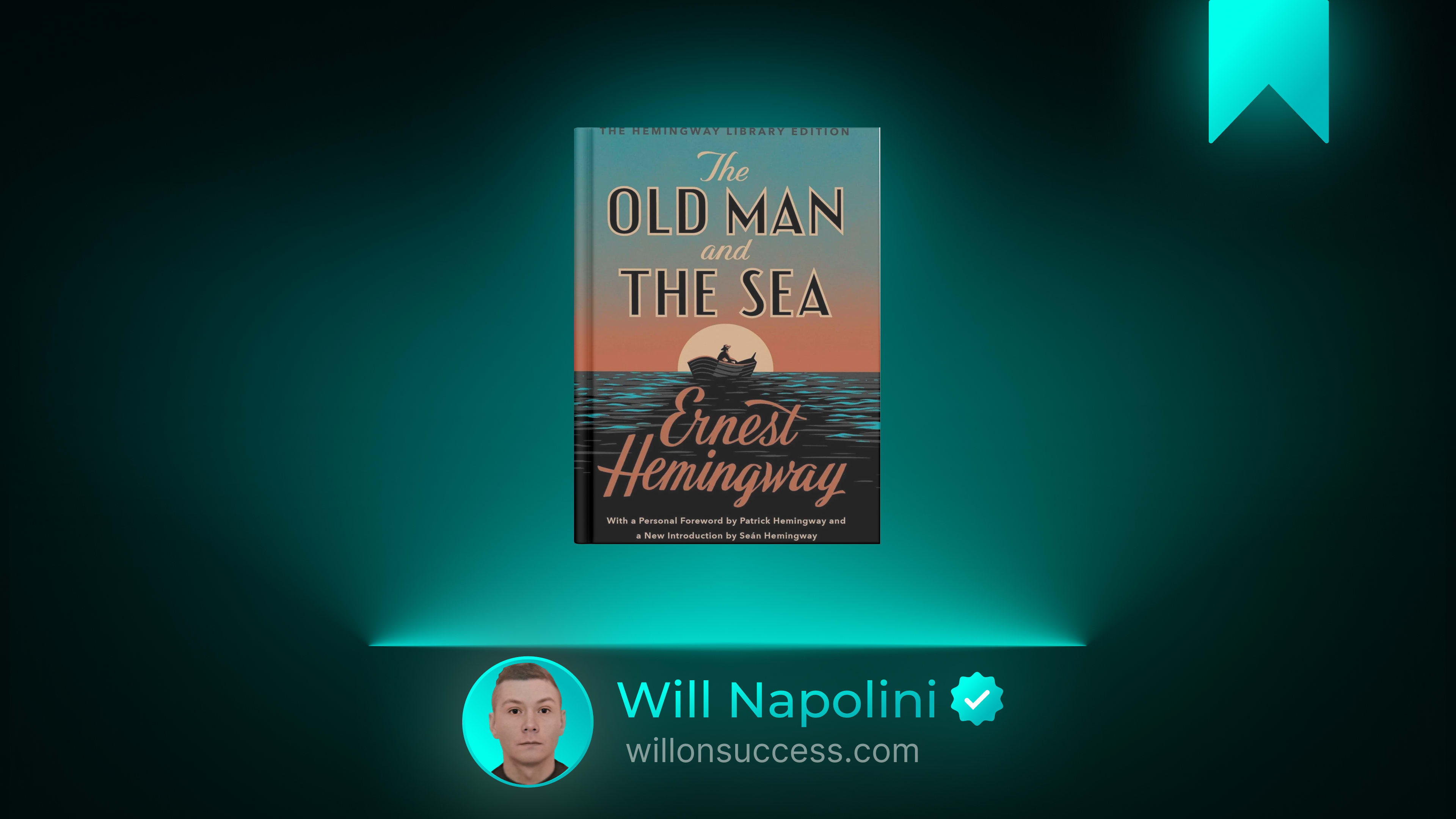
Eighty-four days.
That is how long the old fisherman goes without catching a single fish. Not a small fish. Not a disappointing fish. Nothing. Eighty-four mornings he rows out into the Gulf Stream. Eighty-four evenings he rows back empty-handed while other fishermen haul in their catches and the tourists at the terrace café simply do not notice him.
I want you to sit with that number for a moment. Eighty-four days.
Because I suspect you know what that feels like. Maybe not with a fishing line. Maybe with a business that will not grow. A creative project no one has seen. A job application list that keeps stretching longer. A relationship you are trying to repair, one quiet conversation at a time, with no sign that anything is shifting. A body you are trying to rebuild after illness. A skill you are practicing in a room where no one is watching.
You keep showing up. And the water keeps giving you nothing.
Ernest Hemingway published The Old Man and the Sea in 1952. It is barely thirty thousand words long. You can read it in an afternoon. And yet it won the Pulitzer Prize, contributed to a Nobel Prize, and has spent more than seventy years doing something remarkable: it keeps finding the exact reader who needs it at the exact moment they need it.
I believe it will find you, too. But let me walk you through what it actually teaches, because the lessons inside this small book are enormous, and they are not only about fishing.
The Story in Brief
Santiago is an aging Cuban fisherman. For eighty-four days, he has caught nothing. The boy who used to fish with him, Manolin, has been pulled away by his parents, who think the old man is salao—the worst form of unlucky. But the boy still loves him. Still brings him food. Still talks baseball with him in the evenings.
On the eighty-fifth day, Santiago rows far out. Farther than the other fishermen go. Farther than is sensible. He hooks a marlin so massive that it begins pulling his small skiff instead of the other way around.
What follows is a three-day battle. The old man’s hands bleed. His back aches. He is exhausted, half-delirious, talking to the fish, to his own hands, to the memory of the boy. But he holds the line.
He kills the marlin. Lashes it to his skiff. Begins the long journey home.
And then the sharks come.
One after another, they tear the marlin apart. Santiago fights them with a harpoon, a knife lashed to an oar, a club, the tiller itself. He fights until he has nothing left to fight with.
He reaches the harbor at night. The marlin is gone. Only the skeleton remains, lashed to the boat. He walks to his shack, collapses, sleeps.
In the morning, the boy finds him. Sees his ruined hands. Cries. The tourists at the café see the skeleton and mistake it for a shark.
And Santiago sleeps again. He dreams of lions on a beach in Africa, the way he did when he was young.
That is the whole story. And it is enough to change how you think about your own struggles, if you let it.
“A Man Can Be Destroyed but Not Defeated”
This is the sentence the book is built around, and it appears in Santiago’s thoughts during the long battle: “A man can be destroyed but not defeated.”
I need you to hear the difference between those two words, because most of us blur them together, and that blurring costs us dearly.
Destruction is external. The sharks are destruction. A market crash is destruction. A diagnosis is destruction. A layoff, a divorce, a failure that strips away something you built with your own hands—that is destruction. It happens to you. You cannot always prevent it.
Defeat is internal. Defeat is the moment you decide the struggle was pointless. The moment you set down the line and say, “I will not go back out.” The moment you let the outcome write the final sentence of your identity.
Santiago loses the fish. Completely. Irrevocably. The sharks take every pound of it. By any external measure, the three-day battle produced nothing. He rows home with bones.
And yet he is not defeated. Because he went out. Because he held the line. Because he fought the sharks with a broken oar when the harpoon was gone and the knife was gone and everything sensible said to let go.
Your results can be taken from you. Your effort, your character, your willingness to keep showing up—those belong to you in a way that no shark can touch.
This is not a comforting platitude. It is a distinction that will hold you upright on the worst days of your life. The days when you did everything right and still lost. The days when the reward was stripped away after you had already bled for it. You were not defeated. You were tested, and you held.
Going Far Out
There is a quiet, important detail early in the book. The other fishermen stay close to shore. They work the familiar waters. They catch enough to get by, and they come home at reasonable hours.
Santiago goes far out. Beyond where the others go. Into deep water where the fish are enormous and the risks are real and no one can help you if something goes wrong.
I have seen this pattern in every area of life. There is a shoreline of safety where you can stay indefinitely. You will not starve there. You will not be embarrassed there. You will not fail spectacularly there. But you will also not encounter the thing you were meant to wrestle with.
Going far out looks different for every person. It might mean leaving a stable job to build something of your own. It might mean having the difficult conversation you have been avoiding for two years. It might mean submitting the manuscript, launching the product, asking for the promotion, moving to the city where no one knows you. It might mean committing fully to a relationship after years of keeping one foot on the dock.
The point is not recklessness. Santiago is not reckless. He is prepared. He knows the currents. He respects the sea. But he is willing to go where the comfortable waters end.
And here is what I have learned: the thing you are meant to do, the work that will actually change your life, is almost never waiting for you in the shallows. It is out where the water is deep and the outcome is uncertain and you cannot see the shore anymore.
You do not have to go far out today. But you need to know which direction “far out” is for you. You need to stop pretending the shoreline is where the real work happens.
The Long Season of Invisible Effort
Eighty-four days. Let me come back to that number, because I think it is the most honest part of the book.
Hemingway does not skip those days. He does not say, “After a period of difficulty, Santiago finally caught a fish.” He lets you feel the weight of them. The boy’s parents pulling Manolin away. The other fishermen looking at Santiago with pity or indifference. The old man sleeping in his shack with nothing to show for his labor.
Most of the meaningful work in your life will look like this for a long time before it looks like anything else. You will practice the instrument and sound mediocre. You will write the pages and they will be clumsy. You will build the business and the revenue will not come. You will go to the gym and the mirror will not change. You will apologize and try again and the relationship will still feel fragile.
This is the season no one applauds. No one sees you row out. No one sees you row back empty.
But the eighty-four days are not wasted. They are the preparation that makes the eighty-fifth day possible. Santiago’s hands know the line because of all those empty mornings. His patience is forged in the long silence. His decision to go far out is born from eighty-four days of refusing to accept that the story is over.
You are in your eighty-four days right now, or you will be again. I want you to remember: the absence of visible results is not the absence of progress. Roots grow in the dark before anything breaks the surface.
The Sharks Will Come
This is the part of the book that used to anger me, and I think it is the part that makes the story true.
Santiago does everything right. He endures. He fights. He kills the marlin. He earns it. And then the sharks come, and they take it, and there is nothing he can do to stop them completely.
Life does this. You build something carefully, and a circumstance beyond your control damages it. You earn the promotion, and the company restructures. You heal the relationship, and a new crisis arrives. You reach the goal, and the landscape shifts beneath you.
The sharks are not a punishment. They are not evidence that the effort was meaningless. They are simply part of the sea.
What matters is not whether the sharks come. They will come. What matters is whether you fight them with what you have, even when what you have is a broken oar. And what matters is whether you let the sharks convince you that you should never have gone far out in the first place.
Santiago does not let them convince him. He rows home. He sleeps. And in the morning, he plans to go out again.
The Boy, the Lions, and the Inner Life
Two images sustain Santiago through the story, and I think they are more important than the marlin.
The first is Manolin, the boy. The boy who brings him coffee. Who says, “I will come with you. I have much to learn.” Who believes in the old man when the entire village has written him off. Santiago is not alone in the way that matters. Someone sees him. Someone is learning from him. Someone will carry the knowledge forward.
You need a Manolin. And at some point, you need to be a Manolin for someone else. We are not meant to endure in total isolation. The person who checks on you, who reminds you what you are capable of, who sits with you in the evening and talks about something as simple as baseball—do not undervalue that. Protect those connections. They are not a luxury. They are part of how you survive the long battle.
The second image is the lions. Santiago dreams of lions on a beach in Africa, from a voyage he took when he was young. The lions are not the marlin. They are not the struggle. They are beauty, and youth, and a world that is vast and golden and untouched by the daily grind.
He dreams of them at the end of the book, after the sharks, after the skeleton, after the exhaustion. Not because the struggle is over, but because his inner life is still intact. The part of him that remembers beauty, that holds a vision larger than the present difficulty, has not been destroyed.
What are your lions? What is the image, the memory, the vision that belongs only to you and has nothing to do with productivity or achievement? Keep it alive. You will need it on the nights when you row home with nothing but bones.
What This Looks Like on an Ordinary Tuesday
Let me bring this down from the Gulf Stream to your kitchen table.
You are in the middle of a long project at work, and no one has acknowledged your effort. The results are not visible yet. You are tired. You are wondering whether to keep going or to quietly redirect toward something easier.
Or you have been rebuilding a habit—exercise, writing, saving money, studying—and you missed three days in a row, and the voice in your head is saying, “See, you are the person who cannot sustain this.”
Or you went far out. You took the risk. You launched the thing, had the conversation, made the move. And the sharks came. The response was not what you hoped. The outcome was stripped down to bones.
What does Santiago do? He does not perform a victory speech. He does not pretend the skeleton is a whole fish. He walks home. He rests. And then he begins again.
That is the whole practice. You do not need a dramatic second act today. You need to walk home, rest honestly, and decide that tomorrow you will row out again. Not because you are guaranteed a marlin. Because you are the kind of person who goes out.
Who Should Read This Book
If you are in a season of long, invisible effort—if you are in your eighty-four days—this book will feel like it was written for you. It will not give you a strategy or a hack. It will give you something rarer: the feeling of being seen in the middle of a struggle that no one else can fully understand.
If you have recently lost something you worked for, and you are trying to figure out whether the work still mattered, read it. The answer is in the skeleton lashed to the boat. The proof of your effort remains even when the prize is gone.
If you are a parent, a teacher, a mentor, read it for Manolin. Read it to understand what it means to believe in someone when the world calls them unlucky.
This book is less useful if you are looking for a step-by-step plan or a framework with numbered steps. It is not that kind of book. It is a story, and its power is in the story. It works on you slowly, the way the sea works on a hull. Give it an afternoon. Read it in one sitting if you can. Then let it sit in you for a week before you decide what it means.
One Small Step You Can Take Today
Here is what I would ask you to do. Just one thing.
Think of the area in your life where you have been rowing out and coming back empty. The project, the habit, the relationship, the goal. The thing you are quietly beginning to believe will never produce a result.
Tonight, before you sleep, write down one sentence that answers this question:
“If I could not be guaranteed a result, would I still choose to go out tomorrow?”
You do not have to show the answer to anyone. You do not have to perform it. Just answer it honestly, for yourself, in your own handwriting, on a piece of paper you will keep.
If the answer is yes, then you already know something the sharks cannot take from you. You already know you are not defeated.
And tomorrow, you row out again. Not because the fish are promised. Because the going-out is who you are becoming.
The sea does not owe you a marlin. But you owe yourself the dignity of the attempt. And that attempt, repeated across enough mornings, is not failure. It is a life. It is the only life that is truly yours.
So go far out. Hold the line. Fight the sharks with whatever is left in your hands. And when you come home with nothing but bones, let the boy bring you coffee. Let yourself sleep. Let the lions come back in the dream.
Then wake up, and go again.