Stay Gold: What The Outsiders Teaches Us About the Labels We Accept and the Ones We Reject
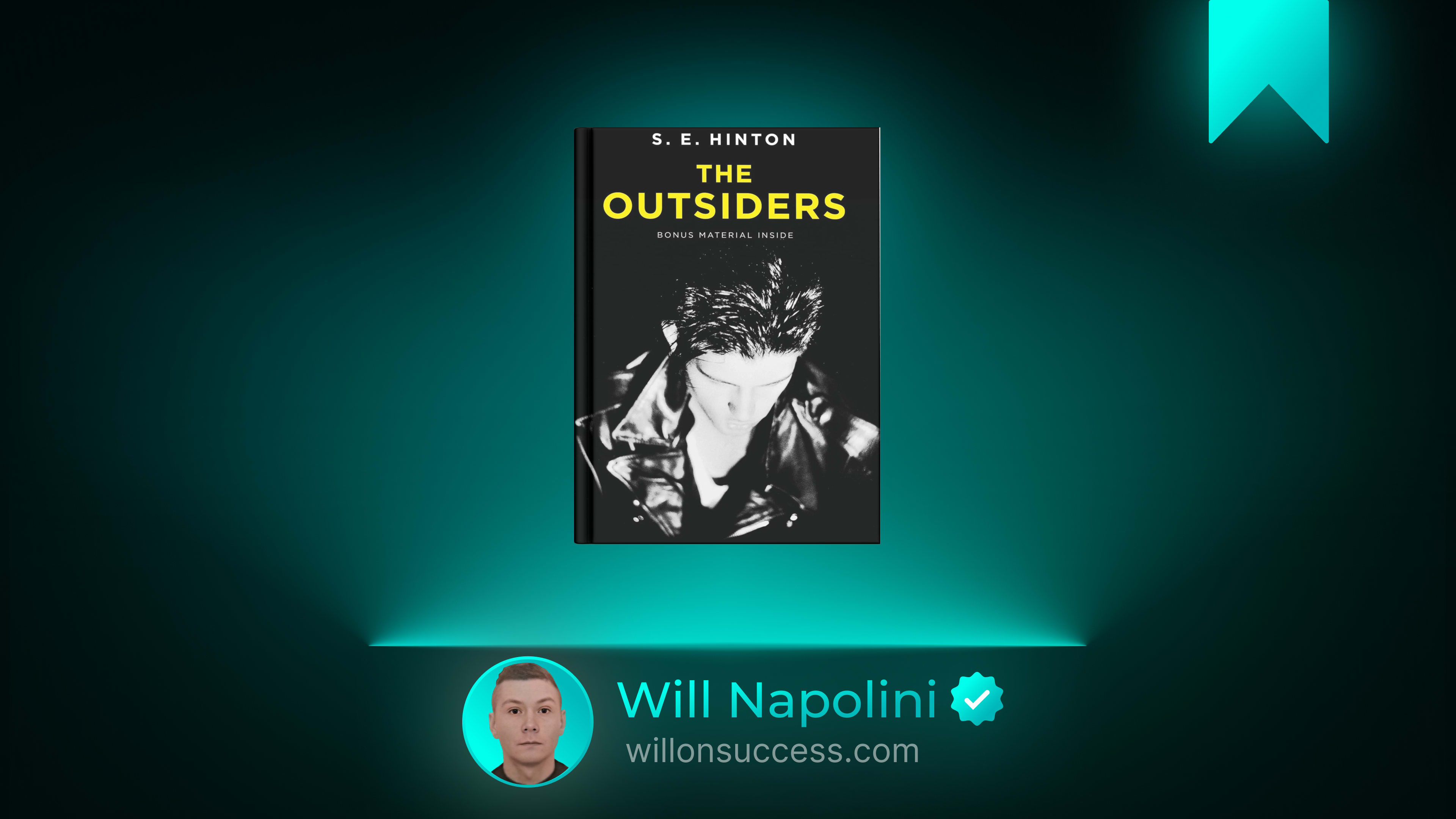
I want to ask you something, and I want you to sit with it for a moment before you answer.
Think about the last time you dismissed someone. Not openly. Not cruelly. Just quietly, in the back of your mind, you looked at a person and sorted them into a category. One of those people. Not my kind. Different from me in a way that matters. Maybe it was a coworker. A neighbor. Someone from the other side of town, the other side of a political divide, the other side of a life you cannot quite imagine living.
Now ask yourself this: what if the thing you sorted them into was the very thing keeping you from understanding them? And what if the thing keeping you trapped is the label you accepted about yourself?
A seventeen-year-old girl in Tulsa, Oklahoma, wrote a novel about exactly this question in 1967. She wrote it in longhand after being beaten up on her way home from school, frustrated that nobody was telling the truth about what it actually felt like to be young, poor, and boxed in by what other people expected of you. Her name was S.E. Hinton. The novel was The Outsiders. And nearly sixty years later, the book still reads like someone reaching across a table, grabbing your hand, and saying: You are not the group they put you in. You are not the story they told about you. And the person sitting across from you, the one you have decided is nothing like you, is carrying a weight you have never bothered to ask about.
That is not a lesson that ages. That is a lesson we keep needing.
The World Hinton Built: Two Sides of the Same Wound
The story is narrated by Ponyboy Curtis, fourteen years old, sharp-eyed, book-smart, and desperate to be seen as something other than a Greaser. In his town, there are two kinds of kids. The Greasers come from the wrong side of the tracks. Long hair, switchblades, hand-me-down jackets, parents who are gone or drunk or dead. The Socs, short for Socials, come from the right side. Mustangs, madras shirts, houses with lawns. The Greasers are rough. The Socs are clean. At least, that is the story everyone agrees on.
Ponyboy lives with his two older brothers, Sodapop and Darry, after their parents died in a car wreck. Around them is a tight circle of friends: Johnny Cade, quiet and bruised, beaten at home and treated like a stray everyone pities; Dallas Winston, hard as iron and twice as cold; Two-Bit, the joker; Steve, the loyal one. They are family by necessity, and they know exactly where they stand in the town’s hierarchy. Near the bottom.
Then one night, at a drive-in movie, Ponyboy talks to a Soc girl named Cherry Valance. She is smart. She is kind. She tells him something that cracks the world open a little: Things are rough all over. The Socs hurt too. They hurt differently, maybe. They hurt in silence, behind closed doors, in houses where nobody is supposed to hear them crying. But they hurt.
From there, the novel tightens like a fist. A confrontation in a park goes horribly wrong. Johnny, defending Ponyboy from a group of Socs who are trying to drown him, kills one of them. Johnny and Ponyboy flee, hide in an abandoned church, and while they are there, a fire breaks out and Johnny runs into the burning building to save trapped children. He is badly injured. He does not recover. Before he dies, he writes Ponyboy a letter. And in that letter, he tells Ponyboy to stay gold. To keep seeing sunsets. To keep reading. To keep being the soft, curious, wondering person he was born as, instead of letting the world sand him down into something hard and gray.
That phrase, stay gold, comes from a Robert Frost poem Ponyboy recites earlier in the story, about how nothing beautiful or new stays untouched for long. Johnny’s argument is that you can fight that. You do not have to let the world take your softness from you. You do not have to become what your circumstances seem to be building you into.
You can choose to remain tender in a world that rewards toughness. And that choice, small as it sounds, is one of the bravest things a person can make.
The Lie of the Two Groups
Here is the idea I keep coming back to, the one that Hinton plants in the soil of this story and never pulls up, because she knows you will keep finding it for years afterward.
The groups are not real. The pain is.
The Greasers and the Socs are not two different species. They are kids, most of them, doing the same thing from different angles: trying to be seen, trying to belong, trying to make the hurting stop. The Socs jump Greasers because they are drunk and angry and bored and have never been taught to sit with their own feelings. The Greasers fight back because nobody else will defend them. Both sides have convinced themselves that the other side is less human. Both sides use the label as permission to stop looking closely.
I have watched this pattern play out in every arena of adult life. In workplaces, where the “sales team” and the “engineering team” treat each other like rival nations. In families, where one sibling is the responsible one and the other is the wild one, and both of them spend decades performing a role someone assigned them when they were twelve. In politics, where we have flattened millions of complicated, contradictory, scared, hopeful human beings into two colors on a map. In our own heads, where we decide I am the kind of person who and then stop growing because the label feels safer than the question.
Hinton saw this when she was seventeen. She saw that the moment you reduce a person to a category, you give yourself permission to stop being curious about them. And the moment you reduce yourself to a category, you give yourself permission to stop becoming.
The cost is enormous. You stop seeing. You stop growing. You stop being surprised. And the world, which is always more complicated than the story you agreed to believe, quietly keeps offering you evidence that your categories are wrong. You just stop noticing.
Johnny’s Lesson: The Person in the Corner Is Carrying the Most
If I could sit across the table from you and tell you one thing this book taught me, it would be this: pay attention to the quiet ones, because they are often holding the most.
Johnny Cade is not loud. He does not lead. He does not swagger. He is small, nervous, always looking over his shoulder because his own father beats him and the neighborhood treats him like something broken. The other Greasers love him, but they protect him the way you protect a fragile object. They do not always ask him what he thinks. They do not always see that beneath the fear is a person of extraordinary moral clarity.
It is Johnny who tells Ponyboy to stay gold. It is Johnny who runs into the burning church without hesitating, because he sees children trapped inside and something in him decides, in that instant, that his own survival matters less than theirs. It is Johnny who, in his final letter, writes something that I think about more than I can say: that a sunset looks the same whether you are on the east side of town or the west side, and that the beauty of it does not care which jacket you are wearing.
What I take from Johnny is not tragedy. What I take from Johnny is this: the people we overlook, the ones we file away as too damaged, too quiet, too much like the background are often the ones who see most clearly. Because they have had to. Because when nobody hands you a comfortable identity, you are forced to build your own from the inside, and the view from there is honest.
You have a Johnny somewhere in your life. Maybe you are the Johnny in someone else’s. The question is whether you are willing to look past the label long enough to find out.
The Danger of Letting Your Wound Become Your Identity
There is a moment in the novel where Ponyboy, trying to make sense of everything, starts to notice that the Socs are not villains in a clean, simple story. Cherry is kind. Randy, Bob’s best friend, is exhausted and guilty and wants the fighting to stop. They are not monsters. They are teenagers who have been handed money and expectation and very little emotional guidance, and they are lashing out because they do not know what else to do with the noise inside them.
This is where the book earns its place among the wisest stories I have encountered, and I say that without exaggeration. Hinton does not let the reader settle into comfortable outrage. She makes you care about the people you were told to hate. And in doing so, she asks you a question that follows you out of the book and into your own Tuesday afternoon: What story have I decided about the people I disagree with, and what am I losing by refusing to revise it?
The flip side of this is equally important, and it is the lesson Ponyboy has to learn the hardest. The Greasers could spend the whole novel being angry at the Socs, and their anger would be justified. The system is unfair. The odds are stacked. Nobody is coming to help. All of that is true.
But if Ponyboy lets the anger become his whole identity, if he decides that being a Greaser means being hard, means being suspicious, means giving up on books and sunsets and the soft, wondering parts of himself, then the Socs win in a way that has nothing to do with money or cars. They win by defining him.
I have seen this in people I care about. Someone gets hurt, treated unfairly, overlooked, and the wound is real and the anger is valid. But then, slowly, the wound becomes the architecture. They build their whole personality around what was done to them. Every new relationship is filtered through the old injury. Every opportunity is met with the assumption that it will not work out, because people like me do not get those things. And the walls they build for protection become the walls of a cell.
Hinton is not saying the unfairness is not real. She is saying that your response to it is still yours to shape. You do not owe anyone your bitterness. You do not owe the people who wronged you the satisfaction of becoming exactly the small, hardened thing they expected you to be.
What “Staying Gold” Actually Looks Like on an Ordinary Wednesday
It is easy to read stay gold as a greeting-card sentiment. Keep being sweet. Stay innocent. Smile through it. That is not what Johnny means, and that is not what Hinton is offering.
Staying gold, as I understand it, is a decision to protect your capacity for wonder, for tenderness, for honest seeing, in a world that will reward you for going numb. It is choosing to read the poem. To watch the sunset without photographing it for approval. To let yourself be moved by a song, a conversation, a stranger’s kindness, without immediately building a cynical explanation for why you should not have been moved.
It is also, and this is the harder part, choosing to see people before their categories. Choosing curiosity before judgment. Choosing to ask the question before you finalize the verdict.
In practical terms, this might look like:
In your relationships, noticing when you have reduced someone to a single trait. She is the critical one. He is the lazy one. They are the difficult family member. And then, deliberately, asking yourself: what am I not seeing? What are they carrying that I have never asked about? You do not have to fix them. You just have to look at them as a whole person again.
In your work, catching yourself the moment you decide that a colleague, a client, a competitor is simply not one of us. The label is easy. The label is comfortable. The label lets you stop thinking. Resist it. Ask what they might be dealing with that you cannot see.
In your own self-talk, noticing the story you tell about yourself. I am not a creative person. I am bad with money. People like me do not get to want that. Those sentences are not facts. They are labels you accepted at some point, probably when you were younger and more vulnerable, and you have been reciting them like a script ever since. You are allowed to revise the script. You are allowed to outgrow the character someone handed you.
In your daily attention, giving yourself five minutes where you are not optimizing, not consuming, not performing. You look out the window. You notice the light. You let yourself feel something small and unnamed without rushing to explain it away. Johnny would call that staying gold. I would call it staying alive.
Why This Book Still Matters When You Are Not Fourteen Anymore
You might be thinking: this is a novel about teenagers in 1960s Oklahoma. I am an adult with a mortgage and a career and responsibilities that would make Ponyboy Curtis look like a kid playing dress-up. What does this have to do with my life?
Here is what it has to do with your life. You are still sorting people. You are still being sorted. You are still deciding, every single day, whether to meet the world with openness or with the armor you built when you were younger and needed it to survive. You are still choosing between the easy story and the true one. You are still deciding whether to stay gold or go gray.
The gangs change names. The territories change shape. The switchblades become passive-aggressive emails and the Mustangs become job titles and the drive-in movie becomes a social media feed where everyone is performing a version of themselves that has very little to do with who they are at ten o’clock at night when the house is quiet and the performance stops.
But the fundamental question is the same one Ponyboy faces. Will you let the world decide who you are? Or will you decide for yourself, with full knowledge that the deciding is hard, that the tenderness costs something, that staying open when every experience tells you to close up is an act of genuine courage?
Hinton wrote this book at seventeen because she was angry and heartbroken and nobody was writing the truth she needed to read. That act of writing, that refusal to let the story be told by someone else, is itself a form of staying gold. She did not harden. She did not decide that because the world was cruel, she would be cruel back. She sat down and made something tender and honest, and it has been finding readers for nearly sixty years because the need it speaks to does not expire.
Who Should Pick Up This Book
If you have ever felt boxed in by a label, whether it came from your family, your zip code, your education, your income bracket, or your own inner critic, this book will find you where you are.
If you work in leadership, teaching, coaching, or any role where you are tempted to sort people into categories for efficiency, this book will gently and firmly remind you of what you lose when you do.
If you are a parent, this book will show you how much weight a young person carries in silence, and how much one honest conversation can change the architecture of a life.
If you are someone who has decided you are too old for a novel written for teenagers, I would challenge you gently: the best books for young people are the ones that tell the truth, and the truth does not have an age limit. This one is 192 pages. You can read it in an evening. Let it stay with you longer than that.
It is not a perfect book. The prose is raw in places. The pacing rushes toward the end. Some of the dialogue sounds more like 1967 than it does like actual teenagers talking. But none of that matters, because the heart of it is so honest and so unflinching that the rough edges become part of the point. This is not a polished performance. This is a young person telling you the truth because she cannot stand not telling it.
One Small Step for Tonight
I am not going to ask you to go solve tribalism or rewrite your entire identity before breakfast. That is not how this works.
Here is what I would ask you to do tonight.
Think of one person in your life you have quietly filed into a category. A coworker you find irritating. A relative you have stopped trying to understand. A neighbor, an acquaintance, a former friend. Someone you decided, at some point, was simply that kind of person, and you stopped looking.
You do not have to call them. You do not have to forgive them or befriend them or perform a grand gesture.
Just sit with a sheet of paper and write three honest answers to this question: What might this person be carrying that I have never asked about?
You do not have to show the answers to anyone. You do not have to act on them tonight. The exercise is not for them. It is for you. It is for the part of you that agreed, at some point, to stop being curious, because curiosity was harder than judgment.
That small act of re-seeing, of refusing to let a person stay flattened into a single adjective, is the beginning of staying gold. Not just for them. For you. Because every time you look at another person with genuine curiosity instead of convenient judgment, you are exercising the very muscle that keeps your own life from hardening into something you do not recognize.
Ponyboy Curtis wrote his whole story because a dying friend told him to keep watching sunsets, to keep being the person who notices things, to keep caring even when caring was the most dangerous thing a person could do. He wrote it down. He turned his seeing into something he could hand to other people.
You do not have to write a novel. You just have to refuse, one more time, to let the world make you look away.
The gold is still there. It has always been there, underneath the labels and the bruises and the stories you were told about who you get to be.
Your only job is to keep it in the light.