The Plague by Albert Camus: Why Your Response to Suffering Defines Your Life
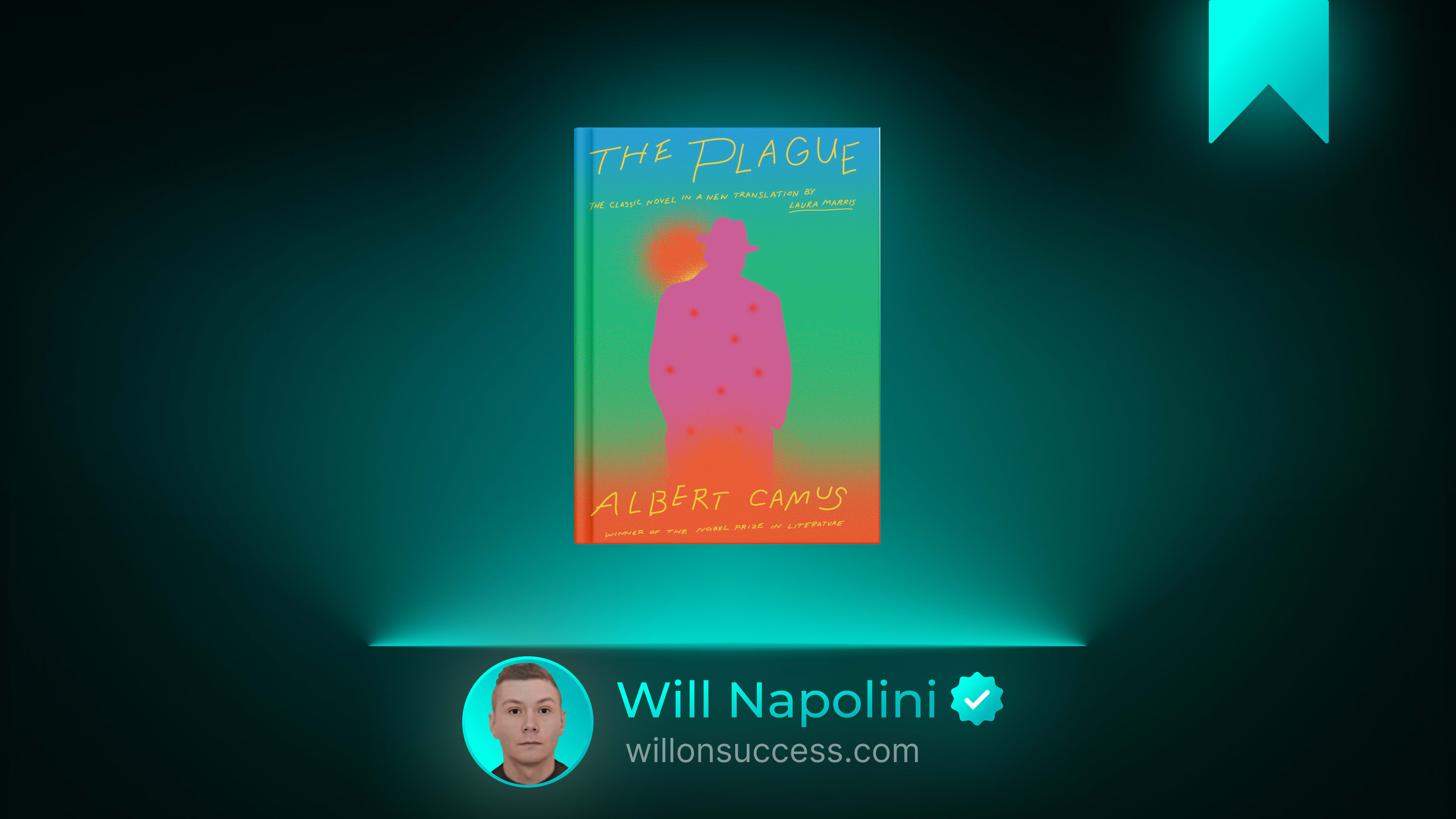
There is a moment early in Albert Camus’s The Plague that I think about more than almost any other scene in literature. A doctor notices something wrong—a few dead rats in a hallway, a mild fever in a patient—and his first instinct is not alarm. It is dismissal. It cannot be what it appears to be. It will pass. Tomorrow will look different.
I recognize that instinct. You probably do too.
We notice the slow erosion in a relationship. We feel the small wrongness at work, in our health, in the direction our life is drifting. And we say, almost reflexively: Not yet. Not me. Not this. We postpone the reckoning because facing it would demand something of us we are not sure we can give.
Camus built an entire novel around that postponement—and around what happens when postponing is no longer possible. And what he discovered, what he wrote into every page of this book, is something I have come to believe is one of the most important truths a person can learn:
You will not be spared from difficulty. But you are never as powerless inside it as you believe. And the choice you make about how to stand in the face of what you cannot control—that choice is where your life is actually lived.
The Story That Holds the Question
Let me give you the shape of the novel, because its power is inseparable from its story.
The year is sometime in the 1940s. The city is Oran, a French-Algerian port town that Camus describes as ordinary to the point of dullness—commerce, routine, small pleasures, small concerns. Then rats begin dying in the streets. Then people begin dying in their beds. The authorities hesitate. They debate words. Is it plague? Surely not plague. Not here. Not now.
By the time the truth is undeniable, the city is sealed. The gates close. No one enters. No one leaves.
What follows is not an adventure story. It is something more honest than that. Camus follows a handful of people through months of quarantine, sickness, separation, and death, and he watches—patiently, without flinching—to see what each of them becomes.
Dr. Bernard Rieux, the narrator, simply works. He treats patients. He keeps records. He does not sleep enough. He does not deliver speeches about heroism. When asked why he fights a disease he cannot cure, his answer amounts to: Because people are dying, and I am a doctor, and this is what is in front of me.
Jean Tarrou, a visitor trapped in the city, organizes volunteer teams to help. He does not do this because he believes he will win. He does it because he has decided, somewhere deep in his past, that he will not be on the side of the thing that kills.
Raymond Rambert, a journalist separated from the woman he loves, spends the first weeks scheming to escape. And then, at the moment escape becomes possible, he stays. He cannot explain it fully, even to himself. He only knows that leaving now would mean pretending the suffering around him is not real.
Father Paneloux preaches that the plague is divine judgment. Then he watches a child die in agony, and something in his theology cracks. He does not abandon faith. But he can no longer explain suffering neatly, and the honesty of that silence is, I think, one of the most courageous moments in the book.
Joseph Grand, a minor municipal clerk, spends the plague writing and rewriting a single sentence of a novel he may never finish. It seems absurd. It seems like nothing. And yet Camus gives Grand’s small, stubborn act of creation a dignity equal to any doctor’s work. Because Grand keeps going. Because he refuses to let the plague have the final word on what a human being does with an evening.
And Cottard, a man who had tried to take his own life before the plague, thrives during it. In a city of locked doors and universal fear, he finally feels at home. Camus does not mock him. He simply shows us what happens when a person’s private despair finds company in public catastrophe—and how dangerous that comfort can become.
The plague eventually recedes. The gates open. People celebrate. And Rieux, writing his account, reminds us that the plague bacillus never truly dies. It lies dormant. It waits. It will return.
That final note is not pessimism. It is the ground on which everything else in the novel stands.
The Big Idea: You Cannot Choose the Plague, but You Can Choose Your Posture
Camus wrote The Plague in the shadow of the Second World War, and readers have long understood the disease as an allegory for the Nazi occupation of France, for totalitarianism, for any force that reduces human beings to statistics and strips them of agency. But the novel reaches further than any single historical parallel.
The plague, in Camus’s hands, is every form of suffering that arrives uninvited and refuses to negotiate. Illness. Loss. Injustice. The slow collapse of something you built. The season of life where nothing responds to your effort and the world feels sealed shut.
And the question the novel presses into your hands is not Will this happen to you? It already will, in some form. The question is: What will you do while you are inside it?
Camus rejects three tempting answers.
He rejects denial—the authorities who argue about terminology while people die.
He rejects grandiose heroism—the need to make suffering meaningful, noble, redemptive, or part of a cosmic plan.
And he rejects resignation—the quiet decision that because you cannot fix everything, you will do nothing.
What remains, after those three refusals, is something quieter and, I believe, far harder: steady, clear-eyed, unglamorous action taken in solidarity with others who are also suffering. You do what is in front of you. You do it alongside other people. You do not require the work to be glorious. You do not require victory to justify the effort. You simply refuse to let the plague have you while you still have breath.
That is the spine of this book. And it is, I have come to believe, one of the most practical philosophies a person can carry into an uncertain life.
The Quiet Work Is the Real Work
I want to linger on Dr. Rieux, because I think he models something most of us misunderstand about courage.
Rieux is tired. He is separated from his wife, who is ill in another city. He loses patients. He watches colleagues break down. He knows, with a doctor’s realism, that he is not going to defeat the plague single-handedly. The disease will run its course. Some people will live. Many will not. His work will not change the final arithmetic in any dramatic way.
And yet he gets up every morning and goes to the next patient.
There is a passage in the novel where Rieux reflects that what is needed in a plague is not heroism. It is simply honesty. And honesty, in this context, means acknowledging what is true and then doing the work that the truth demands.
I have seen this principle play out in small, unglamorous ways in my own life and in the lives of people I care about. The parent who keeps showing up for a difficult child not because the child thanks them, but because showing up is what is in front of them. The person rebuilding a career after a layoff, sending applications into silence, not because each letter guarantees an answer, but because the act of trying is the act of refusing to let circumstance write the ending. The friend who keeps calling, month after month, when someone they love has withdrawn into grief.
None of this looks like bravery from the outside. It looks like routine. It looks like Tuesday.
But Camus understood something that I think we forget: most of what holds a life together, most of what holds a community together, is not dramatic. It is the accumulated weight of small, faithful, uncelebrated actions repeated when no one is watching and no one is applauding.
Your habits of showing up are not small. They are the architecture of your character. And character, in the end, is what you have left when circumstances have taken everything else.
Separation Reveals What Connection Means
One of the novel’s most aching threads is the experience of separation. The city’s gates are locked. Lovers are divided. Parents cannot reach children. Letters are censored. Phone lines are overwhelmed. People are trapped not only with the disease but with the absence of the people who make life bearable.
Camus spends real time inside that absence. He does not rush past it. He lets you feel the specific weight of wanting to hold someone’s hand and being unable to.
And what emerges from that ache is a truth I wish someone had told me earlier in life: we often do not understand the depth of our connections until something interrupts them.
Rambert’s whole arc is built on this. He is desperate to escape Oran, to get back to the woman he loves. He plans, he bribes, he negotiates. And when the moment finally arrives, he discovers that the person he became during those months of plague—working alongside strangers, sharing their fear, eating their thin meals—cannot simply walk away. His love for the woman is real. But so is the bond he has formed with the people beside him. He stays, and he does not fully understand why.
I think that is honest. I think the reasons we choose connection are often deeper than the reasons we can articulate. And I think Camus is suggesting that solidarity is not a grand ideological commitment. It is something that grows in you when you stop treating other people’s suffering as background noise and start letting it land.
Here is what I would tell you if I could sit across the table from you and you were feeling isolated, cut off, alone in whatever plague you are living through: the separation you feel right now is real, and I will not minimize it. But the impulse to reach toward someone—even imperfectly, even awkwardly, even through a text message that says nothing more than I am thinking of you—that impulse is not weakness. It is the most human thing you can do. And it is often the first thread that pulls you back into a life that feels livable.
The Plague Never Fully Leaves
The ending of this novel is not triumphant. The plague recedes. The gates open. There is joy, reunion, relief. And then Camus, through Rieux, reminds us: the bacillus is still there. In the walls. In the linens. In the drawers. Waiting.
This is not a writer being grim for the sake of drama. This is Camus insisting on a truth that I have found both sobering and, strangely, liberating: difficulty is not an interruption of your life. It is woven into the fabric of it.
You will have seasons of health and seasons of illness. Seasons of abundance and seasons of scarcity. Seasons where your work flows and seasons where everything you touch seems to stall. The plague will come in different forms, at different times, and it will not send a warning letter.
Once you accept that—truly accept it, not just nod at it intellectually—something shifts. You stop organizing your entire life around the fantasy that if you can just solve this one problem, everything will finally be calm forever. You stop treating difficulty as evidence that something has gone wrong with your particular life. You begin to build differently. You build for weather. You build for seasons. You build roots deep enough to hold when the wind comes, because you know the wind will come.
And you stop being so shocked when it does. That lack of shock is not cynicism. It is freedom. Because the person who is no longer surprised by difficulty is the person who can actually respond to it, instead of spending weeks or months in the paralysis of this was not supposed to happen.
Abstraction Is the Enemy of Compassion
There is a moment in the novel that has stayed with me since I first read it. Father Paneloux delivers a sermon early in the plague, speaking in broad, sweeping terms about divine punishment and collective sin. The language is large. The framework is tidy. Suffering has a reason. The plague is a lesson.
Then a young boy dies. Slowly. In agony. And Paneloux watches.
After that, his language changes. He cannot preach the same sermon. The abstraction has cracked against the reality of one small, specific, irreplaceable human life.
Camus is making a point here that reaches far beyond theology. Suffering becomes bearable to talk about when it stays abstract. It becomes unbearable—and real—when it has a face. And the temptation in every age, including ours, is to keep suffering abstract. To talk about it in statistics, in categories, in political arguments, in generalities that allow us to feel concerned without ever having to be changed.
I see this in the way we talk about other people’s struggles. People are anxious these days. People are struggling with burnout. People are lonely. And all of that is true. But the moment it stays at the level of people, it costs me nothing. The moment I think of one specific person—my colleague who has gone quiet in meetings, my neighbor I haven’t spoken to in three months, the friend whose last text message was four weeks ago and sounded thinner than usual—the abstraction dissolves, and I am faced with a choice.
Camus asks you, gently but persistently, not to let the plague stay abstract. Not in the world. And not in your own life. If something is hurting, name it. If someone is suffering, look at them. If you are the one suffering, give yourself permission to say so, specifically, to one person who might listen.
The plague thrives in generality. Compassion begins in specificity.
You Do Not Need to Finish the Sentence
I keep coming back to Joseph Grand. The little clerk. The man with his one sentence.
Grand is writing a novel during the plague. He has been writing it for years. He gets as far as the opening line, and then he rewrites it. And rewrites it. He agonizes over a single adjective. He reads his draft aloud to Rieux, searching for approval, searching for the word that will make the sentence true.
It would be easy to dismiss him. The city is dying, and this man is fussing over a comma.
But Camus does not dismiss him. And I think the reason is this: Grand’s sentence is an act of defiance. Not loud defiance. Not heroic defiance. The quiet, stubborn insistence that a human being can still make something, can still shape language, can still reach toward beauty, even in the middle of a plague. Even when no one may ever read it. Even when the sentence is never finished.
You start small. You stay faithful to the work in front of you. You let the making itself be enough.
I have learned, sometimes painfully, that not every season of life allows for grand projects. Sometimes the most you can manage is one sentence. One small task. One honest conversation. One morning where you get out of bed and do the next thing, even if the next thing is modest and no one notices.
That is not failure. That is Grand’s sentence. And it is enough. It is more than enough. It is the proof that the plague has not taken everything.
Who Should Read This Book
If you are in a season where life feels sealed shut—where you are waiting for something to change and it is not changing, where you feel quarantined by circumstance or grief or uncertainty—this book will meet you where you are. It will not rush you. It will not pretend the gates are already open. But it will sit beside you in the waiting, and it will show you that even inside the waiting, you are not without agency.
If you work in a helping profession—medicine, teaching, social work, caregiving—Rieux’s quiet endurance will feel like someone finally telling the truth about what your work costs and why it matters.
If you are drawn to philosophy but find pure philosophy too abstract, Camus gives you ideas inside flesh, inside story, inside the smell of a sickroom and the sound of a city going quiet.
I will be honest: this is not a fast read. It is deliberate. It is sometimes slow in the way that grief is slow. If you want a plot that races, this is not that book. If you want tidy answers about why suffering exists, Camus will not give them to you, and he will not apologize for that.
But if you want a novel that treats you like an adult, that respects your intelligence and your pain, and that offers solidarity instead of easy comfort—this is one of the great ones.
What You Can Do With This, Starting Today
I do not want to leave you inside the idea. Understanding without action is a room with no door.
So here is what I would suggest. Not a grand project. Not a overhaul. One small thing, in the spirit of Grand’s sentence.
Think of one person in your life who is, in some small or large way, living through a plague right now. A difficulty. A season of waiting. A quiet struggle they may not be naming out loud. You do not need to fix it. You do not need to have wisdom. You do not need to arrive with a solution.
Send them a message today. Three sentences at most. Tell them you are thinking of them. Tell them you see them. Tell them you are not going anywhere.
That is it. That is the whole assignment.
Because here is what I have learned, and what Camus teaches on every page of this novel: the opposite of the plague is not the absence of the plague. The opposite of the plague is the decision to face it alongside someone else. To say, with your presence, with your attention, with your small and imperfect faithfulness: You are not in this alone. And neither am I.
The gates will open. They always do, eventually. But what you do while they are closed—whether you turn toward each other or turn away, whether you do the small work or wait for the grand gesture, whether you let the suffering make you bitter or let it make you tender—that is the part that belongs to you. That is the part no plague can take.
You do not need to defeat the whole darkness. You need to light the one candle in front of you, and then the next, and then the next.
And that has always been enough.