Catch-22: What a War Novel Teaches You About Escaping the Systems That Trap You
Have you ever been trapped inside a rule that made no sense, but you could not escape because the rule itself was the lock?
You ask for help, and the person who could help you tells you that asking for help proves you do not need it. You try to leave a job, but leaving would mean losing the reference you need to get the next job. You stay quiet to keep the peace, but your silence is taken as agreement, which deepens the problem you were trying to avoid. You cannot win. You cannot leave. You cannot even explain why you are stuck, because the explanation itself is part of the trap.
If you have ever felt that particular suffocation—the slow, maddening realization that the game is rigged, that the logic is circular, that the institution you serve has no interest in your survival—then you already understand the central idea of Joseph Heller’s Catch-22 in your bones.
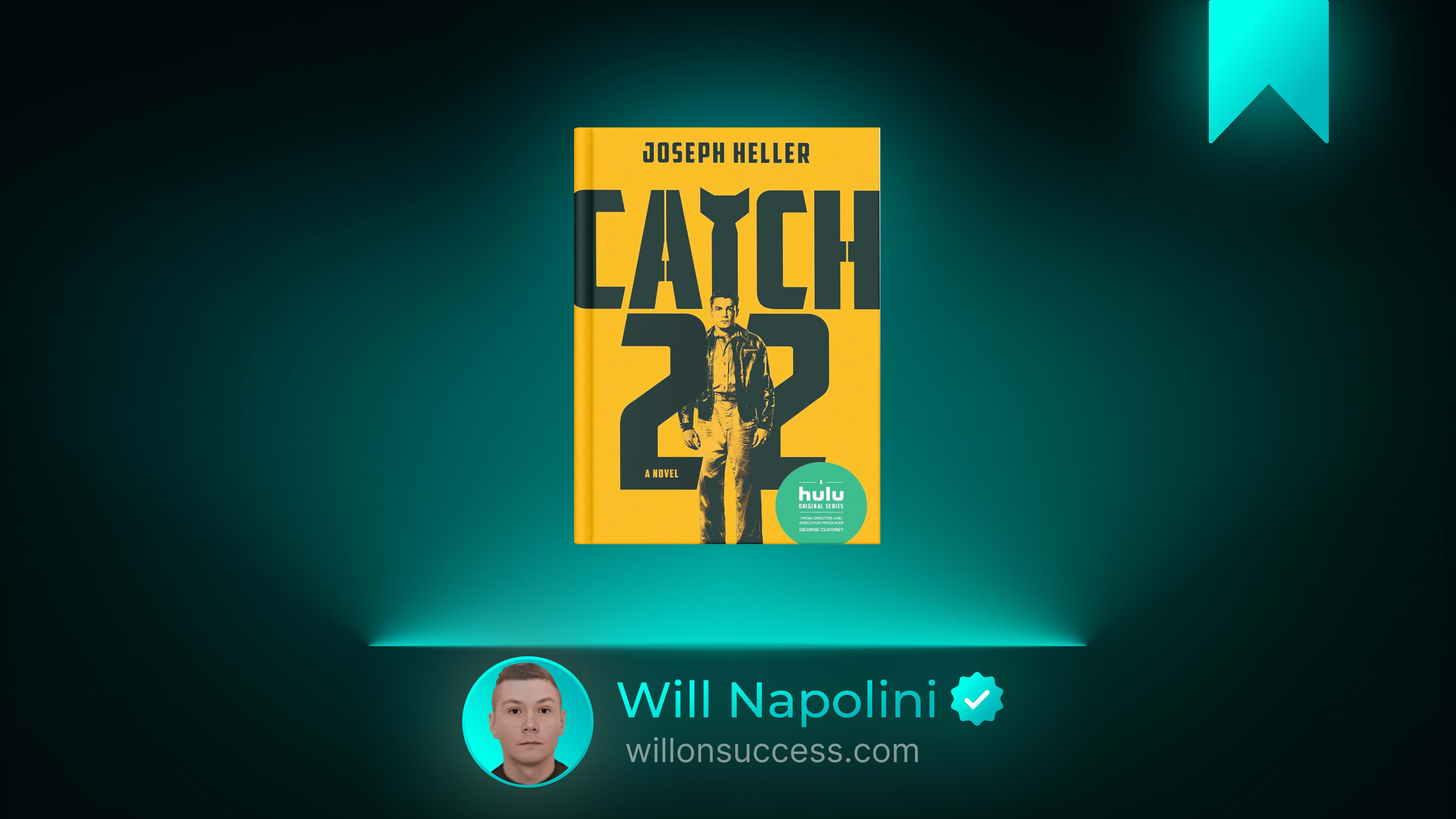
Published in 1961, Heller’s novel is set on a fictional island called Pianosa during the Second World War, following a bombardier named Yossarian who is trying very hard to stay alive while the system around him is trying very hard to get him killed. It is funny. It is horrifying. It is one of the most precise dissections of institutional madness ever written.
But beneath the satire, beneath the absurd comedy and the wartime setting, Heller buried something deeply personal. A question that belongs to every person who has ever worked inside a system, loved someone inside a system, or tried to remain sane inside a system that rewards insanity.
The question is this: When the rules are designed to destroy you, what does sanity actually look like?
The Big Idea: The Trap Is the Logic Itself
The novel’s central paradox is deceptively simple. Yossarian wants to be grounded from combat missions because he is terrified. He goes to the medical officer and says he is crazy. The doctor explains the regulation: a man can be grounded if he is insane, but he must submit a formal request to be grounded. Here is the catch—and it is stated plainly in the text—if a man requests to be grounded because he is concerned for his own safety in the face of real, immediate danger, that concern is the response of a rational mind. Therefore, the act of asking proves you are sane. Therefore, you cannot be grounded. Therefore, you must fly more missions.
You see the architecture of it. The trap is not a wall. The trap is the reasoning. The logic itself is the cage, and the logic is perfectly circular, perfectly sealed, and perfectly inescapable as long as you accept its premises.
Heller named this “Catch-22,” and the phrase entered the English language because every person alive recognizes it. The boss who will not give you experience because you lack experience. The bureaucracy that requires a form to get the form. The relationship where expressing your need is treated as evidence of your weakness.
The novel’s deepest teaching is not about war. It is about what happens when individuals surrender their moral reasoning to systems that have no morality. Institutions do not care whether you live or die. They care whether you comply. And they will construct language, logic, and procedure to make compliance feel like your only rational option.
Your first task, if you want to live freely, is to see the circular logic for what it is. You cannot escape a trap you do not recognize as a trap.
The Man in the Plane: Confronting What Is Real
The emotional center of the novel is not a battle scene or a bureaucratic argument. It is a quiet, terrible moment in the back of a plane.
Yossarian is trying to save a wounded gunner named Snowden. He applies bandages. He talks to him. He tries to keep him warm. And then, near the end, Yossarian opens Snowden’s flak jacket and sees what is underneath. The wound is far worse than he imagined. Snowden’s insides are destroyed. The boy dies in Yossarian’s arms.
Heller withholds this scene for most of the novel. It surfaces in fragments, in memories, in Yossarian’s nightmares. And when it finally arrives in full, it changes everything. Yossarian realizes something he had been avoiding: a human being is matter. Fragile, mortal, physical matter. All the language, all the medals, all the patriotic speeches and mission briefings—none of it changes the fact that a body can be opened like a package and spill onto the floor.
This is the moment Yossarian stops negotiating with the system. He stops trying to find a loophole in the regulations. He stops trying to be a good soldier within the rules. Because he has seen the truth beneath the rules, and the truth is that the rules do not protect him. The rules exist to keep him flying until the mathematics of probability finally kill him.
I have seen this shift in people. The moment they stop trying to optimize their position within a broken system and start asking whether the system deserves their participation at all. It usually comes after a loss. A diagnosis. A betrayal. A moment where the abstraction falls away and you are forced to look at the raw, physical reality of your one finite life.
That confrontation is painful. But it is also the beginning of clarity. You cannot choose freely until you have seen clearly.
The Moving Goalpost: How Authority Feeds on Your Compliance
One of the novel’s most maddening recurring patterns is Colonel Cathcart, the commanding officer who keeps raising the number of missions his men must fly before they can go home. It starts at twenty-five. Then thirty. Then forty. Fifty. Eighty.
Every time the men get close to finishing, Cathcart raises the number. Why? Because the number of missions completed is the metric by which his superiors judge him. He does not raise the missions because the war requires it. He raises them because his career benefits from the appearance of productivity and sacrifice.
The men cannot protest because the raising of the number is framed as a military necessity. They cannot leave because they have not yet completed the new number. They cannot question it because questioning is insubordination. And so they fly. And some of them die. And the number goes up again.
You know this pattern. You have lived it in some form. The promotion that requires one more quarter of results. The project that keeps expanding because someone above you needs a bigger number for their presentation. The relationship where the conditions for acceptance keep shifting, always just beyond your reach.
Heller shows us that the only way to survive a moving goalpost is to stop playing the game as it is defined. You cannot outperform a system that redefines performance to keep you trapped. You can only recognize the game for what it is and decide, consciously, whether you will continue to play.
Milo Minderbinder: When Profit Becomes the Only Logic
There is a character in the novel named Milo Minderbinder who starts as a mess officer and builds a global trading syndicate. He trades with both sides of the war. He buys eggs in one country, ships them through enemy territory, and sells them at a markup. Eventually, he contracts with the Germans to bomb his own squadron because the Germans offered him a profitable rate.
When confronted, Milo is genuinely confused by the outrage. He shows the men the books. The syndicate made a profit. Everyone owns a share in the syndicate. Therefore, everyone profited from the bombing of their own camp. Therefore, no one was harmed. The logic is airtight. The profit is real. The moral horror is simply… absent from the accounting.
Heller wrote this in 1961, but the lesson has not aged. When an institution’s only metric is profit—financial, political, or social—it will eventually consume the people inside it and call the consumption a success. The language of the institution will reframe destruction as growth. The bombing becomes a line item. The harm becomes an externality.
If you work inside a system that measures everything in numbers and nothing in human cost, you must decide what you are willing to participate in. Not because rebellion is easy. But because the alternative is to become Milo. To look at the destruction you helped create and feel only the satisfaction of a balanced ledger.
Orr’s Quiet Escape: The Power of Patient Preparation
There is a character named Orr who crashes his plane on every mission. Everyone thinks he is incompetent. Everyone thinks he is cursed. Yossarian is baffled by him. Orr keeps crashing, keeps surviving, keeps getting back in another plane.
And then, near the end of the novel, Orr crashes over the sea and simply… does not come back. He has paddled his way to neutral Sweden. He has been practicing. Every crash was a rehearsal. Every survival was preparation. While everyone else was trying to endure the system from within, Orr was quietly building his exit.
This is one of the most hopeful images in the entire book. Orr does not argue with the system. He does not file complaints. He does not try to reform Colonel Cathcart or expose Milo Minderbinder. He simply prepares, patiently and persistently, for the moment he can leave. And then he leaves.
I think about this often. We are taught that resistance must be loud. That fighting the system means confronting it head-on, arguing in meetings, posting grievances, demanding change from the people who benefit from your compliance. Sometimes that is right. Sometimes that is necessary.
But sometimes the wisest action is quiet preparation. Building your skills. Saving your resources. Strengthening your relationships outside the system. Practicing, in small ways, the life you will live once you are free. You do not owe the institution a dramatic confrontation. You owe yourself a working exit.
The Choice to Run: What Sanity Looks Like in an Insane World
The novel ends with Yossarian making a decision. He does not complete his missions. He does not accept the comfortable deal his superiors offer him—go home, tell everyone you are a hero, never speak of what happened. He does not become complicit in the lie.
He runs. He deserts. He plans to make his way to Sweden, to follow Orr’s path.
This is not presented as heroic in the traditional sense. Yossarian is terrified. He is uncertain. He knows he might fail. But he has seen Snowden’s wound. He knows what the system costs. And he has decided that his one finite life is not currency to be spent on someone else’s career.
Heller is making a profound claim here. In a world that has lost its moral logic, the most rational act may be to walk away. Sanity is not adjusting yourself to fit an insane system. Sanity is recognizing the insanity, naming it, and refusing to participate.
This does not mean every difficult situation requires you to quit your job or abandon your responsibilities. It means you must examine the terms of your participation. Are you staying because the work is meaningful, or because you are afraid of what leaving would cost you? Are you complying because the rules are just, or because the punishment for disobedience frightens you?
There is a difference between duty and captivity. Heller teaches you to feel the difference in your body.
Why This Matters on an Ordinary Tuesday
You are not flying bombing missions over Italy. But you are living inside systems. You work inside a company with its own logic, its own Catch-22s, its own Colonel Cathcharts raising the number. You navigate social expectations that tell you to be grateful while asking you to sacrifice your health. You exist inside economic structures that reward compliance and punish rest.
What Catch-22 teaches you is to notice when the logic has become circular. To notice when the rule exists to perpetuate the rule rather than to serve a human purpose. To notice when you are being asked to accept a premise that, if you examined it clearly, you would recognize as absurd.
And then, once you see it, to decide what you will do. Not in a panic. Not in rage. But with the quiet, clear-eyed resolve of someone who has looked at the wound beneath the flak jacket and decided that their life is not an abstraction to be managed by someone else’s mathematics.
Who Should Read This Book
If you have ever felt ground down by bureaucracy, by corporate culture, by any institution that speaks in the language of fairness while operating in the language of control, this book will feel like someone finally said the thing you could not articulate.
It is also essential reading if you want to understand how language can be used to make the irrational seem rational. Heller’s prose is repetitive, circular, maddening by design. He makes you feel the trap in the structure of the sentences themselves.
A fair warning: the novel is dark. It is genuinely funny, but the humor is the kind that comes from staring into an abyss and laughing because the alternative is screaming. If you are in a very fragile emotional place, the book’s relentless absurdity and its moments of genuine horror—particularly the Snowden sequence and the novel’s final chapters—may be overwhelming rather than liberating. Read it when you are strong enough to sit with discomfort.
It is not a self-help book. It will not give you a five-step plan. But it will give you something more valuable: the language to name the thing that is trapping you. And naming is the first act of freedom.
Your One Small Step
Today, I want you to identify one Catch-22 in your own life. One place where you feel stuck because the logic is circular. One rule, expectation, or obligation that keeps you trapped because the condition for escape is something the system will never grant you.
Write it down. Not a paragraph. One sentence. State the trap clearly.
“I cannot leave this job because I need the reference, but I cannot get the reference unless I stay, and staying is destroying my health.”
“I cannot ask for help because asking for help means admitting I cannot handle it, and admitting I cannot handle it will be used against me.”
Look at the sentence. Read it twice. Notice that the logic is not a law of nature. It is a construction. It was built by someone, for a purpose that serves them, not you.
You do not have to solve it today. You do not have to run to Sweden. But you have to see the cage clearly before you can find the door.
The trap only holds you as long as you believe its logic is the only logic. The moment you see the circle, you can step outside it. The moment you name the catch, it loses its power to make you feel insane.
You are not crazy for wanting to live. You never were.