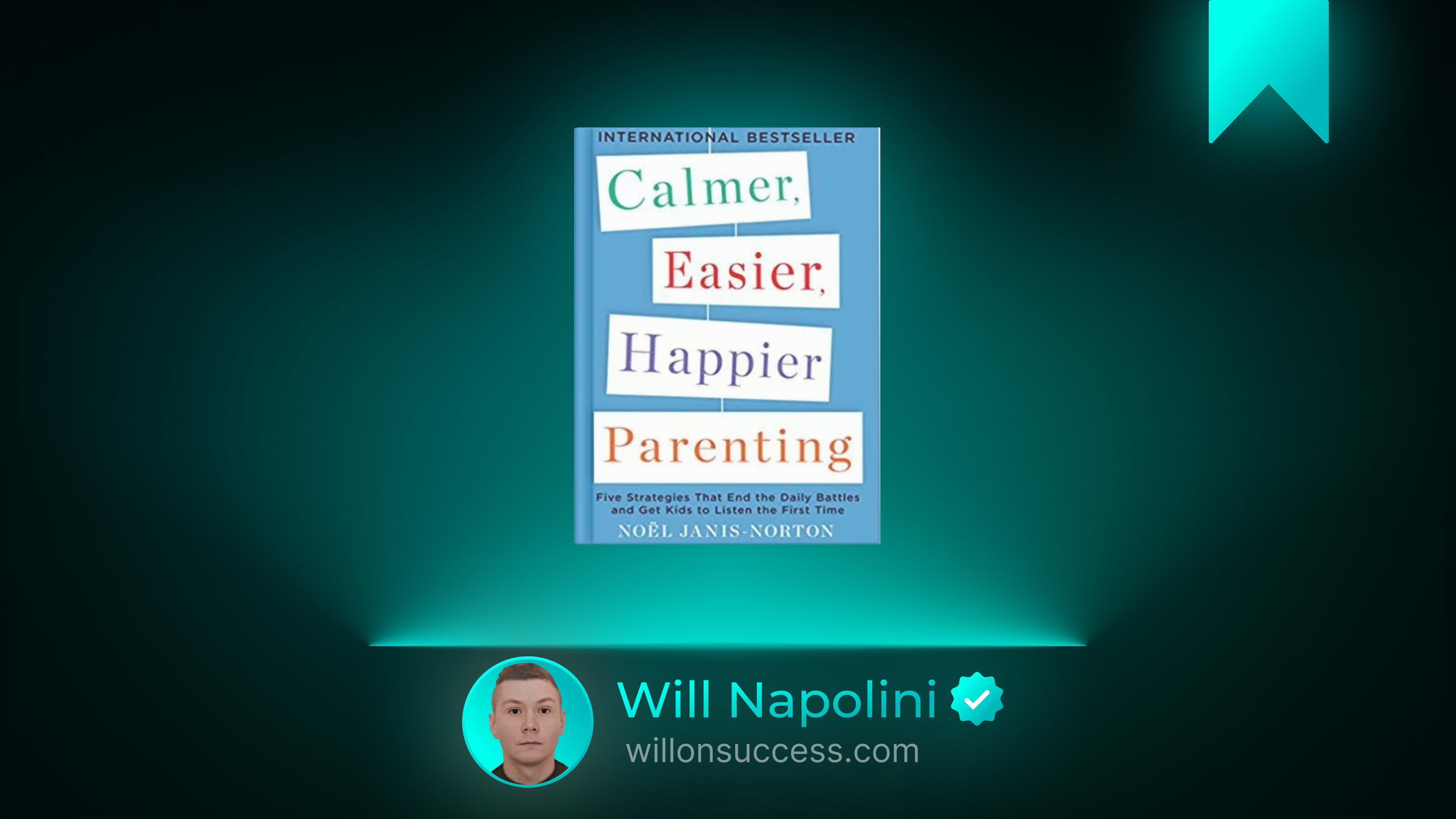
Calmer, Easier, Happier Parenting: How to Stop Fighting and Start Raising Cooperative Kids
It is 7:45 in the morning. The school bus is coming in fifteen minutes. One child is missing a shoe, the other is refusing to eat breakfast, and you can feel the familiar heat rising in your chest. You start by asking nicely. You move to reminding. You escalate to nagging. And finally, right as the clock strikes the hour, you are yelling.
The kids get to school. You get to work. And you spend the rest of the day carrying the quiet, heavy guilt of a parent who promised themselves they wouldn’t lose their temper today, but did anyway.
I know the weight of that guilt. I have watched it play out in hundreds of homes, and I know the exhaustion that comes from feeling like you are the only thing standing between your family and total chaos. You love your children fiercely, but some days, the actual day-to-day business of raising them feels less like a joy and more like a daily battle of attrition.
If this sounds like your life, I want to introduce you to a book that offers a profound shift in perspective. It is called Calmer, Easier, Happier Parenting by Noël Janis-Norton, and it dismantles the dangerous assumption that chaotic, argumentative family life is just “normal.”
It isn’t. And more importantly, it isn’t inevitable.
The Big Idea: You Cannot Control Them, But You Can Architect the Environment
The central thesis of Janis-Norton’s work is both liberating and challenging: your child’s difficult behavior is rarely just a personality flaw or a phase they will magically outgrow. It is usually a reaction to the environment, the expectations, and the dynamic that has been accidentally established in the home.
Most parents operate in a reactive cycle. A child misbehaves, the parent reacts with emotion (nagging, yelling, punishing), the child reacts to the emotion, and the cycle spins faster.
Janis-Norton argues that to get a calmer, easier, happier family life, the parent must step out of the reactive cycle and become an architect of the proactive cycle. You cannot control your child’s internal impulses. But you have absolute authority over the structure, the routines, the feedback, and the expectations that surround them.
When you change your approach from managing crises to preparing for success, the child’s behavior naturally follows. You stop trying to force compliance, and you start engineering cooperation.
The Shift: From Instinct to Skill
One of the most comforting realizations in this book is that parenting is not merely a biological instinct. It is a complex, demanding skill.
We would never expect someone to sit down at a piano and play a sonata just because they love music. We would never expect someone to build a house just because they want a place to live. Yet, we expect ourselves to navigate the psychological and logistical complexities of raising human beings with nothing but love and good intentions. When love and good intentions fail, we assume we are bad parents.
You are not a bad parent. You are just an untrained parent relying on trial, error, and the flawed examples you grew up with. Janis-Norton provides the training. She replaces the vague advice to “be more patient” with specific, observable, repeatable strategies.
Water the Plants You Want to Grow
If you walk into a garden and only water the weeds while ignoring the flowers, you will soon be overrun by weeds. Yet, this is exactly what most families do with their attention.
When your child is playing quietly, reading a book, or putting their shoes on without being asked, you stay quiet. You think, Good, they are behaving, I’ll go answer this email. But when they start fighting with their sibling or throw a toy, you immediately rush over, giving them your full, intense, emotional attention.
Children are biologically wired to seek their parents’ attention. If they learn that misbehavior is the fastest way to get you to look at them, they will misbehave.
Janis-Norton introduces a concept called Descriptive Praise. This is not the empty, generic “Good job!” or “You’re so smart!” that we often throw at kids. Descriptive praise requires you to act like a narrator, specifically calling out the positive behaviors you want to see more of.
«”I noticed you put your plate in the sink without me asking.”»
«”I saw how frustrated you were with that math problem, but you didn’t give up. You kept trying.”»
«”Thank you for speaking to your sister in a calm voice even when you disagreed.”»
This does three powerful things. First, it gives the child the deep psychological nutrition of feeling truly seen. Second, it tells them exactly what “good behavior” looks like in concrete terms. Third, it rewires your own brain. By actively hunting for things your child is doing right, you begin to feel more affectionate and less resentful toward them.
Your attention is the water. Make sure you are watering the flowers.
Build the Track Before the Train Arrives
Think about the transitions in your day. Waking up. Leaving for school. Coming home. Dinner. Bath time. Bedtime.
For most families, these transitions are where the wheels fall off. The parent announces it is time to leave the park, and the child collapses in tears. Why? Because the parent waited until the moment of transition to introduce the expectation.
Janis-Norton calls her solution to this Preparing for Success, and the primary tool is the “Think-Through.”
A think-through is a proactive conversation that happens when everyone is calm, happy, and not in a rush. You sit down with your child and ask them questions about an upcoming transition. You do not tell them the rules; you ask them to articulate the rules.
«”When we get to the grocery store later, what are the rules about asking for treats?”» (The child answers: “We only get one, and only if I ask nicely.”) «”And what will happen if you whine or grab things off the shelf?”» (The child answers: “We will leave the cart and go to the car.”) «”Exactly. And what will you do while I’m paying?”»
When the child says the rule out loud, they take ownership of it. You are no longer the warden enforcing a law; you are simply holding them to the agreement they helped articulate.
When the moment of transition arrives, you do not have to argue. You simply remind them of the think-through. If they still act out, the consequence is already established, calm, and logical. You have built the track. Now, the train just has to run on it.
Validate the Feeling, Hold the Boundary
There will be times when your child is deeply upset about a boundary you have set. Screen time is over. It is time for bed. They cannot have candy for dinner.
In the past, your instinct might have been to fix it, to argue with it, or to give in just to stop the crying. You might say, “Stop crying, it’s not a big deal,” or “If you don’t stop crying, you’re going to your room.”
Janis-Norton teaches a vital skill called Reflective Listening. When a child’s nervous system is flooded with emotion, their logical brain shuts down. You cannot reason with a crying child. You must connect with their emotion before you can correct their behavior.
Reflective listening means you become a mirror for their feelings, without changing the rule.
«”I can see you are so angry that the iPad has to go away. It is really hard to stop playing when you’re having fun.”»
«”You really wish we could stay at the park. It’s disappointing to have to leave.”»
Notice what is missing from these sentences? An apology. A negotiation. A “but.”
You simply validate the difficulty of the moment. Often, just feeling understood is enough to help a child’s nervous system regulate. They might still be sad, but they will stop fighting you. You hold the boundary with iron consistency, but you wrap that boundary in a blanket of deep empathy.
The Architecture of Consequences
A major theme in Calmer, Easier, Happier Parenting is the distinction between a punishment and a consequence, and the difference between a bribe and a reward.
A bribe happens in the heat of the moment to stop bad behavior. “If you stop screaming in this store, I’ll buy you a candy bar.” Bribes teach children that bad behavior is a highly effective negotiating tactic.
A reward is established proactively. “If you complete your morning routine without me having to remind you, you earn your screen time for the afternoon.” Rewards teach children that effort and cooperation lead to positive outcomes.
Similarly, a punishment is often arbitrary and driven by the parent’s anger. “Because you talked back, you are grounded for a week!” It breeds resentment.
A consequence is logical, related to the behavior, and delivered calmly. “Because you threw the toy, the toy is going in the closet for the rest of the day.”
When consequences are delivered without anger, without a lecture, and without the “I told you so” speech, the child is forced to look at their own choices rather than your anger. The architecture of the rule holds them, not your volume.
Why This Matters on an Ordinary Tuesday
You might be reading this and thinking, This sounds like a lot of work. I’m already exhausted.
I understand. But I want to challenge you to look at the math of your daily life.
Right now, you are spending an enormous amount of energy managing the fallout of reactive parenting. You spend twenty minutes negotiating bedtime. You spend fifteen minutes arguing about getting dressed. You spend your evenings mediating sibling fights. You are working incredibly hard, but you are working on the wrong end of the problem. You are trying to mop up the floor while the sink is still overflowing.
Janis-Norton’s principles ask you to turn off the tap.
Yes, it takes fifteen minutes of calm, proactive time on a Sunday afternoon to do a “think-through” about grocery store behavior. But that fifteen minutes saves you the forty-five minutes of crying, yelling, and apologizing that usually happens in aisle four.
Consistency before intensity. You do not need to implement all of these strategies tomorrow. You just need to pick one small area of friction and apply the principle.
When you do, something miraculous happens. The friction decreases. The yelling stops. And in the quiet space that is left behind, you actually get to know your kids again. You get to enjoy them. You remember why you wanted to be a parent in the first place.
Who Should Read This Book
If you are raising children between the ages of three and thirteen, and you feel like your home has become a battleground of minor (and major) power struggles, this book is a lifeline.
It is exceptionally useful for:
- Parents who feel they are constantly nagging or repeating themselves.
- Parents who feel guilty about how often they lose their temper.
- Couples who need to get on a “united front” but argue about discipline styles.
- Parents of strong-willed, highly sensitive, or easily frustrated children who need concrete scripts to handle meltdowns.
Who it might not be for: If you are looking for deep psychological exploration of childhood trauma, or if you are dealing with severe clinical behavioral disorders that require psychiatric intervention, this book is not a replacement for professional therapy. It is a masterclass in everyday family dynamics, routines, and behavioral management. It is also less applicable to infants and toddlers under three, whose brains are not yet developed enough for complex think-throughs.
Your One Small Step
Understanding these concepts is valuable, but understanding without action changes nothing in your home.
So here is what I would ask you to do today.
Do not try to overhaul your entire family routine. Do not try to implement five new strategies at once. Just pick one moment of transition that usually causes friction. Let’s say it’s getting ready for bed.
Sometime this afternoon, when everyone is relaxed and happy, sit down with your child and do a single, two-minute Think-Through.
Ask them: “When we go upstairs for bed tonight, what are the three things we need to do before we read our story?” Let them answer. “And what will happen if we get silly and run around instead of brushing our teeth?” Let them answer. Praise them for knowing the routine.
Then, tonight, when the transition happens, do not nag. Just smile and ask, “What did we agree on during our think-through?”
You will be amazed at how differently they respond when they are reminded of a standard they helped set, rather than a command they are forced to obey.
A calm home is not a home where children never misbehave. A calm home is a home where the parents know exactly how to respond when they do. You have the power to build that home. The foundation is already inside you; you just need to lay the bricks.