The Stranger: What Camus's Unsettling Little Novel Teaches About Honesty, Conformity, and the Courage to Stop Performing
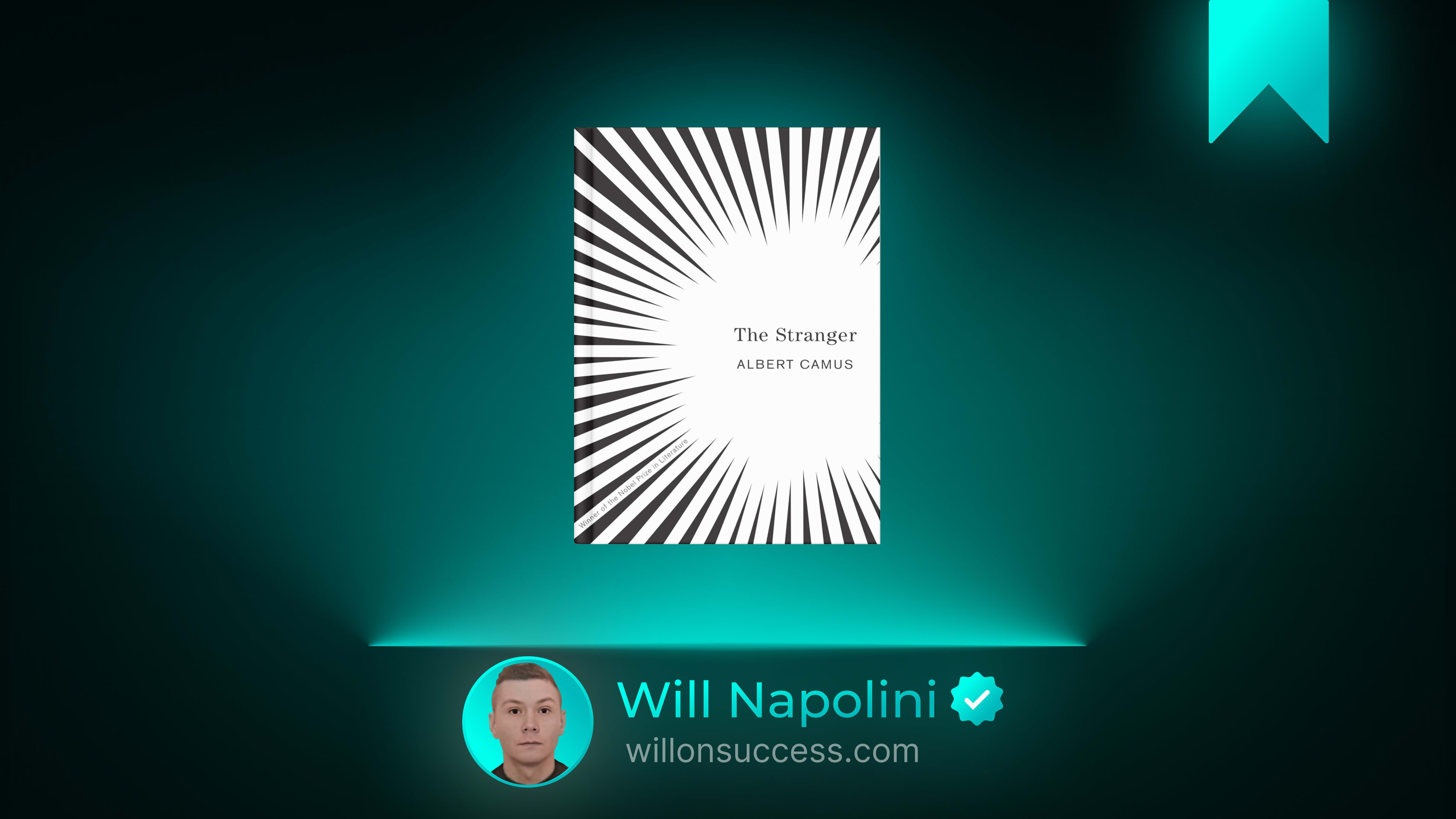
A young man in Algiers receives a telegram telling him his mother has died. He travels to the care home where she lived, sits with her body, smokes a cigarette, declines to open the coffin. He cries very little. The next day he goes swimming, meets a woman he used to work with, begins a relationship, goes to see a comedy film.
That is how Albert Camus opens The Stranger, published in 1942. No dramatic grief. No eulogy. No performance of the sorrow everyone around him expects. Just a man moving through the days with a kind of flat, sensory honesty that makes almost everyone who meets him uneasy.
I have read this opening several times over the years, and each time it lands differently. The first time, I found Meursault cold. The second time, unsettling. By the third or fourth reading, I began to notice something that made me uncomfortable in a more personal way: I recognized how much of my own life was built on performing emotions I only partially felt, saying the right words at the right moments because the script demanded it, and calling that performance being a decent person.
Camus is not asking you to admire Meursault. He is asking you to notice how much of your own life runs on a script you never wrote and never questioned. And that question, once it takes hold, is very difficult to put down.
The Big Idea: The Universe Does Not Owe You a Meaning, and Society’s Script Is Not the Same as Truth
Camus built his philosophical reputation on what he called the Absurd: the confrontation between a human being who craves meaning, order, and purpose, and a universe that offers none of those things. The sky does not explain itself. Death does not negotiate. The sun shines on the just and the unjust with exactly the same indifference.
The Stranger is not a philosophy lecture. It is a novel, short and spare, written in short declarative sentences that feel almost deliberately stripped of ornament. But it dramatizes the Absurd more viscerally than any essay could. Meursault does not theorize about meaninglessness. He simply lives without the comforting narratives most people use to make life feel coherent. He does not pretend his mother’s death devastates him when what he actually feels is a vague tiredness and the heat. He does not pretend to love Marie in the way she wants to hear. He does not pretend to believe in God when the chaplain asks. He does not perform. And for this, the world decides he is monstrous.
The novel’s central argument, if it can be reduced to one, is this: society does not primarily punish you for what you do. It punishes you for refusing to feel what it has decided you should feel, in the order it has decided you should feel it, and to display those feelings in the form it recognizes. The script is not optional. And the person who quietly steps outside it becomes a threat that must be eliminated.
The Story: A Murder, a Trial, and the Wrong Question
I will give you the shape of the plot without draining its strangeness.
The novel is divided into two parts. Part One follows Meursault through several weeks of ordinary life in French Algiers. He goes to work at a shipping office. He swims. He begins a relationship with Marie Cardona. He befriends a neighbor named Raymond Sintès, a man of dubious character. He is aware of the sun, the heat, the physical sensations of his body, the taste of food, the color of the sea. He is not introspective in the way novels usually make their protagonists introspective. He reports what he feels with a kind of blunt, sensory literalism.
Then comes the beach. Meursault, Raymond, and a friend go to the shore. There is a confrontation with a group of men, including an Arab man who is Raymond’s enemy. The confrontation is diffused, but later, Meursault walks alone along the beach. The sun is brutal. The heat is a physical weight. He encounters the Arab man again, who draws a knife. The blade catches the light. Meursault, sweating, half-blinded, feeling the sun pressing against his forehead like a blade itself, pulls the trigger of the revolver Raymond has given him. Then he fires four more times.
Camus does not give you a clean motive. Meursault does not say I killed him because of hatred or because of fear. He points to the sun, the glare, the unbearable heat, the way the light struck the knife and seemed to pierce his eyes. It is not an excuse. It is something stranger and more honest: an acknowledgment that the act came not from a rational decision but from a physical breaking point, a moment where the body overwhelmed the mind.
Part Two is the trial. And here the novel performs its most devastating move. The prosecution spends almost no time on the facts of the murder. Instead, they put Meursault’s character on trial. They call witnesses from the mother’s funeral. Did he cry? No. Did he want to see the body? He declined. Did he smoke a cigarette beside the coffin? He did. Did he go to a comedy film the following day? He did.
The prosecutor builds his case not on the shooting but on the funeral. The argument underneath the argument is: a man who does not weep at his mother’s funeral is capable of anything. The murder becomes almost secondary. What is really being judged is Meursault’s refusal to grieve in the approved way, to perform the sorrow, to conform to the emotional choreography society has written for him.
He is sentenced to death.
In the final pages, alone in his cell, Meursault confronts the chaplain, who insists he must turn to God, must hope, must find meaning. Meursault refuses. And in that refusal, something opens. He feels, for the first time, a kind of fierce peace. He opens himself to what he calls the benign indifference of the universe. He realizes that he has been happy, and that he is happy still. He asks only that on the day of his execution, a crowd be present to greet him with cries of hatred, so that his final act will be authentic to the end.
A note on something important: the man Meursault kills is never given a name. He is referred to throughout only as “the Arab.” This is a fact about the novel that Camus wrote in colonial Algeria, and it is a fact that later writers and critics have examined with great care, asking what it means that a life can be central to a story as a death while remaining invisible as a person. The novel’s philosophical power does not cancel that silence, and an honest reading should hold both truths at once.
The Script You Did Not Write
Here is the question the novel pressed into me, the one I keep turning over.
How much of your emotional life is genuine response, and how much is performance? When someone dies, do you grieve in the way that actually matches your inner weather, or do you grieve in the way the moment seems to require? When a friend tells you good news, does your face perform the enthusiasm you think they need to see, or do you let them witness what you actually feel, even if it is complicated, muted, mixed?
I am not suggesting you owe everyone your unfiltered inner life. Social grace is not the same as dishonesty. There is a difference between being kind and being false. But Camus is pointing at the place where the performance becomes so automatic, so deeply embedded, that you can no longer tell the difference between what you feel and what you are supposed to feel. And that, he suggests, is where something essential in you goes quietly missing.
Meursault is not a hero. He is not a model for how to live. But he is a diagnostic instrument. He shows you, by extreme contrast, how much of your own daily life is spent following a script. The words you say at funerals. The enthusiasm you perform at work. The interest you feign in conversations. The beliefs you express because they are the beliefs someone in your position is supposed to hold.
You do not have to tear up the script tonight. But you can start noticing where it is. You can start distinguishing the lines you are reading from the lines you are actually speaking.
Honesty Has a Cost, and Camus Does Not Let You Forget It
I want to be clear about something, because I have seen readers romanticize Meursault’s honesty as though it were a simple virtue, a liberation you can adopt like a new jacket. It is not.
Meursault’s honesty destroys him. The society around him cannot tolerate a person who will not perform, and it kills him for it. Camus does not soften this. There is no last-minute reprieve, no clever reversal, no moment where the jury suddenly understands and lets him go. The machine of social judgment grinds forward, and Meursault is fed into it, and that is the end.
If you decide to stop performing every emotion you are expected to perform, if you decide to say what you actually think instead of what the room requires, if you decide to grieve in your own way rather than the approved way, there will be consequences. People will be uncomfortable. Some will withdraw. Some will judge. The social contract, it turns out, is enforced, and the enforcement is not gentle.
Camus is honest about this cost. He does not promise that authenticity will be rewarded. He only insists that the alternative, a life spent entirely in performance, is a kind of death that happens long before the body follows.
The question is not whether honesty is safe. It is whether the safety of silence is worth the slow disappearance of the person you might have been if you had spoken.
The Body Knows What the Mind Has Not Yet Admitted
One of the novel’s most distinctive features is how physical Meursault’s experience of the world is. He notices the temperature of the water, the color of Marie’s dress, the taste of food, the weight of the sun on his skin. His emotional life is thin, but his sensory life is rich and immediate.
The murder itself is triggered not by a thought but by a physical sensation: the sun, the heat, the glare of the blade, the sweat running into his eyes. Camus is showing you something unsettling about how much of human action is governed by the body, by heat and fatigue and sensory overload, while the mind is busy constructing rational explanations after the fact.
I think about this in smaller, less dramatic terms. How often have you made a decision, spoken a harsh word, sent a message you regretted, agreed to something you should have refused, and later realized that you were tired, hungry, overheated, physically depleted? The body was shouting, and the mind pretended not to hear.
You do not need to live in Meursault’s purely sensory world. But you can learn to notice when your body is telling you something your mind is talking over. The tightness in your chest during a conversation. The exhaustion that is not just physical but emotional. The restlessness that means you are in the wrong place, doing the wrong thing, wearing a mask that no longer fits.
The body is honest in a way the mind often is not. It does not perform. It just reports.
What the Confrontation with Death Strips Away
In the final chapter, Meursault sits in his cell and the chaplain comes to him, urging repentance, faith, hope. Meursault refuses, and in the refusal, something cracks open. He does not find God. He does not find a cosmic meaning. What he finds is the absence of meaning, and he discovers, to his own surprise, that the absence is not the void he feared. It is a kind of clearing. Without the obligation to believe in a story he does not believe, without the pressure to perform hope he does not feel, he is left with the bare fact of his own existence, the sky outside the window, the sound of the night, the simple reality of being alive in a universe that did not create him for a purpose.
And in that bareness, he feels free.
I do not think you have to face a literal death cell to reach this place. But I have seen it happen in smaller forms. The diagnosis. The loss. The failure that strips away the career, the status, the identity you built. The moment when the script no longer applies because the situation was not in the script. And in that nakedness, some people discover, beneath the grief, a strange and terrifying clarity. The things they thought mattered fall away. What remains is simpler. Harder. But more real.
You do not need to seek that confrontation. But if it finds you, as it finds everyone eventually in some form, know that the clearing it creates is not emptiness. It is the ground beneath all the stories. And you can build on it, if you choose, something that is yours rather than inherited.
Who Should Read This Book, and Who Might Struggle With It
The Stranger is short. You can read it in an afternoon. And it will stay with you for a long time afterward, which is the mark of a book doing something that has nothing to do with length.
It will reward you if you are in a season of questioning the narratives you have inherited, if you feel a quiet exhaustion from performing a version of yourself that no longer fits, if you are drawn to philosophy but prefer it delivered through story rather than argument. It is for readers who can sit with ambiguity, who do not need the protagonist to be likable, who are willing to let a book disturb them without resolving the disturbance into a tidy lesson.
It may not be for you if you need a protagonist to root for in the conventional sense. Meursault is not warm. He is not aspirational. He does not grow in the way novel protagonists are supposed to grow. If you need emotional warmth and moral clarity from your fiction, this novel will feel cold and unsatisfying, and that is a fair response. The book is what it is, and it does not apologize.
It is also worth reading in translation with some care. The English versions vary in tone. The spare, flat quality of Camus’s French is part of the meaning, and a translation that smooths it out or adds emotional shading can change the experience significantly.
One Small Step You Can Take Today
You do not need to overhaul your emotional life by Thursday. You do not need to stop performing overnight or announce your inner truth to everyone in your orbit. That would be drama, not honesty, and Camus had no interest in drama.
But here is one small experiment, and it is the same experiment Meursault conducts on a smaller scale every day of his life, the experiment of noticing the gap between what you feel and what you are performing.
Today, in one conversation, one meeting, one exchange, pause before you respond with the expected line. Just for a moment. Notice what you actually feel. Not what you think you should feel. Not what the other person needs you to feel. What is actually there, in you, right now.
You do not have to say it. You do not have to announce it. You only have to know it. To register, honestly, in the privacy of your own mind, that what you are about to say and what you actually feel are two different things.
That small act of noticing is the beginning of the experiment. Not the rejection of the script. Just the awareness that it is a script. That you are reading lines. That somewhere underneath the performance, there is a person who feels something slightly different, something more complicated, something that does not fit the shape the moment has prepared for it.
Camus wrote a novel about a man who could not bring himself to lie about what he felt, and the world destroyed him for it. The lesson is not that you should go where Meursault went. The lesson is that you should know, before the world asks you to perform, what the truth of your own feeling actually is.
Because once you know it, you can choose. You can decide when to speak it and when to let it rest, when to honor the social moment and when to honor the private one. You are no longer on autopilot. You are no longer reading lines without knowing they are lines.
And that small, quiet knowing, sustained over time, is the difference between a life that happens to you and a life you are actually living.
The sun will be there tomorrow. The script will be waiting. The performance will ask you to step into your marks and say your lines. And you will step in, because that is what living among other people requires. But you will do it knowing what you feel beneath the words. And on the day it matters most, the day the script fails, the day the lines run out and the sky offers no explanation, you will not be a stranger to yourself.
That is the only freedom the novel offers. It is not much. It is everything.