The Story of My Experiments with Truth: Gandhi's Radical Argument That You Are Never Finished Becoming
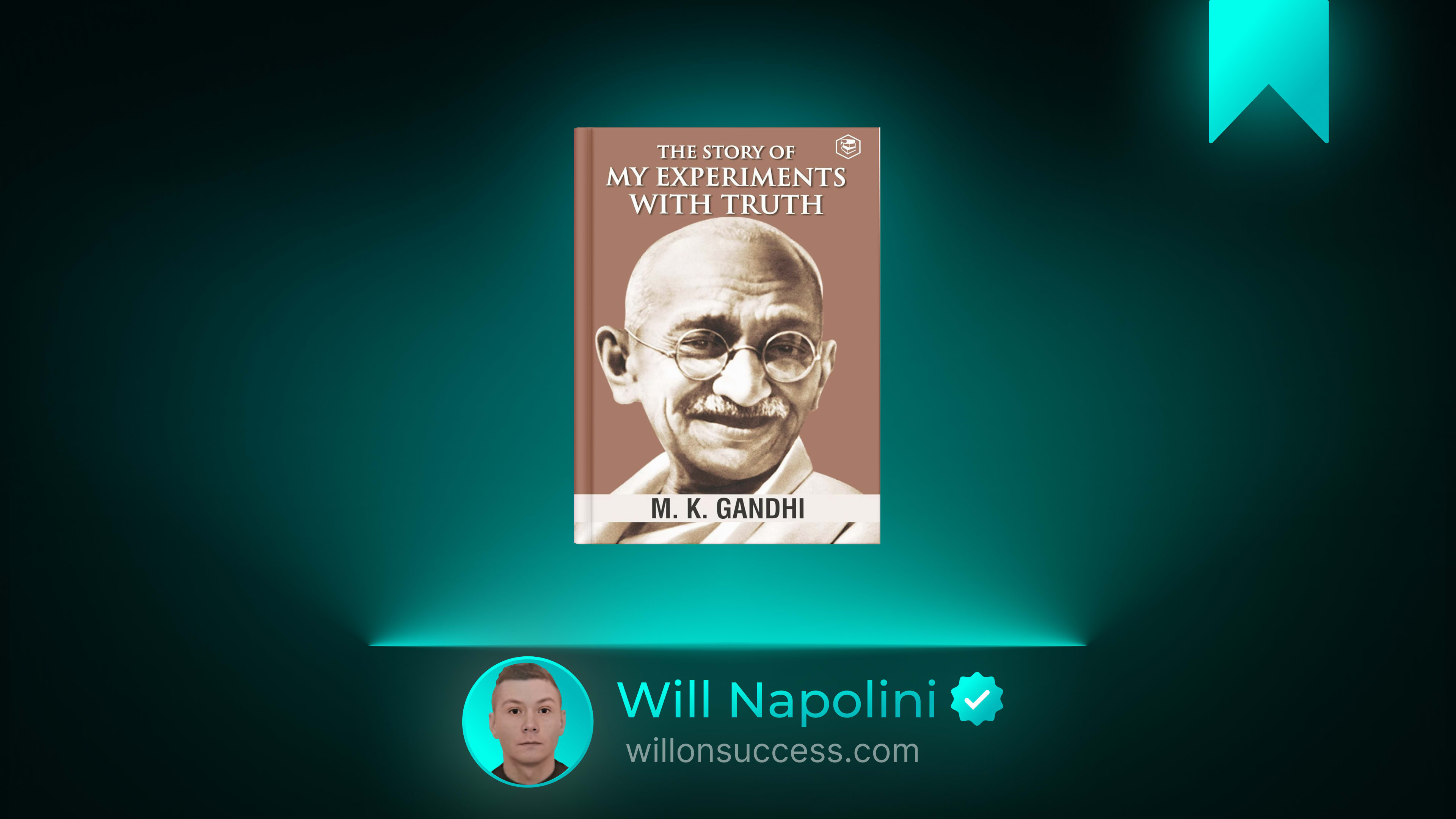
Most autobiographies are written by people who have arrived. They look back from a summit and arrange the story into a clean arc: struggle, effort, victory. The reader is meant to admire. The implied message is look what I became.
Mohandas Gandhi wrote his autobiography in the mid-1920s, in Gujarati, as weekly installments in his own journal, and he did something almost no one else in the history of the form has done. He called it experiments. Not achievements. Not lessons. Not triumphs. Experiments. And he included the failures alongside the successes, the petty jealousies alongside the moral breakthroughs, the nights he could not control his own mind alongside the days he stood before an empire and refused to move.
The implication is staggering once you sit with it. You are not writing the story of a finished person. You are keeping a laboratory notebook. Some experiments confirm the hypothesis. Some explode in your face. You write both down. You adjust. You try again tomorrow.
I have returned to this book more than once in seasons when I felt stuck, when I had convinced myself that I should by now have arrived somewhere, become someone more settled, more resolved, more done. And every time, Gandhi’s quiet, stubborn insistence pulls me back: you are not done. No one is done. The experiment continues until the last breath. And that is not a failure. That is the whole point.
The Big Idea: Truth Is Not a Destination but a Practice
The title tells you everything. Gandhi does not say he discovered truth. He does not say he mastered truth. He says he conducted experiments with truth, the way a chemist conducts experiments with a volatile element: carefully, repeatedly, with full expectation that some attempts will go wrong.
For Gandhi, truth—satya—was not a doctrine to be memorized or a belief to be defended. It was a living thing you approached through action, through self-examination, through the daily grind of aligning what you do with what you know to be right. You never fully possess it. You move toward it the way a river moves toward the sea: always approaching, never quite arriving, and the movement itself is the life.
This single reframe has the power to change how you relate to your own growth. If truth is a destination, then every mistake is evidence that you have failed. But if truth is a practice, then every mistake is data. It tells you something. It narrows the field. It is part of the experiment, not a refutation of it.
The Shape of the Book
The autobiography covers Gandhi’s life from his childhood in the small towns of Gujarat through his years studying law in London, his transformative two decades in South Africa, and his return to India up to roughly 1921. It stops well before independence, before the Salt March, before the events most people associate with his name. That is deliberate. Gandhi was less interested in narrating political history than in examining the inner life that made the political work possible.
The South Africa years form the heart of the book. A young Indian lawyer arrives in Natal in 1893, expecting to handle a legal case and return home. Instead, he is thrown off a train at Pietermaritzburg for sitting in a first-class compartment despite holding a valid ticket. He is struck, humiliated, ordered around, made to feel that his presence is an offense. And over the next twenty-one years, that humiliation becomes the crucible in which he forges satyagraha—truth-force, soul-force, the insistence on resisting injustice without inflicting it back.
But the book is not primarily a political narrative. It is a record of inner experiments. Gandhi tests his diet, removing meat, then eggs, then eventually subsisting on very little, watching how food affects his mind and his capacity for restraint. He tests celibacy, taking a vow of brahmacharya and recording, with uncomfortable honesty, how often his mind still wandered. He tests simplicity, stripping away possessions, clothing, and comfort to discover what remained when everything unnecessary was gone. He tests his own courage, his own patience, his own capacity to forgive the people who humiliated him.
And he records the results with a candor that is almost disarming. He tells you when he was petty. When he was afraid. When he treated his wife unfairly and had to reckon with it. When his vow wavered. He does not perform humility. He practices it, which means he shows you the stumbling alongside the standing.
You Do Not Need Permission to Begin the Experiment
One of the things that strikes me most about this book is that Gandhi did not wait until he was pure to begin serving others. He did not say, I will work on myself in isolation for twenty years and then, when I am sufficiently refined, I will step into the world. He stepped into the world as a flawed, uncertain young man and allowed the world to expose his flaws so that he could work on them in real time.
The train incident at Pietermaritzburg did not happen to a saint. It happened to a twenty-three-year-old lawyer who was, by his own admission, still full of timidity, still uncertain of his own convictions, still carrying the social anxieties of a young man from a modest background trying to make his way in a foreign country. The injustice found him before he was ready. And that was the point. He did not get to choose the timing. He only got to choose the response.
If you have been waiting to feel ready before you begin the thing that matters to you—the honest conversation, the new discipline, the act of service, the creative work you keep postponing—Gandhi’s life is a gentle, firm rebuttal. Readiness is not a prerequisite. It is a byproduct. You become ready by beginning, not the other way around.
Means and Ends Are Inseparable
If there is one principle Gandhi returns to with the persistence of a man who knows most people will try to find a way around it, it is this: you cannot separate the method from the outcome. The means are not merely the road to the destination. The means are the destination in embryo. You cannot build a just society through unjust methods. You cannot create peace through violence. You cannot arrive at truth through deception.
This sounds abstract until you apply it to your own Tuesday. It means you cannot build a trusting relationship through manipulation, even well-intentioned manipulation. You cannot create a calm inner life through frantic, scattered effort. You cannot earn genuine respect by performing competence you do not yet have. The shortcut that violates the principle also undermines the result.
Gandhi applied this with a rigor that most of us would find almost unbearable. He refused to exaggerate an opponent’s position to win an argument. He refused to use a dishonest tactic even when the cause was righteous. He insisted that if the method was wrong, the experiment had failed, regardless of whether it produced a superficially successful outcome.
This is not naïveté. It is the opposite. It is the recognition that every action you take is a seed, and the fruit will carry the nature of the seed. You cannot plant thistle and expect roses.
The Discipline of Honest Self-Accounting
Gandhi kept accounts. Not just financial accounts, though he kept those too, with a precision that would satisfy an auditor. He kept moral accounts. He tracked his vows. He noted when he broke them, why he broke them, what triggered the lapse. He examined his motives with a scrutiny most of us reserve for examining a suspicious invoice.
He did not do this to punish himself. He did it because he believed that self-knowledge was the foundation of all other knowledge. You cannot correct what you will not see. You cannot change a pattern you refuse to name.
There is a passage in the autobiography where Gandhi describes his struggle with anger, with the desire to retaliate when he was wronged. He does not present himself as naturally gentle. He presents himself as a man who felt the heat of rage and had to build, over years, a practice for meeting it without being consumed by it. The practice included silence. It included deliberate pauses before speaking. It included physical labor to burn off the energy of resentment. It included prayer, though he was honest that prayer sometimes felt like talking to an empty room.
What I take from this is not that I should imitate his specific practices. It is the underlying discipline: look at yourself without flinching. Not to condemn. Not to wallow. But because the experiment requires accurate data. You cannot adjust what you will not measure.
If you keep a journal, even three sentences at the end of the day, you already have the tool. The question is whether you use it honestly. Whether you write what actually happened in your inner life, or what you wish had happened. Gandhi chose the former, every time, for decades. The result was not perfection. It was clarity. And clarity, sustained over years, becomes something very close to freedom.
Simplicity Is Not Deprivation. It Is the Removal of Obstacles.
Gandhi’s experiments with simplicity—fewer possessions, simpler food, hand-spun cloth, manual labor—are often misunderstood as asceticism for its own sake. But read carefully, and his reasoning is practical. He did not believe suffering was virtuous. He believed that excess created noise. That every unnecessary possession, every unnecessary indulgence, every unnecessary complication added a layer of distraction between himself and the work he was trying to do.
He simplified not to punish the body but to free the mind. To reduce the number of decisions, the number of dependencies, the number of things that could be taken from him or used to control him. Simplicity, in his practice, was not the absence of comfort. It was the presence of focus.
You do not have to spin your own cloth or live on fruit and water. But you can ask yourself, honestly, what in your current life is noise. What you are maintaining out of habit or appearance that costs you energy and gives you nothing in return. What subscription, what obligation, what accumulation of stuff, what performance of a lifestyle you do not actually want.
Removing one thing is not deprivation. It is clearing the bench so you can see the work more clearly.
The Power of a Deliberate Vow
Gandhi took vows seriously. He believed that a vow, once made, created a structure that ordinary willpower could not. When you decide I will try to eat less sugar, the decision evaporates the moment temptation is strong. When you take a vow—I will not eat sugar for thirty days, and I will tell someone, and I will record each day—you have built a small architecture around the intention. You have made it harder to drift.
This is not about rigidity. Gandhi himself modified his vows when he discovered they were causing harm or when new understanding required adjustment. But he did not modify them casually. He treated a vow as a contract with himself, and he understood that breaking a contract with yourself is the most expensive kind of debt, because it erodes the one trust you can never fully outsource: your trust in your own word.
If there is one area of your life where you keep making soft, revocable promises to yourself and then quietly breaking them, you know the slow erosion I am describing. The vow does not have to be dramatic. It can be small. I will walk for twenty minutes every morning for thirty days. I will not check my phone for the first hour after waking. I will write down one honest sentence about how I actually feel before I go to sleep.
The size matters less than the keeping. Each kept vow is a brick in the foundation of self-trust. Each broken one removes a brick. And self-trust, once gone, is the hardest structure to rebuild.
Service Requires Self-Purification, but Self-Purification Requires Service
Here is a paradox Gandhi lived inside without trying to resolve it into a neat formula. He believed you could not serve others effectively while you were still governed by your own unexamined appetites, angers, and fears. Service without self-knowledge becomes projection. You end up helping people in the shape of your own needs rather than theirs.
But he also believed you could not purify yourself in isolation. The self reveals itself in contact with others. You discover your impatience in the queue, your pride in the disagreement, your cowardice in the moment that requires speaking up. The world is the laboratory. You cannot run the experiment in a sealed room.
So the two practices—inner work and outer service—feed each other in a cycle. You examine yourself, you serve, the service exposes new layers, you examine again, you serve with slightly more clarity. The cycle does not end. You do not graduate from it. You deepen within it.
Who Should Read This Book
This autobiography will reward anyone in a season of honest self-reckoning. If you are questioning your direction, rebuilding after a failure, trying to align your daily life with values you have only vaguely articulated, Gandhi’s patient, meticulous record of a man trying to close the gap between what he knows and what he does will feel like company.
It will especially help readers who are drawn to the idea of principled action but struggle with the daily discipline of living those principles. Gandhi does not make it look easy. He makes it look possible, which is different and more useful.
A fair warning: the prose, particularly in Mahadev Desai’s English translation, is plain, unhurried, and sometimes repetitive. Gandhi is not a stylist. He is a man thinking aloud on paper. If you need narrative momentum and lyrical language to stay engaged, the middle sections on diet and communal living may test your patience. I would encourage you to stay with them, because the patience they demand is part of the teaching. But I will not pretend the book reads like a novel.
It is also worth acknowledging that Gandhi is a complex historical figure, and not every reader will find every aspect of his personal choices or social views comfortable. The autobiography is his own account, told from his own perspective, and it does not resolve all the questions his life raises. Read it as one person’s honest attempt to examine himself, not as a final word on any subject.
One Small Step You Can Take Today
You do not need to overhaul your life tonight. You do not need to take a vow of silence or give away your possessions or move to a communal farm. Gandhi’s whole point is that the experiment begins small, specific, and honest.
So here is what I would invite you to do.
Tonight, before you sleep, take a sheet of paper or open a blank note on your phone. Write three sentences.
The first: one thing you did today that was aligned with the person you are trying to become.
The second: one thing you did today that was not. Do not explain it away. Do not justify it. Just name it, the way Gandhi named his own lapses, plainly and without drama.
The third: one small adjustment you will try tomorrow. Not a revolution. One adjustment. One variable changed in the experiment.
Then close the notebook. Go to sleep. Tomorrow, you run the experiment again.
That is all. That is the whole method. You do not have to arrive. You only have to keep testing, keep recording, keep adjusting, keep turning toward the truth of your own life with the stubborn, tender honesty of a man who spent fifty years doing exactly that and never once claimed he had finished.
The experiment is not a performance for an audience. It is a conversation you are having with yourself, in ink, in the quiet, in the small hours when no one else is watching. And the most remarkable thing about it, the thing Gandhi understood better than almost anyone, is this: the conversation never ends. You are not building toward a final draft. You are building toward a deeper honesty, and deeper honesty always reveals another layer beneath it.
You are not behind. You are not finished. You are in the middle of the experiment, and the middle is where all the real work happens.
Pick up the pen. Write the next entry. See what tomorrow teaches you.