The Shadow of the Wind: What a Barcelona Gothic Novel Reveals About Choosing Your Story and Refusing to Forget
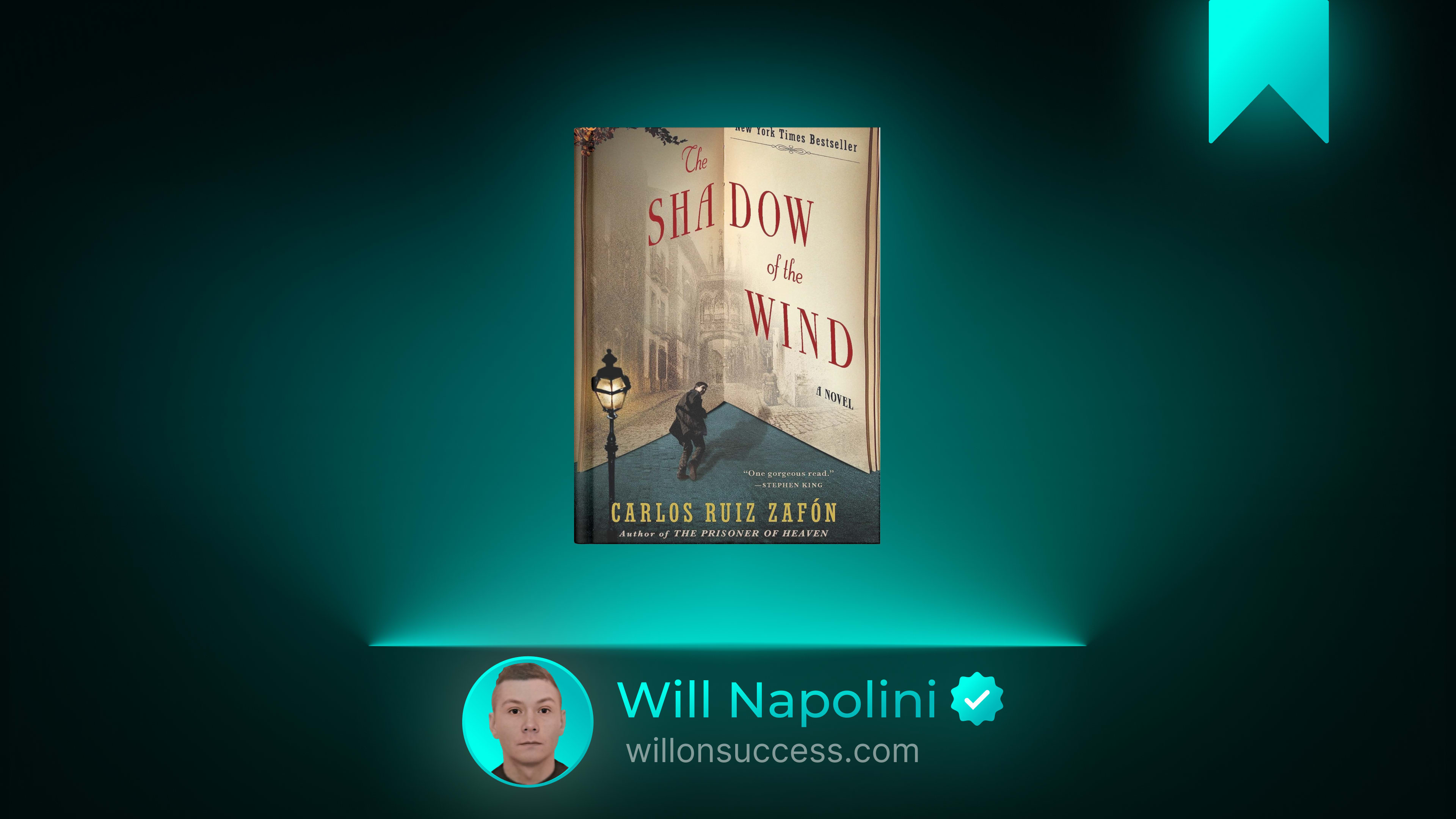
Imagine a father taking his son by the hand, walking him through the dim streets of a city still nursing its war wounds, down alleys that smell of rain and old paper, until they reach a door that should not exist. Behind it: a labyrinth of forgotten books, thousands upon thousands of them, waiting in the dark for someone to remember they are alive.
The rule is simple. You choose one. You take it home. You swear to protect it from oblivion.
That is the opening image of Carlos Ruiz Zafón’s The Shadow of the Wind, and I have thought about it more times than I can count. Not because it is a beautiful scene, though it is. But because it contains, in miniature, the most honest description I have ever encountered of how a human life actually gets built.
You reach into the unknown. Something grabs you. You commit. And then you spend years discovering what that commitment actually means.
The Big Idea: You Are the Story You Refuse to Let Die
Zafón wrote a novel about a boy who finds a book, but what he was really writing about is the architecture of identity. The central argument, if a novel can be said to argue, is this: the stories we choose to carry do not merely entertain us. They become the scaffolding of who we are. They shape our questions, our obsessions, our loves, our blindnesses. And the stories we allow to be forgotten, the ones we let burn or bury or simply stop telling, take pieces of us with them when they go.
This matters because most of us move through life as though our identity were a fixed object we inherited at birth. Zafón suggests something more unsettling and more freeing: you are, in large part, the narrative you have chosen to protect. And you can choose differently.
The Story: A Boy, a Book, and a Decade of Shadows
Barcelona, 1945. The Civil War has ended, but its silence is everywhere, pressed into the spaces between conversations, into the empty chairs at family tables, into the things no one says aloud. Young Daniel Sempere cannot sleep. His mother is gone. His father, a bookshop owner with gentle hands and a quiet grief, decides it is time.
He takes Daniel to the Cemetery of Forgotten Books.
There, among spiraling staircases and towers of neglected volumes, Daniel pulls a novel from a shelf: The Shadow of the Wind, by Julián Carax. He reads it that night and feels something shift inside him, the way a key turns in a lock you did not know existed.
Then he searches for another Carax novel and discovers a disturbing truth. Someone has been hunting down every copy of every book Carax ever wrote. Burning them. Erasing the man from the world, one page at a time. The figure responsible calls himself Laín Coubert, a name taken from the devil in Carax’s own fiction, as though a character has crawled off the page to destroy his creator.
What follows spans roughly a decade. Daniel grows from a grieving child into a young man, and his pursuit of Carax’s story becomes the lens through which he understands everything else: love, friendship, courage, the weight of secrets, the price of silence. He is joined by Fermín Romero de Torres, a homeless man with a philosopher’s mind and a past he has buried so deep he flinches when it is touched. Together they unravel a history of passion, betrayal, and cruelty that stretches back decades, involving a penitentiary, a wealthy family, a forbidden love, and a police inspector named Fumero who represents what happens when power strips away every trace of conscience.
The deeper Daniel digs, the more he realizes that Carax’s life and his own are not merely parallel. They are braided. The choices Carax made are the choices Daniel is being invited to make, or to refuse.
Zafón constructs this like a cathedral built from fog and lamplight. Every corridor opens onto another. Every answer breeds three new questions. Barcelona itself becomes a character, all Gothic spires and hidden courtyards, rain-slicked streets and whispered histories, a city that remembers what its people are trying to forget.
The Cemetery of Forgotten Books Is a Mirror
I want to sit with that opening image for a moment, because I think it holds more practical wisdom than most self-help books manage in three hundred pages.
The Cemetery is not a library. A library organizes. A library makes everything findable. The Cemetery is something stranger: it is a place where things go to wait for someone who needs them specifically. The books do not arrange themselves by genre or author. They arrange themselves, the novel implies, by the reader who will eventually come looking.
Daniel does not choose Carax’s book through logic. He does not compare reviews or check a reading list. He wanders. He lets himself be drawn. Something in the title reaches for him, and he reaches back.
I have watched this pattern in my own life and in the lives of people I care about. A career begins not with a five-year plan but with one strange, unexplainable pull. A friendship forms because one sentence in a conversation lands differently than it should. A direction reveals itself not through analysis but through a kind of resonance, a feeling of yes, this, I do not yet know why but I will find out.
The wisdom here is not “follow your passion,” which is advice so vague it borders on useless. The wisdom is more specific: pay attention to what pulls at you before you understand it. Then commit. Then let the commitment teach you what the pull meant.
A small decision becomes a direction, and a direction, held long enough, becomes the shape of a life.
What You Allow to Be Forgotten Shapes You as Much as What You Remember
The villain of this novel is not a person. The villain is erasure. Laín Coubert does not merely kill Carax’s body. He burns the books. He removes the evidence that Carax ever existed, ever thought, ever loved, ever mattered. He makes the world forget.
And Zafón makes you feel the violence of that. Because forgetting is not neutral. Forgetting is a choice with consequences. When a story is erased, the people inside it lose their witnesses. Their suffering becomes invisible. Their love becomes as though it never happened. Their mistakes stop teaching anyone anything.
I think about this in terms that go beyond literature. What stories have you quietly burned in your own life? What chapter of your history do you refuse to revisit because revisiting it hurts? What relationship, what failure, what version of yourself have you decided is easier to forget than to face?
I am not suggesting you should reopen every wound. Some doors, once closed, are best left closed, and Zafón’s novel is dark enough to acknowledge that some truths carry a real cost. But there is a difference between choosing to leave a painful memory at rest and systematically destroying it so that you never have to acknowledge it existed. The first is peace. The second is a slow disappearing.
What you refuse to remember does not vanish. It goes underground. And underground things grow in the dark, and they grow without your seeing them, and by the time they surface you no longer recognize them as yours.
Fermín and the Courage to Tell the Truth About Who You Were
Among the novel’s many characters, Fermín Romero de Torres might carry the most quietly important lesson. Fermín arrives as a homeless man, brilliant and funny and evasive, spinning elaborate stories about his past while concealing the actual truth. He has survived a prison, survived torture, survived the erasure of his identity by a regime that wanted him to simply stop existing. And he has responded by building a new self out of humor, wordplay, and carefully maintained distance.
What Daniel’s friendship slowly does for Fermín is not fix him. It gives him a reason to let one person see the version of his story that is not performance. It gives him a witness.
And that, I have learned, is what truth-telling actually requires. Not an audience. Not validation. One person who will sit with you while you say the thing you have been carrying alone.
Fermín’s arc reminds me that reinvention is possible. You can build a new life after the old one has been damaged or taken. But reinvention without acknowledgment of what came before is not freedom. It is just a more elaborate hiding. The bravest thing Fermín does in the entire novel is not survive prison. It is, eventually, tell a friend what happened to him there, in plain words, without a joke to soften the blow.
If there is a chapter of your own story you have been narrating with a joke or a deflection every time it comes up, you know what I mean. You do not have to tell it to everyone. But you may need to tell it to one person, in one honest conversation, before you can fully set it down.
The Parallel Lives: You Are Not the First to Face This Choice
One of the novel’s most powerful structural choices is the way Daniel’s life mirrors Carax’s. Both fall in love with a woman they feel they should not love. Both must decide whether to pursue truth at the cost of safety. Both face the temptation to let someone else’s version of events become the official record.
Zafón is not being clever here. He is showing you something true about how the past educates the present. We are rarely the first person to face our particular dilemma. Someone has stood in a similar place, made a choice, lived with the consequences. Their story, if we are willing to read it, becomes a map. Not a command. A map. It shows you the terrain. You still choose which path to walk.
This is why reading matters. Not because books give you answers, but because they show you that your question has been asked before, and that someone, somewhere, sat with it long enough to write down what they found. You are less alone than you think. You have been less alone than you think for a long time.
What This Looks Like on an Ordinary Tuesday
You are not going to wander into a hidden library and pull a cursed novel from a shelf. Probably. But the principles underneath Zafón’s story apply to the small, unglamorous architecture of a normal week.
It looks like noticing which story you keep telling yourself about why you cannot start the thing you want to start. The one where you say you are not ready, not qualified, not enough. That story is a book someone else wrote about you. You are allowed to choose a different one.
It looks like asking yourself, honestly, what you have been letting burn. A friendship you stopped tending. A creative impulse you laughed off. A truth about your own history that you have decided is too heavy to carry, so you set it down and walked away and pretended your hands were never full.
It looks like choosing one book, one conversation, one question, one pursuit, and saying: I will not let this be forgotten. I will carry this forward, even when it is inconvenient, even when I do not fully understand why it matters yet.
You do not need to understand the whole journey before you take the first step. Daniel did not know, pulling that novel from the shelf, that he was stepping into a decade of mystery, danger, love, and self-discovery. He only knew that something in the title reached for him.
That is enough. That has always been enough.
Who Should Read This Book, and Who Might Not
If you love stories that braid mystery with emotion, if you find yourself drawn to books about books, if Barcelona in the rain sounds like a place you could lose yourself for a week, this novel will hold you. It is for readers who want a plot that moves but also want sentences that make them stop mid-page and stare at the wall for a while.
It will especially resonate if you are in a season of trying to understand your own history, if you are building a new identity out of the pieces of an old one, if you suspect that the stories you have been telling yourself about who you are might need revision.
It may not be for you if you prefer lean, fast-moving prose with minimal description. Zafón luxuriates in atmosphere. His Barcelona is dense, sensory, almost hallucinatory. If you want a thriller that gets in and out, this will feel slow in places. The pacing builds gradually, like fog rolling in off the sea. You have to let it accumulate.
And a gentle caution: the novel deals with cruelty, imprisonment, and loss with unflinching honesty. It is ultimately a story about love and survival, but the road there passes through genuinely dark country.
One Small Step You Can Take Today
Here is what I would invite you to do, and it is small, and it is doable, and it connects directly to what Zafón is teaching.
Tonight, or tomorrow morning, take five minutes. Sit somewhere quiet. And ask yourself this question: What is one story, one memory, one ambition, one relationship, or one truth about myself that I have been quietly letting disappear?
You do not have to fix it. You do not have to act on it today. You only have to name it. To say it aloud, even just to yourself, so that it stops being a ghost and becomes a thing with a name.
Then decide, gently, whether you are going to let it go or carry it forward. Both are valid choices. But make it a choice, not an accident. Make it a decision you walk toward, not a book you let someone else pull off the shelf and burn while you are looking the other way.
Zafón’s novel believes, fiercely and without apology, that stories matter. That the things we read, remember, protect, and pass along are not ornaments on the surface of life. They are the structure underneath it.
You are, right now, living inside a story. The only question is whether you are the one holding the pen.
Pick up the book you have been meaning to open. Tell the truth you have been meaning to tell. Choose the direction that pulls at you before you can explain why.
The Cemetery of Forgotten Books is waiting. And somewhere in its labyrinth, there is a volume with your name on it, patient as stone, holding its breath until you finally walk down the aisle and reach for it.