The Giver: Why a Life Without Pain Is a Life You Should Not Want
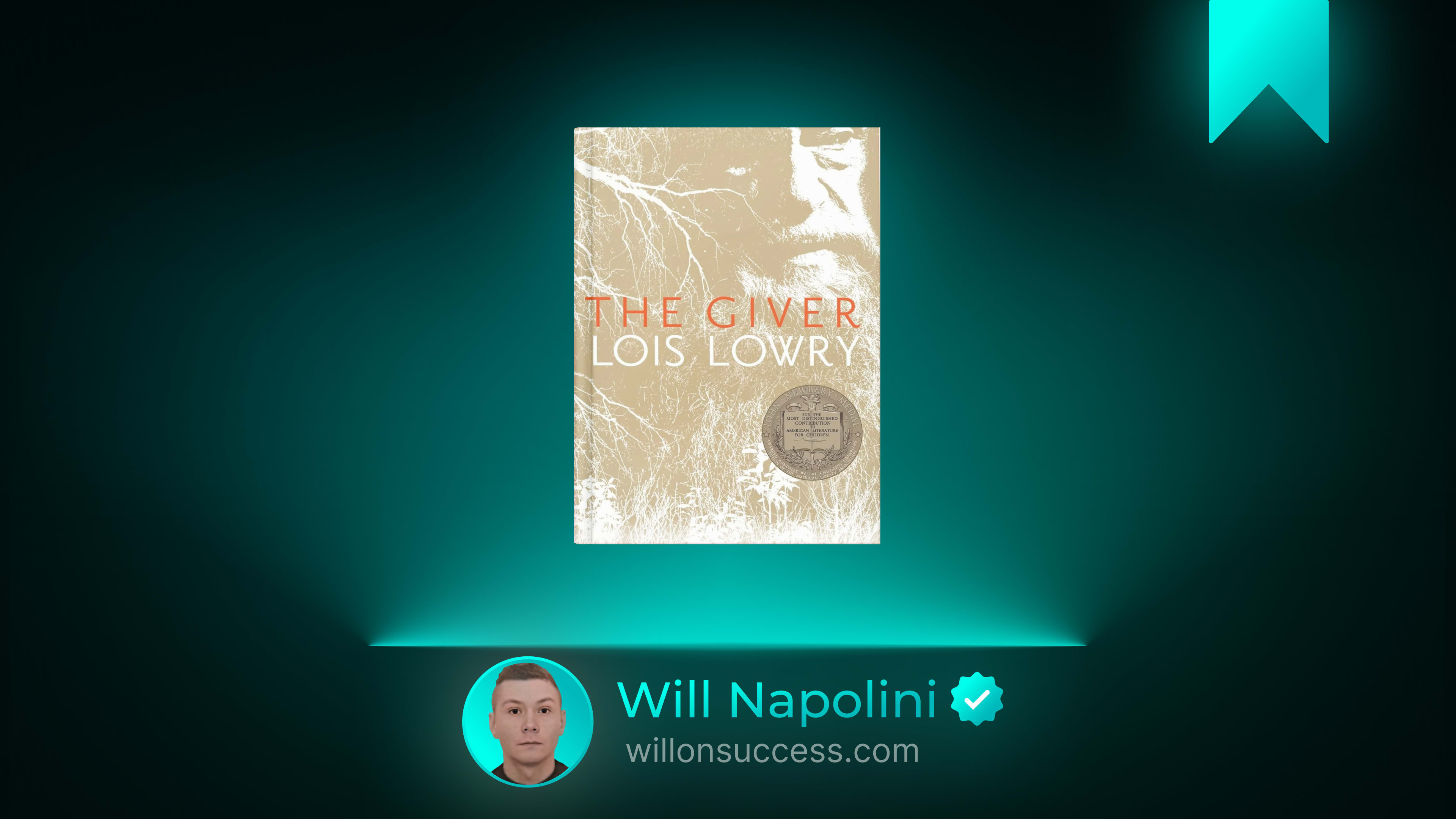
I want you to imagine something for a moment.
Imagine a life with no heartbreak. No grief. No uncertainty about whether you chose correctly. No sharp sting of failure, no restless nights wondering if you matter, no awkward fumbling toward love with no guarantee it will be returned. Imagine weather that never surprises you. Colors you never have to choose between. A role assigned to you at twelve years old that fits neatly into a system where everyone is provided for, everyone is polite, and no one ever has to suffer.
It sounds, if you are honest, almost like relief.
Now imagine the price. To get that relief, you surrender memory. You surrender the ability to see color, to feel the sun on your skin as anything more than temperature, to love someone so completely that losing them would devastate you. You surrender the right to choose your own work, your own partner, your own path. You surrender the past—every war, every symphony, every act of cruelty and every act of grace that made the world what it was. You surrender depth. You surrender texture. You surrender the full spectrum of being alive.
And you never notice the surrender, because no one in your world remembers what was taken.
That is the world Lois Lowry built in The Giver. And it is one of the most quietly terrifying books I have ever encountered, precisely because the trade it describes is one so many of us are making in smaller ways every single day.
The Big Idea: Comfort Without Depth Is Not Peace—It Is Numbness
Lowry’s novel is set in a community that calls itself ideal. There is no war. No hunger. No cruelty that anyone can name. Every citizen is assigned a family unit, a dwelling, a job. Language is regulated. Emotions are monitored. Children are raised by assigned parents according to precise rules. The elderly are cared for and then “released” with ceremony. Everything is orderly. Everything is safe.
And everything is flat.
The community achieved this by implementing what it calls Sameness. They eliminated weather variation, color, terrain, and—most critically—memory. The collective past, with all its beauty and all its horror, is held by one person: the Receiver of Memory. Everyone else lives in a perpetual, pleasant present, untroubled by history because they simply do not have access to it.
The novel’s central argument is this: a life without pain is not a life of peace. It is a life of absence. And the absence is not limited to suffering. When you remove the capacity for deep sorrow, you also remove the capacity for deep joy. When you eliminate the risk of loss, you eliminate the possibility of love. When you flatten the landscape of human experience into a smooth, predictable plain, you do not get happiness. You get existence without living.
That idea struck me with a force I did not expect, and it has stayed with me for years. Because I recognize the impulse. I recognize the desire to smooth everything down. To avoid the difficult conversation, the uncertain path, the emotional risk. To choose the comfortable option not because it is good but because it does not hurt.
Lowry does not condemn that impulse. She understands it. But she asks, with tremendous gentleness and tremendous firmness: What are you becoming in the process of making sure nothing ever touches you?
Jonas and the Weight of Memory
The story belongs to Jonas, an eleven-year-old boy on the eve of his twelfth birthday, when every child in the community receives their lifelong assignment. Most children get predictable roles—Nurturer, Laborer, Instructor. Jonas receives something no one expected. He is selected to be the next Receiver of Memory.
His trainer is the current Receiver, an old man the community calls the Giver. And what the Giver does is transfer memories—real, sensory, emotional memories of the world before Sameness—into Jonas’s mind.
The first memories are gentle. Snow. A sled. Sunshine. The color red. Jonas is astonished. He did not know the world could contain these things. He did not know he had been living in a world drained of them.
Then the memories grow heavier. War. Hunger. Loneliness. A boy dying on a battlefield, calling for water. The Giver does not protect Jonas from these. He cannot. The whole point of the role is to hold the full truth of human experience so that the community’s leaders can, theoretically, draw on wisdom when making decisions. But the community stopped consulting long ago. The memories are simply warehoused in one person’s suffering so that everyone else can remain comfortable.
Jonas begins to see his world differently. He sees the politeness for what it is: not kindness but the absence of feeling deep enough to be either kind or cruel. He sees the assignments for what they are: not purpose but the elimination of choice. He sees “release” for what it truly is—not a gentle departure but the killing of those who are inconvenient, including infants who do not develop quickly enough.
And he cannot unsee it. That is the point. Once you have truly seen, you cannot return to the comfortable blindness. And that is where the real courage begins.
The Quiet Violence of a World Without Choice
One of the novel’s most unsettling features is that the community is not run by a tyrant. There is no dictator barking orders. There is no secret police dragging people from their beds. The control is woven into language, into routine, into the gentle, smiling enforcement of rules that no one remembers choosing.
Children are corrected for imprecise language. Feelings are shared each morning in a ritual that reduces them to manageable, nameable units. No one locks their doors because no one has been taught to want anything that belongs to another person. It is not oppression through force. It is oppression through the slow, patient removal of everything that would make you want more.
I think about how this shows up in smaller forms in the lives I observe. The person who has not made a real choice in years—who drifts through a career they fell into, a routine they inherited, relationships they maintain because the alternative would require deciding what they actually want. The life that is comfortable and functional and faintly gray, where nothing is wrong exactly, but nothing is alive either.
No one forced that life on them. They simply stopped choosing. And each small surrender of choice made the next one easier to skip, until one day they looked up and realized they could not remember the last time they wanted something badly enough to risk discomfort for it.
Choice is not a burden, even though it often feels like one. Choice is the mechanism by which you become a particular person rather than a generic one. Every time you choose—truly choose, with uncertainty and risk and no guarantee of the outcome—you are asserting that your life is yours to shape. And that assertion is the foundation of everything meaningful.
Pain Is the Price of Admission to a Full Life
The Giver tells Jonas that his role is to suffer so that others do not have to. And Jonas, as he receives memory after memory of human agony, begins to understand the terrible arithmetic: the community’s peace is purchased with one person’s unending pain, and the transaction is invisible to everyone except the two people in the room.
But the novel pushes further than that. It suggests that the pain is not merely a price paid for someone else’s comfort. The pain is the point. Not because suffering is good—it is not. But because the capacity to suffer is inseparable from the capacity to love, to create, to be moved, to be changed.
You cannot selectively numb. That is what the community learned, though they learned it so long ago they forgot they learned it. When you flatten grief, you flatten joy. When you eliminate the risk of loss, you eliminate the depth of attachment. When you make everything safe, predictable, and regulated, you do not get a life of contentment. You get a life of mild, pleasant nothing.
I have watched people try to engineer the pain out of their lives. They avoid difficult conversations. They stay in situations that are merely tolerable rather than risking the uncertainty of change. They numb discomfort with distraction, with busyness, with the soft glow of a screen that asks nothing of them. And I understand the impulse. Pain is not pleasant. Grief is not pleasant. Uncertainty is not pleasant.
But here is what I have come to believe: the goal of a life is not to minimize discomfort. The goal is to be fully present inside your own experience, including the parts that ache. Because the ache is where the meaning lives. The grief is the proof that the love was real. The uncertainty is the proof that you are still choosing, still growing, still reaching toward something you cannot yet see.
A life without pain is not a life protected. It is a life unlived.
The Courage to Feel in a World That Rewards Numbness
Jonas’s journey is, at its core, a journey into feeling. Every memory the Giver transfers is an act of emotional exposure. Jonas must feel the sunburn, the sledding joy, the battlefield terror, the quiet tenderness of a family at holiday. He must feel it all, in his own body, with no preparation and no anesthesia.
And the community around him continues its pleasant, regulated routine, unaware that he is being torn open and remade.
There is something in this that I find deeply relevant to the way many of us live now. We exist in a culture that rewards efficiency, composure, and the appearance of having everything handled. Vulnerability is tolerated as a concept but often punished in practice. The person who cries in a meeting, who admits they are struggling, who says I do not know and I am afraid—that person is often quietly moved aside. Not with cruelty. With the same gentle, smiling efficiency Lowry’s community uses.
And so people learn to flatten themselves. To perform steadiness. To keep their grief and their wonder and their confusion private, manageable, contained. To be fine.
The novel asks what is lost when an entire culture agrees to be fine. And the answer, I think, is everything that makes us specific. Everything that makes us capable of recognizing another person’s pain. Everything that makes art, and love, and moral courage possible.
You do not have to perform your feelings for anyone. But you do owe it to yourself to have them. To let them move through you. To grieve when you have lost something. To be uncertain when you do not know the answer. To feel the full weight of your life rather than skimming the surface and calling it enough.
Who Should Read This Book
The Giver is a short novel—fewer than two hundred pages—and it is written in language simple enough for a young teenager. Do not let that mislead you. The simplicity is deliberate. Lowry strips the prose down the way the community strips the world down, and the effect is quietly devastating.
This book is for anyone who has ever felt that their life is comfortable but somehow hollow. For anyone who has noticed a slow, gentle numbing creeping in and cannot quite name what is missing. For anyone who suspects that the safety they have built might also be a cage.
It is also, honestly, a book for people who work inside systems—schools, corporations, institutions—and who sense that the system’s smoothness is maintained by quietly removing the things that make individuals fully themselves.
If you are looking for a complex, sprawling epic, this is not it. The world-building is spare. The plot moves with quiet inevitability rather than explosive twists. Some readers want more, want louder drama, want the dystopia to be more visibly violent. Lowry’s horror is quieter than that. It is the horror of a world where nothing is wrong and everything is missing.
One Small Step
Here is what I would invite you to do today.
Think of one small discomfort you have been avoiding. Not a crisis. Not a trauma. A small one. The phone call you keep not making. The honest conversation you keep softening. The creative project you keep postponing because it might not be good. The feeling you keep pushing down because sitting with it would be unpleasant.
Choose one. Just one. And instead of smoothing it over today, step toward it. Make the call. Say the honest sentence. Open the notebook. Sit quietly for five minutes and let yourself feel the thing you have been managing around.
You do not have to solve it. You do not have to fix the whole pattern today. You just have to refuse, once, to flatten yourself for the sake of comfort.
Because here is what Lowry understood, and what I want to leave you with:
You were not made for a life without weather. You were made for the storm and the clearing after it. You were made for the sled at the top of the hill and the cold air in your lungs and the not-knowing whether you will reach the bottom safely. You were made for color, and risk, and the terrible beautiful weight of remembering.
Do not trade your full life for a safe one. The safe one is smaller than you. And you were not built small.
The memories are yours. All of them. Even the ones that ache.
Feel them. They are how you know you are alive.