The Girl with the Dragon Tattoo: What a Dark Thriller Teaches Us About Truth, Resilience, and the Courage to Look
There is a question that haunts every generation, every family, every institution, and—if we are honest—every individual life: What are you willing to look at, and what do you quietly decide not to see?
I want to talk to you about a novel that asks that question on nearly every page. Not gently. Not politely. It grabs you by the collar and says, Look. Look at what is right here. Look at what everyone agreed to ignore.
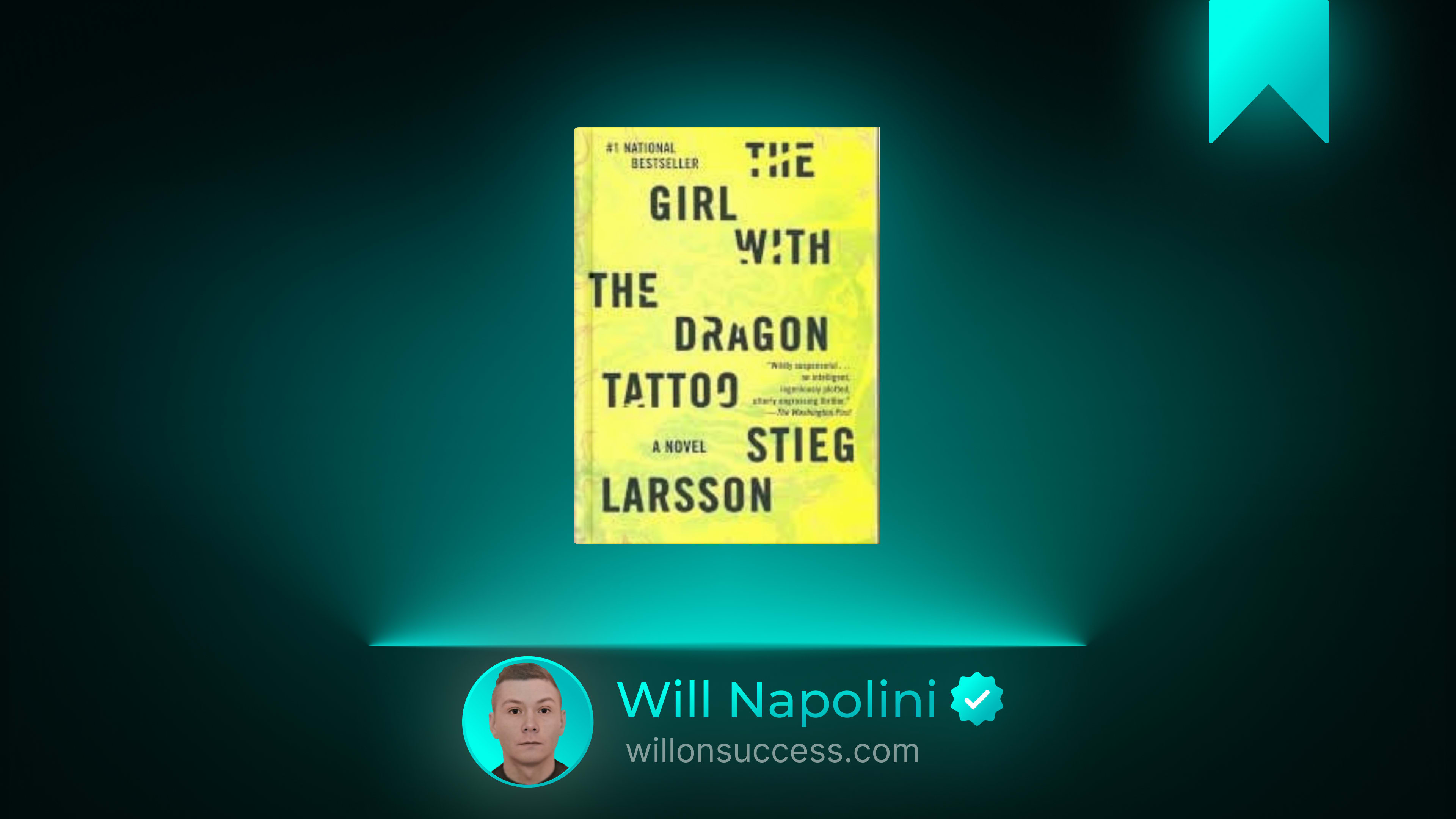
The book is Stieg Larsson’s The Girl with the Dragon Tattoo. On the surface, it is a thriller—a disgraced journalist and a brilliant, damaged young woman unravel a decades-old disappearance in a wealthy Swedish family. But underneath the mystery, underneath the suspense and the darkness, Larsson built something that has stayed with me long after the last page. He built a story about the cost of silence. About the strange, stubborn resilience of people the world writes off. About what integrity actually looks like when it is expensive.
If you have ever wondered whether speaking the truth is worth the price it demands, this book will sit with you for a long time.
The Big Idea: Truth Does Not Expire
The central engine of the novel is a forty-year-old secret. Henrik Vanger, an aging industrialist, hires journalist Mikael Blomkvist to investigate the disappearance of his niece Harriet, who vanished from a small island in 1966. Four decades have passed. The police stopped looking. The family moved on—or pretended to. Everyone agreed, without quite saying so, that the truth had a shelf life. That after enough years, you are allowed to stop asking.
Larsson’s answer is a firm, quiet no.
The truth does not expire. Injustice does not dissolve because enough calendar pages have turned. What was buried does not become harmless simply because the people who buried it grew old and comfortable.
This matters beyond the plot. Think about your own life. Think about the conversations you postponed. The boundary you never enforced. The thing you saw at work, in a relationship, in your own habits, and decided to file under I will deal with that later—a later that quietly became never. Larsson understood that unresolved truth does not stay still. It ferments. It shapes everything around it. It poisons the ground.
The novel argues, with considerable force, that the bravest thing a person can do is look directly at what others have agreed to forget.
Two Unlikely Seekers of Truth
Before I draw out the lessons, let me make sure you understand the two people at the heart of this story, because who they are matters as much as what they do.
Mikael Blomkvist is a journalist who has just been convicted of libel after publishing an exposé on a powerful businessman. His reputation is in tatters. He is principled, sometimes naive, and stubbornly committed to the idea that the truth should be printed even when it ruins you. He is not a superhero. He is a man trying to hold onto his integrity while the ground shifts beneath him.
Lisbeth Salander is something else entirely. She is a young woman the system has failed repeatedly—a ward of the state, labeled incompetent, surveilled, controlled, and abused by the very people appointed to protect her. She is also a researcher and hacker of extraordinary ability. She is small, fierce, deeply guarded, and utterly unwilling to perform the version of herself that would make other people comfortable. Society looks at her and sees a problem. The novel asks you to look again.
Together, they are an unlikely pair. He brings the journalist’s instinct for evidence and narrative. She brings the survivor’s refusal to be fooled by polished surfaces. Neither fits neatly into the role society assigned them. And that, I think, is precisely why they are the ones who can see what everyone else missed.
The Cost of Looking Away
One of the novel’s most disturbing truths is not about the crimes themselves. It is about the silence surrounding them.
People knew. Family members suspected. Neighbors noticed. Colleagues looked the other way. And each person who turned their gaze elsewhere did not think of themselves as complicit. They thought of themselves as reasonable. As not wanting to make a scene. As minding their own business.
Larsson does not let the reader off the hook for that kind of quiet retreat. He shows, again and again, that evil rarely announces itself with a trumpet. It arrives wrapped in normalcy. It hides behind a family name, a company logo, a polite smile at dinner. And it survives because good people decide, in small private moments, that looking too closely would be inconvenient.
I have seen this pattern in smaller, quieter forms in ordinary life. The colleague who notices something wrong in a meeting and says nothing. The friend who senses that another friend is struggling and sends a text instead of making the phone call. The person who knows, deep down, that a habit is destroying them but keeps saying Monday. I will start Monday.
Looking away is not neutral. It is a choice. And every time you make it, the thing you refused to see grows a little stronger in the dark.
What would change in your life if you stopped granting comfortable things the benefit of your silence?
Resilience Is Not the Absence of Damage
Lisbeth Salander is not a character who has been untouched by the world. She has been broken in ways that most people cannot imagine. And Larsson does not pretend otherwise. He does not hand her a tidy redemption arc where the wounds simply close.
What he gives her instead is something more honest and more remarkable: the refusal to let what was done to her become the final word on who she is.
She is scarred. She is angry. She trusts almost no one. And she is also brilliant, resourceful, fiercely protective of the people she decides to protect, and utterly unwilling to be a victim in the way the world expects. She does not forgive neatly. She does not perform healing for an audience. She simply continues, on her own terms, with her own rules.
Here is what I have learned from watching characters like Salander, and from watching real people walk through their own versions of what she endured: resilience is not the absence of damage. It is not bouncing back to exactly who you were before. It is the decision—made again and again, sometimes hourly—that your story does not end at the worst thing that happened to you.
You do not owe anyone a polished recovery. You do not owe anyone a timeline. But you do owe yourself the refusal to let the wound be the whole architecture of your life.
You can be marked by something and still be the author of what comes next.
Integrity When It Costs You Something
Blomkvist’s libel conviction is not a minor plot point. It is the moral spine of his character. He published a story he believed was true, about a man with enough power and money to crush him. He lost. His reputation took a serious hit. His magazine, Millennium, suffered. And yet the novel makes clear that he would do it again. Not because he is reckless. Because he decided, somewhere deep in his bones, that a journalist who only publishes safe truths is not a journalist.
This is the kind of integrity that is easy to admire in a character and very difficult to practice on an ordinary Tuesday when your boss asks you to soften a report, when a friend asks you to pretend you did not notice something, when the easiest path forward requires you to quietly edit the truth into something more palatable.
Integrity is not a grand gesture made once under bright lights. It is a thousand small refusals to bend what is true into what is convenient. And it is almost never free.
The question the novel poses is not Are you honest? Most people will say yes. The question is Are you honest when honesty costs you something you want?
The Strength of Not Fitting the Mold
Both Blomkvist and Salander are, in their different ways, people who do not fit cleanly into the boxes around them. He is a journalist in a world that increasingly rewards speed over depth. She is a woman in a world that wants her compliant, grateful, and small.
And yet it is precisely their refusal to fit that makes them capable of seeing what everyone else missed. The people inside the system, comfortable within it, cannot question it. They have too much invested in its story being the right one.
I think about this often. The person in the meeting who asks the question nobody else wants to ask. The friend who says, Actually, I think we are going the wrong direction, when everyone else has already nodded. The young person who looks at the career path laid out for them and says, That is not mine.
Not fitting the mold is uncomfortable. It is lonely, sometimes. But it is also where clear sight lives. If you have ever felt like the odd one out, the one who could not simply go along, I want you to hear me: that discomfort is not evidence that you are broken. It may be evidence that you are seeing something the room has decided not to see.
Who Should Read This Book
If you are drawn to tightly plotted mysteries with morally complex characters, this novel will hold you. If you care about stories that take institutional failure, the abuse of power, and the resilience of survivors seriously—without turning them into tidy fables—this is your book.
It is not a light read. Larsson does not flinch from darkness, and some scenes, particularly those involving violence against women, are difficult and confrontational. If you are in a season of life where you need gentleness, this may not be the right moment. There is no shame in setting a book down and returning to it later, or not at all.
But if you can handle the weight of it, the payoff is significant. You will finish this novel thinking differently about what silence costs, what courage looks like when it is unglamorous, and what it means to decide that the truth matters more than your comfort.
One honest caveat: the novel is long, and the first section moves deliberately. Larsson is building a foundation. Trust the pace. The architecture reveals itself.
What This Looks Like on an Ordinary Tuesday
Let me bring this out of the novel and into your week.
You do not need to solve a forty-year-old disappearance to practice what this book teaches. The principles are the same, scaled to your life.
Notice what you are avoiding. Is there a conversation you have been postponing for months? A financial truth you have been not quite looking at? A habit you keep describing as temporary that has quietly become structural? You do not have to solve it today. But you can stop pretending you do not see it. Name it. Write it down. Say it out loud to yourself. The act of naming breaks the spell of comfortable silence.
Ask what your silence is protecting. Often we avoid a truth not because it is too painful but because facing it would require us to change something, and we are not ready. That is understandable. But at least be honest about the reason. I am not looking at this because I am afraid of what I would have to do about it is a more useful starting point than I will deal with it later.
Honor the people who do not fit. Think about someone in your life—perhaps yourself—who does not conform to expectations. Who is too intense, too quiet, too different, too much. This novel is a long argument that those people often see most clearly. Give them—and yourself—the benefit of that possibility.
Do one honest thing that costs you something. Tell the truth in a situation where a small, convenient distortion would be easier. Decline politely when agreeing would be simpler. Send the email you have been drafting and deleting for a week. Integrity is built in increments, not in grand declarations.
One Small Step
Here is what I would ask you to do today. Not this week. Today.
Take five minutes. Sit somewhere quiet. And write down one truth about your own life that you have been quietly avoiding. Not someone else’s truth. Yours. The thing you know but have not yet said, even to yourself.
You do not have to fix it today. You do not have to tell anyone. You just have to stop pretending you do not see it.
Write it in plain words. I am unhappy in this role. I have been avoiding this conversation. I am not taking care of my body. I know this relationship is not working, and I have been making excuses for it.
Then close the notebook. Or keep it open. But do not delete the sentence. Do not cross it out. Let it exist.
Because the truth, once named, begins to change the shape of what is possible. And you cannot build a life you actually want on a foundation of things you are pretending not to see.
Larsson knew that. He spent his life as a journalist exposing what powerful people preferred to keep hidden, and he built this novel around the same conviction: that looking is the first act of justice, and the first act of freedom.
You do not need to unravel a forty-year-old mystery. You just need to stop looking away from the one sitting in front of you.
The door is not locked. You simply have to walk through it.