The Secret of the Ages by Robert Collier: Why Your Mind Is Already Building the Life You Keep Wishing For
There is a workshop inside you that never closes. It runs through your sleep, through your distractions, through every conversation you half-listen to. It does not ask your permission before it begins its work. It simply takes whatever you hand it—every recurring thought, every emotional image, every quiet belief you rehearse in the dark—and it builds.
Most of us never visit this workshop. We walk past it for years, occasionally wondering why the structure of our lives looks nothing like the blueprints we once drew. Then one day, if we are honest, we realize the workshop has been building faithfully all along. We just handed it the wrong materials.
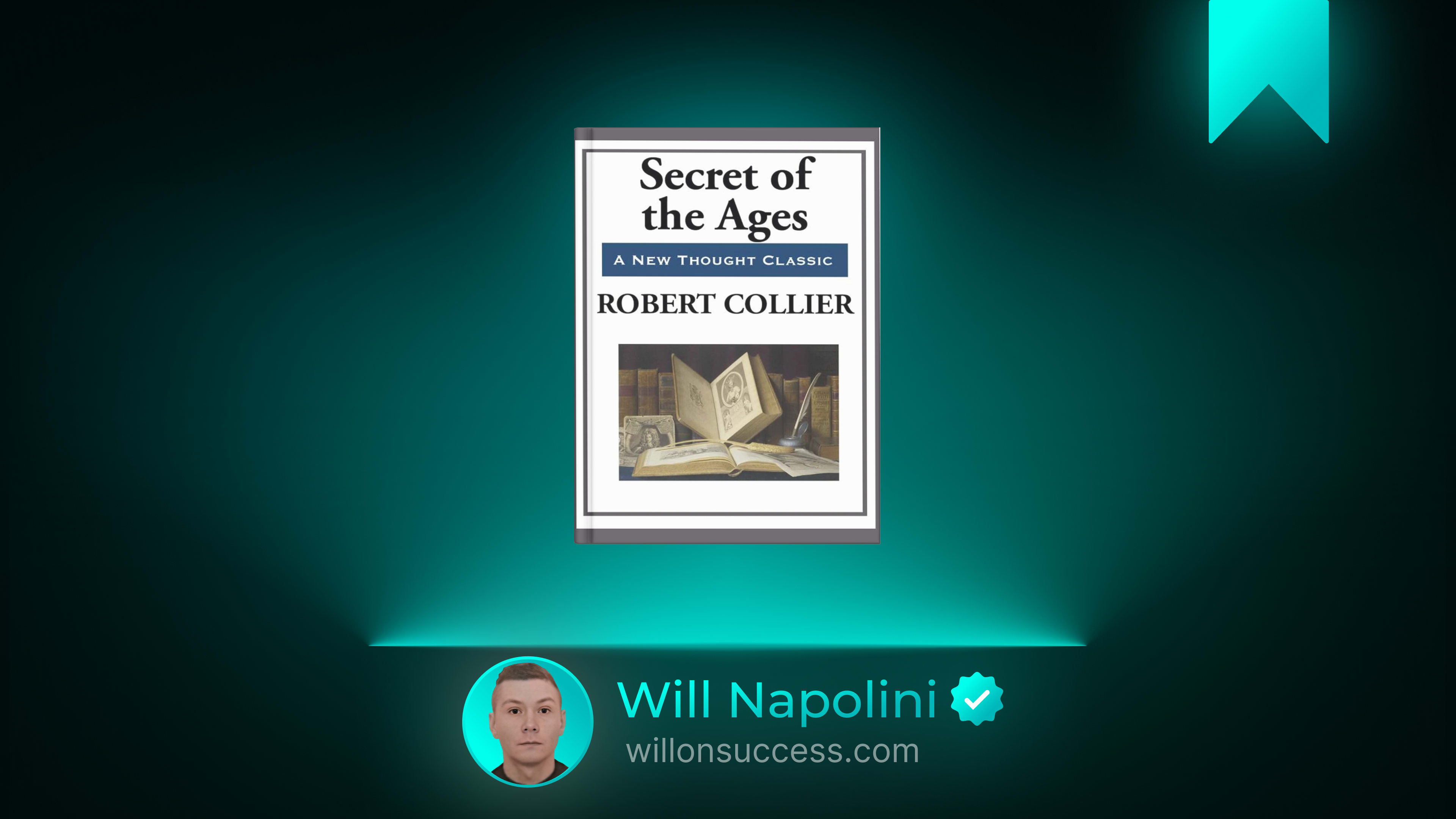
Robert Collier understood this. In 1926, he published The Secret of the Ages, a book that arrived decades before the modern self-help industry existed, yet articulated something that industry still struggles to explain clearly: the mind is not merely a mirror reflecting reality. It is a builder shaping it. And the materials it uses are the thoughts you repeat, the images you hold, and the desires you refuse to let go of.
I have returned to this book more than once over the years. Not because every sentence lands perfectly—Collier’s prose carries the cadence of the 1920s, and some of his framing feels dated. But because the central idea, once you strip away the era’s language, remains startlingly practical. It is not mysticism dressed up as philosophy. It is a description of how attention, belief, and persistence actually operate in a human life.
Let me walk you through what Collier was really saying, why it still matters, and what you can do with it starting tonight.
The Big Idea: You Are Not Waiting for Your Life to Begin
Collier’s central argument is deceptively simple. The mind possesses a creative faculty—primarily housed in what he calls the subconscious—and this faculty operates according to consistent, discoverable laws. When you understand those laws and deliberately direct them, you stop being a passenger in your own circumstances. You become, in a very real sense, the architect.
He does not mean that you can think a mansion into existence while sitting motionless on a couch. Collier was a publisher and businessman. He built enterprises. He knew that effort, timing, and action mattered. What he means is more subtle and more important: the direction of your effort, the opportunities you notice, the decisions you make, and the persistence you sustain are all downstream of what occupies your mind consistently.
Two people can work equally hard at the same job. One carries a quiet, persistent image of a life being built toward something specific. The other carries a vague anxiety about getting by. Their hours look similar. Their trajectories do not.
That is the secret Collier is pointing toward. Not magic. Direction. The slow, invisible power of a mind aimed at something and held there.
The Faithful Builder Who Never Argues
The most useful concept in the book is Collier’s description of the subconscious mind. He presents it not as some mystical wellspring but as a practical mechanism: a builder who never questions the architect’s plans.
Give it an image, and it will work toward that image. Give it fear, and it will work toward that fear with equal dedication. It does not judge whether the blueprint is wise or foolish. It does not pause to ask whether you truly want what you are picturing. It simply builds.
This is why Collier places so much emphasis on what you repeat in your own mind. A passing worry does not reshape your life. But a worry you rehearse every night, a limitation you quietly affirm each time you consider a risk, a story about yourself that you tell so often it feels like identity—these are the materials the builder uses.
I think of it this way. Imagine you hired a construction crew and gave them instructions every single day. Some days you hand them a sketch of a garden. Other days you hand them a sketch of a wall. Most days you hand them nothing clear, just a vague gesture and a sigh. What they build will be incoherent. Not because they are incompetent. Because the instructions were incoherent.
Your subconscious is that crew. And most of us have been handing it vague, contradictory, fear-based instructions for years, then wondering why the structure feels wrong.
Desire Is the Ignition, Not the Fuel
One distinction Collier draws that I find genuinely important is the difference between idle wishing and genuine desire.
A wish is light. It floats. You think, “Wouldn’t it be nice if…” and then the thought dissolves because nothing underneath it holds weight. You feel a small pang, then you open your phone, then the day moves on.
Desire, as Collier describes it, is different. It has roots. It engages your emotions, your imagination, and your will simultaneously. It is the kind of wanting that makes you rearrange your evening without being told to. The kind that makes you notice a relevant book on a shelf, or hear a useful sentence in a conversation you almost tuned out.
The mechanism here is not supernatural. When you want something deeply and specifically, your attention reorganizes. You begin to perceive opportunities that were always present but invisible to you before. You begin to make small decisions aligned with the goal without exhaustive deliberation. The desire becomes a filter, and the filter changes what you see and choose.
Collier insists that this desire must be definite. Not “I want to be successful.” Not “I want to be happier.” Those are weather patterns, not destinations. He asks for specificity. What exactly? By when? What does it look like on an ordinary morning once you have it?
The more definite the image, the more precisely the builder can work.
The Image Must Precede the Reality
A principle runs through the entire book: nothing is built twice in the physical world that has not first been built once in the mind.
Collier draws this from observation of craftspeople, engineers, and business builders. Before the bridge exists in steel, it exists as a drawing. Before the business exists as revenue and employees, it exists as a picture in one person’s imagination that they refused to abandon.
He extends this to individual lives. The person you are becoming is, in part, the person you are picturing. Not in some mystical manifestation sense. In the practical sense that your self-image determines the range of actions you believe are available to you.
If the picture you hold is of someone who always struggles, who never quite finishes, who is fundamentally the kind of person that things happen to—then your subconscious builder is working with that blueprint. And it will find evidence, opportunities, and decisions that confirm it.
If the picture shifts—even slightly, even imperfectly—the range of what you attempt shifts with it. You apply for the role. You make the call. You stay in the difficult conversation instead of walking away. Not because you are suddenly fearless. Because the image you are building toward makes those actions feel like your actions rather than someone else’s.
Persistence Turns a Thought into a Force
Here is where Collier separates himself from superficial optimism. He does not say, “Think it once and receive it.” He says something far more demanding: hold the image. Return to it. Feed it with attention daily, even when external evidence has not yet changed.
This is the hardest part. And I want to be honest with you about why.
The first week of holding a new mental image feels almost exciting. You are deciding something. You are choosing a direction. There is novelty in it.
The third week is harder. The old picture keeps reasserting itself. Your circumstances have not visibly shifted. A voice in you says, “This is silly. Nothing is different.” The temptation is to conclude that the principle doesn’t work and return to the familiar blueprint, even if that blueprint produces a life you don’t want.
Collier’s answer to this is simple and unsentimental: the seed does not show itself the day after it is planted. You do not dig it up every morning to check. You water. You wait. You trust the process you set in motion.
Persistence, in this framework, is not grinding effort. It is returning. Returning to the image each morning. Returning to the desire when distraction pulls you away. Returning to the belief that direction matters, even on days when progress is invisible.
A small thought, repeated, becomes a belief. A belief, sustained, becomes a posture toward the world. And a posture held long enough becomes a life.
The Law of Use: What You Exercise Grows, What You Ignore Atrophies
Collier includes a principle he calls the Law of Use, and it is perhaps the most grounded idea in the book. Your mental faculties, your confidence, your capacity for focused thought—all of these strengthen with exercise and weaken with neglect.
This is not a revelation. Anyone who has trained a physical skill knows it. You do not get stronger by reading about strength. You get stronger by lifting.
Collier applies this to the mind’s creative capacity. The ability to hold a clear image, to sustain a desire, to direct your attention deliberately—these are skills. They are weak at first. They feel awkward. The mind wanders. The old patterns reassert.
But they strengthen with use. The tenth time you sit quietly and picture the direction you want your life to take, it is easier than the first. The fiftieth time, it feels less like an exercise and more like home.
You do not need to be good at this today. You need to begin. And you need to return tomorrow.
Why This Matters on an Ordinary Tuesday
Let me bring this down from principle to practice, because I think that is where most summaries of books like this fail. They leave you nodding at the idea while your actual Tuesday remains unchanged.
Suppose you have been carrying a quiet belief that you are not the kind of person who can build something of your own. Maybe it is a business. Maybe it is a body of creative work. Maybe it is simply a life that feels chosen rather than inherited. That belief is not a fact. It is a blueprint you have been handing the builder for years.
On Tuesday morning, that belief shapes small things. You scroll past the article that would teach you something useful because a voice says, “This isn’t for people like you.” You skip the conversation that might open a door because the picture you hold of yourself does not include walking through it. You let the evening dissolve into distraction because the alternative—sitting with the discomfort of beginning—feels like entering a room you were not invited into.
None of this is dramatic. That is what makes it dangerous. The life is not derailed by one catastrophe. It is quietly narrowed by a thousand small surrenders to an image that was never true.
What Collier offers is not a dramatic rescue. It is a different set of materials for the builder. A new image, held with patience, rehearsed with honesty, acted upon in small ways. Over weeks. Over months. Over the slow, invisible seasons of a life being quietly rebuilt from the inside.
A Practical Starting Point
If any of this resonates, I do not want you to close this article and simply feel inspired. Inspiration without structure fades by Thursday. Here is something concrete.
Tonight, before you sleep, take five minutes. Not thirty. Five. Sit somewhere quiet. Close your eyes. And construct one image of the direction you want your life to move in. Not a fantasy of perfection. A direction. A version of your Tuesday six months from now that feels more alive, more chosen, more yours than the Tuesday you just lived.
Hold that image for five minutes. Let it be specific. What are you doing? Where are you? What did you say yes to that you have been avoiding?
Then let it go. Sleep.
Tomorrow morning, before you open your phone, return to it. Five minutes. Same image. Maybe it shifts slightly. That is fine. You are not carving stone. You are planting.
Do this for fourteen days. Not because fourteen days will transform your circumstances. Because fourteen days will begin to change the instructions you hand the builder. And the builder is already working whether you direct it or not.
You might also ask yourself one journaling question this week: What image of myself have I been rehearsing so long that I mistook it for the truth? You do not have to answer it immediately. Just let it sit. See what surfaces.
Who Should Read This Book
The Secret of the Ages will reward you most if you have ever felt that you are working hard but building in the wrong direction. If you sense that the obstacle is not effort but orientation. If you are drawn to the idea that inner clarity precedes outer results but you want that idea explained in practical, grounded terms rather than mystical abstraction.
It is a book from 1926, and you should go in knowing that. The prose is formal by modern standards. Some of Collier’s examples reflect a world that no longer exists. He occasionally leans on the rhetorical style of his era in ways that may feel ornate.
Where it may disappoint: if you are looking for a step-by-step system with measurable milestones, this is not that book. Collier paints principles and trusts you to build the structure. If you need rigid frameworks, you may find it frustrating. If you want a mindset shift that recontextualizes how you approach your own goals, it remains remarkably effective.
Read it slowly. Let a chapter sit for a day before moving to the next. The value is not in speed. It is in absorption.
One Small Step
Here is what I would ask you to do today. Not tomorrow. Today.
Choose one area of your life where you have been operating from a picture you never consciously chose. A career path you inherited. A belief about what you are capable of that you absorbed at nineteen and never questioned. A relationship pattern you repeat as though it were inevitable.
Name it. Write it down in one sentence. Then, beneath it, write one sentence describing the direction you would choose if that old picture lost its authority.
You do not have to solve it tonight. You do not have to announce it. You simply have to give the builder a new sketch, even a rough one, and commit to holding it in mind tomorrow morning.
That is where it starts. Not with a dramatic reinvention. With one clear image, held in a quiet mind, repeated until the direction becomes more real than the doubt.
The workshop inside you is running right now, whether you pick up the pen or not. The only question has always been: what are you handing it?
Pick up the pen. Draw something truer. Then let time do what time does best—turn a small, honest sketch into a structure you can walk around in and call your own.