The Architecture of Meaning: How Taking Responsibility Anchors You in a Chaotic World
Have you ever caught yourself secretly resenting the people around you for their success, while feeling entirely justified in your own stagnation?
You watch a peer get the promotion, buy the house, or build the relationship you desperately want, and a quiet, bitter voice whispers in your ear. It tells you that the game is rigged. It tells you that your parents didn’t give you the right advantages, that the economy is stacked against you, or that you were simply dealt a bad hand. It feels incredibly comforting in the moment to play the victim, because if the world is unfair, then your lack of progress isn’t your fault.
But if I could sit across the table from you right now, I would look you in the eye and tell you the hardest, most liberating truth I have ever learned: Resentment is a heavy stone you carry in your own pocket while demanding someone else apologize for its weight.
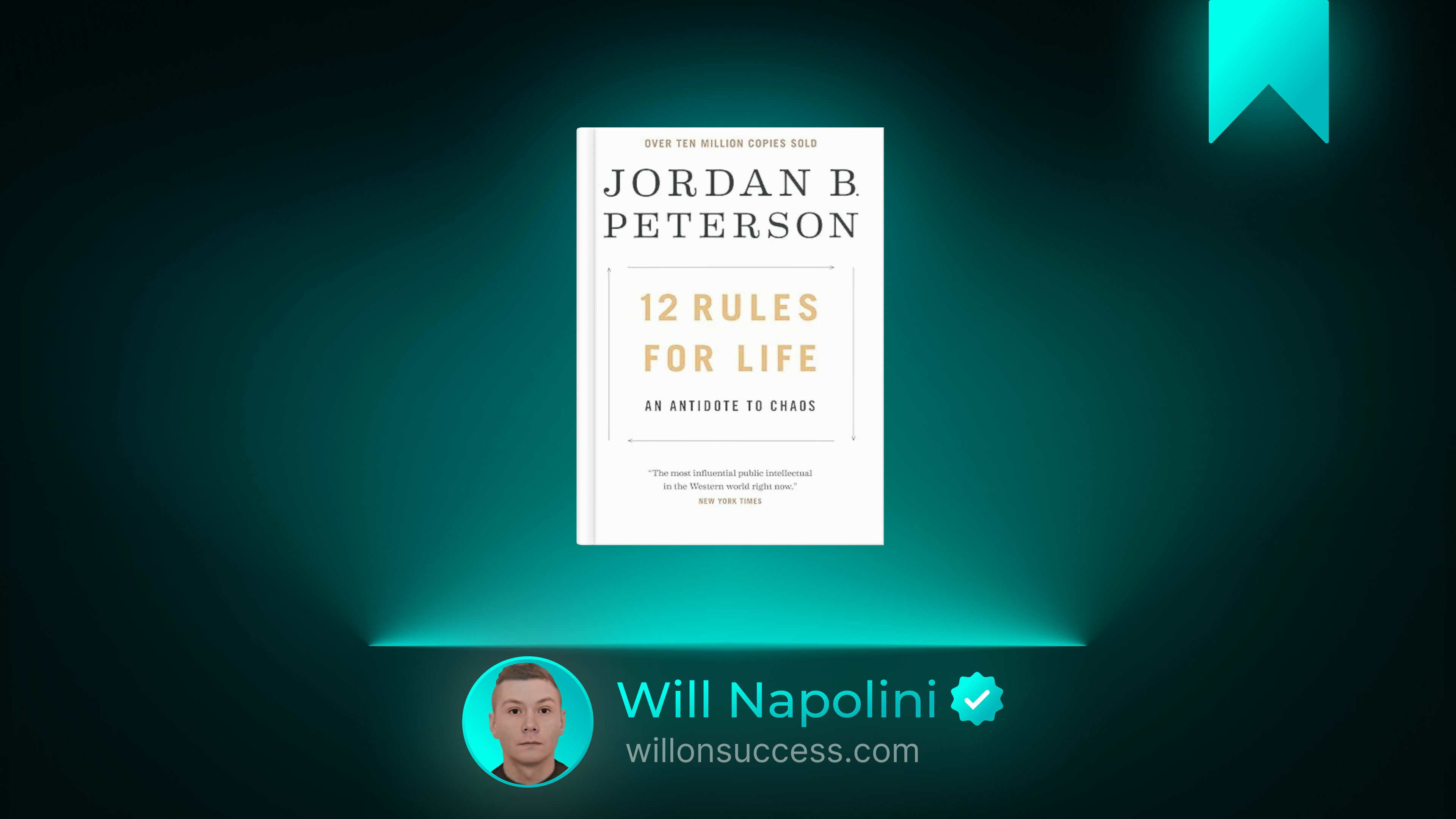
In his deeply challenging and profoundly necessary book, 12 Rules for Life: An Antidote to Chaos, clinical psychologist Jordan B. Peterson dismantles the modern obsession with victimhood and shallow happiness. He does not offer you a comfortable cushion. He offers you a heavy backpack, and he tells you that picking it up is the only way you will ever find peace.
The central thesis of the book is that life is inherently tragic, difficult, and chaotic. You cannot escape suffering, and you cannot engineer a life free of problems. Therefore, the goal of life is not to pursue fleeting happiness. The goal is to adopt enough meaningful responsibility that the suffering of life becomes bearable, and even noble. You are not a helpless leaf blown about by the winds of circumstance. You are an agent of order, capable of standing up, facing the chaos, and building a foundation of meaning.

The Ancient Biology of Standing Tall
To understand why taking responsibility is so vital, we have to look past human psychology and look at biology. Peterson opens the book with a fascinating exploration of the lobster.
Lobsters have been around for hundreds of millions of years, and they operate on a strict dominance hierarchy. When two lobsters fight, the winner’s brain releases a rush of serotonin, making it stand taller, act more confidently, and win future conflicts. The loser’s serotonin levels plummet; it shrinks, scurries away, and becomes highly vulnerable to the next predator.
Human beings, despite our complex brains and modern technology, are governed by a remarkably similar neurochemical system. When you face the world with your head down and your shoulders slumped—both physically and metaphorically—your brain registers defeat. Your serotonin drops. You become more reactive, more anxious, and more prone to depression. You signal to the world, and to your own nervous system, that you are prey.
But when you choose to stand up straight with your shoulders back, you are not just practicing good posture. You are making a profound metaphysical declaration. You are voluntarily accepting the terrible burden of conscious existence. You are telling your ancient nervous system, “I am ready to face whatever comes.” When you physically embody courage, your brain chemistry shifts to support it. You cannot demand respect from a world you are unwilling to face.
You Are Someone Worth Rescuing
One of the most heartbreaking phenomena Peterson observed in his clinical practice is how poorly people treat themselves. If you have a dog, and the veterinarian prescribes a daily medication for it, you will meticulously administer that pill every single day. You will hide it in peanut butter; you will gently hold the dog’s jaw. But if that same veterinarian prescribes medication for you, there is a high statistical probability that you will forget to take it, or simply decide you don’t need it.
Why do we care for our pets better than we care for ourselves?
Peterson argues that it stems from a deep, often unconscious self-contempt. You know your own flaws. You know the petty, selfish, cowardly thoughts that run through your head. Because you know you are flawed, a dark part of you believes you do not deserve to be cared for. You harbor a secret belief that you are fundamentally inadequate, so you neglect your own health, your own career, and your own boundaries.
The antidote to this is a radical shift in perspective. You must treat yourself as if you are someone you are responsible for helping. Imagine that you were handed the care of a young, vulnerable person who had immense potential but was deeply flawed. You wouldn’t let them eat garbage, and you wouldn’t let them waste their days in cynical apathy. You would guide them, discipline them, and nurture them. You must extend that exact same fierce, compassionate stewardship to yourself.
The Trap of the Highlight Reel
We live in an era of infinite comparison. You can open your phone and instantly view the curated, polished, heavily edited triumphs of millions of people. It is a psychological torture device.
When you compare your messy, behind-the-scenes reality to someone else’s public highlight reel, you will always lose. You will look at a peer’s new business or perfect family and feel a corrosive envy. But Peterson offers a vital correction: Compare yourself to who you were yesterday, not to who someone else is today.
Your life is a unique, complex tapestry of circumstances, genetics, and history. The person you are comparing yourself to is playing an entirely different game on a different board. The only valid baseline for your growth is your own past. Did you read one more page today than you did yesterday? Did you hold your temper for five extra seconds? Did you pay off ten dollars of debt?
When you shift your focus from the external horizon to the internal mirror, envy loses its power. You stop trying to beat the world, and you start trying to beat your own past limitations.
Clean Your Own Room Before You Fix the World
There is a profound temptation, especially when we are young or feeling lost, to look at the massive, systemic problems of the world and decide that we must fix them. It is much easier to be outraged by global injustice, political corruption, or corporate greed than it is to deal with the chaos in our own living room.
Ideological arrogance allows us to point fingers at the “evil” structures of society while ignoring the fact that we haven’t done our laundry in three weeks, we haven’t spoken to our estranged brother in five years, and we are chronically late to work.
Peterson issues a stark challenge: Set your house in perfect order before you criticize the world.
This is not an excuse to ignore societal problems. It is a demand for personal integrity. You cannot bring order to a nation if you cannot bring order to your own bedroom. Every time you clean a chaotic space, pay a lingering bill, or tell a difficult truth to a loved one, you are literally pushing back the darkness of chaos and establishing a foothold of order. You are proving to yourself that you are competent. And only when you have mastered your own domain do you earn the moral authority to step out and help heal the wider world.
Meaning Is Found in the Heaviest Load You Can Carry
Modern culture tells you that the meaning of life is to be happy. We are told to pursue what is expedient—what feels good right now, what avoids pain, what brings immediate pleasure. But a life lived only for expedience eventually collapses into nihilism. When the inevitable tragedies of life strike—the loss of a loved one, a cancer diagnosis, a sudden economic collapse—the pursuit of happiness offers absolutely no shock absorption. Happiness is a fleeting weather pattern; meaning is the bedrock that holds you steady when the storm hits.
Meaning is found in the willing adoption of responsibility. It is the decision to sacrifice what you want now for something better later.
Think of a parent waking up at 3:00 AM to comfort a crying child. It is exhausting. It is not “happy” in the moment. It is deeply inconvenient. But it is profoundly meaningful. The parent has voluntarily taken on the heavy burden of nurturing another human life, and that burden anchors them to the earth. It gives their suffering a purpose.
If your life feels empty, it is rarely because you lack entertainment. It is because you lack a burden heavy enough to require your full strength. Stop asking what the world owes you. Start asking what heavy, meaningful load you are strong enough to carry.
Why This Matters on an Ordinary Tuesday
It is easy to read philosophy and feel a temporary surge of inspiration. But how do these rules apply to the messy, frustrating reality of a random Tuesday?
Imagine you wake up late. You are stressed about a looming deadline at work. Your partner makes a passive-aggressive comment about the dishes. The easy, expedient path is to snap back, storm out, and spend your commute mentally rehearsing arguments, convincing yourself that you are surrounded by idiots. That is the path of chaos. It leads to a day of resentment, poor work, and a cold evening at home.
Applying the rules of this book changes the trajectory entirely.
You catch your slumping posture and physically pull your shoulders back, signaling to your brain that you can handle the stress (Rule 1). You recognize that your partner’s comment is born of their own exhaustion, and instead of attacking, you treat the relationship with the care you would give a prized garden (Rule 2). You stop comparing your stressful morning to the curated morning routines of influencers on your phone (Rule 4). You take three minutes to load the dishwasher, bringing a tiny patch of order to your environment before you walk out the door (Rule 6).
You haven’t magically eliminated the stress of the deadline. But you have stopped adding the poison of resentment to it. You have maintained your dignity. You have remained the architect of your day, rather than a victim of it.
How to Reclaim Your Agency Today
Understanding these concepts is valuable, but understanding without action changes nothing. If you want to stop drifting in the chaos and start building a life of meaning, you must begin applying these principles immediately.
1. The Posture Reset For the next 24 hours, set a recurring alarm on your phone for every two hours. When it goes off, do a physical audit. Are your shoulders rolled forward? Is your head down? Pull your shoulders back, lift your chin, and take a deep breath. Notice how your internal monologue shifts when your physical posture shifts from prey to participant.
2. The “Future Self” Negotiation Stop treating yourself like a slave who must be whipped into productivity, and stop treating yourself like a toddler who must be bribed with junk food. Treat yourself like an employee you respect and want to see succeed. Tonight, negotiate with yourself. Say, “If you do this difficult, necessary task tomorrow morning, I will give you this specific, healthy reward in the afternoon.” Make a deal with yourself, and more importantly, keep your word to yourself. This is how you rebuild self-trust.
3. The Room Audit Look around your immediate environment. Find one space that is chaotic, broken, or ignored. It could be a junk drawer, the glovebox of your car, or a strained relationship with a sibling. Do not try to fix your whole life today. Pick one small, localized area of chaos. Spend thirty minutes bringing absolute order to it. Clean it, organize it, or make the difficult phone call to repair it. Stand back and look at the order you have created. Let that small victory prove to you that you are capable of making the world slightly better.
Who Needs to Read This Book
12 Rules for Life is a vital intervention for anyone who feels lost in the modern epidemic of meaninglessness. It is essential reading for the chronic cynic, the resentful over-thinker, and the person who feels paralyzed by the overwhelming complexity of the world. It is particularly powerful for those who have been coddled by a culture that tells them they are perfect just the way they are, and who are secretly starving for someone to challenge them to be better.
However, if you are currently in the depths of acute trauma, severe clinical depression, or profound grief, this book may feel too demanding. Peterson’s voice is that of a stern, loving father figure who demands you stand up and face the dragon. If your leg is currently broken, you need a medic, not a drill sergeant. Heal your acute wounds first, then pick up this book when you are ready to start training for the marathon of life.
Your First Step Toward Meaning
You do not need to solve the riddle of your entire existence today. You do not need to apologize to everyone you have ever wronged, or completely overhaul your career.
You only need to take ownership of the square footage immediately surrounding you.
Here is what I want you to do today. Identify one thing in your life that you know is wrong, that you have the power to fix, and that you have been avoiding because it is uncomfortable. It might be a stack of unopened mail. It might be an apology you owe a friend. It might be throwing away the junk food in your pantry.
Do not negotiate with it. Do not wait until you “feel” like doing it. Walk over to it, and fix it.
When you fix that one small thing, you are doing much more than organizing your life. You are pushing back the chaos of the universe. You are proving that you are a force for order.
The world does not need you to be perfectly happy. It needs you to be reliably useful. Pick up your burden, stand up straight, and take the first step.