Atomic Habits by James Clear: Why Tiny Changes Build Extraordinary Lives
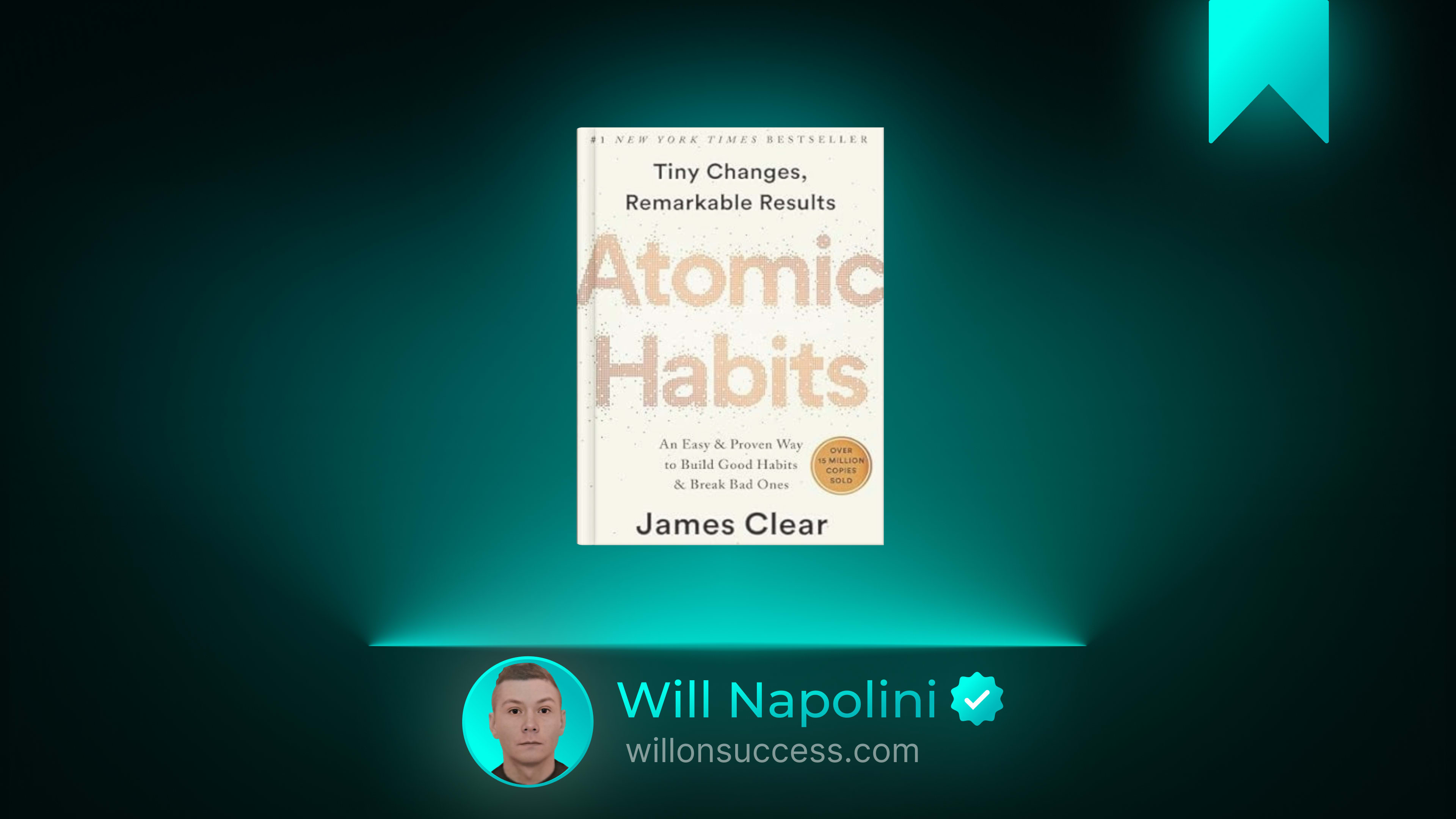
There is a quiet lie most of us tell ourselves, usually around January, usually after a failure, usually in the tired hours when we are trying to talk ourselves into trying again. The lie goes something like this: If I could just make one big, decisive change, everything would finally be different.
So we overhaul our entire routine. We throw out the pantry. We sign the annual gym membership. We announce the transformation publicly, as though the announcement itself were progress. And for a week or two, it feels like momentum. Then the old patterns reassert themselves, quietly and completely, and we conclude that we simply lack the discipline. That we are not the kind of person who can sustain change.
James Clear wrote Atomic Habits to dismantle that conclusion. Not to argue that you need more willpower, but to show you that the entire model of transformation you have been using is structurally flawed. The problem was never your character. The problem was the scale at which you were trying to operate.
If I could sit across the table from you and say only one thing about this book, it would be this: you do not need a revolution. You need a better system for making very small decisions, over and over, until those decisions quietly rebuild the architecture of your life.

The Central Idea: What You Repeat in Private Eventually Becomes Visible in Your Life
The word “atomic” carries a double meaning in Clear’s framework. An atom is extraordinarily small, almost invisible on its own. But it is also the fundamental building block of everything larger. An atomic habit is both of those things simultaneously: a tiny behavior, barely noticeable in the moment, that serves as the foundational unit of a much larger outcome.
Clear presents a simple piece of arithmetic to anchor the idea. If you improve by just one percent each day for a year, you end up roughly thirty-seven times better than where you started. If you decline by one percent each day, you erode down to nearly nothing. The math is not the point. The point is that small changes do not remain small. They compound. And most of us are completely blind to the compounding because we are watching for dramatic, overnight results.
This is where most people give up. Clear calls it the “plateau of latent potential.” You put in the work for days, weeks, sometimes months, and the visible results look flat. You are below the line where effort seems to matter. The temptation is to quit, because the gap between what you are doing and what you can see feels discouraging. But the work is not wasted. It is being stored. Like water heating in a pot, the temperature rises degree by degree with nothing visible happening until, suddenly, it boils. The boiling did not come from the last degree. It came from every degree before it.
You are not failing because nothing has changed. You are in the part of the curve where the change is real but not yet visible.
The Story That Proves the Principle: British Cycling and the Aggregation of Marginal Gains
One of the most memorable illustrations in the book is the transformation of British professional cycling. For nearly a century, British cycling was mediocre. Then a performance director named Dave Brailsford took over the national team with a philosophy he called “the aggregation of marginal gains.” The idea was straightforward: if you broke down everything involved in riding a bicycle and improved each element by just one percent, the cumulative effect would be enormous.
The team redesigned bike seats for comfort. They rubbed alcohol on tires for better grip. They tested different massage gels for muscle recovery. They hired a surgeon to teach athletes how to wash their hands properly to avoid catching colds. They even tested different pillows and mattresses to find the best sleep setup for each rider. Individually, none of these adjustments looked like a breakthrough. Together, over years of relentless small refinement, British cycling went from near-irrelevance to dominating the Tour de France and the Olympic Games.
What strikes me about this story is not the cycling. It is the patience. Brailsford did not look for one dramatic fix. He looked for a hundred invisible ones. And he trusted that the accumulation would do what no single intervention could.
That is the entire philosophy of this book, compressed into one example. You are not looking for the one perfect move. You are looking for the next small one, and the one after that.
Identity Before Outcomes: Become the Person, Then Let the Results Follow
Here is where Clear separates himself from most habit advice. Most approaches start with the outcome. I want to lose twenty pounds. I want to write a book. I want to save ten thousand dollars. Clear argues that this is the wrong starting point, and that beginning with outcomes is one of the primary reasons habits collapse.
He proposes three layers of change. The outermost layer is outcomes: the results you get. The middle layer is processes: the systems and habits you build. The deepest layer is identity: the beliefs you hold about who you are.
Most people try to change from the outside in. They fixate on the result and work backward. Clear suggests working from the inside out. Instead of saying, “I want to quit smoking,” you say, “I am not a smoker.” Instead of saying, “I want to run a marathon,” you say, “I am a runner.” The behavior follows the identity, not the other way around.
This is not wishful thinking or positive affirmation dressed up as strategy. It is a practical observation about how human beings operate. Every action you take is a small vote for the type of person you are becoming. One healthy meal does not make you a healthy person, but it casts one vote in that direction. One page written does not make you a writer, but it is a vote for that identity. Over time, the votes accumulate, and the identity shifts. And once the identity shifts, the behavior sustains itself because it is no longer something you are forcing. It is simply who you are.
The question you should ask yourself is not, “What do I want to achieve?” It is, “Who do I want to become, and what would one small vote for that person look like today?”
The Four Laws: A Practical Architecture for Building Any Habit
Clear organizes the mechanics of habit formation around a four-part loop: cue, craving, response, reward. Every habit your brain has ever built follows this sequence. A trigger in your environment sparks a desire, the desire motivates a behavior, and the behavior delivers a payoff that teaches your brain to repeat the cycle.
To build a good habit, you work with each stage of the loop:
Make it obvious. Design your environment so the cue for the behavior is impossible to miss. If you want to read more, place the book on your pillow every morning. If you want to drink more water, fill a bottle and set it beside your keyboard before you sit down. You are not relying on memory or motivation. You are engineering a prompt.
Make it attractive. Pair the habit you need with something you enjoy. Clear calls this “temptation bundling.” You listen to your favorite podcast only while you exercise. You enjoy your evening tea only while you review the next day’s priorities. The attraction of one activity pulls the other along.
Make it easy. Reduce friction. Shrink the habit to its smallest possible version. Clear’s “two-minute rule” is especially useful here: when starting a new habit, scale it down so it takes less than two minutes. Want to start running? Put on your shoes and step outside. Want to start journaling? Write one sentence. The goal is not to do the full activity. The goal is to make showing up effortless, because showing up is where the identity vote gets cast.
Make it satisfying. Give yourself an immediate, visible reward for completing the habit. Track it on a calendar. Put a mark on a chain. The satisfaction of seeing the streak grow becomes its own reinforcement, and the habit begins to feed itself.
To break a bad habit, you invert each law. Make the cue invisible. Make the craving unattractive. Make the behavior difficult. Make the consequence unsatisfying. Remove the trigger from your environment rather than trying to white-knuckle past it every day.
What I appreciate about this framework is that it treats you like a human being operating inside a real environment, not a purely rational agent who should simply decide better. It acknowledges that you are influenced by your surroundings, your energy levels, your emotional state, and the path of least resistance. And then it gives you levers to work with those realities instead of fighting them.
Your Environment Is Quietly Shaping Your Behavior
One principle deserves its own emphasis because it is the one most people overlook entirely: you are not as independent from your surroundings as you believe.
Clear argues that environment design matters more than motivation. A person with strong willpower in a poorly designed environment will eventually lose to a person with average willpower in a well-designed one. If your phone is on the nightstand, you will check it. If the cookies are on the counter, you will eat them. If the guitar is in the closet, you will not play it. If the guitar is on a stand in the middle of the living room, you probably will.
You are not weak. You are responding to the architecture around you. And the good news in that observation is enormous, because architecture can be redesigned.
You do not need to become a different person to change your habits. You need to rearrange the room.
Think about your own space right now. What is visible? What is within arm’s reach? What requires effort to access? Those answers are quietly scripting your behavior every single day, whether you are aware of it or not. The most powerful thing you can do this week is not summon more discipline. It is change one element of your physical environment so that the habit you want becomes the default and the habit you want to break becomes inconvenient.
Systems Over Goals: Why Winners and Losers Have the Same Goals
Clear makes a case that I have found repeatedly true in my own experience: goals are useful for setting direction, but they are terrible engines for daily progress. Every competitor in a race wants to win. The goal is identical. What separates the people who finish from those who do not is the system of daily training they follow.
Goals create a binary. You either achieve them or you do not. And the moment you achieve one, the motivation evaporates, because the target is gone. Systems, on the other hand, are ongoing. A system is the routine, the process, the repeatable structure that produces results as a byproduct. You do not need to obsess over the outcome if you trust the process that generates it.
A goal is the summit. The system is the trail you walk every morning. The summit does not make you fitter. The walking does.
This reframing matters because it frees you from the anxiety of results. You stop asking, “Am I there yet?” and start asking, “Did I follow the process today?” That single shift in attention changes the emotional experience of working toward something. It replaces the pressure of a distant finish line with the manageable question of the next step.
Why This Matters on an Ordinary Tuesday
It is easy to read a framework like this and think it applies to grand ambitions. Starting a company. Writing a novel. Transforming your health. But the real power of these ideas shows up in the unremarkable hours.
It is Tuesday afternoon and you are tired and the easy thing is to scroll your phone for forty minutes instead of working on the project you care about. Atomic habits thinking does not ask you to white-knuckle through an hour of deep focus. It asks you to make the cue obvious (open the document before lunch), make it easy (commit to writing one paragraph), and make it satisfying (close the laptop and let yourself enjoy the evening without guilt).
It is the small Tuesday decisions, repeated across hundreds of Tuesdays, that build the life. Not the dramatic Monday-morning resolutions. Not the weekend overhauls. The ordinary, almost invisible choices that nobody sees and nobody applauds.
What you repeat in private eventually becomes visible in your life. The private repetitions are where everything is actually decided.
A Small Experiment to Start Today
If this idea resonates but you are not sure where to begin, here is a concrete starting point. Clear’s framework is designed for immediate use, so use it immediately.
Tonight, before you go to sleep, do three things.
First, choose one habit you want to build. Keep it genuinely small. Not “exercise for an hour.” More like “do five push-ups” or “read two pages” or “write one sentence in a journal.” The size almost does not matter. The consistency matters.
Second, attach it to something you already do every day. This is what Clear calls “habit stacking.” The formula is simple: After I [existing habit], I will [new tiny habit]. After I pour my morning coffee, I will write one sentence in my journal. After I brush my teeth at night, I will read two pages. You are anchoring the new behavior to a cue that already exists, so you do not have to manufacture motivation from nothing.
Third, make the environment cooperate. Put the journal on the coffee machine. Put the book on the pillow. Put the running shoes by the door. Remove one step of friction between you and the action.
Tomorrow, do the tiny habit. Then do it the day after. Then the day after that. Do not worry about scaling it up. Do not worry about whether five push-ups “count.” They count. They are a vote for the person you are becoming, and the votes are accumulating whether you can see the tally or not.
Who Should Read This Book
If you have ever started something with genuine enthusiasm and watched it dissolve within a few weeks, this book was written for you. If you tend to think of change as an all-or-nothing event, a dramatic before-and-after, Clear’s framework will gently and thoroughly dismantle that assumption.
It is especially valuable for anyone building a creative practice, trying to improve their health, developing professional skills, or attempting to break a dependency on distraction. The principles are general enough to apply to almost any domain of behavior.
A reader looking for a quick burst of motivation or a list of “ten hacks” may find the book slower than expected. Its strength is depth and structure, not speed. It asks you to think carefully about how your habits actually function before you start rearranging them. If you want a surface-level pep talk, this is not that book. If you want to understand the mechanics well enough to build something that lasts, it is one of the most practical guides available.
One Small Step, Right Now
You do not need to redesign your entire life before the weekend. You do not need a new planner, a new app, or a new identity. You need one decision, made small enough that you cannot talk yourself out of it.
Pick the habit. Shrink it until it feels almost too easy. Attach it to something you already do. Remove one piece of friction from your environment.
Then do it tomorrow. And the day after. And let the compounding do what compounding does, which is work quietly, invisibly, and then all at once.
You are not waiting to become someone new before you begin. You begin, and in the beginning, you become. Every small repetition is a quiet act of self-authorship, a single brick laid in a structure you will not fully see for months or years. But the structure is rising. It is rising today, in the smallest, most ordinary choice you make next.
Lay the brick. Then lay another. The cathedral takes care of itself.