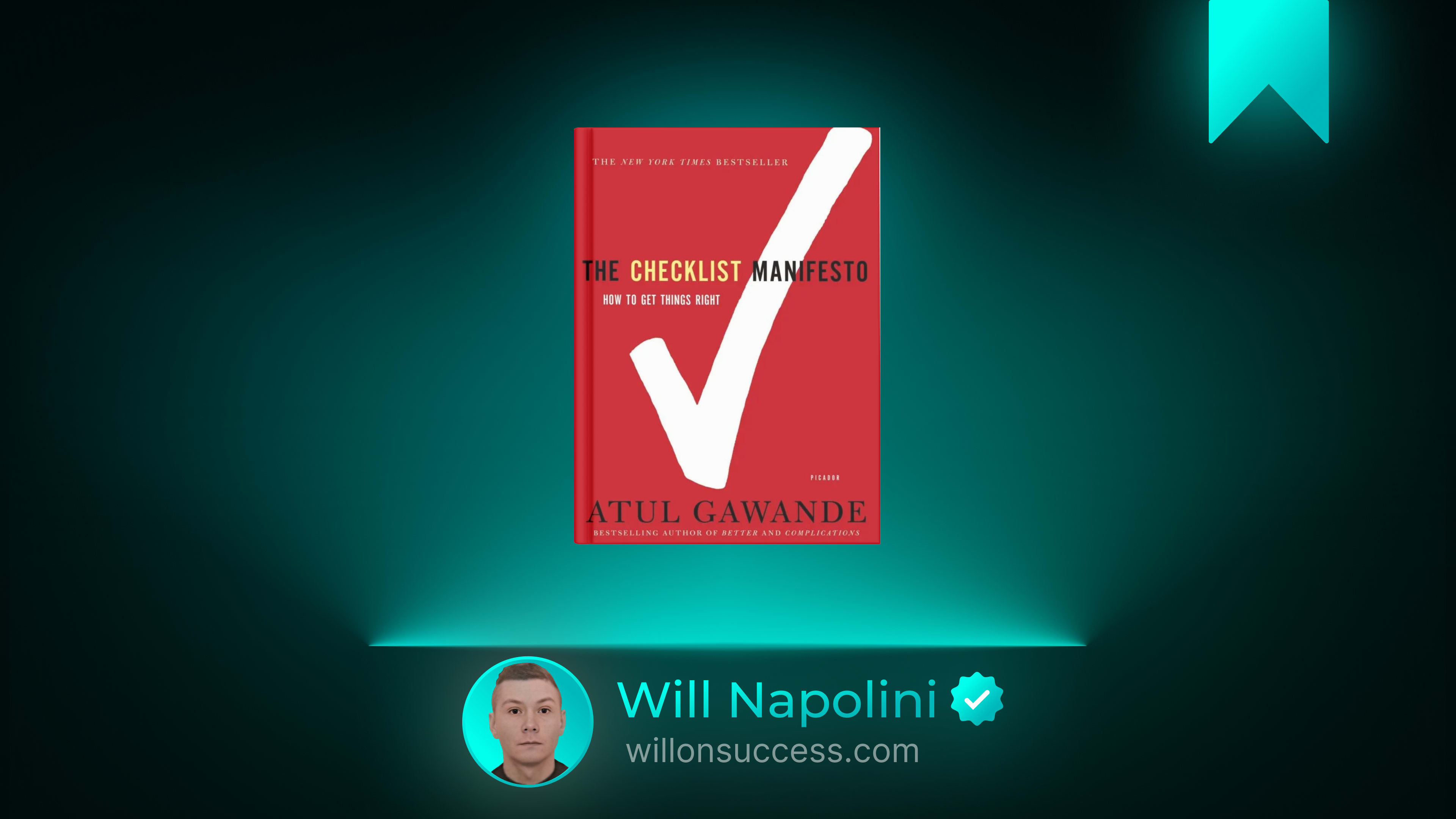
The Checklist Manifesto by Atul Gawande: Why the Smartest People Still Make Avoidable Mistakes, and What a Simple Piece of Paper Can Do About It
On October 30, 1935, a crowd gathered at Wright Field in Dayton, Ohio, to watch the future of military aviation take shape. The Boeing Model 299—what would later become the B-17 Flying Fortress—sat gleaming on the runway. It was enormous. It had four engines, a wingspan longer than a tennis court, and the ability to fly faster, farther, and higher than any bomber ever built. The generals in the stands were already calculating how many to order.
Then it took off. And it crashed. And two men died.
The investigation found no mechanical failure. No sabotage. No defect. The plane had been in perfect working order. The problem, the report concluded, was that the aircraft was simply too complex for one pilot to manage. Too many levers. Too many gauges. Too many things to remember in the right sequence at the right moment. The pilot was not incompetent. He was overwhelmed.
And here is what the military did next. They did not order a simpler plane. They did not demand a more experienced pilot. They did not write a longer training manual. A small group of test pilots sat down together and wrote a card. On it, they listed the things a pilot must check before takeoff, during flight, before landing, and in an emergency. Four short categories. A few items each.
They called it a checklist.
With that card in the cockpit, the B-17 went on to be flown 1.8 million hours without a major accident. The army ordered nearly thirteen thousand of them. And the card that made it possible cost almost nothing to produce.
I start here because Atul Gawande starts here, and because I think this story contains one of the most liberating truths I have ever encountered about why good people fail at things they already know how to do.
The Big Idea: You Do Not Need More Knowledge. You Need a System to Apply What You Already Know.
Gawande is a surgeon. He operates on people. He has spent decades in rooms where a single missed step can end a life. And what he noticed, over years of watching brilliant colleagues make catastrophic errors, is this: the failures were almost never caused by a lack of knowledge.
They were caused by a failure to apply knowledge reliably under pressure.
The surgeon knew the antibiotics had to be given within sixty minutes of the incision. The surgeon had been taught this. The surgeon believed it. And yet, in the chaos of a busy operating room, with a bleeding patient and a nurse calling out vitals and a resident asking a question, the antibiotics got forgotten. Not because the surgeon was careless. Because the surgeon was human.
Gawande names two kinds of failure. The first is ignorance. We do not know enough. The science has not caught up. The problem is genuinely beyond our current understanding. For most of human history, this was the primary enemy. We failed because we simply did not know.
The second kind of failure is ineptitude. We know what to do. We have the knowledge. We have the training. We have the resources. And we still fail to do it correctly. We skip a step. We forget a detail. We assume the obvious thing was handled and discover, too late, that it was not.
Gawande’s argument is that in the modern world—medicine, aviation, construction, finance, law, education, parenting, almost every domain of serious work—ignorance is no longer our primary enemy. Ineptitude is. We are drowning in what we know and starving for the ability to reliably do it.
And the checklist, humble and unglamorous, is one of the most effective tools ever devised to bridge that gap.
The problem is not that you are not smart enough. The problem is that you are trying to hold too much in your head at once, and your head was never designed for that.
The Pause Before the Cut
Let me tell you the story that convinced me this book was not just about surgery.
In 2008, the World Health Organization, with Gawande leading the effort, introduced a surgical safety checklist. It was not a complicated document. It had nineteen items. Before the patient was put under anesthesia, the team confirmed the patient’s identity, the surgical site, and any known allergies. Before the incision, they paused. They said the patient’s name aloud. They confirmed the procedure. They confirmed that antibiotics had been given. They confirmed that blood was available. The surgeon introduced themselves. The anesthesiologist introduced themselves. The nurses introduced themselves.
That was it. A pause. A few spoken sentences. A moment where everyone in the room stopped, looked at each other, and confirmed the obvious.
The results, published in the New England Journal of Medicine, were staggering. Across eight hospitals on five continents, complications dropped by roughly a third. Deaths dropped by nearly half. Not in one hospital. In all eight. In wealthy countries and in poor ones. In teaching hospitals and in community clinics. The same small piece of paper, in every context, produced the same dramatic improvement.
Why? Because the checklist did not teach the surgeons anything new. They already knew the antibiotics mattered. They already knew to confirm the surgical site. They already knew to check for allergies. The checklist simply created a moment—a structure, a pause, a shared ritual—where that knowledge was guaranteed to be applied. Where no one could skip it because the room was watching. Where the assumption that someone else had handled it was replaced by the spoken confirmation that someone had.
I think about that pause every time I rush into a meeting without confirming what the meeting is actually for. Every time I start a project without writing down what “done” looks like. Every time I begin a difficult conversation without first asking myself what I actually want the other person to feel when it is over.
The pause is not a sign of weakness. It is the architecture of reliability.
The Checklist Is Humility Made Visible
Here is the hardest lesson in this book, and the one I think most people resist. Not because it is complicated. Because it is uncomfortable.
To use a checklist, you have to admit you are fallible.
You have to look at your years of training, your degrees, your experience, your track record, and say, Yes, and I will still forget something. Under pressure, in the noise, in the fatigue, in the Tuesday-afternoon monotony, I will miss a step. And I will build a small system to catch me.
Gawande writes about how pilots embraced the checklist early. Surgeons resisted it for years. And the reason, he suggests, is cultural. Pilots had already internalized the idea that the cockpit is not a place for ego. The plane does not care how many hours you have logged. The plane does not care about your reputation. The plane will kill you just as efficiently on your ten-thousandth flight as on your first.
Surgeons, by contrast, trained in a culture of individual mastery. The lone expert. The steady hand. The person whose judgment you trust because they are the best in the room. And to hand that person a checklist is, in that culture, to imply they might forget something. To imply they are not, in the moment of cutting, fully sufficient.
And that implication is correct. They are not fully sufficient. No one is. And the checklist does not diminish their expertise. It protects it. It ensures that the expertise they spent twenty years building is actually present in the room, applied in the right order, at the right moment, every single time.
A checklist is not an insult to your intelligence. It is a safeguard for your attention. And attention, under pressure, is the most fragile thing you possess.
I have watched this play out in every professional context I have observed. The writer who will not outline because outlining feels like a constraint on genius, and then produces a rambling draft that says nothing. The entrepreneur who will not write down their assumptions because writing them down makes them vulnerable to being wrong. The manager who will not create a simple onboarding list because they trust their instincts, and then watches three new hires in a row make the exact same avoidable mistakes.
The instinct behind the resistance is understandable. We want to believe that our skill, our experience, our intelligence will carry us through. That we are the kind of people who do not need a list.
But the B-17 did not crash because the pilot was unintelligent. It crashed because the pilot was trying to be intelligent without a system. And the system did not make him less skilled. It made his skill usable.
Design: Short, Precise, and Focused on What Gets Skipped
Gawande is careful to point out that not every checklist works. A bad checklist—a long one, a vague one, a checklist that tries to capture every possible step in a process—is worse than no checklist at all. It creates the illusion of safety while actually slowing people down and teaching them to skim.
The checklists that work, he argues, share a few qualities.
They are short. Five to nine items. Not thirty. Not fifty. Five to nine. The goal is not to document the entire process. The goal is to catch the steps that are most likely to be missed under pressure. The “killer items.” The ones that, when skipped, cause the most damage.
They are precise. Each item is a specific, observable action. Not “be careful.” Not “pay attention to detail.” But “confirm patient name.” “Verify surgical site.” “Check that antibiotics were administered within the last sixty minutes.” You can look at the item and know, with a yes or a no, whether it was done.
They have a pause point. A moment where the team stops, looks at the list, and goes through it together. The pause is not bureaucratic. It is relational. It is the moment where the hierarchy in the room flattens just enough for a nurse to say, Doctor, you have not confirmed the blood type. And for the doctor to say, Thank you, without feeling diminished.
They are tested in the real world. Gawande emphasizes that the WHO checklist was not written in an office and handed down. It was drafted, tested in actual operating rooms, revised based on what worked and what did not, and tested again. A checklist is not a decree. It is a living tool, refined by the hands that use it.
I think about this when I look at the systems people build in their own lives. The elaborate morning routine with seventeen steps that no one can sustain past the second week. The project plan with forty-seven line items that no one reads after the first meeting. The relationship “rules” that sound good in theory but collapse the first time someone is tired and hungry and irritable.
The system that works is the system that is small enough to use. That focuses on the two or three things that, if skipped, cause the most damage. That has a built-in pause. That you can adjust when reality tells you something is not working.
A good checklist does not add complexity to your life. It removes the anxiety of trying to hold complexity in your head.
The Culture of the Pause: Letting Other People See Your Gaps
There is a quieter lesson in this book that I think matters just as much as the checklist itself. It is about what happens to a team when the checklist is introduced.
Before the WHO checklist, the operating room had a hierarchy. The surgeon was the authority. The anesthesiologist managed the drugs. The nurses managed the instruments. Everyone had a role, and the roles were arranged in a clear order of power. And in that hierarchy, it was difficult for a junior nurse to say, I think something is wrong. Difficult for a resident to say, You missed a step. Difficult for anyone to interrupt the momentum of the room and say, Wait. Let us check.
The checklist changed that. Not because it contained new information. Because it created a sanctioned moment where everyone was expected to speak. Where the pause was not an interruption but a protocol. Where saying, Let us confirm the surgical site, was not a challenge to the surgeon’s authority but a shared responsibility embedded in the process.
Gawande describes hospitals where, after the checklist was introduced, nurses reported feeling safer speaking up. Where complications were caught earlier because someone felt permitted to voice a concern. Where the culture shifted from the expert will handle it to we are all responsible for the outcome.
I have seen this pattern in every team I have watched closely. The team where one person holds all the knowledge and everyone else waits for instructions is a fragile team. It works until that person is tired, or sick, or distracted, or wrong. And then it breaks, because no one else was permitted to see the gap.
The team where the process includes a pause—where everyone is expected to look at the same list, confirm the same items, and speak up if something is missing—is a resilient team. Not because the people are smarter. Because the structure gives them permission to be honest with each other.
You do not build trust by pretending you have no gaps. You build trust by creating a moment where the gaps can be named without shame.
What This Looks Like on an Ordinary Tuesday
You are not performing surgery. You are probably not flying a B-17. You may not be building a skyscraper. But you are managing complexity. Every day. In smaller, less visible ways that still accumulate, still cost you, still create the quiet frustration of knowing you could be doing better and not knowing why.
Maybe you are a parent trying to get three children out the door in the morning while also remembering a permission slip, a lunch, a work call, and the fact that the car needs oil. Maybe you are a freelancer juggling four clients, each with different expectations, different deadlines, different communication styles. Maybe you are a team leader trying to onboard a new hire while also finishing a project while also managing the slow erosion of your own energy.
The instinct in all of these situations is to try harder. To hold more in your head. To white-knuckle the complexity. To believe that if you just focus more, care more, push more, you will not miss anything.
And you will miss something. Because you are human. And the human mind, under load, skips.
The alternative is not to give up. It is to build a small, honest system. A list. A pause. A ritual. A three-item card on your desk that says: Before I send this email, did I attach the file? Before I start this meeting, did I state the purpose? Before I end this day, did I write down the one thing that matters most for tomorrow?
Five items. Maybe fewer. The killer items. The ones you skip when you are tired. The ones that, when skipped, cost you the most.
Who Should Read This Book
Read this book if you are a professional of any kind—a doctor, a teacher, a manager, an engineer, a writer, a designer—and you have ever looked back on a mistake and thought, I knew better. I had the knowledge. I simply failed to apply it. This book will not make you feel worse. It will make you feel seen. And then it will hand you a tool.
Read it if you are building a team and you want to understand why the smartest people in the room still produce mediocre outcomes when the structure around them is weak. Read it if you are a perfectionist who secretly believes that needing a system is a sign of inadequacy. It is not. It is a sign of maturity.
I will be honest: the book is short, and some readers may feel the core idea could be delivered in a long essay rather than a full book. Gawande repeats his central argument across several domains—surgery, aviation, construction, finance—and if you grasp the principle early, the later chapters may feel like reinforcement rather than revelation. But the repetition serves a purpose. It shows you that this is not a medical insight or an aviation insight. It is a human insight. And seeing it applied across radically different fields makes it harder to dismiss as relevant only to someone else’s work.
One Small Step
Here is what I would ask of you today. One thing. Small. Specific. Achievable before the day is over.
Think of one recurring task in your life where you know, from experience, that you sometimes skip a step. A step that matters. A step that, when skipped, causes a small but real problem. Maybe it is the file you forget to attach. Maybe it is the question you forget to ask at the start of a meeting. Maybe it is the thing you forget to say to your partner before you walk out the door in the morning.
Write that step down. Not a whole list. One item. Put it on a sticky note. Put it on your phone. Put it on the door you walk through.
And tomorrow, when you do that task, pause. Look at the note. Confirm the item was done. Then proceed.
That is all. One item. One pause. One small act of honesty with yourself.
You do not need to be smarter. You do not need to work harder. You do not need another course, another book, another strategy. You already know what to do. You have known for a while.
What you need is a moment. A pause. A small, humble structure that says, I am skilled, and I am also human, and I will not let my humanity undo my skill.
The B-17 did not need a better pilot. It needed a card. And the card did not diminish the pilot. It freed him to fly the plane he was trained to fly, without the constant, exhausting fear of forgetting something obvious.
You are already trained. You are already capable. You are already enough.
You just need a pause. And the honesty to take it.