The Celestine Prophecy by James Redfield: How to Stop Fighting for Energy and Start Following the Quiet Pull of Your Life
Have you ever thought of a friend you hadn’t spoken to in years, only to have your phone buzz with their name on the screen ten seconds later? Have you ever been wrestling with a difficult decision, walked into a random bookstore, and seen a book lying face-up on a table with the exact answer you needed printed on the cover?
We call these moments coincidences. We smile, shake our heads, and brush them off as statistical anomalies. We return to our spreadsheets, our commutes, and our carefully planned lives, assuming the universe is mostly a dead, mechanical place that occasionally glitches in our favor.
But what if it isn’t a glitch? What if the universe is not a machine at all, but a living conversation? And what if those moments are not accidents, but breadcrumbs?
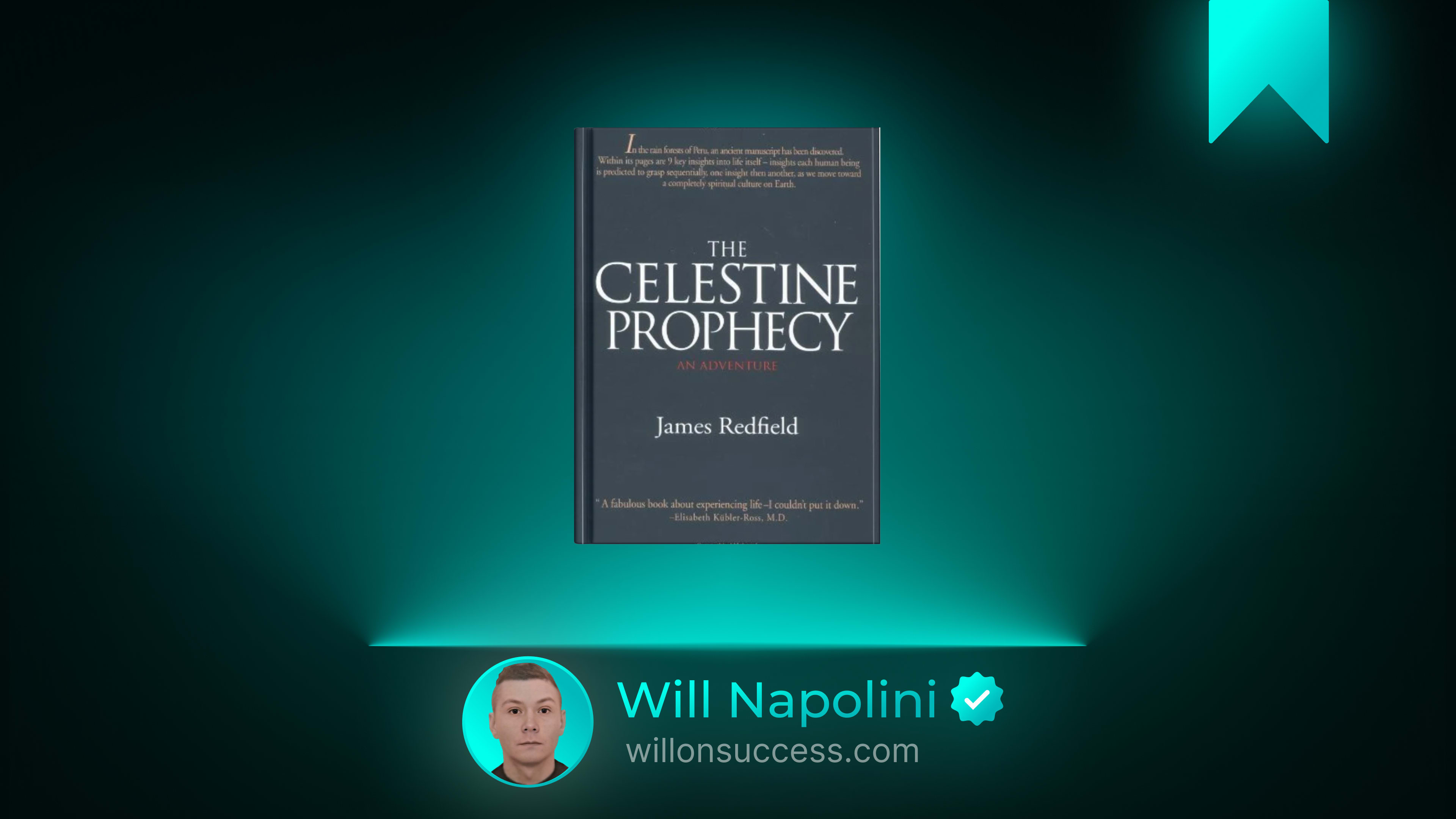
In 1993, James Redfield self-published a novel called The Celestine Prophecy. It went on to sell millions of copies, sparking a cultural earthquake. On the surface, it is an adventure story about a man traveling to the jungles of Peru to find an ancient, suppressed manuscript containing nine spiritual insights. The prose is straightforward. The plot relies on chase scenes and narrow escapes.
But millions of people did not read it for the car chases. They read it because it named a profound, unarticulated hunger in the modern soul. It suggested that our exhaustion, our cynicism, and our endless interpersonal conflicts were not just psychological problems. They were energetic ones.
If you have ever walked out of a meeting feeling inexplicably drained, or if you have ever felt a quiet, persistent tug toward a life you cannot yet see, this book was written for you. Let us walk into the jungle together and look at what Redfield actually found.
The Big Idea: You Are Not a Closed System; You Are an Energy Exchange
Redfield’s central thesis is deceptively simple: human beings are fundamentally energetic beings, and our entire reality is shaped by how we manage, steal, and generate that energy.
For the last five hundred years, Redfield argues, humanity has focused entirely on mastering the physical world. We built science, technology, and economies to survive and conquer. But in doing so, we lost our connection to the deeper, spiritual current of life. Cut off from that internal source, we became starved for energy. And when humans are starved, they compete.
We began unconsciously stealing energy from one another. We do this through manipulation, dominance, victimhood, and withdrawal. We turn our families, our workplaces, and our marriages into battlegrounds for emotional resources.
The “Prophecy” of the title is that humanity is now on the verge of a new awakening. We are beginning to remember how to connect to the internal source of energy, which stops the need to steal it from others. And when we stop fighting each other for scraps, we become sensitive to the “synchronicities”—the meaningful coincidences—that are trying to guide us toward our actual purpose.
You do not need to fight for your place in the world. You need to tune into the frequency where your place is already waiting for you.
The Story: A Map for the Invisible World
The narrator of the novel is an ordinary man who travels to Peru after hearing rumors of a manuscript that the government and the church are trying to destroy. The authorities fear the manuscript because it outlines a shift in human consciousness that would render their old structures of control obsolete.
As the narrator moves through the jungle, evading soldiers and meeting secretive guides, he learns the “Insights” one by one. Each insight shifts his perception. He learns to see the “energy fields” around people. He learns to recognize how his own past has conditioned him to manipulate others. And he learns to follow the subtle, intuitive pulls that lead him to the right person, at the right place, at the exact right time.
The genius of Redfield’s structure is that the external journey mirrors the internal one. The soldiers represent the old, fearful, controlling paradigm trying to suppress the new. The jungle represents the unknown, intuitive territory we must walk through to find ourselves. And the manuscript is not a magical object; it is a mirror. It simply reflects back the reality we have been too distracted to see.
The Four Control Dramas: How We Unconsciously Steal Energy
If there is one concept from The Celestine Prophecy that has permanently altered how I view human relationships, it is the concept of “Control Dramas.” This is the psychological anchor of the book, and it is devastatingly accurate.
Redfield suggests that when we are children, we realize we are dependent on our parents for energy (attention, love, resources). If that energy is not given freely and consistently, we develop a specific strategy—a drama—to extract it. We carry this strategy into adulthood, deploying it in our marriages, our boardrooms, and our friendships, usually without realizing we are doing it.
There are four primary dramas. If you read them carefully, you will recognize yourself. And you will recognize the people who exhaust you.
1. The Intimidator
The Intimidator gets energy by threatening others. They use anger, aggression, or loud dominance to force people to pay attention to them. When you are around an Intimidator, you feel like you are walking on eggshells. You give them your energy just to keep them calm and keep the peace. They feed on your fear.
2. The Interrogator
The Interrogator gets energy by finding flaws. They ask pointed, critical questions. They pry into your life, point out your mistakes, and make you feel scrutinized. When you are around an Interrogator, you feel defensive and small. You give them your energy by trying to justify yourself, explain yourself, and win their approval. They feed on your insecurity.
3. The Aloof
The Aloof gets energy by withdrawing. They are distant, mysterious, and emotionally unavailable. They make you feel like you have to chase them, guess what they are thinking, and work incredibly hard to earn a crumb of their attention. When you are around the Aloof, you feel anxious and ignored. You give them your energy by projecting onto them, trying to break through their wall. They feed on your pursuit.
4. The Poor Me
The Poor Me gets energy through victimhood. Everything is always happening to them. The world is unfair, their health is failing, their boss is cruel. They make you feel guilty if you do not rescue them, listen to them, or fix their problems. When you are around a Poor Me, you feel drained, obligated, and trapped. You give them your energy out of pity and a misplaced sense of duty. They feed on your guilt.
I want you to pause and look at those four categories. Think about your last major argument with your partner. Think about the colleague who makes you dread going to work. Think about your own behavior when you are stressed, tired, or feeling unseen.
We do not use control dramas because we are evil. We use them because we are empty. We use them because, at some point in our lives, we learned that this was the only way to get the emotional oxygen we needed to survive. But what kept us alive in childhood is suffocating us in adulthood.
The Interpersonal Ethic: Lifting the Room
Once you recognize your own control drama, and you stop using it to siphon energy from the people around you, a vacuum is created. How do you fill it?
Redfield introduces what he calls the “Interpersonal Ethic.” It is the practice of consciously directing your energy outward to elevate the people around you, rather than pulling their energy inward to sustain yourself.
When you stop playing the Interrogator, you can start asking questions out of genuine curiosity, rather than a desire to find a flaw. When you stop playing the Aloof, you can offer your presence fully, making the other person feel seen and safe. When you consciously project energy toward someone—when you listen to them deeply, when you affirm their worth, when you believe in their potential—a remarkable thing happens.
You do not lose energy. You generate it.
I have seen this happen in leadership. A manager who operates from a place of scarcity (a control drama) micromanages, hoards information, and creates a tense, low-energy team. A manager who operates from the Interpersonal Ethic walks into a room and actively looks for ways to make their team feel capable, valued, and inspired. The room literally feels different. The air changes. Ideas flow.
When you try to dominate a room, you shrink it. When you elevate the people in it, the room expands, and there is finally enough space for you, too.
Synchronicity: Following the Breadcrumbs
When you stop exhausting yourself with control dramas, you suddenly have the bandwidth to notice the subtle currents of your life. This brings us to the most mystical, yet practically applicable, insight in the book: Synchronicity.
Redfield argues that the universe is constantly trying to guide us toward our highest path, but it does not use words. It uses coincidences. It uses chance encounters. It uses sudden, inexplicable urges to take a different route home, or to walk into a specific coffee shop, or to read a particular article.
Most of us ignore these prompts. We call them distractions. We stick to the rigid five-year plan we wrote when we were twenty-two, even though we are a completely different person now. We force our way through locked doors because we are terrified of the unknown.
But Redfield suggests that if you treat your life as an evolving mystery, and if you pay close attention to the “meaningful accidents,” a path will reveal itself. You will meet the exact person you need to meet. You will stumble upon the exact piece of information you need to solve your problem.
This is not magic. It is alignment. When your internal energy is clear—when you are not clouded by the need to manipulate, control, or defend yourself—your intuition becomes sharp. You start to notice the doors that are actually open, rather than banging your head against the ones that are shut.
Your intuition is not a random misfire in your brain. It is a compass. And a compass only works if you are willing to walk in the direction it points.
Why This Matters on an Ordinary Tuesday
You might be thinking, This sounds beautiful, but I have a mortgage, a demanding boss, and a teenager who won’t clean their room. How does ancient Peruvian wisdom help me on a Tuesday morning?
It helps you because it changes the mechanics of your daily friction.
Imagine you come home exhausted. Your partner asks how your day was. In the old paradigm, you might slip into the “Poor Me” drama, sighing heavily, complaining about your boss, and unconsciously demanding that your partner absorb your stress to make you feel better. Your partner, feeling drained, might slip into the “Aloof” drama, retreating to their phone to avoid your heavy energy. The evening is ruined. You both go to bed feeling lonely and resentful.
Now, apply the Prophecy. You walk through the door. You feel the exhaustion. You notice the urge to play the victim rising in your chest. You catch it. You name it. I am about to use a control drama to steal energy.
You take a breath. You choose the Interpersonal Ethic. You look at your partner and say, “I am incredibly drained today, and I need twenty minutes to decompress in silence so I can be present with you. Is that okay?”
You did not manipulate. You did not steal. You stated your truth, and you respected their energy. The dynamic shifts. The friction dissolves. You have just altered the trajectory of your life in a single, quiet moment.
Who Should Read This Book
I want to be entirely honest with you about the reading experience. The Celestine Prophecy is a product of its time. The dialogue can be stiff. The characters are sometimes mouthpieces for philosophy rather than fully fleshed-out human beings. If you are looking for a masterpiece of literary fiction with complex character arcs and lyrical prose, you will likely be disappointed.
Furthermore, the book leans heavily into New Age terminology. If you are a strict materialist who requires peer-reviewed, double-blind clinical trials before you accept a premise, the concept of “energy fields” and “synchronicities” may make you skeptical.
But if you are willing to read it as a fable—a modern parable designed to shift your perception—it is a profound tool.
You should read this book if you feel a persistent, quiet sense that there is more to life than the material grind. You should read it if you find yourself repeatedly falling into the same toxic relationship dynamics and cannot figure out why. You should read it if you want a framework for understanding your intuition and learning how to trust the strange, serendipitous pulls of your own heart.
It is a book that acts less like a textbook and more like a tuning fork. You read it to remember the frequency you are supposed to be vibrating at.
One Small Step
I am not going to ask you to meditate for two hours a day or move to the jungle. I am going to ask you to do one specific, observable thing this week.
Identify your primary Control Drama, and catch it in the act.
Take a quiet ten minutes today. Look at the Intimidator, the Interrogator, the Aloof, and the Poor Me. Which one feels the most familiar? Which one did you use to survive your childhood? Which one do you default to when you are stressed at work or arguing with your spouse?
Write it down on a piece of paper. Put that paper in your pocket or on your desk.
For the next three days, your only job is to become a witness to your own behavior. When you feel the urge to criticize someone (Interrogator), when you feel the urge to shut down and give someone the silent treatment (Aloof), when you feel the urge to complain about how unfair your life is (Poor Me)—just notice it.
You do not even have to stop doing it yet. Just say to yourself, Ah. There is my drama. I am trying to steal energy right now because I feel empty.
Awareness is the prerequisite to all change. You cannot dismantle a mechanism you do not know you are operating. By simply naming the drama, you begin to loosen its grip on you. You create a tiny space between the trigger and your reaction. And in that space, your real life begins.
You are not a closed system waiting to be filled by the approval, attention, or submission of others. You are an open channel. The energy you are looking for is already flowing around you, in the quiet coincidences, in the eyes of the people you love, and in the deep, steady center of your own chest.
Stop fighting for scraps. Step into the current.