The Catcher in the Rye by J.D. Salinger: What a Grieving Boy Wandering New York Can Teach You About Letting Go
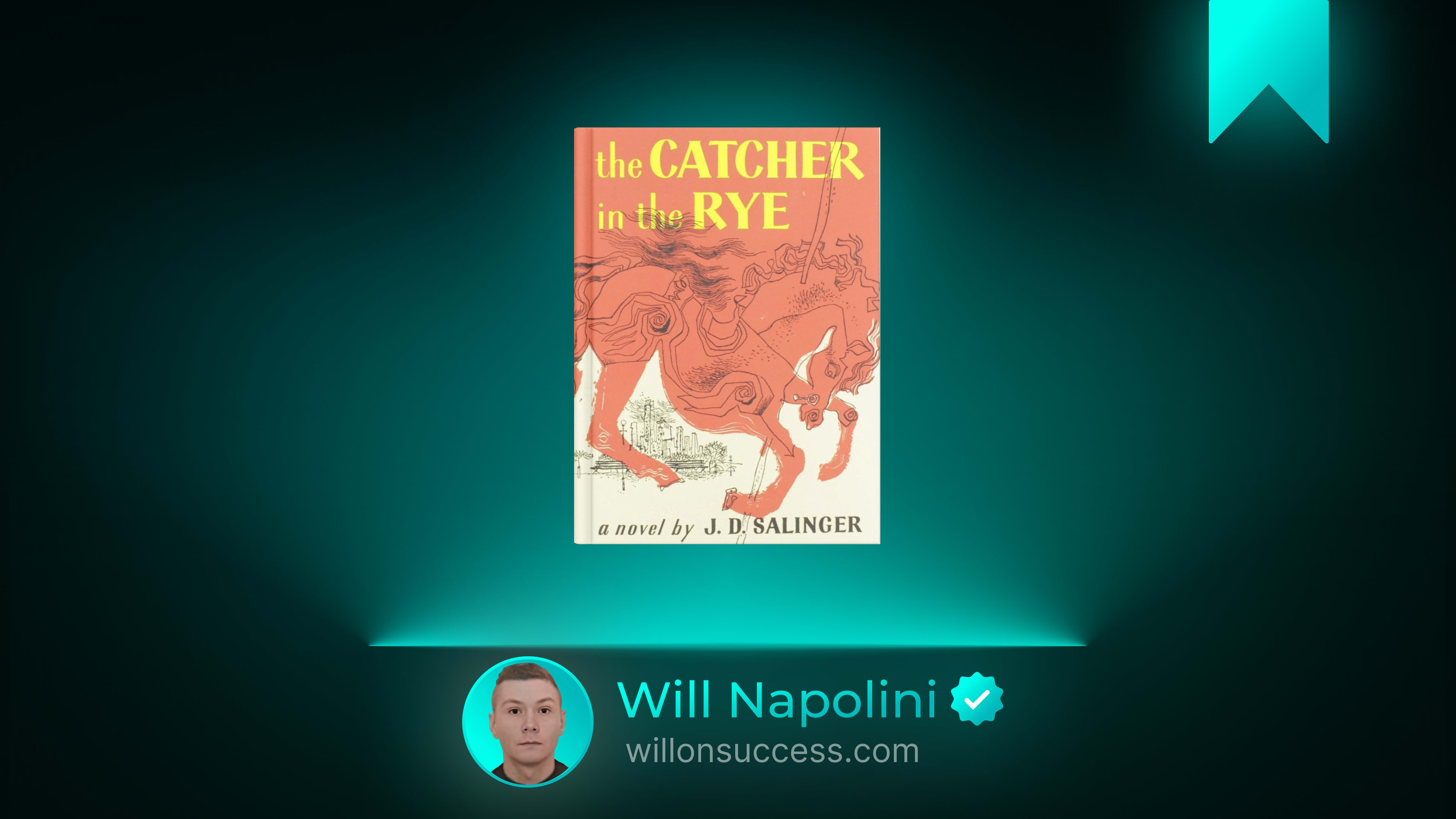
There is a particular kind of loneliness that does not come from being abandoned. It comes from standing in a crowded room and feeling like you are the only person who sees clearly. Like everyone else is performing a script you never received. Like the world is full of people smiling at each other over a void no one will name.
If you have ever felt that—if you have ever walked through a city surrounded by millions of people and felt utterly, inexplicably alone in a way you could not explain to anyone—then a book published in 1951 was written for you.
The Catcher in the Rye by J.D. Salinger is often described as a novel about teenage rebellion. About a kid who calls everyone a phony and wanders around New York in a red hunting hat. And yes, it is that. But if you read it slowly, if you sit with it the way I would ask you to sit with a friend who has not slept in three days, you discover something else entirely.
This is a novel about grief. About a boy who lost someone he loved more than anyone in the world, and who has been walking ever since, trying to outrun the fact that the person is gone and the world kept turning as though nothing happened.
And it is a novel about the most painful lesson a human being can learn: that you cannot protect the people you love from growing up, from changing, from reaching for things that might make them fall.
Let me walk you through what Salinger built, and what I have learned from walking inside it.
The Big Idea: You Cannot Catch Everyone. And Trying Will Break You.
The title comes from a fantasy Holden Caulfield describes near the end of the novel. He misremembers a Robert Burns poem, and in his version, there are children playing in a vast field of rye near the edge of a cliff. And one person—just one—stands at the edge, catching the children before they fall. Holding them. Keeping them safe.
That is what Holden wants to be. The catcher. The one who stands at the boundary between innocence and experience, between childhood and whatever comes after, and says, Not yet. You are not ready. I will not let you go over.
He wants to stop time. He wants to freeze the world the way it was before everything broke.
And the novel’s deepest, most honest truth is this: you cannot do that. No one can. And the attempt to do it will isolate you from every living person, because living means changing, and changing means letting go, and letting go means watching someone you love reach for something you cannot control.
That is not a comfortable truth. I know. But Salinger does not give you comfortable truths. He gives you true ones. And true ones, held gently, are where healing begins.
The Story: Three Days of Walking
The plot is deceptively simple. Holden Caulfield is sixteen. He has just been expelled from Pencey Prep, his fourth school. It is December. He cannot face going home to his parents yet, so he leaves school early and takes a train into New York City. He has a little money. He has no plan. He has a red hunting hat he bought after losing the fencing team’s equipment. And he has a hole in his chest shaped exactly like his younger brother Allie, who died of leukemia a few years before.
For three days, Holden wanders. He checks into a hotel. He goes to bars. He hires a cab and asks the driver what happens to the ducks in Central Park when the lagoon freezes over. He calls people and hangs up. He meets an old friend, arranges a date, cancels it, arranges another one. He hires a prostitute, then cannot go through with it, then gets beaten up by her pimp. He visits a former teacher. He sneaks into his family’s apartment to see his little sister Phoebe.
Throughout all of this, he is trying to call Jane Gallagher, a girl he cared about deeply over a summer. He picks up the phone. He puts it down. He picks it up again. He never calls her.
And underneath everything, beneath the sarcasm and the judgments and the walking, there is Allie. Allie and his baseball mitt with poems written on the fingers in green ink. Allie, who was the smartest one, the kindest one, the one who never called anyone a phony because he never needed to. Allie, who is gone. And no one in Holden’s world has helped him understand how to keep living in a world where Allie is not in it.
That is the engine of the whole novel. Not rebellion. Not teenage angst. Grief. Unprocessed, unspoken, wandering grief looking for a place to land.
Grief Becomes a Lens If You Do Not Let It Become a Story
Here is what I have learned, and what Salinger dramatizes with extraordinary precision: grief that is not spoken does not disappear. It changes form. It becomes a way of seeing.
Holden does not say, I am shattered because my brother died and no one helped me carry it. He says, Everyone is a phony. He looks at his roommate, his teachers, the people in bars, the actors in movies, the nuns on the street, and he finds them all performing, all false, all going through motions that mean nothing.
And some of his observations are sharp. Some of them are true. People do perform. Social life does involve a certain amount of mask-wearing. Holden is not wrong to notice it.
But the intensity of it—the way it poisons every interaction, the way it makes him unable to sit in a room with another person without cataloging their flaws—that is not clear-eyed observation. That is a wound talking. That is a boy who lost the one person he felt was genuinely real, and who now cannot believe that authenticity exists anywhere else.
I have seen this pattern in my own life. When I have been hurt and have not processed the hurt, I do not become more perceptive. I become more suspicious. I start reading malice into neutral gestures. I start assuming that kindness is manipulation, that enthusiasm is performance, that connection is a transaction. I call it being realistic. But it is not realism. It is injury wearing the disguise of insight.
Cynicism is often tenderness that has been hurt too many times and has decided to wear armor. If you find yourself dismissing everyone, doubting every motive, assuming the worst of every interaction, I would gently ask you: is this clarity, or is this a wound that has not been allowed to speak?
The Museum: Wanting to Freeze the World
There is a passage in the novel where Holden talks about the Museum of Natural History. He loved it as a child. Not because of the exhibits, but because nothing changed. The Eskimo was always fishing. The birds were always flying south. The deer was always drinking from the pond. You could go back a hundred times, and everything would be exactly where you left it.
Holden loves the museum because it is the one place in his life where time stands still. Where loss has not entered. Where Allie is still alive, in the sense that the world has not moved on without him.
I think about that museum every time I catch myself wanting to freeze something. A relationship. A season of life. A version of myself. A version of someone I love. I want to put them behind glass. I want to say, Stay here. Stay this way. Do not grow into something I do not recognize. Do not leave the field I know.
But life is not behind glass. And the people we love are not exhibits. They are moving, changing, reaching, becoming. And if we try to hold them in place—if we try to make them stay the size and shape they were when we first loved them—we do not protect them. We suffocate them. And we suffocate ourselves.
You cannot love someone and also require them to remain unchanged. Those two things are in opposition. Love means watching someone grow into a person you have not met yet, and choosing to keep meeting them.
The Carousel: Letting Them Reach for the Gold Ring
Near the end of the novel, Holden takes Phoebe to the park. She rides the carousel. And there is a gold ring you can reach for as the carousel goes around. The kids on the carousel stretch their arms out, trying to grab it. Some miss. Some almost fall.
Holden watches Phoebe reach. And for one moment, he wants to stop her. He wants to call out, Be careful. You’ll fall.
And then he stops himself. And Salinger writes something that I have carried with me for years. The idea—and I will paraphrase rather than risk misquoting—is this: the thing with kids is, if they want to grab for the gold ring, you have to let them do it, and not say anything. If they fall off, they fall off. But you cannot interfere.
That is the moment Holden begins to let go of the catcher fantasy. He realizes he cannot stand at the edge of the cliff forever. He cannot protect Phoebe from every fall. He cannot keep her in the field of rye, innocent, unchanged, safe. She is going to reach. And sometimes she is going to miss. And that is not a failure of love. That is what love looks like when it accepts reality.
I think about that scene when I am tempted to control outcomes. When I want to manage someone else’s risk for them. When I want to intervene, to warn, to hover, to catch. When I want to make sure the person I love does not fail, does not stumble, does not learn the lesson the hard way.
Sometimes you have to stand on the bench and watch. You have to let them reach. You have to trust that they can survive the fall, because they cannot become who they are becoming without the reaching.
You do not protect people by preventing their falls. You protect them by being present when they land.
The Phone Call That Never Happens
Throughout the novel, Holden keeps trying to call Jane Gallagher. She is the person he most wants to talk to. The person who knew him before everything broke. The person he played checkers with over a summer, who kept her kings in the back row because it was pretty.
He picks up the phone. He puts it down. He picks it up. He says, I’ll call her tomorrow. He never calls her.
And this, I think, is one of the truest things Salinger captured about loneliness. It is not that Holden has no one. It is that he cannot make himself reach. The distance between wanting connection and actually picking up the phone, actually saying the words, actually letting another person hear the shake in your voice—that distance can feel as wide as an ocean.
I have been on both sides of that phone. I have been the person who picks it up, puts it down, picks it up again, and ultimately sets it back on the receiver because the vulnerability of saying I need you feels more dangerous than the loneliness of silence. And I have been the person on the other end, wondering why someone who mattered simply disappeared.
If you are in that place right now—if you have a person you need to call, a conversation you need to have, a truth you need to speak, and you keep finding reasons not to—I will not pretend it is easy. I will not say, Just do it. I know the phone feels like it weighs fifty pounds. I know the silence feels safer than the risk.
But I will tell you what Holden’s wandering teaches: the silence does not protect you. It compounds. Every day you do not reach, the distance grows a little wider, and the story you tell yourself about why you cannot call grows a little louder, until one day you believe you are the kind of person who does not call, who does not reach, who walks alone. And that story becomes a cage.
You do not have to make the call perfectly. You do not have to have the words figured out. You just have to pick up the phone and let it ring. That is all. The rest will come.
Who Should Read This Book
Read this book if you have ever felt that the world is asking you to perform a version of yourself you do not recognize. If you are in a season of transition—between jobs, between relationships, between the person you were and the person you are becoming—and you feel untethered. If you are carrying a grief that you have not spoken aloud, and you are tired of pretending it is not there.
Read it if you appreciate a voice that is messy, contradictory, funny, and deeply human. Holden is not a hero. He is judgmental, unreliable, self-sabotaging, and sometimes cruel. But he is also tender, perceptive, and desperately trying to find something real in a world that feels made of cardboard. You do not have to like him to recognize yourself in him.
I will be honest about the book’s limitations. It was published in 1951, and some of its social world will feel dated. Holden’s perspective is narrow—white, male, privileged in specific ways—and the novel does not grapple with the broader structures of the world around him. If you are looking for a sweeping historical epic or a tightly plotted thriller, this is not that book. It is a voice. A three-day walk. A mood.
But the mood is real. And the voice, seventy-five years later, still sounds like someone you might meet on a train at two in the morning, telling you the truth they have never told anyone else.
One Small Step
Here is what I would ask of you today. One thing. Small. Specific.
Think of one person in your life you have been meaning to call. Not a professional contact. Not a networking opportunity. A person who knew you before. A person you have been carrying in your mind for weeks or months, thinking, I should reach out. I should ask how they are. I should let them hear my voice. And then you set the phone down. And the days accumulate. And the silence grows a little thicker.
Tonight, before the day is over, send them one message. A text. A voicemail. A short email. It does not need to be eloquent. It does not need to explain the silence. You can simply say, I was thinking about you. How are you?
That is all. You do not have to solve the grief. You do not have to fix the relationship. You do not have to stop being cynical or stop being angry or stop feeling like the world is full of people performing scripts you never received. You just have to let one small, honest signal cross the distance.
Holden walked for three days because he could not pick up a phone. You do not have to walk for three days. You do not have to wander until you break.
The gold ring is there. The carousel is turning. And the person on the other end of the line is probably waiting, probably hoping, probably wondering if you still remember them.
Reach. Not perfectly. Not bravely. Just reach.
That is how you come back from the field. That is how you walk out of the rye and back into the world where people are living, changing, falling, and reaching for things they cannot quite grasp.
You do not have to catch them. You just have to be in the park, watching, letting them try.
And that is enough. That has always been enough.