Love Means Facing the Loss: What Erich Segal's Love Story Teaches About Courage and Presence
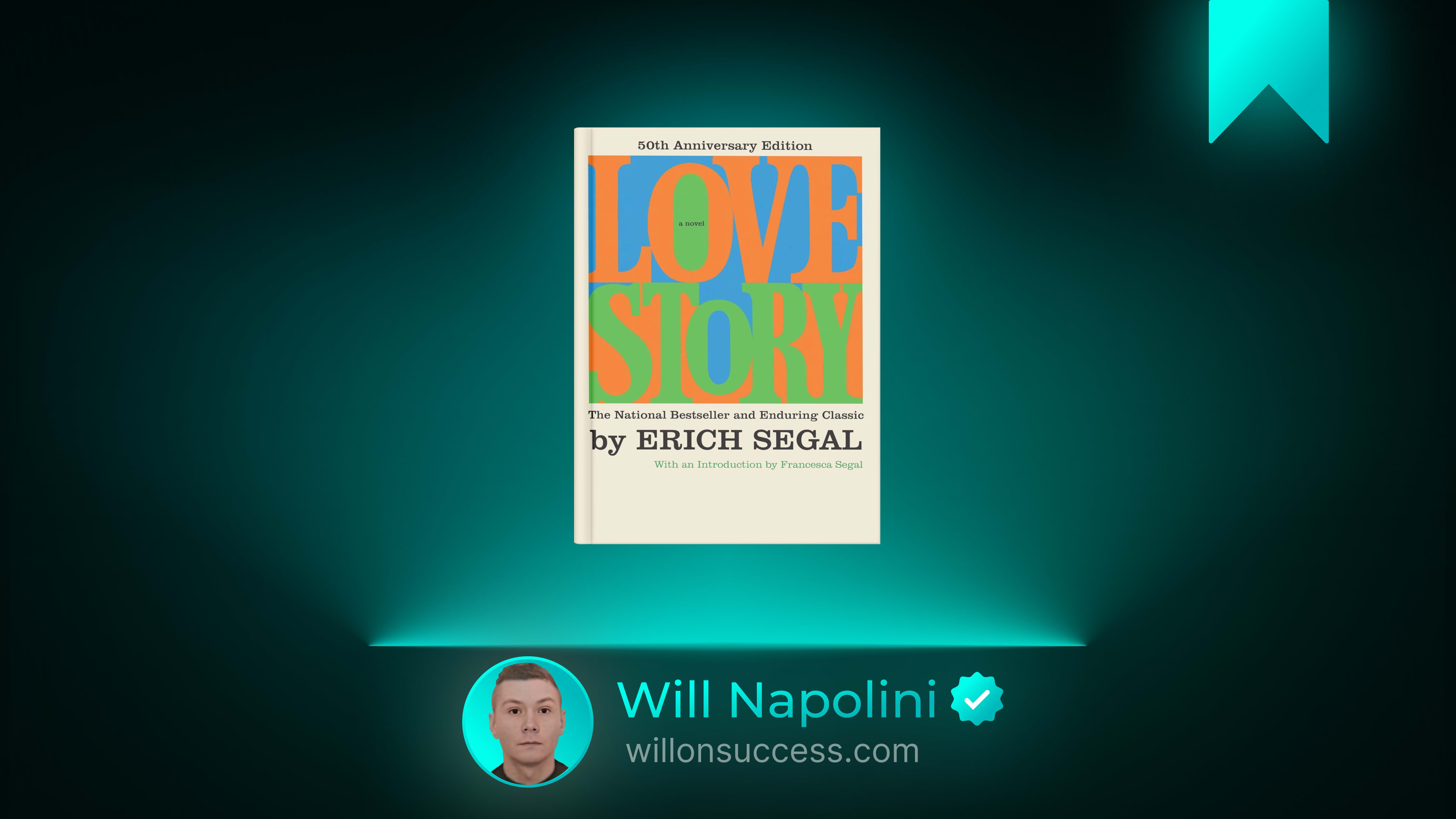
“What can you say about a twenty-five-year-old girl who died?”
That is how Erich Segal’s Love Story begins. Not with a grand declaration. Not with a sweeping landscape. With a question so blunt, so stripped of ornament, that it stops you mid-breath. The narrator already knows the ending. He is not going to spare you. He is going to tell you about the girl, about the love, about the months they had, and he is going to make you feel the full weight of what it meant.
The book is only about one hundred and twenty-seven pages. You can read it in a single evening. And yet, since its publication in 1970, it has sold millions of copies, been translated into dozens of languages, and lodged itself in the cultural memory with a force that far exceeds its length.
Why? Because underneath the simplicity of its plot—a boy meets a girl, they fall in love, she dies—there is a set of questions that every one of us must eventually face. What are you willing to give up for the person who makes you feel most like yourself? How do you love someone when you know, with absolute certainty, that you will lose them? And what does it mean to say “I love you” not as a greeting, not as a habit, but as the defining commitment of your life?
The central idea of Love Story is not that love conquers death. It doesn’t. Death wins. Jenny Cavilleri dies. The central idea is that love is still worth choosing, even when you know how it ends. Especially when you know how it ends. And that the courage to love fully is the most radical act a person can perform in a world that guarantees nothing.
The Boy Who Walked Away from Everything He Was Given
Oliver Barrett IV is heir to a fortune, a legacy, a name. His family is old New England money—Harvard men, expectations carved in stone, a life mapped out before he could walk. He is supposed to become his father. He is supposed to marry the right girl, join the right firm, maintain the right silence.
Then he meets Jenny Cavilleri in the Harvard library. She is a Radcliffe music student from Cranston, Rhode Island. Working-class. Sharp-tongued. She calls him “Preppy” and mocks his money and refuses to be impressed by any of it. She is everything his world tells him he should not want.
And he chooses her. Not casually. Not as a rebellion that will fade. He chooses her completely, knowing exactly what it will cost him. When his father demands he wait, demands he finish his education, demands he conform, Oliver refuses. His father cuts him off. The money stops. The name becomes a closed door.
I have seen this moment play out in smaller, quieter ways in many lives. The moment you realize that the person you are expected to become and the person you actually are cannot occupy the same space. The moment you must choose between approval and authenticity. Between the inheritance that comes with strings and the life that comes with uncertainty.
Oliver chooses uncertainty. He chooses Jenny. And in doing so, he chooses himself—the self he is becoming, not the self he was manufactured to be.
You cannot inherit a life. You can only build one. And building one often means walking away from the blueprint someone else drew for you.
This is not a lesson about being reckless. Oliver does not walk away thoughtlessly. He walks away because he has found something more real than the script he was handed. The question the book asks you is simple and uncomfortable: What would you walk away from, if it meant walking toward the thing that actually matters to you?
The Architecture of a Small, Ordinary Love
What Segal does brilliantly—and what critics sometimes mistake for simplicity—is show you the texture of an ordinary love. Oliver and Jenny do not have grand adventures. They do not travel the world. They get married at the courthouse. They live in a small apartment. Jenny works to support Oliver through law school. They bicker. They make terrible coffee. They sit in silence and feel the weight of being young and broke and uncertain.
And it is enough. It is more than enough. It is everything.
I have learned that we often wait for love to announce itself with fireworks before we recognize it. We think the defining moments of a relationship will be dramatic—grand gestures, sweeping declarations, cinematic reconciliations. But the love that sustains you, the love that actually builds a life, is made of Tuesday evenings. Of someone making you tea without being asked. Of a shared glance across a crowded room that says, I see you. I’m here. You’re not alone.
Oliver and Jenny’s love is built from these small, unglamorous bricks. And when Jenny becomes ill, it is these bricks that hold the structure together. Not grand speeches. Not heroic rescue. Just presence. Just showing up. Just being there in the hospital room, holding her hand, not knowing what to say but refusing to leave.
The measure of a love is not how loudly it is declared. It is how steadily it remains when the world goes quiet and the future becomes uncertain.
The Line Everyone Remembers (And What It Actually Means)
“Love means never having to say you’re sorry.”
This line appears in the novel. Jenny says it. Oliver repeats it at the very end, after she is gone, when his father arrives at the hospital and says, “I’m sorry.” Oliver responds with Jenny’s words.
The line has become iconic. It has been quoted endlessly, parodied endlessly, debated endlessly. Some find it beautiful—a statement of unconditional acceptance, of a love so complete that forgiveness is implicit, woven into the fabric of the relationship. Others find it problematic—a suggestion that love excuses you from accountability, that genuine harm requires no acknowledgment.
Here is what I have come to believe, after sitting with this line for many years: In the context of the novel, it is not about avoiding responsibility. Oliver and Jenny are not perfect. They wound each other in small ways. They snap. They withdraw. But their love is not a ledger. They do not keep score. They do not demand formal apologies as proof of devotion. They forgive each other continuously, fluidly, as a natural function of their bond.
The line is about a love that has moved past transaction. Past the need to prove you were right. Past the need for the other person to acknowledge their fault before you release your resentment. It is about a love where grace is the default, not the exception.
But I will be honest with you. In my own life, I have learned that most relationships are not yet at that level. Most of us still need to say “I’m sorry.” We still need to name the harm, acknowledge the wound, take responsibility for our carelessness. And that is not a failure of love. That is the work of love, still in progress.
Perhaps the line is not a description of where love begins, but a glimpse of where it can arrive—after years of practice, after enough shared history that forgiveness becomes as natural as breathing. You do not owe anyone that level of grace before you are ready. But you can aim toward it. You can practice releasing the small debts. You can choose, in the small moments, not to keep score.
The Urgency That Loss Teaches
The novel’s structure is itself a lesson. Oliver tells you from the first page that Jenny is dead. There is no suspense about the ending. You know, from the beginning, that you are watching a countdown. And that knowledge changes everything about how you read. Every small moment becomes precious. Every ordinary evening becomes sacred. Every stupid argument becomes a waste of time they did not have.
This is the most difficult and most important truth the book offers: You do not know how much time you have. None of us do.
I do not say this to frighten you. I say it because I have watched people postpone their love, their honesty, their presence, as if time were an unlimited resource. They say, “I’ll call them next week.” They say, “I’ll apologize when the moment is right.” They say, “We’ll take that trip when things settle down.” And sometimes the moment never comes. Sometimes the next week doesn’t arrive. Sometimes the illness is already growing in silence while you are making other plans.
Jenny is twenty-five when she dies. Twenty-five. The book does not soften this. It does not give her a long, slow decline surrounded by grandchildren. It takes her in the middle of the beginning. And Oliver is left with the unbearable, ordinary task of continuing to exist in a world that no longer contains her.
What does he do? He tells the story. That is the book. That is the act of survival. He takes the love they had and he gives it language. He refuses to let it disappear into silence. He says, This happened. This mattered. She was here.
And in doing so, he teaches you what to do with your own love, while you still have it: Speak it. Show it. Do not hoard it for a future that is not promised.
Who Should Read This Book
Love Story is not a complex novel. It is not a literary puzzle. Segal writes in clean, direct, almost spare prose. The book has been called sentimental, melodramatic, too simple. And I will be honest: if you require your fiction to be structurally innovative or intellectually dense, this may not satisfy you.
But if you are willing to meet the book on its own terms—to let its simplicity be its strength—it will do something to you that complexity cannot.
You will connect with this book if you:
- Have loved someone and felt the terror of how fragile that love is
- Are in a season of grief and need permission to feel it fully
- Are standing at a crossroads between expectation and authenticity
- Need to be reminded that ordinary love—small, quiet, daily love—is not lesser than grand love
- Want a book you can read in one sitting and sit with for a long time afterward
You may want to approach carefully if you:
- Are currently in acute grief over the loss of a young partner or child (the book is unflinching and may be too raw)
- Are looking for a nuanced exploration of illness or medical ethics (the book uses Jenny’s illness primarily as a narrative catalyst)
- Require complex plot or psychological ambiguity (the characters are archetypal by design)
The book is short. It is direct. It is designed to make you feel something. Let it.
One Small Step You Can Take Today
You do not need to lose someone to learn what loss teaches. You can learn it now, in advance, gently, by simply paying attention.
Tonight, before you sleep, identify one person you love and have been postponing something with.
Maybe it is a conversation you have been avoiding. Maybe it is a simple “I love you” that you have let become routine, automatic, unsaid. Maybe it is an apology you owe, or a thank-you, or a promise to be more present. Maybe it is just the decision to put your phone down and actually look at them when they speak.
Do not wait for the right moment. The right moment is the one you create. Say the thing. Make the call. Write the note. Hold the hand a little longer. Look at them as if you are seeing them for the first time, because in a way you are—the person they were yesterday is already gone, and the person they will be tomorrow is not yet here. This moment, this exact configuration of light and breath and presence, will never come again.
You do not need to say it perfectly. You do not need to say it grandly. You only need to say it while the saying still means something to a living ear.
The greatest act of courage is not loving someone forever. It is loving them fully today, knowing that today is all you are guaranteed.